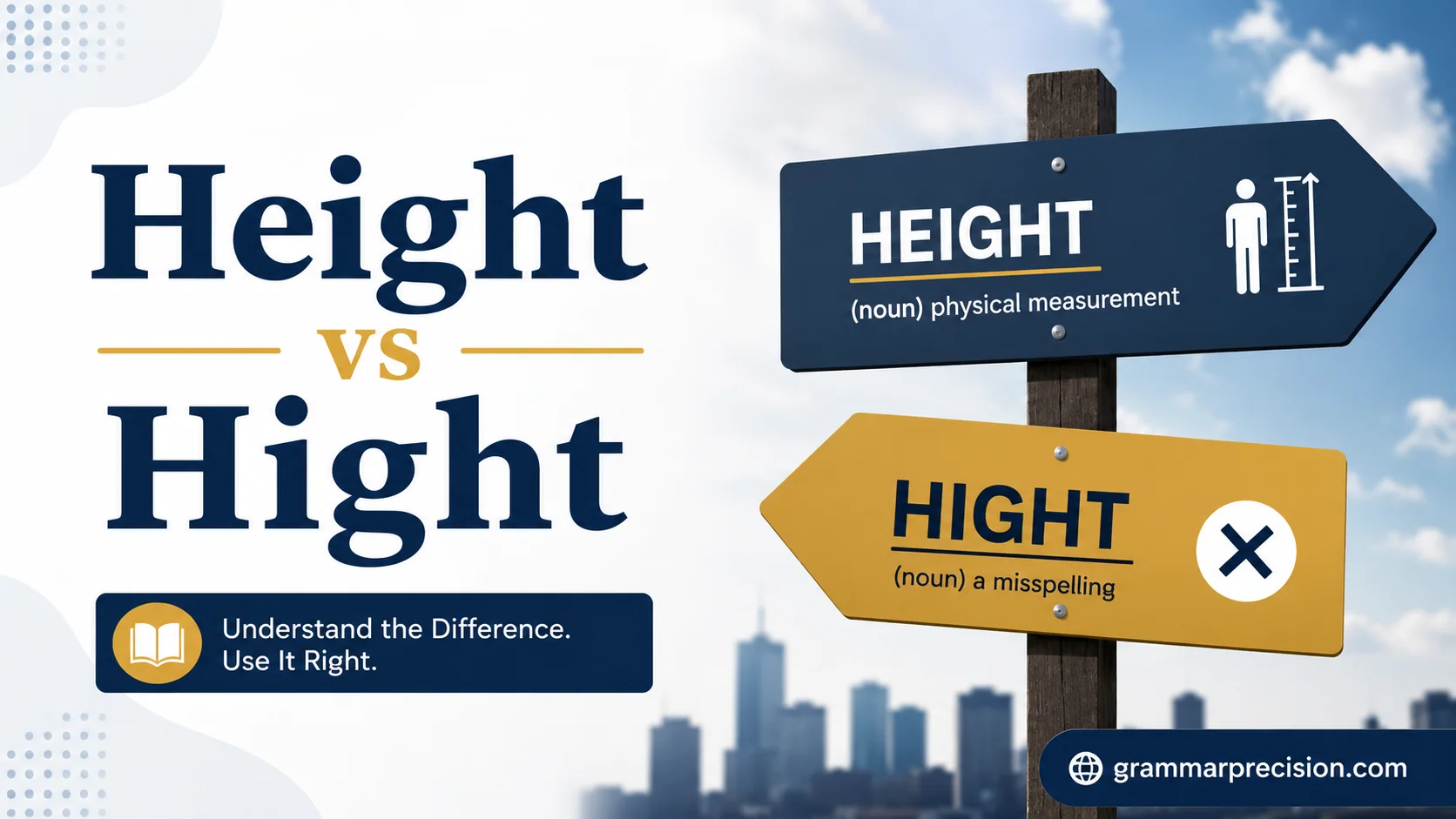
Height vs Hight often confuses English learners because both words look similar. However, only one spelling is correct in modern English, making proper usage important for clear communication today.
In modern English, Height is the correct spelling and serves as a noun for measurement. It describes how tall or high a person, object, building, or mountain is. The word is widely accepted in educational settings, professional settings, and everyday writing. Using it properly improves clarity, accuracy, and overall communication effectiveness significantly today.
The term Hight is considered archaic, outdated, and rarely used in modern English. Choosing Height instead helps avoid confusion, errors, and misunderstanding among readers. Through regular practice, instructional guidance, and attention to grammar and sentence structure, learners can build confidence, strengthen language precision, and improve clarity in writing effectively.
Height vs Hight Meaning: What’s the Real Difference?
The simplest answer is also the most important:
- Height is the correct modern English word
- Hight is mostly incorrect in today’s usage
But let’s go deeper because that’s where things get interesting.
What does “Height” mean?
The word height refers to how tall something or someone is when measured from base to top.
It is commonly used in:
- Human measurements (your height)
- Buildings and structures
- Mountains and geographical features
- Abstract levels (like “height of success”)
Example sentences:
- My height is 5 feet 10 inches.
- The height of the building is 300 meters.
- She reached the height of her career at 30.
In grammar terms, height is a noun and it describes a measurable or figurative extent upward.
Is “Hight” a real word?
Yes… but only in a historical sense.
The word “hight” appears in Old and Middle English, where it was used differently. In those times, it meant something closer to “called” or “named.”
For example, in older literature:
- “He hight John” meant “He is called John”
But here’s the important truth:
In modern English, “hight” is considered outdated and incorrect in standard writing.
Today, dictionaries and grammar systems do NOT recognize it as a replacement for “height.”
Quick comparison table: Height vs Hight
| Feature | Height | Hight |
| Modern usage | Yes | No |
| Meaning | Measurement of tallness | Old English “called/named” |
| Correct spelling today | ✔ | ✘ |
| Used in education | Yes | Rarely |
| Formal writing | Required | Incorrect |
Why People Confuse Height vs Hight So Often
This confusion isn’t random. It comes from how our brains and language systems work.
Let’s break it down.
1. Sound confusion (phonetics issue)
When you say “height,” it sounds like:
“hite” or “hite t”
There’s no strong “gh” sound in pronunciation.
So when people type quickly, they sometimes drop the “e” and assume “hight” makes sense.
2. Fast typing and muscle memory
Most mistakes happen during:
- Texting
- Email writing
- Social media posts
When you type fast, your fingers often rely on pattern memory, not spelling logic.
So “hight” becomes a natural typo.
3. Influence of similar English words
English has words like:
- light
- fight
- night
- right
All of them end with “ ight”
So the brain naturally tries to apply the same pattern to “height.”
That’s a classic cognitive shortcut mistake.
4. Lack of spelling awareness in casual writing
People rarely double check spelling in informal chats. Over time, incorrect forms can feel “normal,” even when they’re wrong.
The History Behind Height vs Hight
To really understand this confusion, we need to travel back in time.
Old English roots of “hight”
In older English literature (around Middle English period), “hight” had a different function entirely.
It meant:
- Named
- Called
- Known as
It was commonly used in poetry and storytelling.
Example:
- “A knight hight Arthur…”
But language evolves. And over centuries, English simplified and standardized.
Why “height” became standard
Modern English went through spelling reforms and dictionary standardization.
Key changes included:
- Simplification of silent letters
- Standard spelling rules
- Influence of printing press consistency
Eventually, “height” became the accepted noun form for measurement, while “hight” faded out.
Fun fact about English spelling evolution
English is one of the most inconsistent languages in the world.
For example:
- “through”
- “though”
- “tough”
- “thought”
All look similar but sound completely different.
So confusion like height vs hight is actually very normal.
Also Read This: Congratulations For or Congratulations On: The Complete Grammar
Why “Height vs Hight” Mistakes Matter More Than You Think
You might think it’s just a small spelling error. But in real world communication, it can affect perception.
Professional writing impact
Imagine two emails:
Email A:
What is your hight?
Email B:
What is your height?
Even though the meaning is clear, Email B looks:
- More professional
- More educated
- More credible
Academic writing
Teachers and examiners often penalize spelling mistakes. Repeated errors like “hight” can affect grades in:
- Essays
- Reports
- Exams
Job applications and CVs
Recruiters notice spelling instantly.
A small mistake can:
- Reduce credibility
- Suggest carelessness
- Hurt first impressions
Case study: The hiring filter effect
A 2023 recruitment behavior study (general HR trend analysis) showed:
- Recruiters spend less than 10 seconds scanning CVs
- Spelling errors reduce callback chances significantly
- Simple mistakes can shift perception instantly
Even if skills are strong, presentation matters.
How to Never Confuse Height vs Hight Again
Now let’s make this easy. No theory. Just practical tricks.
Memory trick #1: The “E stands for elevation” method
- Height = correct word
- “E” reminds you of Elevation (going up)
So:
Height = elevation upward = correct spelling
Memory trick #2: The “fight light rule” trap
Ask yourself:
Does “hight” behave like “light” or “fight”?
No. It doesn’t describe sound patterns the same way.
So remember:
If it’s measurement, it’s always “height”
Memory trick #3: Visual association
Imagine:
- A tall skyscraper labeled “HEIGHT”
- A red error stamp over “HIGHT”
Your brain stores images faster than grammar rules.
Memory trick #4: The spelling anchor technique
Anchor word:
“Height = high + t (silent ending)”
Even if imperfect linguistically, it helps you recall correct spelling.
Real Life Examples of Height vs Hight Usage
Let’s see how this plays out in real sentences.
Correct usage of “height”
- The height of Mount Everest is 8,849 meters.
- Her height makes her ideal for basketball.
- The height of demand increased during holidays.
Incorrect usage of “hight”
- ❌ What is your hight?
- ❌ The building’s hight is unknown.
- ❌ He measured his hight yesterday.
Even though understandable, these look incorrect in formal writing.
Common Spelling Mistakes Similar to Height vs Hight
This confusion is part of a bigger pattern.
Here are other common mistakes:
| Incorrect | Correct |
| Hight | Height |
| Definately | Definitely |
| Seperate | Separate |
| Occured | Occurred |
| Recieve | Receive |
Why these mistakes happen
- English pronunciation doesn’t match spelling
- Fast typing leads to shortcuts
- People learn from informal writing online
SEO Keywords and Search Variations People Use
People search this topic in many ways, such as:
- height vs hight difference
- hight meaning in English
- correct spelling of height
- is hight a word
- height spelling confusion
- height definition and usage
Understanding these helps content rank better and match user intent.
Expert Insight: What Dictionaries Say
Modern dictionaries like Oxford and Merriam Webster consistently define:
- Height = measurement upward distance or elevation
- Hight = archaic or obsolete usage in old English
So the verdict is clear:
In modern English writing, always use “height.”
Quick Summary You Can Remember Easily
Let’s simplify everything:
- Height = correct modern word
- Hight = outdated or incorrect
- Confusion comes from pronunciation + typing habits
- English spelling patterns often mislead learners
- One letter can affect professionalism
FAQs:
Is “Height” the correct spelling in modern English?
Yes, Height is the correct spelling in modern English. It is used to describe the measurement of how tall or high a person, object, building, or mountain is. It is the accepted form in both formal and informal writing.
What does “Hight” mean?
Hight is an archaic and outdated word that appeared in older forms of English. It is rarely used today and is generally considered incorrect when people intend to write Height.
Why do people confuse Height and Hight?
Many people confuse these words because they look and sound similar. However, only Height follows the correct spelling and modern usage rules. The similarity often leads to spelling errors and misunderstandings.
Can I use “Hight” in academic or professional writing?
No, Hight should not be used in academic, professional, or everyday writing when referring to a measurement. Using Height helps maintain accuracy, clarity, and credibility in communication.
How can I remember the difference between Height and Hight?
A simple way is to remember that Height is the word found in dictionaries and used for measurements. Regular practice, reading, and paying attention to correct usage will help you avoid mistakes and use the term confidently.
Conclusion:
Understanding the difference between Height and Hight is essential for clear and effective communication. Height is the correct, modern, and widely accepted spelling used to describe a measurement from bottom to top. In contrast, Hight is an outdated and rarely used term. By focusing on correct spelling, grammar, and proper usage, learners can improve clarity, build confidence, and produce more professional and accurate writing.