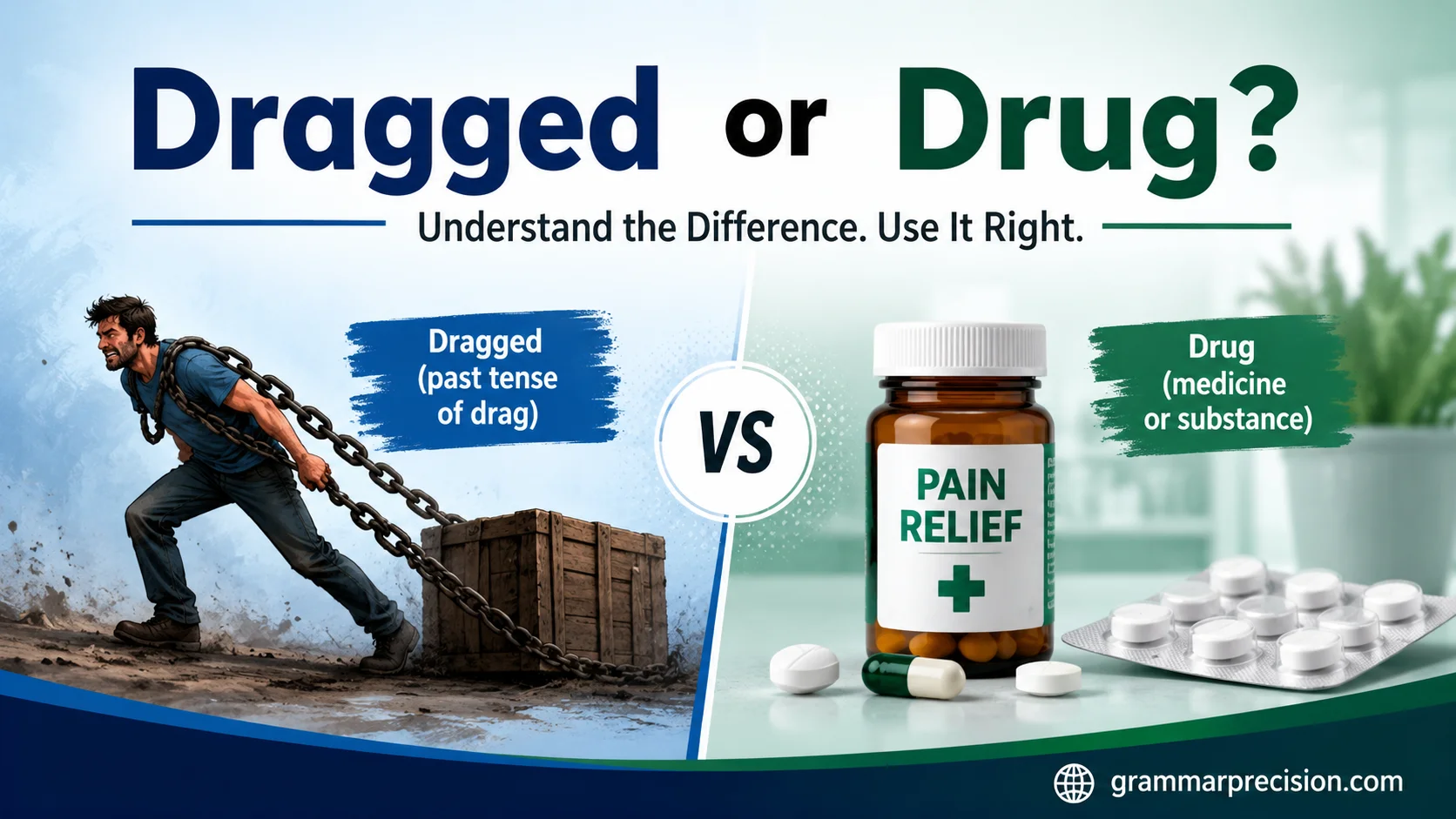
Dragged or Drug is a common grammar confusion that affects many writers and speakers. This guide explains the difference between dragged or drug, their meanings, correct usage, and examples to help you avoid mistakes.
Many people confuse dragged and drug because they sound similar, but they have different meanings. The word dragged means pulled or moved something, while drugged relates to giving a substance or medication. Understanding their difference makes your English writing clearer and more accurate.
Choosing the right word can improve your grammar skills and communication. Whether you’re writing an article, essay, or professional message, knowing when to use dragged or drug helps you sound more natural. This detailed explanation covers rules, examples, and common mistakes.
Dragged or Drug: What Is the Difference?
The main difference between dragged and drug comes down to their meanings and grammatical roles.
Dragged is the standard past tense of the verb drag, which means to pull something along a surface or move something with effort.
Drug has a completely different meaning in standard English. It is usually connected to the verb drug, meaning to give someone medication or another substance. The past tense of drag is not normally drug in formal American English.
Here is a quick comparison:
| Word | Base Form | Past Tense | Meaning | Example |
| Dragged | Drag | Dragged | Pulled or moved something | She dragged the suitcase across the floor. |
| Drug | Drug | Drugged | Gave someone medicine or a substance | The patient was drugged before surgery. |
The easiest way to remember it is:
Drag → Dragged → Dragging
(Pulling or moving something)
Drug → Drugged → Drugging
(Giving medicine or using a substance)
What Does Dragged Mean?
The word dragged is the past tense and past participle form of drag.
The verb drag means to pull something across a surface, usually with some resistance. Imagine pulling a heavy box across a carpet. The box doesn’t move smoothly, so you have to use force. That action is called dragging.
Examples of Dragged in Everyday Situations
- She dragged the chair across the room.
- He dragged the suitcase through the airport.
- The child dragged his toy behind him.
- They dragged the old furniture outside.
In each sentence, something is being pulled from one place to another.
However, dragged does not only describe physical movement. English speakers also use it in several figurative ways.
Different Meanings of Dragged
The word dragged has developed several meanings depending on the context.
Dragged as Physical Movement
This is the most common meaning.
When you pull something that touches the ground or another surface, you drag it.
Examples:
- I dragged the heavy box upstairs.
- She dragged the blanket across the yard.
- The dog dragged its leash through the mud.
The action usually suggests effort, weight, or resistance.
Dragged as Something That Takes Too Long
English speakers often use dragged to describe situations that feel slow or boring.
For example:
- The meeting dragged on for three hours.
- The movie dragged after the first half.
- The conversation dragged because nobody had anything new to say.
Here, nobody is physically pulling anything. Instead, the situation feels like it is being stretched longer than necessary.
Think of it like pulling a heavy object through thick mud. The progress feels slow.
Dragged in Online Conversations
Modern English has added another meaning of dragged, especially on social media.
When someone says:
“She dragged him online.”
They usually mean that someone criticized, exposed, or strongly responded to another person.
Examples:
- The comedian dragged the company for its poor customer service.
- Fans dragged the celebrity after the controversial statement.
This meaning comes from slang and is common in informal online communication.
Why Is Dragged the Correct Past Tense of Drag?
The reason is simple: drag is a regular verb.
Regular verbs usually form their past tense by adding -ed.
Examples:
| Present Verb | Past Tense |
| Walk | Walked |
| Talk | Talked |
| Open | Opened |
| Move | Moved |
| Drag | Dragged |
Because drag follows the regular verb pattern, the correct past tense is dragged.
There is no standard grammar rule that changes drag into drug.
What Does Drug Mean?
The word drug has different meanings, but it is not normally the past tense of drag.
The most common meaning of drug relates to medicine or substances.
A drug can be a chemical substance used to treat, prevent, or diagnose a medical condition.
Examples:
- The doctor prescribed a new drug for the infection.
- Some drugs require a prescription.
- The research team developed a new drug treatment.
When used as a verb, drug means giving someone a substance, often medicine or a sedative.
The past tense is usually drugged.
Examples:
- The patient was drugged before the operation.
- The criminal drugged the victim’s drink.
Drug vs Drugged: Understanding the Difference
Many people confuse drug and drugged because they look similar.
Here is the difference:
| Word | Meaning | Example |
| Drug | A medicine or substance | This drug helps reduce pain. |
| Drugged | Given a substance or medicine | The patient was drugged before treatment. |
Notice that drugged has the -ed ending because it functions as the past tense of the verb drug.
Is “Drug” Ever Used as the Past Tense of Drag?
This is where things become interesting.
In some regional dialects, especially in parts of the United States, some speakers use drug as the past tense of drag.
For example:
“He drug the chair across the floor.”
You may hear this in casual speech. However, many style guides and grammar experts consider dragged the standard choice, especially in formal writing.
If you are writing:
- an academic paper
- a business email
- a blog article
- professional content
you should use:
✅ She dragged the table outside.
instead of:
❌ She drug the table outside.
Using dragged keeps your writing clear and widely accepted.
Why Do People Confuse Dragged and Drug?
The confusion happens because English contains many verbs that change their form in unexpected ways.
For example:
| Present | Past |
| Sing | Sang |
| Drink | Drank |
| Begin | Began |
| Swim | Swam |
Because these verbs change their vowels, some speakers assume other verbs work the same way.
Someone may think:
- Sing becomes sang.
- Drink becomes drank.
- Drag becomes drug.
The pattern feels logical, but English does not work that way.
The correct form is:
Drag → Dragged
not:
Drag → Drug
A Simple Memory Trick to Remember Dragged vs Drug
Here is an easy way to remember the difference:
Think About the Action
If you are pulling something, use:
✅ Dragged
Example:
“I dragged my suitcase across the airport.”
If you are talking about medicine or a substance, use:
✅ Drugged
Example:
“The patient was drugged before the procedure.”
A simple question can help:
“Am I pulling something or giving something?”
- Pulling → Dragged
- Giving medicine → Drugged
Dragged or Drug in American English: Which One Should You Use?
When it comes to standard American English, the answer is straightforward: use dragged as the past tense of drag.
American English follows the regular verb pattern:
Drag → Dragged → Dragging
So if you are describing someone pulling, moving, or extending something, dragged is the correct choice.
Examples:
- She dragged the heavy suitcase up the stairs.
- The puppy dragged its blanket across the room.
- The project dragged because the team couldn’t agree on a solution.
The word drug, on the other hand, has its own meaning and usually relates to substances or medication.
Examples:
- The doctor drugged the patient before the operation.
- The scientist studied the effects of the new drug.
Using drug instead of dragged in formal writing can distract readers because it changes the meaning of your sentence.
Also Read This: Coral vs. Corral: What’s the Difference?
Dragged or Drug: A Complete Usage Comparison
Understanding the difference becomes much easier when you see the words side by side.
| Situation | Correct Word | Example |
| Pulling an object | Dragged | He dragged the box across the garage. |
| Moving something heavy | Dragged | She dragged the table into another room. |
| Making something last longer | Dragged | The meeting dragged for hours. |
| Criticizing someone online | Dragged | The company was dragged on social media. |
| Giving someone medicine | Drugged | The patient was drugged before surgery. |
| Talking about medication | Drug | This drug helps treat infections. |
The key difference is the action behind the word.
Dragged involves movement.
Drug involves substances or medication.
Common Mistakes With Dragged and Drug
Even experienced English speakers sometimes mix up these words. Let’s look at some common mistakes and how to fix them.
Mistake: “I Drug the Bag Across the Floor”
❌ Incorrect:
I drug the bag across the floor.
✅ Correct:
I dragged the bag across the floor.
Why?
The sentence describes pulling something. It has nothing to do with medicine or substances.
Mistake: “She Dragged Before Surgery”
❌ Incorrect:
She was dragged before surgery.
✅ Correct:
She was drugged before surgery.
Why?
The sentence needs a word that means someone received medication. The correct verb is drugged.
Mistake: “The Movie Drug On Forever”
❌ Incorrect:
The movie drug on forever.
✅ Correct:
The movie dragged on forever.
Why?
When something continues slowly and feels too long, we use dragged on.
Examples:
- The lecture dragged on all afternoon.
- The conversation dragged because everyone was tired.
Dragged On vs Drugged: A Common Area of Confusion
Many people confuse these phrases because they sound similar.
However, they describe completely different situations.
Dragged On Meaning
The phrase dragged on means something continued for a long time, often longer than expected.
Examples:
- The meeting dragged on until midnight.
- The argument dragged on for weeks.
- The final season dragged on without much excitement.
Think of something moving slowly, like a heavy suitcase being pulled across rough ground.
Drugged Meaning
The word drugged means someone received a drug or substance.
Examples:
- The patient was drugged to reduce pain.
- The animal was drugged before the medical procedure.
The meaning is completely different from dragged on.
Dragged vs Drug: Examples From Real-Life Situations
Seeing these words in different situations helps you remember them naturally.
At Home
Imagine moving furniture.
“I dragged the sofa across the living room because I wanted to change the layout.”
The sofa is physically moving, so dragged is correct.
At Work
Imagine a long business meeting.
“The meeting dragged on because nobody could make a final decision.”
The meeting did not physically move. Instead, it lasted too long.
In Healthcare
Imagine a medical procedure.
“The patient was drugged before the surgery started.”
The person received medication, so drugged is correct.
On Social Media
Imagine an online debate.
“The influencer was dragged after making an offensive comment.”
Here, dragged means criticized publicly.
The Difference Between Dragged, Drug, and Drugged
These three words often appear together, but they have separate meanings.
| Word | Grammar Role | Meaning | Example |
| Dragged | Past tense of drag | Pulled or extended | She dragged the suitcase. |
| Drug | Noun or verb | Medicine/substance | The doctor prescribed a drug. |
| Drugged | Past tense of drug | Given a substance | The patient was drugged. |
A useful shortcut:
Dragged = moved
Drug = substance
Drugged = received a substance
Is “Drug” Incorrect Everywhere?
Not exactly.
Language changes depending on region, culture, and everyday speech. Some dialects use drug as a past tense form of drag.
For example:
“He drug the chair outside.”
You might hear this phrase in some areas of the United States. However, it is not the preferred form in edited writing.
When you write for a broad audience, especially online, it is better to choose the form most readers expect.
That means:
✅ She dragged the suitcase.
is usually the safest option.
Why Standard English Prefers Dragged
English grammar does not always follow perfect patterns. Some verbs are irregular, while others are regular.
The verb drag belongs to the regular group.
Here are similar examples:
| Verb | Correct Past Tense |
| Walk | Walked |
| Jump | Jumped |
| Push | Pushed |
| Pull | Pulled |
| Drag | Dragged |
Changing drag into drug creates an irregular form that English does not officially recognize in standard usage.
How Writers Can Avoid the Dragged or Drug Mistake
Whether you are a student, blogger, employee, or content creator, word choice matters.
A small grammar mistake can affect how professional your writing appears.
Follow these simple steps:
Think About the Meaning First
Before choosing the word, ask:
What action is happening?
- Pulling something? → Dragged
- Giving medicine? → Drugged
Check the Sentence Context
Look at the words around it.
For example:
“The heavy bag ___ behind me.”
The sentence clearly describes movement.
Correct:
“The heavy bag dragged behind me.”
Avoid Copying Informal Speech
You may hear people say:
“I drug it over there.”
However, spoken language and formal writing do not always follow the same rules.
Professional writing should use:
“I dragged it over there.”
Quick Guide: When to Use Dragged or Drug
Use this chart whenever you feel unsure:
| Question | Answer | Word to Use |
| Did someone pull something? | Yes | Dragged |
| Did something move slowly? | Yes | Dragged |
| Did something last too long? | Yes | Dragged |
| Was someone given medicine? | Yes | Drugged |
| Are you talking about medication? | Yes | Drug |
FAQs:
What is the difference between dragged and drug?
Dragged is the correct past tense of the verb drag, which means to pull or move something along a surface. For example, “She dragged the suitcase across the floor.” On the other hand, drug usually refers to a medicine or substance. The past tense of the verb drug is drugged, not dragged.
Is drug the past tense of drag?
No, drug is not the standard past tense of drag in American English. The correct form is dragged because drag is a regular verb that adds “-ed” in the past tense. Although some regional dialects use drug informally, dragged is the preferred choice in formal writing.
When should I use dragged in a sentence?
You should use dragged when you are talking about pulling, moving, or extending something. For example, “He dragged the heavy box into the garage.” It can also describe situations that last too long, such as “The meeting dragged on for hours.”
What does drugged mean?
Drugged means that someone or something was given a drug or substance, often for medical purposes. For example, “The patient was drugged before surgery.” It can also refer to giving someone a substance without their knowledge, depending on the context.
Why do people confuse dragged and drug?
People often confuse dragged and drug because English has many irregular verbs that change forms, such as sing/sang and drink/drank. Some speakers assume that drag follows the same pattern. However, the correct standard form remains drag → dragged.
Conclusion:
Understanding the difference between dragged and drug helps you communicate with greater accuracy and confidence. Use dragged when you mean pulling, moving, or making something last longer. Use drugged when you are talking about giving a medicine or substance. Although some people use drug informally for drag, dragged remains the correct and widely accepted choice in standard English writing.