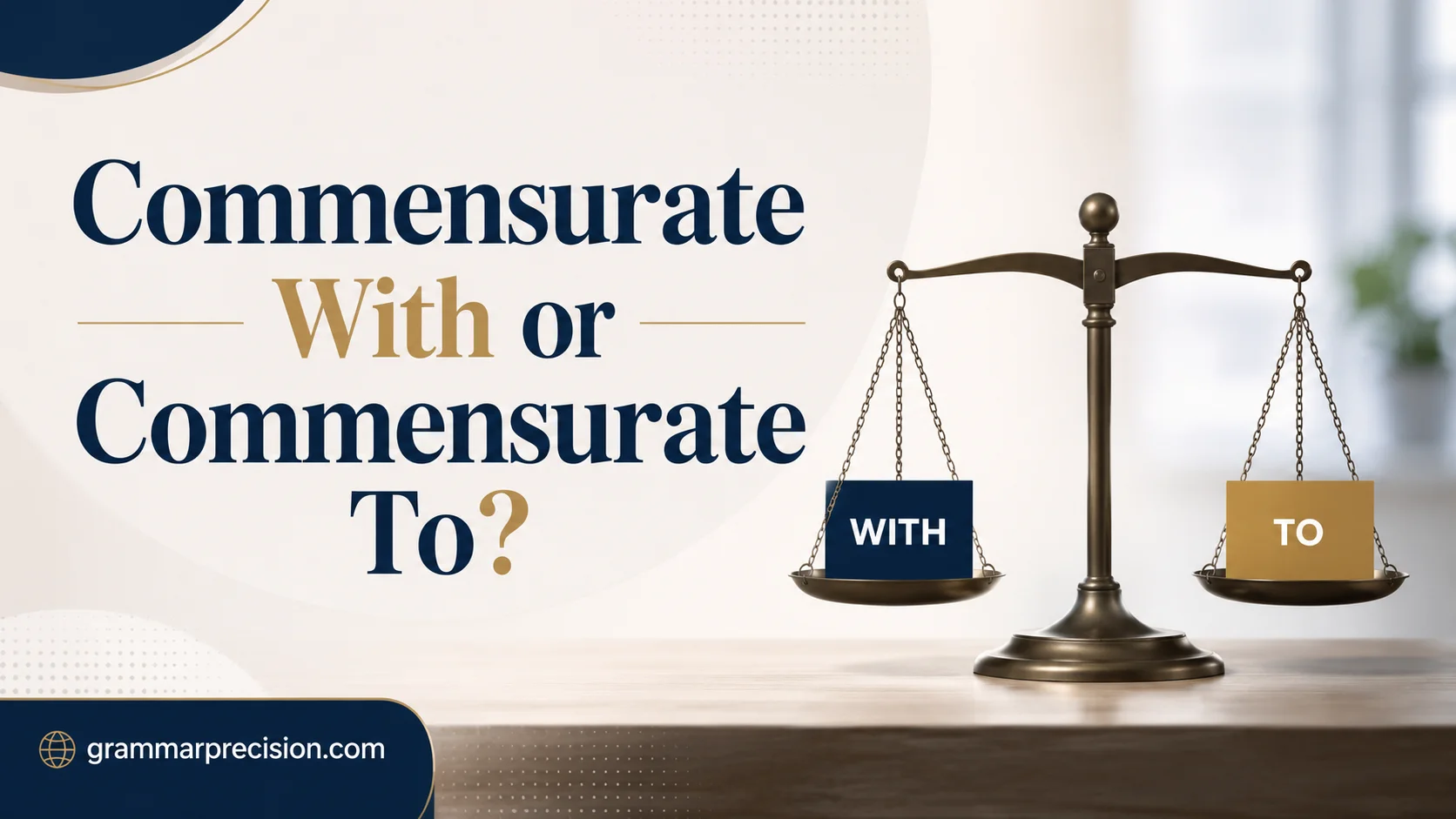
Many learners struggle with Commensurate With or Commensurate To? because choosing the correct preposition affects English grammar, sentence structure, communication, and overall semantic clarity in modern writing across different contexts and usage patterns.
While working with new writers, I noticed how Commensurate With sounds more natural in business emails, academic papers, and daily English. Many writers create clarity issues and lose credibility when grammar, correct prepositions, or wording precision feel incorrect. Strong linguistic patterns, better phrase selection, and accurate contextual meaning improve communication standards and support natural writing flow.
The word Commensurate comes from Latin roots like mensura, mensus, and metiri, all connected to the idea of measure. Understanding its etymology, semantic history, and linguistic origin helps writers improve language correctness, semantic relevance, and grammatical structure. This knowledge also strengthens writing quality, contextual accuracy, and modern English usage in professional communication.
What Does “Commensurate” Mean?
The word commensurate means:
- equal in measure
- proportional
- matching in degree
- appropriate for something else
The word describes something that corresponds properly in size, amount, or level.
In simpler terms:
If two things are commensurate, they match each other appropriately.
For example:
- A high-risk investment should produce rewards commensurate with the danger.
- A senior executive expects pay commensurate with experience.
- Responsibilities should be commensurate with authority.
Notice the repeated pattern?
Native speakers almost always pair the word with “with.”
Is It “Commensurate With” or “Commensurate To”?
The standard expression is:
Commensurate With
That is the form used by:
- major dictionaries
- academic writing
- business communication
- legal documents
- professional editors
- native English speakers
Examples from authoritative dictionaries consistently show “commensurate with.”
For example:
- “Salary commensurate with experience”
- “Punishment commensurate with the offense”
- “Benefits commensurate with contribution”
Is “Commensurate To” Wrong?
Technically, you may occasionally find “commensurate to” in older writing or scattered online examples. However, it sounds unnatural in modern English.
Even when it appears, many editors would revise it immediately.
Here’s why.
The adjective commensurate naturally expresses comparison and correspondence. In English, the preposition usually handles that relationship.
Think about similar structures:
Natural ExpressionUnnatural Versionconsistent withconsistent tocompatible withcompatible toproportional toproportional withaligned withaligned to
Language patterns matter. Native speakers absorb these combinations instinctively.
That instinct is called collocation.
“Commensurate with” has become the accepted collocation.
Why “Commensurate With” Sounds Natural
English often relies on fixed word partnerships.
For example:
- interested in
- afraid of
- good at
- depend on
You simply memorize them over time.
“Commensurate with” works the same way.
The preposition creates a sense of correspondence between two things.
For example:
- pay with experience
- responsibility with authority
- risk with reward
The relationship feels balanced.
By contrast, to usually suggests direction or movement:
- go to
- speak to
- respond to
That subtle mismatch makes “commensurate to” sound slightly off.
Why People Accidentally Say “Commensurate To”
The mistake is understandable.
English learners often see patterns like:
- equal to
- similar to
- related to
- connected to
Then they naturally assume “commensurate” should follow the same structure.
But English loves exceptions.
Sometimes the language behaves like a cat. It ignores logic and does whatever it wants.
That’s exactly what happens here.
Real Examples of “Commensurate With”
Understanding grammar becomes easier when you see real usage.
Here are examples across different contexts.
Salary Commensurate With Experience
This is probably the most common use online.
Example Sentences
- The company offers compensation commensurate with experience.
- Employees receive bonuses commensurate with performance.
- Senior developers earn salaries commensurate with their expertise.
Business Examples
Businesses love formal vocabulary.
Sometimes too much.
Still, “commensurate with” appears constantly in corporate writing.
Examples
- The investment carried risks commensurate with potential rewards.
- Staffing levels failed to increase commensurate with demand.
- Customer expectations rose commensurate with pricing.
Legal Examples
Legal English favors precision and balance.
That makes “commensurate” especially useful.
Examples
- The punishment should be commensurate with the crime.
- Penalties must remain commensurate with violations.
- Compensation should be commensurate with damages.
Academic Examples
Academic writing often uses “commensurate with” when discussing proportional relationships.
Examples
- Funding failed to increase commensurate with enrollment growth.
- Research output should be commensurate with institutional support.
- The response was commensurate with the severity of the crisis.
Everyday Examples
Although the word sounds formal, people occasionally use it in normal conversation.
Examples
- If you take bigger risks, you expect rewards commensurate with them.
- Her responsibilities aren’t commensurate with her salary.
- The effort wasn’t commensurate with the outcome.
Still, in casual speech, most people choose simpler alternatives instead.
Better Alternatives to “Commensurate”
Here’s the truth.
Many native speakers rarely use “commensurate” in daily conversation.
Why?
Because it sounds formal and slightly corporate.
In regular speech, people often prefer clearer alternatives.
Natural Synonyms for “Commensurate With”
Formal PhraseMore Natural Alternativecommensurate withmatchescommensurate withequal tocommensurate withproportional tocommensurate within line withcommensurate withappropriate forcommensurate withconsistent with
Examples Using Simpler Language
Instead of:
- “Compensation commensurate with qualifications”
You could write:
- “Pay that matches your qualifications”
Instead of:
- “Responsibilities commensurate with seniority”
You could write:
- “Responsibilities appropriate for senior staff”
The second versions usually sound warmer and easier to read.
Why Businesses Love the Word “Commensurate”
Corporate writing often tries to sound authoritative.
That explains why job ads constantly use phrases like:
- salary commensurate with experience
- compensation commensurate with qualifications
- benefits commensurate with role
Companies use the word because it sounds professional and flexible at the same time.
It lets employers avoid listing exact numbers.
Sneaky? Sometimes.
Useful? Absolutely.
What “Salary Commensurate With Experience” Really Means
Job seekers see this phrase constantly.
But many misunderstand it.
Here’s what employers usually mean:
PhraseHidden MeaningSalary commensurate with experienceFlexible pay rangeCompetitive salaryWe may negotiateDOEDepends on experienceMarket-based compensationWe’re avoiding specifics
Sometimes the phrase signals opportunity.
Other times it hides uncertainty.
Or budget limitations.
Also Read This: Fiancé vs. Fiancée
Native Speakers Rarely Say This Casually
Here’s something interesting.
Most native speakers understand “commensurate,” but many rarely use it in conversation.
Why?
Because the word feels:
- formal
- corporate
- academic
- legalistic
In casual conversation, people usually say:
- “The pay matches the work.”
- “The reward fits the risk.”
- “That salary seems fair.”
Simple language often sounds more natural.
Common Grammar Mistakes With “Commensurate”
Small grammar mistakes can make polished writing sound awkward instantly.
Here are the most common problems.
Using “Commensurate To”
Incorrect
- Salary commensurate to experience
Correct
- Salary commensurate with experience
This remains the biggest mistake by far.
Overusing the Word
Some writers use “commensurate” repeatedly because it sounds sophisticated.
That backfires quickly.
Awkward
- The compensation was commensurate with performance and responsibilities commensurate with expectations.
Better
- The compensation matched performance and responsibilities aligned with expectations.
Variety improves readability.
Using It in Casual Contexts
Overly Formal
- My pizza quality was not commensurate with the price.
More Natural
- The pizza wasn’t worth the price.
Sometimes simpler language wins.
How Native Speakers Instinctively Judge Correct Usage
Many grammar choices operate subconsciously.
Native speakers may not explain the rule clearly, but they immediately recognize what sounds natural.
That happens because of exposure.
People read and hear “commensurate with” thousands of times across:
- contracts
- business reports
- articles
- news coverage
- academic papers
Eventually the phrase becomes fixed in memory.
By contrast, “commensurate to” feels unfamiliar.
Even if readers cannot explain why, they notice the difference.
What Dictionaries and Experts Say
Major dictionaries overwhelmingly favor “commensurate with.”
Here’s a quick comparison.
SourcePreferred FormMerriam-Webstercommensurate withCambridge Dictionarycommensurate withBritannica Dictionarycommensurate with
That consistency matters.
When multiple authoritative references agree, you can confidently follow the standard form.
Can “Commensurate To” Ever Be Correct?
Language evolves constantly.
You may occasionally encounter examples like:
- “Players expect salaries commensurate with their status.”
However, these cases remain uncommon.
Most editors, teachers, and native speakers still strongly prefer “commensurate with.”
So if your goal is natural, polished English:
Use “commensurate with.”
Every time.
The Psychology Behind Formal Words
People often use sophisticated vocabulary to sound intelligent.
Ironically, overdoing formal language can create the opposite effect.
Readers may think the writing sounds:
- stiff
- pretentious
- robotic
- unnecessarily complex
Strong writing values clarity over decoration.
That doesn’t mean you should avoid advanced vocabulary completely.
It simply means you should use it intentionally.
“Commensurate” works best when precision matters.
When You Should Use “Commensurate With”
The phrase works well in:
- contracts
- resumes
- business writing
- legal documents
- academic papers
- professional emails
It adds precision and professionalism.
When You Should Avoid It
Avoid overusing it in:
- casual conversation
- lifestyle writing
- friendly emails
- social media captions
- relaxed blog content
Simpler alternatives usually sound more human.
Pronunciation Guide
Many learners hesitate because they’re unsure how to pronounce the word.
Here’s the American pronunciation:
kuh-MEN-suh-rut
Phonetic spelling:
/kəˈmen.sɚ.ət/
Easy Memory Trick
Here’s a quick trick that actually works.
Think of the phrase:
“in harmony WITH”
Both words describe balance and matching relationships.
That makes with feel natural.
Meanwhile, “to” feels directional rather than comparative.
Tiny trick. Huge payoff.
Mini Quiz: Which Version Sounds Natural?
Choose the correct sentence.
Example 1
A. Salary commensurate to experience B. Salary commensurate with experience
✅ Correct answer: B
Example 2
A. Rewards commensurate with effort B. Rewards commensurate to effort
✅ Correct answer: A
Example 3
A. Punishment commensurate with the offense B. Punishment commensurate to the offense
✅ Correct answer: A
You’re probably noticing the pattern now.
Real-World Case Study: Job Advertisements
Search online job boards and you’ll repeatedly find:
- compensation commensurate with experience
- salary commensurate with qualifications
- benefits commensurate with expertise
The phrase survives because it sounds formal, flexible, and legally safe.
Formal vs Casual English Comparison
Formal EnglishCasual EnglishCompensation commensurate with experiencePay based on experienceResponsibilities commensurate with rankDuties that fit the roleRisk commensurate with rewardBig risk, big rewardBenefits commensurate with contributionBenefits that match effort
Notice how the casual versions feel warmer and easier to process.
That matters online.
Modern readers prefer clarity.
Why This Tiny Grammar Choice Matters
Grammar shapes perception.
People unconsciously judge writing quality within seconds.
Using unnatural phrasing can subtly affect:
- credibility
- professionalism
- readability
- trust
The difference between “commensurate with” and “commensurate to” may seem small.
Yet native speakers immediately feel the distinction.
That’s the strange beauty of language.
Tiny details create huge impressions.
FAQs:
Is “Commensurate With” grammatically correct?
Yes, Commensurate With is the most accepted and natural phrase in modern English grammar. It is commonly used in business communication, academic writing, and professional contexts to describe balance, proportion, or fairness.
Why do people confuse “Commensurate With” and “Commensurate To”?
Many learners become confused because of changing language patterns, different writing contexts, and weak understanding of correct prepositions. The similarity between both phrases also creates usage confusion in daily English.
Can “Commensurate To” ever be used?
Although some people use Commensurate To, it is generally considered less standard in formal English usage. Most grammar experts and style guides prefer Commensurate With for better clarity and natural communication.
How does the word “Commensurate” relate to Latin?
The word Commensurate comes from Latin roots such as mensura, mensus, and metiri, all connected to the idea of measure. Its historical background explains why the word often describes proportion, equality, and balance.
Why is the correct preposition important in writing?
Using the correct preposition improves sentence structure, semantic clarity, and overall communication. Correct usage also increases credibility, especially in professional emails, academic papers, and formal writing.
Conclusion:
Understanding Commensurate With or Commensurate To? becomes easier when you focus on contextual meaning, grammar rules, and natural English usage. In most situations, Commensurate With is the preferred and more professional choice because it provides better clarity, stronger communication, and improved writing quality. Learning the word’s etymology, Latin roots, and proper grammatical use can also help writers avoid common mistakes and communicate with greater precision and confidence.