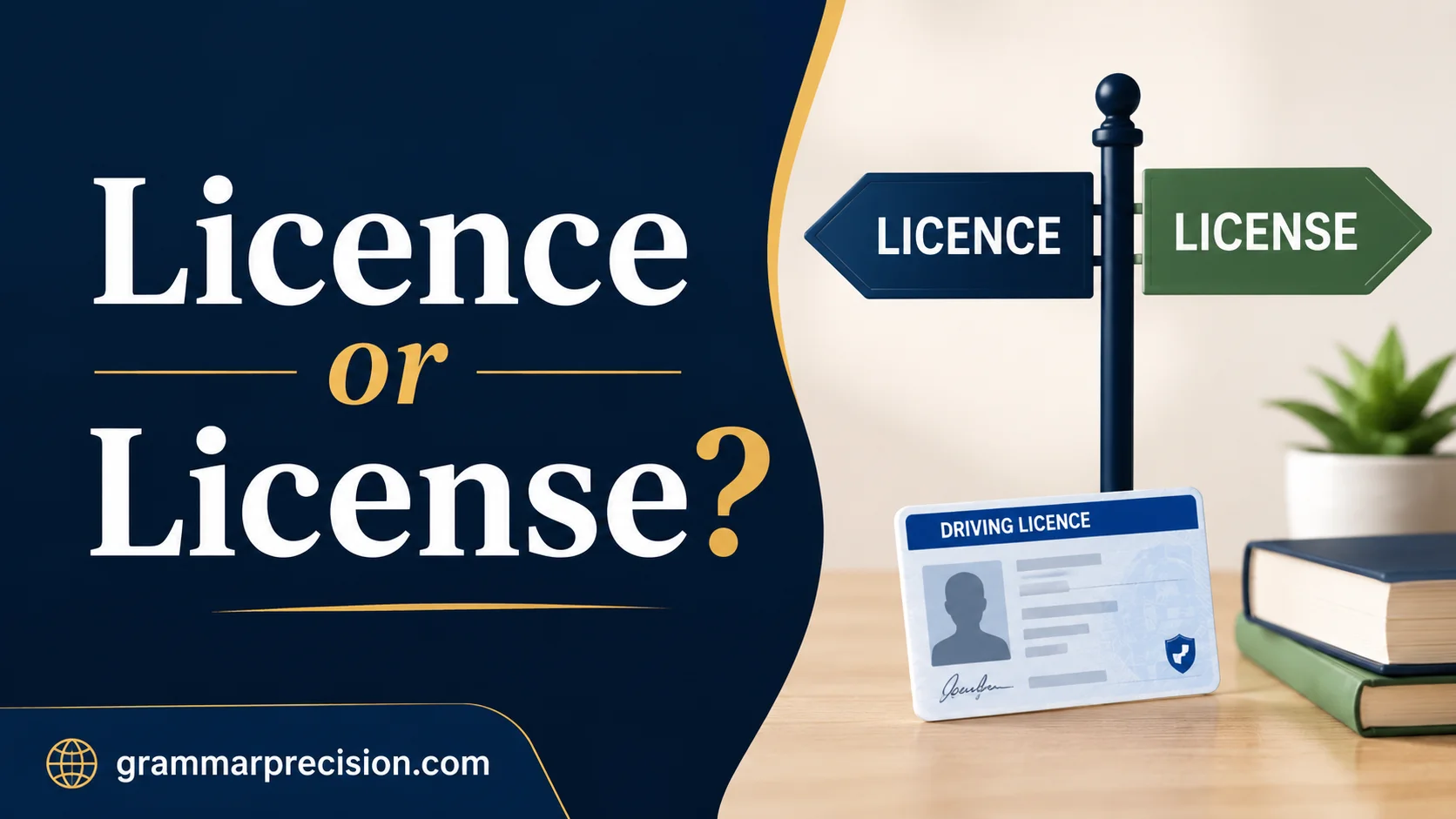
Licence or License? is a common grammar confusion because both words look similar. Their usage depends on British English and American English writing styles and grammatical functions.
In British English, licence is usually used as a noun, while license works as a verb. In American English, license is commonly used for both forms. Understanding this difference improves writing accuracy, strengthens grammar skills, and helps writers avoid common language mistakes in formal and informal communication.
Many learners confuse Licence or License? because the spelling changes with regional English rules. Knowing the correct form is important for academic writing, professional documents, and everyday use. Correct grammar usage also builds credibility, improves clarity, and makes your English sound more polished and natural.
What Is the Difference Between Licence and License?
The simplest answer looks like this:
WordEnglish StylePart of SpeechExampleLicenceBritish EnglishNounI renewed my driving licence.LicenseAmerican EnglishNoun + VerbShe received her driver’s license.LicenseBritish EnglishVerbThe city licensed the restaurant.
In other words:
- British English separates the noun and verb forms.
- American English uses “license” for both.
That tiny distinction creates most of the confusion online.
The Fastest Rule You’ll Ever Learn
If you only remember one thing from this article, remember this:
British English
- Licence = thing/document/permission
- License = action of giving permission
American English
- License = both noun and verb
That’s it.
Simple. Clean. Easy to apply.
Why People Constantly Confuse Licence and License
The confusion happens for three major reasons.
They Sound Exactly the Same
Unlike “advice” and “advise,” pronunciation doesn’t help here.
Both “licence” and “license” sound identical.
That means your ears can’t guide your spelling.
American English Dominates the Internet
Many websites, apps, and spellcheck tools default to American English.
As a result:
- British users often see “license” autocorrected
- International companies mix spellings
- Students accidentally combine UK and US grammar
One Reddit user joked that autocorrect keeps changing “licence” into “license” even with UK English enabled.
That happens more often than people admit.
Most Schools Don’t Teach the Grammar Rule Properly
Many learners only hear:
“British uses licence. Americans use licences.”
That explanation is incomplete.
The real distinction involves noun versus verb usage.
Without understanding that structure, people continue guessing.
Licence vs License in British English
British English follows a grammatical distinction.
This system resembles several other British spelling pairs.
“Licence” Is the Noun
Use “licence” when talking about:
- a document
- permission
- certification
- legal approval
Examples
- He renewed his fishing licence.
- She lost her driving licence.
- The business received a liquor licence.
- You need a television licence in the UK.
In each sentence, “licence” acts as a thing.
That makes it a noun.
“License” Is the Verb
Use “license” when describing the action of granting permission.
Examples
- The city licensed the taxi company.
- Authorities licensed the software provider.
- The government licensed new broadcasters.
Here, “license” describes an action.
That makes it a verb.
Licence vs License in American English
American English simplified the rule.
Instead of separating noun and verb spellings, American English uses:
License for Everything
Examples
- I got my driver’s license.
- The software company issued a new license.
- The state licensed the doctor.
- The company licenses its technology globally.
Americans rarely use “licence.”
In formal US writing, “licence” usually appears incorrect.
A Memory Trick That Actually Works
Most grammar tricks feel forgettable.
This one sticks.
LetterReminderMeaningC in licenceCertificateNounS in licenseSomething happeningVerb
Think about it this way:
- A licence is a certificate.
- To get a license means to do something.
That tiny mental shortcut saves enormous frustration.
Real Life Examples of Licence vs License
Grammar rules become clearer with realistic examples.
Here’s how native speakers use these words daily.
Driving Licence vs Driver’s License
This is the most searched version online.
British English
- driving licence
American English
- driver’s license
Notice another difference:
Americans usually say “driver’s license.”
Brits commonly say “driving licence.”
Examples
British EnglishAmerican EnglishI forgot my driving licence.I forgot my driver’s license.She passed her driving test.She passed her driver’s test.
Software Licence vs Software License
Technology companies often mix spellings accidentally.
That can damage brand consistency.
UK Style
- software licence
- licensing agreement
US Style
- software license
- software licensing
Many international tech companies choose American English because it dominates global software markets.
Business Licence vs Business License
Governments issue permits differently around the world.
UK Example
- restaurant licence
- alcohol licence
- operator’s licence
US Example
- business license
- liquor license
- contractor license
Broadcasting Licence vs Broadcasting License
British media often uses “licence.”
For example:
- TV licence
- broadcasting licence
Meanwhile, American publications typically use:
- broadcast license
- television license
The Hidden Grammar Pattern Most Websites Ignore
Here’s where things become interesting.
“Licence” and “license” follow a larger British English pattern.
Several British spelling pairs separate nouns and verbs.
NounVerbAdviceAdvisePracticePractiseDeviceDeviseLicenceLicense
This pattern explains why British English prefers different endings.
The noun usually ends in:
- ce
The verb usually ends in:
- se
Once you notice the pattern, the rule suddenly feels logical.
A Reddit discussion compared “licence/license” with “advice/advise” because both follow similar grammar distinctions.
Why American English Dropped “Licence”
This difference traces back to language simplification.
American English gradually removed many spelling distinctions.
Much of that movement came from Noah Webster, the influential lexicographer behind early American dictionaries.
Webster promoted spelling reforms that simplified English.
That’s why American English prefers:
British EnglishAmerican EnglishColourColorDefenceDefenseTravellingTravelingLicenceLicense
The goal was consistency and simplicity.
Over time, American English standardized “license” for both forms.
Also Read This: Put Two and Two Together Meaning
The History Behind Licence and License
The word originally comes from Latin.
The root word:
- licentia
meant freedom or permission.
Later, Old French influenced English spellings during the Middle Ages.
Over centuries, spelling conventions evolved differently across regions.
British English kept the noun verb distinction.
American English simplified it.
Language evolution rarely follows strict logic.
English especially enjoys making simple things complicated.
Common Mistakes People Make
Even fluent writers slip up.
Here are the biggest errors.
Using “Licence” in American Writing
Incorrect for US English:
I renewed my driving licence.
Correct:
I renewed my driver’s license.
Using “License” as a Noun in British English
Technically incorrect in formal UK writing:
I lost my driving license.
Preferred British version:
I lost my driving licence.
However, casual British usage increasingly mixes both spellings due to American influence online.
Mixing UK and US Spellings Together
This looks unprofessional instantly.
Example:
The organisation renewed its software license while updating its colour scheme.
That sentence combines:
- British spelling (“organisation,” “colour”)
- American spelling (“license”)
Readers notice inconsistency fast.
Confusing “Licensed” and “Licenced”
This area creates additional chaos.
American English
- licensed
- licensing
British English
Both forms appear, though “licensed” remains common internationally.
Many UK publications still prefer “licensed.”
That inconsistency confuses writers everywhere.
How Native Speakers Actually Use These Words
Real world language rarely stays perfectly clean.
Many British speakers casually use “license” for everything online.
Meanwhile, international companies often default to American spelling for simplicity.
That’s why you’ll sometimes see mixed usage even on professional websites.
A Reddit commenter humorously noted:
“This has never confused anyone and we always get it right.”
Then another user immediately pointed out inconsistent real world usage.
That perfectly captures English spelling chaos.
Does Pronunciation Change?
No.
Both words sound identical:
- /ˈlaɪ.səns/
That’s another reason learners struggle.
Unlike:
- advice / advise
- belief / believe
there’s no pronunciation clue.
You must rely entirely on grammar and regional spelling conventions.
Why Using the Correct Version Matters
Some people think this distinction feels trivial.
It isn’t.
Small spelling details shape credibility.
Academic Writing
Professors notice inconsistent English styles immediately.
If you choose British English:
- stay fully British
If you choose American English:
- stay fully American
Mixing both weakens professionalism.
Business Communication
Brands need consistency.
A UK company using American spellings randomly may appear careless.
The same applies in reverse.
SEO and Website Localization
This matters enormously online.
People search differently depending on their region.
For example:
RegionCommon SearchUKdriving licenceUSdriver’s licenseUKTV licenceUSTV license
Smart SEO strategies target both variations naturally.
That increases international search visibility.
Professional Licensing Industries
Certain industries rely heavily on correct spelling.
Examples include:
- medicine
- law
- software
- broadcasting
- engineering
- finance
Incorrect regional spelling can look unprofessional in legal or government contexts.
Licence vs License in Different Countries
English varies worldwide.
Here’s how major regions typically handle the spelling.
CountryPreferred UsageUnited StatesLicenseUnited KingdomLicence , License CanadaMixed but often British influencedAustraliaLicence , License New ZealandLicence , License
Canada sits somewhere in the middle.
Canadian English often blends British and American conventions.
Quick Quiz: Can You Spot the Correct Version?
Try these yourself.
Sentence One
She renewed her driving _____ yesterday.
Answer
- UK: licence
- US: license
Sentence Two
The city will _____ three new restaurants.
Answer
- license
That’s a verb in both systems.
Sentence Three
The software company sells annual _____ agreements.
Answer
- UK: licence
- US: license
Easy Ways to Never Forget the Difference Again
Here are the most effective memory methods.
Use the “C = Certificate” Rule
- licence = certificate/document
Think About Action
- license = action/verb
Match Your Audience
Before writing, ask:
- Is my audience American?
- British?
- International?
Then stay consistent throughout the piece.
Related Word Pairs You Should Learn Next
If this topic interests you, these similar spelling differences often confuse writers too.
British EnglishAmerican EnglishDefenceDefensePractisePracticeTravellingTravelingGreyGrayOrganiseOrganize
Learning these together strengthens your overall English accuracy.
FAQs
Is “Licence” correct in American English?
No, American English mainly uses license for both the noun and verb forms. The spelling licence is mostly used in British English as a noun.
When should I use “License”?
You should use license when writing in American English or when using the word as a verb in British English. It commonly appears in legal, business, and official contexts.
Why do people confuse “Licence or License?”
People confuse these words because both have the same pronunciation and meaning. The difference depends on regional grammar rules and whether the word is used as a noun or verb.
Is “Driver’s Licence” or “Driver’s License” correct?
Both are correct depending on the country. Driver’s licence is correct in British English, while driver’s license is correct in American English usage.
How can I remember the difference between “Licence” and “License”?
A simple trick is to remember that in British English, licence ends with “ce” for a noun, while license with “se” is generally used as a verb.
Conclusion
Understanding Licence or License? helps improve your grammar accuracy and writing confidence. The correct spelling depends on whether you use British English or American English. Learning these differences makes your communication more professional, clear, and grammatically correct in both academic and everyday writing.