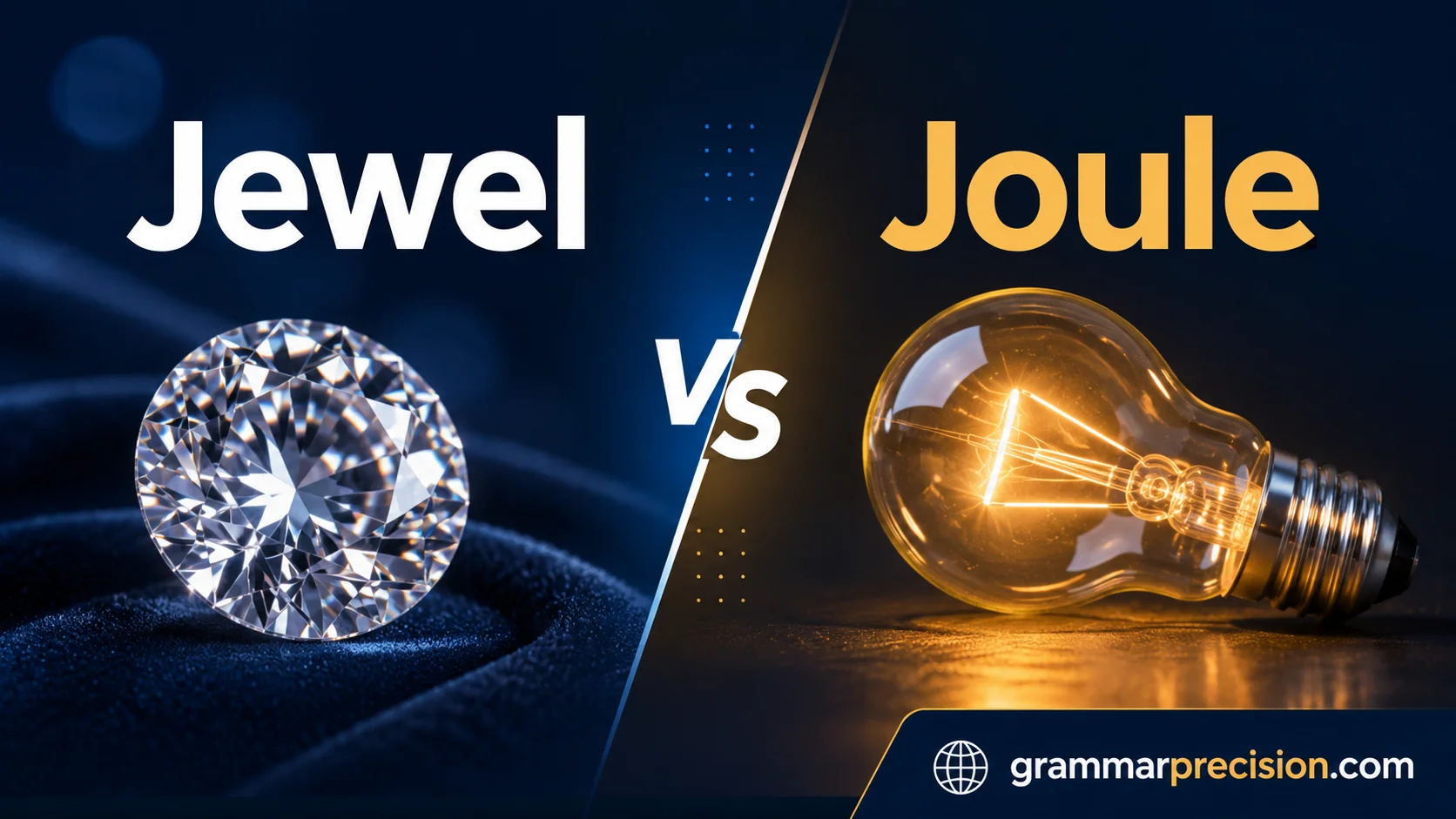
Jewel vs Joule is a commonly confused pair of words in English. Although they sound similar, their meanings are completely different. Understanding the correct usage helps improve writing, communication, and vocabulary skills effectively.
A jewel refers to a precious stone or an item of valuable jewelry, often associated with beauty, luxury, and fashion. In contrast, a joule is a scientific unit used to measure energy, work, or heat in physics. Knowing this distinction is important for both academic and everyday English.
Many English learners mix up these words because of their similar pronunciation. However, remembering their contexts can make usage easier. Jewel belongs to the world of gems and ornaments, while joule belongs to science and mathematics. Learning such confusing word pairs strengthens your grammar accuracy and overall language confidence.
Jewel vs Joule: Quick Difference Table
| Feature | Jewel | Joule |
| Meaning | A precious stone or valuable ornament | A unit of energy in physics |
| Field | Jewelry, fashion, beauty | Science, physics, electricity |
| Part of Speech | Noun | Noun |
| Pronunciation | /ˈjuːəl/ | /dʒuːl/ |
| Example Sentence | She wore a beautiful jewel necklace. | Energy is measured in joules. |
| Related To | Gems, luxury, decoration | Work, heat, electricity |
| Common Usage | Daily conversation and fashion | Scientific and academic contexts |
| Easy Memory Tip | Jewel = Jewelry | Joule = Energy Unit |
What Does “Jewel” Mean?
The word jewel refers to something valuable and decorative. Usually, it means a precious stone or a highly prized object.
People commonly associate jewels with:
- Diamonds
- Rubies
- Emeralds
- Gold necklaces
- Crowns
- Luxury accessories
A jewel often symbolizes beauty, wealth, or rarity.
Simple Definition of Jewel
A jewel is a precious stone or valuable decorative object.
Examples of “Jewel” in Sentences
- She kept the family jewels in a locked safe.
- The queen’s crown contained several rare jewels.
- That watch is the jewel of his collection.
- Her necklace sparkled like a jewel under the lights.
Notice something interesting here.
The word “jewel” also appears metaphorically. People sometimes describe a person, place, or object as a “jewel” when it’s exceptionally valuable or beautiful.
For example:
- “Hawaii is the jewel of the Pacific.”
- “That little café is a hidden jewel downtown.”
English loves poetic shortcuts like this.
The Origin of the Word “Jewel”
The word comes from Old French and Latin roots connected to playthings, ornaments, and objects of value.
Over centuries, “jewel” evolved into a word strongly associated with luxury and beauty.
Today, you’ll hear it in:
- Fashion
- Literature
- Movies
- Royal history
- Advertising
- Pop culture
Luxury brands especially love the word because it sounds elegant and timeless.
What Does “Joule” Mean?
Now things take a hard left turn into science.
A joule is a unit of energy.
Scientists use joules to measure:
- Work
- Heat
- Energy transfer
- Electricity
- Motion
The joule belongs to the International System of Units (SI).
Simple Definition of Joule
A joule is the amount of energy transferred when one newton of force moves an object one meter.
That sounds technical. So let’s simplify it.
Imagine pushing a small box across the floor. The energy used in that movement can be measured in joules.
Easy.
The Science Behind the Joule
The word “joule” comes from James Prescott Joule, a British physicist famous for studying energy and heat.
His research helped scientists understand how mechanical energy converts into thermal energy.
That work became foundational in thermodynamics.
Today, the joule appears everywhere in science.
Everyday Things Measured in Joules
ActivityApproximate EnergyLifting an apple one meter1 jouleA phone batteryThousands of joulesA lightning strikeBillions of joulesA food calorieAbout 4,184 joulesRunning for 30 minutesHundreds of thousands of joules
Suddenly physics feels less intimidating.
Energy surrounds you constantly.
How Scientists Define a Joule
Scientists define one joule as:
1\ J = 1\ N\cdot m
That means:
- One newton of force
- Moving an object
- Across one meter
The joule also equals one watt second.
In electrical systems:
1\ J = 1\ W\cdot s
Physics may sound complicated at first. However, joules simply measure energy in different forms.
Why Jewel and Joule Sound the Same
Welcome to the chaotic beauty of English pronunciation.
“Jewel” and “joule” are homophones.
That means they sound identical but carry different meanings and spellings.
Pronunciation
Both words are pronounced:
/dʒuːl/
Or simply:
“JOOL”
English contains thousands of homophones.
Here are a few famous examples:
HomophonesMeaning DifferenceFlower vs FlourPlant vs baking ingredientKnight vs NightWarrior vs eveningSea vs SeeOcean vs visionBrake vs BreakStop vs damage
“Jewel vs joule” becomes extra confusing because both words are relatively uncommon in everyday conversation.
One belongs to fashion.
The other belongs to physics class.
That’s a recipe for spelling disaster.
Jewel vs Joule: The Biggest Differences
Meaning
This is the biggest distinction.
- Jewel = precious object
- Joule = unit of energy
Simple.
Usage
People use “jewel” in decorative or emotional contexts.
People use “joule” in scientific or technical contexts.
Tone
“Jewel” feels elegant and artistic.
“Joule” feels mathematical and scientific.
One sparkles.
The other calculates.
Memory Tricks That Actually Work
Some grammar explanations vanish from your brain within five minutes.
These tricks stick.
Trick One: Jewel Has “Jew”
Think of jewelry.
Both words share similar spelling.
- Jewel
- Jewelry
That connection helps instantly.
Trick Two: Joule Starts With “Jou”
Think of:
- Joules
- Electricity
- Joule meter
- Science
The unusual spelling feels more technical.
Trick Three: Visual Memory
Picture two scenes:
Jewel
A sparkling diamond ring inside a velvet box.
Joule
A scientist measuring electricity in a laboratory.
Your brain remembers images better than definitions.
Real Life Examples of Jewel vs Joule
Learning grammar without examples feels like learning to swim without water.
So let’s make this practical.
Examples of Jewel
- The museum displayed ancient jewels from Egypt.
- Her engagement ring contained a rare jewel.
- That island is a jewel in the Caribbean.
- The necklace featured blue jewels and gold chains.
Examples of Joule
- The experiment produced 50 joules of energy.
- Batteries store energy measured in joules.
- One calorie equals roughly 4,184 joules.
- The laser emitted several thousand joules.
Notice the pattern?
Whenever science enters the room, “joule” appears.
Whenever beauty or luxury appears, “jewel” appears.
Also Read This: Years of Experience vs. Years’ Experience
Common Mistakes People Make
Even smart writers mix these up.
Here’s why.
Spellcheck Often Misses It
Both words are real.
That means grammar tools sometimes ignore the error.
For example:
❌ “The experiment generated 500 jewels of energy.”
Technically spelled correctly.
Scientifically ridiculous.
Students Frequently Confuse Them
Physics students often type “jewel” accidentally because that spelling feels more familiar.
Meanwhile, English learners sometimes assume “joule” is a typo.
It isn’t.
Search Engines Reveal the Confusion
Many people search things like:
- “What is a jewel in physics?”
- “Joule meaning in English”
- “Difference between jewel and joule”
- “Jewel unit of energy”
That confusion appears everywhere online.
Even Reddit discussions show people struggling with the definition and usage of joules in science.
The Fascinating History of the Joule
The joule didn’t appear randomly.
Scientists named it after James Prescott Joule because his experiments changed modern physics forever.
During the 1800s, Joule studied the relationship between:
- Heat
- Electricity
- Mechanical work
His discoveries helped prove energy conservation principles.
That work eventually shaped thermodynamics.
Pretty impressive legacy for a word people confuse with gemstones.
Joules in Everyday Life
Many people think joules only matter in science class.
Not true.
You encounter joules constantly.
Food Energy
Food energy can convert into joules.
For example:
FoodApproximate EnergyBanana400,000+ joulesSlice of pizza1,200,000+ joulesChocolate bar900,000+ joules
That’s your body’s fuel system at work.
Electronics
Phone batteries, laptops, and power banks all involve joules.
A battery stores energy. That energy eventually powers your device.
No joules. No scrolling TikTok at 2 AM.
Sports
Athletes generate huge amounts of kinetic energy.
A baseball pitch.
A soccer kick.
A sprint finish.
All measurable in joules.
Science quietly hides inside daily life like a ninja wearing a lab coat.
Jewel in Literature and Culture
Unlike “joule,” the word “jewel” carries emotional and symbolic meaning.
Writers use it to suggest:
- Beauty
- Purity
- Wealth
- Love
- Importance
Famous Expressions Using “Jewel”
PhraseMeaningCrown jewelsMost valuable possessionsJewel of the cityBest part of a cityHidden jewelUnderrated treasureFamily jewelsValuable family assets
Some expressions even become humorous slang depending on context.
English loves layers of meaning.
Jewel vs Joule in Academic Writing
This distinction matters more than people realize.
Using the wrong word can completely undermine credibility.
Imagine submitting a physics report saying:
“The machine produced 2,000 jewels.”
Your professor might laugh before deducting points.
Academic Tip
Always double check these words in:
- Science essays
- Research papers
- Technical writing
- Engineering reports
Spellcheck won’t always save you.
A Funny Analogy You’ll Never Forget
Imagine this conversation.
“I bought a jewel yesterday.”
You probably picture a diamond necklace.
Now imagine:
“I bought a joule yesterday.”
That sounds like someone walked into a physics store carrying batteries and equations.
One sparkles under light.
The other powers the light.
That difference sticks surprisingly well.
Case Study: How One Letter Changes Meaning
Let’s compare two sentences.
Sentence One
“The queen protected her jewels.”
Meaning: Precious gemstones.
Sentence Two
“The machine consumed 5,000 joules.”
Meaning: Energy measurement.
Same pronunciation.
Completely different mental image.
That’s the power of homophones.
Why English Learners Struggle With Homophones
English pronunciation often ignores spelling logic.
That frustrates learners worldwide.
Why Homophones Cause Problems
- Same sound
- Different spelling
- Different meanings
- Different contexts
Your brain hears identical sounds and assumes identical words.
Unfortunately, English says:
“Nice try.”
Homophones Similar to Jewel vs Joule
If you confuse jewel and joule, you’re not alone.
These pairs confuse people too.
Word PairDifferencePrincipal vs PrinciplePerson vs ruleAffect vs EffectVerb vs nounCompliment vs ComplementPraise vs completionStationary vs StationeryStill vs paperBrake vs BreakStop vs damage
English spelling sometimes feels like assembling furniture without instructions.
Mini Quiz: Jewel or Joule?
Test yourself.
Question One
“The scientist measured 300 _____ of energy.”
Answer
Joules.
Question Two
“She inherited rare family _____.”
Answer
Jewels.
Question Three
“A lightning strike contains millions of _____.”
Answer
Joules.
Question Four
“The necklace featured a blue _____.”
Answer
Jewel.
Easy now, right?
Quotes About Energy and Beauty
Here’s where things get interesting.
One word represents beauty.
The other represents power.
Quote About Beauty
“Beauty is how you feel inside.”
Beauty connects emotionally.
Like jewels.
Quote About Science
“Energy cannot be created or destroyed.”
That principle defines modern physics.
Like joules.
Strange how two identical sounds can represent entirely different worlds.
Jewel vs Joule Pronunciation Guide
Even though both words sound alike, pronunciation guides still help learners.
WordPronunciationJewelJOOLJouleJOOL
No difference.
Zero.
That’s exactly why people confuse them.
FAQs:
What is the difference between Jewel and Joule?
A jewel is a precious gemstone or decorative ornament used in jewelry. A joule, on the other hand, is a scientific unit that measures energy or work in physics. Although both words sound similar, their meanings are completely different.
Is Joule used in everyday English?
The word joule is mostly used in science, physics, and educational subjects. It is not very common in daily conversation unless someone is discussing energy, electricity, or scientific calculations.
Can Jewel and Joule be used interchangeably?
No, jewel and joule cannot be used interchangeably because they belong to completely different fields. Jewel relates to fashion and valuables, while joule relates to scientific measurement and energy concepts.
Why do people confuse Jewel and Joule?
People often confuse these words because they have a similar pronunciation. However, understanding the context makes the difference clear. Jewel refers to something valuable and decorative, while joule is connected to science and physics.
How can I remember the difference between Jewel and Joule?
A simple trick is to associate jewel with jewelry and beauty, while joule can be linked with energy and scientific formulas. This memory technique helps improve vocabulary and prevents common English mistakes.
Conclusion:
Understanding the difference between Jewel vs Joule is important for improving English vocabulary and avoiding confusion. While jewel represents beauty and valuable ornaments, joule is a scientific measurement of energy. Learning these commonly confused words helps enhance grammar accuracy, communication skills, and confidence in both writing and speaking English.