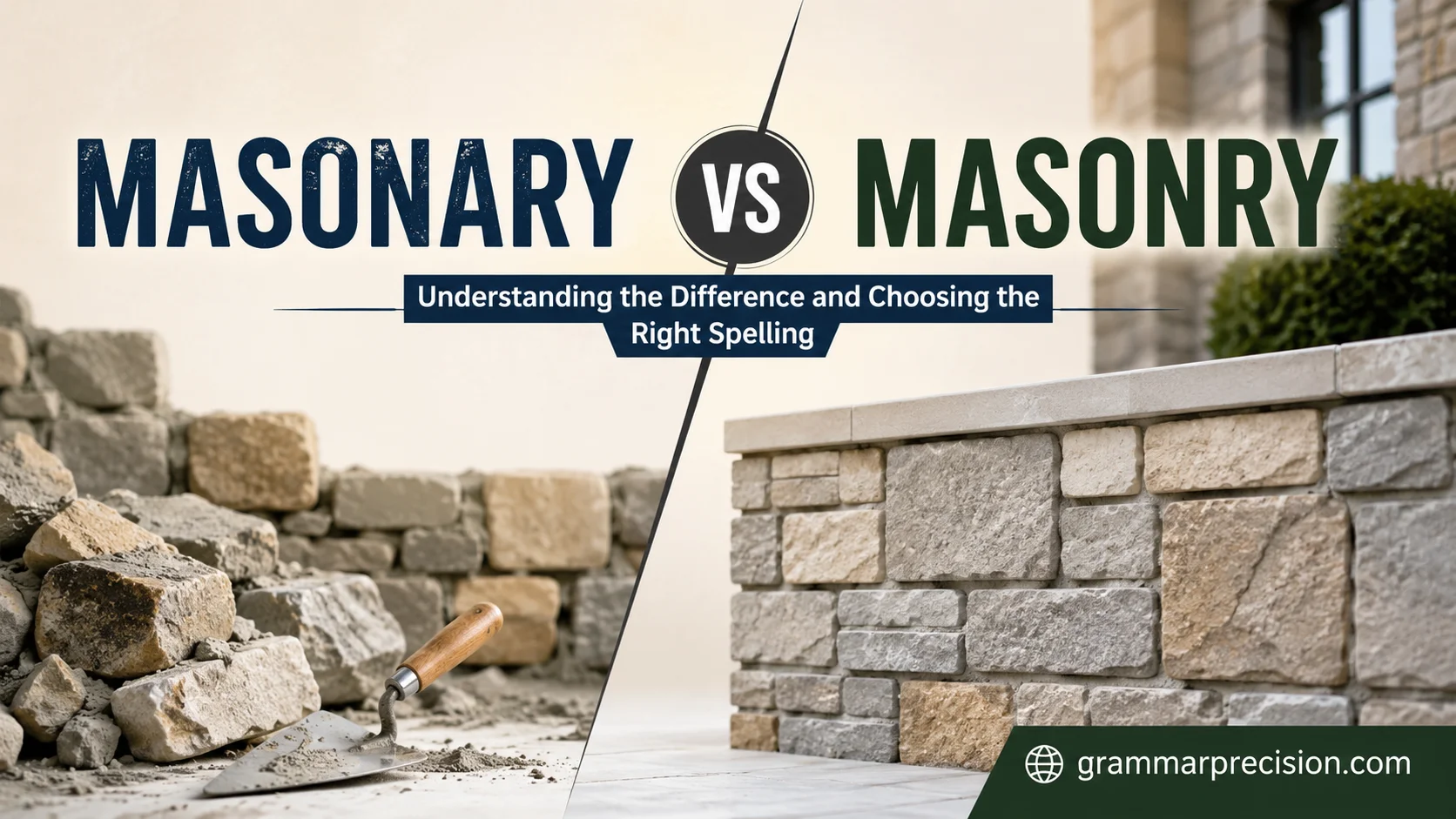
Masonary vs Masonry is a common confusion in construction writing where correct spelling improves clarity, communication, and professional understanding in real industry usage.
In the construction industry, I often see confusion in blogs, textbooks, and websites where masonry and masonary mix due to typing habits, regional usage, and quick searches that spread misspelling fast. This affects professional documents, students, writers, architects, and builders, where a wrong letter impacts academic writing, search engine optimization, and everyday usage, reducing overall clarity and communication.
In real hands on work, experts in masonry show true skill, where masons use bricks, mortar, stone, granite, concrete, and block materials to build walls, paths, and outdoor builds. These structures are constructed, shaped, and arranged on job sites through steady practice, following real trade and craft processes that reflect true art and science of building.
Masonary vs Masonry: Which Spelling Is Correct?
The correct spelling is masonry.
The word “masonary” is a misspelling and is not considered proper English.
Here’s a simple comparison table:
WordCorrect?MeaningUsageMasonry✅ YesConstruction work using brick or stoneCorrect EnglishMasonary❌ NoMisspelling of masonryTyping mistake
Many people mistakenly add an extra “a” because of how the word sounds when spoken quickly.
What Does Masonry Mean?
The word masonry refers to the art and craft of building structures using materials like:
- Brick
- Stone
- Concrete blocks
- Mortar
“The art, trade, or occupation of a mason.”
In simple words, masonry is construction work done with brick, stone, or concrete.
Examples include:
- Brick walls
- Stone houses
- Fireplaces
- Chimneys
- Concrete block buildings
Masonry has existed for centuries and still plays a huge role in modern construction.
How to Pronounce Masonry Correctly
One major reason people type “masonary” comes from pronunciation confusion.
The correct pronunciation is:
/ˈmeɪ.sən.ri/
You can pronounce it as:
MAY suhn ree
Not:
- MAY so na ree
- MAY son airy
- MAY son uh ree
When people hear the word casually, they often assume there’s an extra vowel in the spelling.
Why People Misspell Masonry as “Masonary”
English spelling can be confusing. Some words simply refuse to follow predictable patterns.
Here are the biggest reasons this mistake happens so often.
Pronunciation Confuses People
The word sounds longer than it actually is.
People hear:
“May son ree”
Then accidentally type:
“masonary”
This happens with many English words.
Similar English Words Influence Spelling
English contains many words ending in:
- ary
- ery
- ory
Examples include:
- Necessary
- Dictionary
- Cemetery
- Stationary
Because of these patterns, people naturally assume “masonary” must be correct.
Typing Habits and Autocorrect
The misspelling appears frequently online, including on:
- Websites
- Social media posts
- Business listings
- Online forums
As a result, autocorrect doesn’t always catch the mistake.
Regional Accents Play a Role
Different accents stretch vowel sounds differently. In some regions, “masonry” sounds almost identical to “masonary.”
That creates even more spelling confusion.
The History and Origin of the Word Masonry
The word masonry comes from the Old French word:
maçonnerie
It originally referred to stonework and the trade of skilled builders.
The word entered Middle English during the 13th century and has remained part of construction vocabulary ever since.
For hundreds of years, masons built:
- Castles
- Temples
- Bridges
- Cathedrals
- Defensive walls
Without masonry, many of the world’s greatest historical structures would not exist today.
What Does a Mason Do?
A mason is a trained construction worker who builds structures using:
- Brick
- Stone
- Concrete
- Mortar
Their responsibilities often include:
- Building walls
- Repairing chimneys
- Installing stonework
- Restoring old buildings
- Creating decorative brick designs
Modern masonry combines traditional craftsmanship with engineering precision.
A skilled mason must understand:
- Measurements
- Structural balance
- Material strength
- Weather resistance
- Safety standards
Types of Masonry Explained
Masonry includes several construction methods. Each one serves different purposes depending on the project.
Brick Masonry
Brick masonry uses clay bricks joined together with mortar.
It’s one of the most common forms of construction worldwide.
Advantages
- Affordable
- Fire resistant
- Easy to install
- Attractive appearance
Common Uses
- Houses
- Schools
- Boundary walls
- Commercial buildings
Stone Masonry
Stone masonry uses natural stones like:
- Granite
- Marble
- Limestone
- Sandstone
This type of masonry creates extremely durable structures.
Advantages
- Long lifespan
- Elegant appearance
- Strong weather resistance
Drawbacks
- Expensive
- Heavy materials
- Labor intensive
Stone masonry helped create ancient wonders like the Egyptian pyramids.
Concrete Block Masonry
Concrete block masonry uses larger blocks instead of smaller bricks.
It’s commonly used for:
- Warehouses
- Factories
- Garages
- Commercial buildings
Benefits
- Faster construction
- Strong structure
- Lower labor costs
Veneer Masonry
Veneer masonry provides the appearance of real stone or brick without using full structural thickness.
Builders attach decorative masonry materials to another wall system.
This option offers:
- Lower cost
- Faster installation
- Stylish design
Reinforced Masonry
Reinforced masonry includes steel reinforcement bars for additional strength.
This improves resistance against:
- Earthquakes
- Heavy winds
- Structural stress
Modern buildings often combine masonry with steel reinforcement for better safety.
Famous Masonry Structures Around the World
Masonry has shaped human civilization for thousands of years.
Some of the world’s most iconic landmarks still stand because of exceptional masonry work.
The Great Wall of China
The Great Wall used brick and stone masonry across thousands of miles.
It remains one of the greatest construction achievements in history.
Egyptian Pyramids
The pyramids demonstrate incredible stone masonry precision despite being thousands of years old.
The craftsmanship still amazes engineers today.
Roman Aqueducts
Roman builders mastered masonry arches and water systems that influenced architecture for centuries.
Many Roman structures still survive today.
Medieval Cathedrals
European cathedrals showcase detailed stone masonry with massive arches and intricate carvings.
Some took more than a century to complete.
Why Masonry Remains Popular Today
Even with modern building technology, masonry remains one of the most trusted construction methods worldwide.
Here’s why.
Masonry Is Extremely Durable
Brick and stone structures can survive for centuries with proper maintenance.
Wood may rot. Metal may rust. Masonry lasts far longer.
Masonry Provides Fire Resistance
Unlike wood framing, masonry materials resist fire effectively.
This improves building safety.
Masonry Handles Harsh Weather Well
Masonry performs well against:
- Rain
- Wind
- Heat
- Pests
- Moisture
That makes it ideal for many climates.
Masonry Improves Energy Efficiency
Brick and stone absorb heat slowly and release it gradually.
As a result, masonry buildings often stay:
- Cooler during summer
- Warmer during winter
This improves energy efficiency.
Masonry Looks Timeless
Few construction materials offer the same classic appearance as brick and stone.
Masonry adds elegance, strength, and character to buildings.
Masonry vs Other Construction Methods
Here’s how masonry compares with other building techniques.
Construction TypeMain MaterialDurabilityFire ResistanceCostMasonryBrick/StoneExcellentExcellentMedium to HighCarpentryWoodModerateLowMediumSteel FramingSteelHighModerateHighConcrete ConstructionReinforced ConcreteVery HighExcellentHigh
Each method has strengths, but masonry remains one of the most durable options available.
Masonry in Modern Architecture
Modern architects still use masonry because it combines beauty with structural performance.
Today’s designs include:
- Decorative brick interiors
- Stone facades
- Modern concrete homes
- Industrial style buildings
Masonry no longer belongs only to traditional architecture. Contemporary designers continue finding creative ways to use it.
Common Masonry Terms You Should Know
Understanding masonry vocabulary helps readers understand construction discussions more easily.
TermMeaningMasonSkilled worker who builds with stone or brickMortarMaterial used to bind bricks or stonesBricklayerMason specializing in brickworkVeneerDecorative outer masonry layerRepointingRepairing mortar jointsTuckpointingDecorative mortar finishing technique
Real Life Example of Masonry Durability
Many historic buildings across Europe still stand after hundreds of years because of strong masonry construction.
Instead of rebuilding entire structures, restoration experts repair damaged sections while preserving the original masonry.
That level of durability makes masonry one of the most valuable construction methods ever developed.
Also Read This: Waive vs. Wave
Masonry in Freemasonry: Are They Connected?
The word “Masonry” can also refer to Freemasonry, the historic fraternal organization.
The connection comes from medieval stone masons who originally inspired the organization’s symbolism and traditions.
Today, construction masonry and Freemasonry have completely different meanings, although they share historical roots.
Is “Masonary” Ever Correct?
No.
Professional dictionaries recognize only masonry as the correct spelling.
However, many people still search for “masonary” online because the pronunciation creates confusion.
That doesn’t make it correct. It simply makes it common.
Examples of Masonry Used Correctly in Sentences
Here are proper examples of the word “masonry.”
Construction Examples
- The company specializes in stone masonry.
- Masonry walls provide excellent durability.
- They hired a mason to repair the chimney.
Academic Examples
- Roman masonry influenced modern architecture.
- The cathedral’s masonry survived for centuries.
Everyday Examples
- My grandfather worked in masonry for decades.
- Masonry homes often increase property value.
Incorrect Examples to Avoid
These examples contain the wrong spelling.
❌ The contractor offers masonary services. ❌ He studied masonary construction. ❌ Masonary walls resist fire.
Correct versions:
✅ The contractor offers masonry services. ✅ He studied masonry construction. ✅ Masonry walls resist fire.
Easy Tricks to Remember the Correct Spelling
Spelling “masonry” correctly becomes much easier with a few simple tricks.
Remember the Root Word
The word comes from:
Mason + ry
Not:
Mason + ary
That simple breakdown helps many people remember the correct form instantly.
Use This Phrase
“A mason builds masonry.”
It’s short, memorable, and effective.
Think About Brick and Stone
There’s no extra “a” in:
- Brick
- Stone
- Mortar
So there’s no extra “a” in masonry either.
Common English Words People Misspell Like Masonry
“Masonary” is far from the only English spelling mistake people make.
Here are similar examples.
IncorrectCorrectCemetaryCemeterySeperateSeparateMaintainanceMaintenanceOcassionOccasionSupercedeSupersedeMasonaryMasonry
Even experienced writers sometimes struggle with these words.
Why “Masonary” Gets So Many Google Searches
This spelling mistake receives large search traffic because:
- People spell words based on sound
- Voice pronunciation creates confusion
- Many websites repeat the typo
- Users type quickly without proofreading
Some websites even optimize content for both “masonry” and “masonary” to capture typo related traffic.
FAQs:
What is the correct spelling: Masonary or Masonry?
The correct spelling is masonry. The word masonary is a common misspelling found in blogs, websites, and searches, but it is not accepted in English grammar or dictionaries. Using the correct form improves clarity, communication, and professional writing.
Why do people write Masonary instead of Masonry?
People often write masonary due to typing habits, regional usage, and influence from online content. This leads to confusion in students, writers, and even builders, especially when they rely on fast search engine results and repeated misspelled versions.
What does Masonry mean in construction?
Masonry refers to the construction work using brick, stone, concrete, and block materials. It is a skilled craft where masons build walls, paths, and structures with strong mortar work and precise placement techniques.
Is Masonary used in professional writing?
No, masonary is not used in professional documents, academic writing, or industry standards. Only masonry is considered correct in formal English usage, ensuring proper grammar, accuracy, and meaning in communication.
How can I avoid spelling mistakes like Masonary?
You can avoid such spelling errors by learning from dictionaries, practicing English grammar, and checking trusted websites. Regular editing, reading examples, and improving writing habits help maintain clarity and prevent mistakes.
Conclusion:
Masonry is the only correct and standard spelling used in construction, academic, and professional writing. The incorrect form masonary creates unnecessary confusion, weakens communication, and reduces clarity in both formal and informal contexts.
Understanding the correct usage improves overall language skills, strengthens writing quality, and ensures better knowledge of the construction industry and its terminology.