If you’ve ever hesitated between imminent vs immanent, you’re not alone. These two adjectives look remarkably similar, sound identical in standard pronunciation, and yet point to completely different ideas. One tells you that something is about to happen. The other describes something that exists within or forms an essential part of something else.
That single extra letter can send a sentence down an entirely different road.
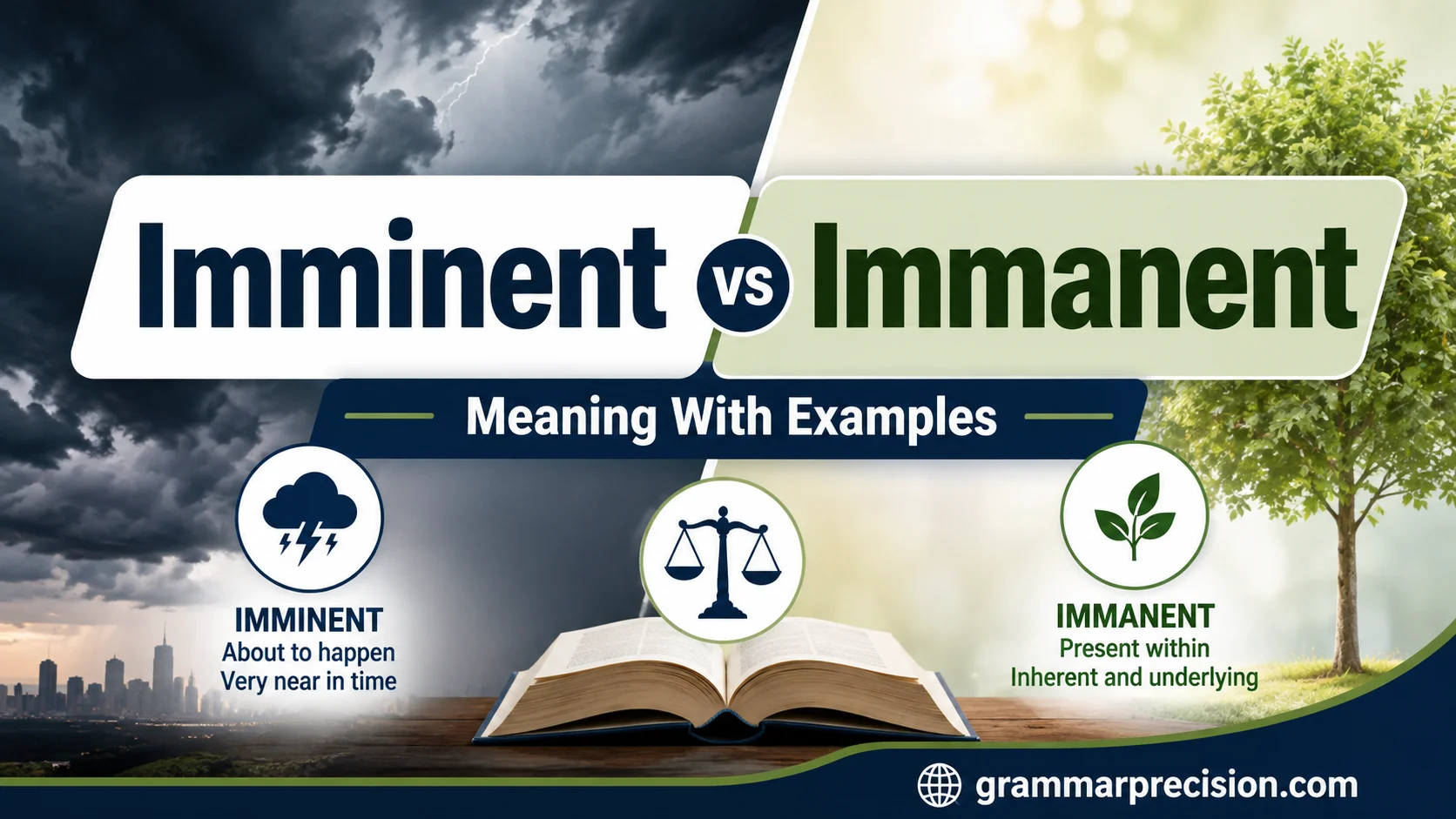
The distinction becomes much easier once you connect each word with its core idea. Imminent deals with time and approaching events. Immanent deals with presence, inner qualities, philosophy, and things existing within something.
This guide breaks down the difference between imminent and immanent, explains their pronunciation and origins, compares them with eminent, immediate, and impending, and gives you practical examples you can use confidently.
Imminent vs Immanent at a Glance
The quickest way to separate these words is simple:
Imminent = about to happen.
Immanent = existing within or inherent in something.
Here’s the difference at a glance:
| Word | Meaning | Main idea | Example |
| Imminent | About to happen very soon | Near in time | A storm is imminent. |
| Immanent | Existing within something | Internal or inherent | Creativity may be immanent in human nature. |
| Eminent | Distinguished or highly respected | Outstanding | She is an eminent scientist. |
Think of imminent as something moving toward you on a timeline. Think of immanent as something already situated within a thing.
That distinction solves most usage problems.
What Does “Imminent” Mean?
Imminent is an adjective that means ready to happen, about to occur, or very close in time. Merriam-Webster defines it as “ready to take place” or “happening soon.” The word often appears when an event feels close enough to demand attention.
For example:
- The train’s imminent arrival caused everyone to gather near the platform.
- Scientists warned that a major change was imminent.
- The company announced an imminent expansion.
- The patient’s delivery was imminent.
- Officials prepared for imminent flooding.
Notice something important: imminent doesn’t always mean something bad.
You can describe a welcome event as imminent:
The actor’s return to the stage is imminent.
However, English speakers often use the word for threatening or unpleasant situations because something approaching can create urgency. Common expressions include imminent danger, imminent death, imminent disaster, and imminent threat.
Imminent Means “Very Soon,” Not Simply “Possible”
This distinction matters.
If something is possible, it might happen. If something is imminent, it’s expected to happen very soon.
Compare these sentences:
- A power outage is possible.
- A power outage is imminent.
The first sentence expresses uncertainty. The second suggests that signs point toward an event that’s close at hand.
That’s why imminent often carries a sense of urgency.
Common Collocations With Imminent
Certain words naturally pair with imminent:
- imminent arrival
- imminent departure
- imminent change
- imminent decision
- imminent danger
- imminent threat
- imminent collapse
- imminent disaster
- imminent attack
- imminent death
- imminent release
- imminent launch
These combinations can help you recognize the word quickly when reading.
What Does “Immanent” Mean?
Immanent is also an adjective, but its meaning moves in a completely different direction.
Consider these examples:
- The artist believed beauty was immanent in nature.
- Some philosophers argue that morality is immanent in human consciousness.
- The theory examines forces immanent within society.
- The author explores the immanent qualities of the natural world.
Here, nothing is necessarily approaching.
Instead, the quality or force already exists within the subject.
That’s the key.
Immanent Has a Strong Philosophical Meaning
You’ll encounter immanent far more often in philosophical, theological, academic, and literary writing than in casual conversation.
In philosophy, immanent can describe something that exists or operates within the boundaries of experience or within a particular system. It’s often contrasted with transcendent, which refers to something beyond ordinary experience or outside the limits of a particular system.
For example:
The philosopher explored whether consciousness is immanent in the physical world.
The sentence isn’t saying consciousness is about to happen. It’s asking whether consciousness exists inherently within that world.
That’s a very different idea from:
A major scientific breakthrough is imminent.
The first sentence concerns internal existence. The second concerns near-future occurrence.
Immanent Can Mean “Inherent”
In less technical writing, you can often understand immanent as similar to inherent, intrinsic, or innate.
For example:
The capacity for cooperation may be immanent in human communities.
In simpler language, that means cooperation may naturally exist as part of those communities.
However, immanent has a more specialized flavor than inherent. If you’re writing a casual email, inherent will usually sound more natural. If you’re discussing philosophy or a complex theoretical idea, immanent may be exactly the right term.
Imminent vs Immanent: Key Differences
The spelling looks almost identical, but the meanings have very different centers of gravity.
| Feature | Imminent | Immanent |
| Part of speech | Adjective | Adjective |
| Core meaning | About to happen | Existing within |
| Main concept | Time | Internal presence |
| Common contexts | News, emergencies, events, everyday English | Philosophy, theology, academia, literature |
| Common synonyms | Impending, approaching, looming | Inherent, intrinsic, innate |
| Example | The deadline is imminent. | The quality is immanent in the work. |
| Opposite or contrast | Distant, remote | Transcendent, external |
| Pronunciation | /ˈɪmənənt/ | /ˈɪmənənt/ |
The simplest mental picture is a timeline versus an interior space.
If something is moving closer in time, choose imminent.
If something exists inside another thing as part of its nature, choose immanent.
Imminent vs Immanent Pronunciation
Here’s where the plot thickens: imminent and immanent are homophones in standard English pronunciation.
Both are commonly pronounced approximately:
ih-muh-nent
So you generally cannot rely on sound alone to distinguish them.
Context does the heavy lifting.
For example, if someone says:
“A storm is ___.”
You’ll likely choose imminent because a storm can approach in time.
But if someone says:
“The principle is ___ within the system.”
The correct choice is immanent because the principle exists within the system.
Why Their Pronunciation Causes Problems
English contains plenty of homophones and near-homophones. When you hear one word without seeing its spelling, your brain has to reconstruct the intended meaning from context.
That’s why writers sometimes use the wrong spelling even when they understand the intended idea.
The solution isn’t to memorize pronunciation alone. Memorize the meaning and context together.
The Best Memory Trick for Imminent vs Immanent
Try this simple association:
Imminent → immediate → happening soon
The first letters aren’t identical throughout the words, but both ideas point toward nearness in time.
For immanent, think:
Immanent → in → existing within
That gives you a useful conceptual shortcut.
A Visual Memory Trick
Imagine two pictures.
Imminent: A dark cloud hanging over a town. The storm is almost here.
Immanent: A seed containing the potential for a tree. The quality exists within it.
One is approaching.
The other is inside.
If you remember those two images, the spelling becomes much easier to retrieve.
Imminent vs Immanent vs Eminent
There’s a third word that often gets dragged into this spelling tangle: eminent.
Unlike imminent and immanent, eminent has a different meaning and a different initial vowel sound.
Eminent means distinguished, prominent, famous, or outstanding in quality or position. Merriam-Webster lists meanings such as standing above others in quality or position and being conspicuous.
Compare:
- An imminent storm is about to arrive.
- An immanent quality exists within something.
- An eminent scientist is highly respected.
Here’s an easy memory aid:
Eminent = exceptional.
Imminent = incoming.
Immanent = internal.
The words may look like linguistic triplets, but their meanings point in three directions.
A Three-Way Comparison
| Word | Easy meaning | Example |
| Imminent | Coming soon | The announcement is imminent. |
| Immanent | Existing within | The pattern is immanent in the system. |
| Eminent | Highly distinguished | She is an eminent researcher. |
This distinction becomes especially important in professional and academic writing. A spelling error can completely alter the meaning of a sentence.
Also Read This: Pistol vs Pistil: Meaning, Difference, Pronunciation & Examples
Imminent vs Immediate vs Impending
Imminent also gets confused with several words that describe something near in time.
Imminent vs Immediate
Immediate can mean occurring at once, requiring no delay, or directly next in sequence.
Imminent means something is expected to happen very soon.
Compare:
The manager needs an immediate response.
That means the response should happen now or without delay.
The manager’s decision is imminent.
That means the decision is expected very soon.
The distinction is subtle but useful:
Immediate = now or without delay.
Imminent = soon and approaching.
Imminent vs Impending
Impending is one of the closest synonyms of imminent. Both describe something approaching in time. Merriam-Webster lists impending and looming among synonyms of imminent.
However, impending often carries a stronger sense of something negative or troublesome.
For example:
The company faces an impending financial crisis.
The company faces an imminent financial crisis.
Both work. The second emphasizes that the event is very close. The first emphasizes that the event is approaching and potentially threatening.
How to Use “Imminent” in a Sentence
Because imminent describes approaching events, it normally modifies a noun related to something that can happen.
Here are useful examples:
- The baby’s arrival is imminent.
- The team expects an imminent announcement.
- Officials warned of imminent flooding.
- Her departure seemed imminent.
- The company denied rumors of an imminent closure.
- The deadline is imminent, so finish your work today.
- The signs suggested that a major shift was imminent.
- The hikers were rescued before the danger became imminent.
A useful pattern is:
[Event] + is/was/seems + imminent.
Another common pattern is:
imminent + [event noun]
For example, imminent change, imminent arrival, or imminent danger.
How to Use “Immanent” in a Sentence
Immanent works differently because it describes a quality, principle, force, or characteristic that exists within something.
Examples include:
- The philosopher considered reason immanent in human thought.
- The novel explores an immanent sense of belonging.
- The theory assumes that order is immanent in nature.
- The artist searched for beauty immanent in ordinary objects.
- The concept examines forces immanent within social structures.
- The author describes hope as immanent in human experience.
Because the word often deals with abstract concepts, context matters enormously.
If your sentence means “already present within,” immanent may fit.
If your sentence means “about to happen,” imminent is the better choice.
Immanent vs Transcendent
Readers who encounter immanent in philosophy or theology will often see another important term nearby: transcendent.
The two concepts form a useful contrast.
Immanent generally points toward something existing or operating within a particular reality, system, or sphere of experience.
Transcendent points beyond that boundary.
Think of a building.
Something immanent exists inside the building and functions within its structure.
Something transcendent, in the conceptual sense, reaches beyond the building’s boundaries.
This distinction can become sophisticated in philosophical and theological discussions. The exact meaning depends on the tradition and writer, so context should guide interpretation.
The Etymology Behind Imminent and Immanent
Their histories explain why the words look so similar.
Imminent comes through French from Latin imminēre, associated with the idea of overhanging, projecting, impending, or threatening. Merriam-Webster dates its first known English use to 1528.
That historical image of something hanging over you fits the modern meaning beautifully.
Imagine a cliff edge above you. It projects outward and feels dangerously near. The modern sense of something approaching or about to happen developed from that older imagery.
Immanent, by contrast, comes from Late Latin immanēre, meaning to remain in place. Its history connects with the idea of remaining or staying within. Merriam-Webster gives its first known use as 1535.
That creates a surprisingly useful conceptual contrast:
- Imminent: something approaches from the horizon.
- Immanent: something remains within.
The spellings are similar because of their historical forms. Their meanings, however, developed along different paths.
Common Mistakes With Imminent and Immanent
The most common error happens when writers use immanent to mean “about to happen.”
Incorrect:
The company expects an immanent announcement tomorrow.
Correct:
The company expects an imminent announcement tomorrow.
Why? The announcement is approaching in time.
Another common mistake reverses the problem.
Incorrect:
The principle is imminent within the theory.
Better:
The principle is immanent within the theory.
Here, the principle exists as part of the theory rather than approaching in time.
Quick Correction Guide
| If you mean… | Use… |
| About to happen | Imminent |
| Coming very soon | Imminent |
| Existing naturally within something | Immanent |
| Inherent or intrinsic | Immanent |
| Highly respected or distinguished | Eminent |
| Happening without delay | Immediate |
| Approaching, especially a problem | Impending |
Imminent vs Immanent in Real-World Writing
Context makes these words much easier to understand.
News Writing
Journalists frequently use imminent for events that appear close:
Officials warned that an evacuation could become imminent.
The word creates urgency because readers understand that time is running short.
Business Writing
Business writers might say:
The company expects an imminent product launch.
That means the launch should occur soon.
They could also write:
The strategy contains an immanent tension between growth and cost control.
That second sentence is much more abstract. It describes a tension existing within the strategy itself.
Academic Writing
Academic and philosophical writing provides fertile ground for immanent:
The researcher argues that social change contains forces immanent within the structure of the institution.
Here, immanent identifies something internal to the system being studied.
Everyday Conversation
Imminent is much more common in everyday English.
You might naturally say:
“Our guests’ arrival is imminent.”
You probably wouldn’t casually say:
“Friendship is immanent in human experience.”
That second sentence isn’t wrong. It simply belongs to a more formal or abstract register.
A Practical Case Study: One Letter, Two Meanings
Imagine a weather reporter preparing a morning update.
The forecast shows a powerful storm approaching rapidly.
The reporter writes:
A major storm is imminent.
Perfect. The storm is expected very soon.
Now imagine a philosopher writing about human responses to nature.
The philosopher writes:
A sense of awe is immanent in the human experience of nature.
Again, the word fits.
The first sentence describes an approaching event.
The second describes an internal quality or presence.
Same basic spelling pattern. Completely different conceptual territory.
That’s why replacing one word with the other isn’t a harmless spelling slip. It changes the sentence’s meaning.
Imminent vs Immanent Quiz
Choose the correct word in each sentence.
- The company says a major announcement is ______.
- The philosopher argued that meaning is ______ within experience.
- The scientist is an ______ authority in her field.
- Officials warned that severe flooding was ______.
- The theory examines values ______ in the culture.
- The patient’s arrival at the hospital was ______.
- She is an ______ scholar of medieval history.
- The author describes compassion as ______ in human nature.
Answers
- imminent
- immanent
- eminent
- imminent
- immanent
- imminent
- eminent
- immanent
The trick is to ignore the spelling for a moment and identify the meaning first.
Ask:
Is something coming soon? Choose imminent.
Does something exist within something else? Choose immanent.
Is someone or something distinguished? Choose eminent.
That three-question test can save you from most mistakes.
FAQs:
What is the difference between imminent and immanent?
Imminent means something is about to happen or is expected very soon. Immanent means something exists within another thing or forms part of its essential nature.
Are imminent and immanent pronounced the same?
Yes. In standard English, imminent and immanent are generally pronounced the same. Their meanings and spellings distinguish them in writing.
Does imminent mean immediate?
Not exactly. Imminent means something is approaching and likely to happen soon. Immediate usually means something happens at once or requires no delay.
How can I remember immanent?
Think of “in” when you see immanent. The word describes something that exists within or naturally belongs to something else.
What does eminent mean?
Eminent means distinguished, prominent, or highly respected. For example, an eminent scientist is someone recognized for exceptional knowledge or achievement.
Conclusion:
Understanding imminent vs immanent becomes easy once you focus on meaning. Imminent describes something approaching soon, while immanent describes something existing within. Remember the simple distinction: imminent is incoming, immanent is internal, and eminent is exceptional. This quick mental shortcut can help you choose the right word with confidence.