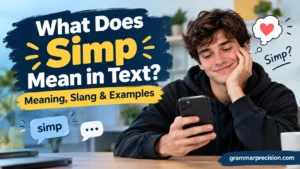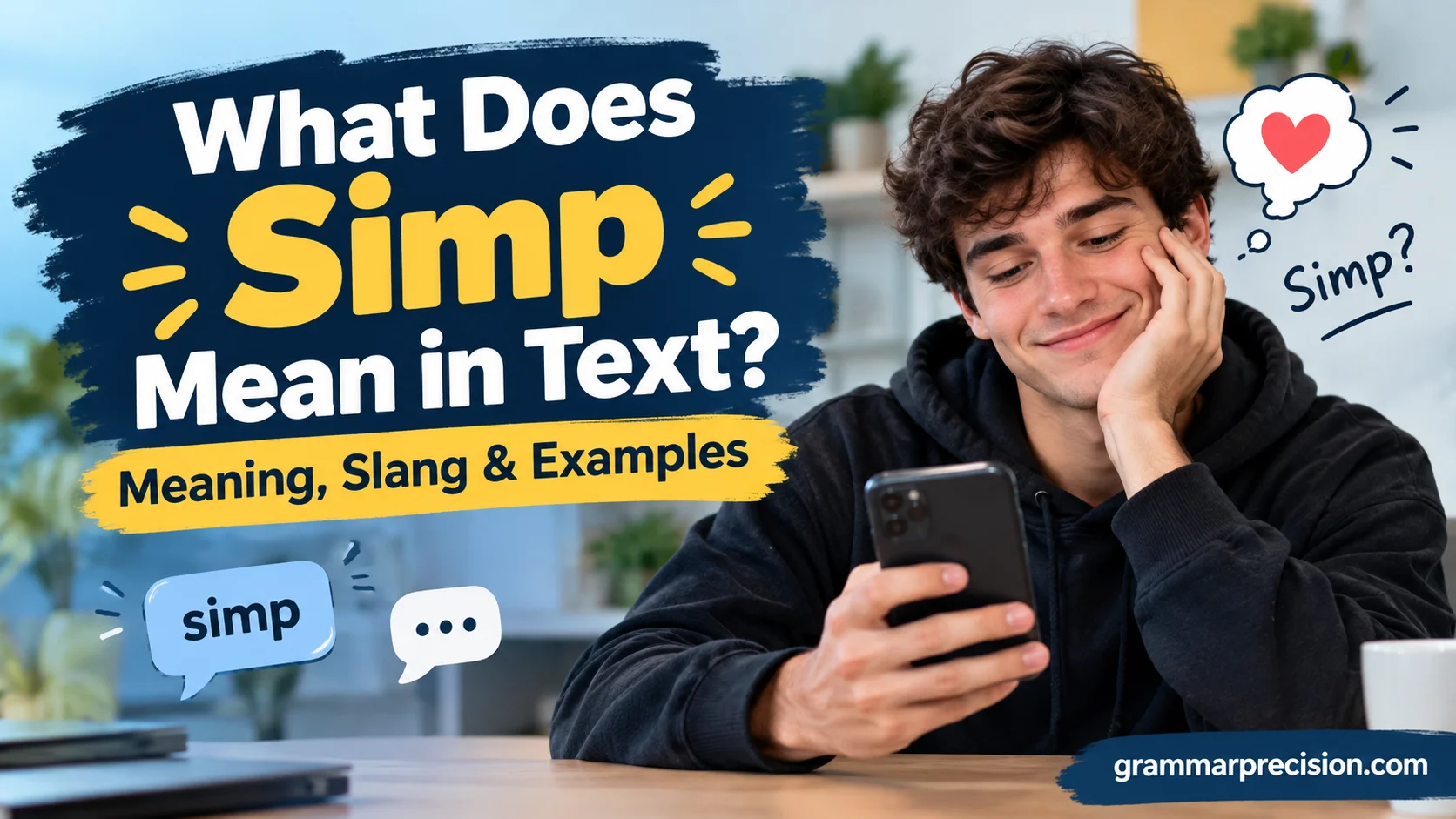
What does simp really mean when someone uses it in a text or social media conversation? The term has become common in online communication, but its meaning can shift with context, tone, and intent. In this guide, we’ll explain What Does Simp Mean in Text, where the slang comes from, and how people use it naturally. You’ll also see clear examples that make its English usage, grammar, and everyday meaning easier to understand.
Understanding internet slang can improve digital communication, just as consistency matters in formal writing and professional settings. Although terms like simp rarely appear in business communication, meetings, scheduling, online booking, broadcasting, calendar planning, time management, and project management often require more precise language. We’ll also consider US and UK usage, along with common style-guide preferences, so you can distinguish casual texting from formal writing and use the term appropriately.
What Does Simp Mean in Text?
In texting, simp usually means a person who gives someone they like too much attention, effort, praise, or loyalty, especially when that attention doesn’t seem equally returned.
For example, imagine someone constantly texting their crush, defending everything they do, buying expensive gifts, and rearranging their schedule around them. A friend might jokingly text:
“Dude, you’re simping hard.”
The word doesn’t necessarily mean the person has done something terrible. Often, friends use it as playful teasing. Context matters enormously.
Simple Definition of Simp
A simp is commonly described as someone who shows excessive devotion toward another person, especially a romantic interest.
The term often suggests that someone is:
- Trying too hard to impress a crush
- Giving excessive attention
- Putting another person on a pedestal
- Seeking affection or approval
- Doing favors without receiving similar effort
- Ignoring their own boundaries
- Acting overly submissive toward someone they like
Still, being kind doesn’t automatically make someone a simp. Buying your partner dinner, supporting a friend, or showing affection can simply be normal human behavior.
Simp Meaning in a Text Message
The exact meaning depends on the sentence.
| Text | Likely Meaning |
| “You’re such a simp.” | You’re overly devoted to someone you like. |
| “Stop simping for her.” | Stop giving her excessive attention. |
| “I’m simping over this actor.” | I really admire or adore this actor. |
| “He’s simping hard.” | He’s acting extremely devoted or attracted. |
| “I might be a simp.” | I’m jokingly admitting strong admiration. |
Notice the difference. “You’re a simp” can sound critical, while “I’m simping over this character” often sounds playful.
Is Simp an Insult or a Joke?
It can be either.
When someone uses simp seriously, they may be accusing another person of lacking self-respect or becoming excessively submissive. When friends use it casually, however, the word may simply mean, “You’re obviously crushing on them.”
That distinction makes tone important.
A laughing emoji, exaggerated wording, or playful conversation can soften the term. A hostile argument can make the same word much more insulting.
What Does Simp Mean in Slang?
Modern slang uses simp in several related ways. The central idea remains excessive admiration or devotion.
People may use it as a noun:
“He’s a simp.”
They may use it as a verb:
“He’s simping for her.”
They can also use related forms such as simping, simpy, or simp behavior.
Dictionary.com defines the slang verb as behaving excessively attentively or submissively toward someone, particularly someone viewed as a sexual or romantic interest.
Simp as a Noun
As a noun, simp identifies a person.
Example:
“Mark became a total simp after meeting his girlfriend.”
The speaker isn’t necessarily describing Mark’s entire personality. They’re commenting on behavior they consider overly devoted.
Simp as a Verb
The verb to simp means to behave in that supposedly excessive way.
Example:
“He’s simping for his favorite streamer.”
This construction has become especially common online.
Simp as an Adjective
You may also encounter simpy, meaning something resembles the behavior associated with a simp.
For instance:
“That was a pretty simpy comment.”
Dictionary.com lists simpy as an adjective meaning “of or like a simp.”
Where Did the Word Simp Come From?
The history of simp is more complicated than many internet posts suggest.
One documented meaning comes from simpleton, an older word for a foolish or gullible person. Etymological sources date simp as a shortening of simpleton to the early 1900s.
However, the modern romantic sense developed separately through slang and popular culture.
Dictionary.com reports that the relationship-related slang appeared in hip-hop culture during the 1980s and 1990s. It later spread through online communities before becoming mainstream social-media slang.
From Older Slang to Internet Culture
The important point is simple: TikTok didn’t invent the word.
Social media helped turn it into a mainstream expression.
By the late 2010s and early 2020s, simp appeared frequently across platforms such as TikTok, Twitch, YouTube, and other online communities. The viral “Simp Nation” trend helped push the term into everyday internet vocabulary.
A Note About the Popular Acronym Claim
You may have seen claims that SIMP stands for a vulgar phrase such as “Suckers Idolizing Mediocre…” followed by an offensive term.
That explanation is widely circulated online, but it isn’t the documented linguistic origin of the word. It functions as a backronym: an existing word gets a phrase invented afterward to match its letters.
In other words, don’t treat that popular expansion as the official full form of simp.
How “Simp” Became Internet Slang
Internet culture gave simp a much bigger stage.
During the late 2010s and especially around 2019–2020, users began applying the term to dating, fandoms, gaming, livestreaming, and social media. Dictionary.com specifically identifies the late-2019 and early-2020 Simp Nation trend as a major driver of its popularity.
The word then became flexible.
Someone could “simp” for a romantic partner. Another person could “simp” for a celebrity. A gamer might “simp” for a fictional character.
That flexibility helped the term survive beyond one particular meme.
What Does “Simping” Mean?
Simping refers to the behavior of acting like a simp.
It can involve excessive attention, admiration, gifts, praise, or emotional investment. The person receiving that attention may not return the same level of interest.
Consider these examples:
- “He’s simping for his crush.”
- “She keeps simping over that actor.”
- “Everyone knows you’re simping in the comments.”
- “I’m not simping. I just like her music.”
The last example shows how humor often shapes modern usage.
What Does “Simping for Someone” Mean?
When someone says they are simping for someone, they usually mean they’re extremely attracted to or impressed by that person.
It doesn’t always imply serious desperation.
For example:
“I’m simping for that new singer.”
This could simply mean:
“I really like this singer.”
That’s why modern simp usage can feel lighter than its older, more insulting sense.
Simp Meaning on Social Media
Social media helped transform simp from relatively niche slang into a widely recognizable internet term.
Simp Meaning on TikTok
TikTok played a major role in popularizing the modern term. The Simp Nation trend became prominent around late 2019 and early 2020. Users joked about behaviors they considered stereotypically “simpish.”
TikTok also encouraged a more ironic form of usage.
People could label themselves simps while openly admitting their admiration. That self-aware humor softened the word in some communities.
Simp Meaning on Instagram
On Instagram, the term often appears in comments.
For example:
“Bro liked every post. Certified simp.”
Here, the commenter is usually joking about someone showing obvious interest.
Another example might be:
“I’m simping over this outfit.”
That version simply expresses strong admiration.
Simp Meaning on Gaming and Streaming Platforms
Gaming and livestreaming communities also helped spread the term.
A viewer might repeatedly donate money, praise a streamer excessively, or defend them during every disagreement. Other viewers may call that person a simp.
However, the label can become unfair when people use it for ordinary support or respectful interaction.
Simp Meaning in Dating and Relationships
Dating provides the clearest context for the traditional modern meaning.
Suppose someone constantly cancels their own plans to satisfy a crush. They always pay, always apologize, and keep giving attention despite receiving little effort in return.
Friends might call that behavior simping.
But healthy affection is different.
Healthy Interest vs. Simping
There’s nothing wrong with caring about someone.
A healthy relationship usually includes:
- Mutual effort
- Respect
- Emotional support
- Honest communication
- Reasonable boundaries
- Shared decision-making
- Reciprocal affection
The problem appears when one person repeatedly sacrifices their dignity, needs, money, time, or boundaries simply to receive attention.
That distinction matters because internet slang can flatten complicated relationships into one funny label.
When Attraction Gets Labeled as Simping
People sometimes call someone a simp simply because they show affection.
That’s not always accurate.
Imagine someone brings flowers to their partner on an anniversary. Calling that person a simp misses the context. It’s a normal expression of affection.
Now imagine someone spends their rent money buying gifts for a person who barely responds to them. The label makes more sense.
The difference is often excess, imbalance, and motivation.
Simp Examples in Text Messages
Seeing the word in realistic conversations makes its meaning easier to understand.
Example: Friendly Teasing
Alex: “I ordered her favorite coffee again.”
Jake: “Bro, you’re such a simp.”
Here, simp probably functions as playful teasing.
Example: Excessive Attention
Mia: “He sends her good-morning texts every single day.”
Lena: “He’s seriously simping.”
The speaker suggests that his attention has become excessive.
Example: Celebrity Admiration
Chris: “That actress is incredible.”
Sam: “You’re simping again.”
Here, the word may simply mean intense admiration.
Example: Self-Deprecating Humor
Jordan: “I bought her flowers because she had a rough week.”
Taylor: “Okay, I’m officially a simp.”
The speaker is joking about their own romantic behavior.
Is Simp a Bad Word?
Simp is usually informal and can be derogatory, especially when directed at another person.
Oxford’s learner dictionary labels the term as informal and offensive in American English when used in its insulting sense.
However, context can soften it considerably.
| Situation | Likely Tone |
| Close friends joking | Playful |
| Online argument | Insulting |
| Self-description | Often humorous |
| Romantic conversation | Context-dependent |
| Celebrity fandom | Usually playful |
| Workplace communication | Inappropriate |
Avoid using simp in formal writing or professional communication. It belongs to casual language.
Simp vs. Similar Slang Terms
Several internet expressions overlap with simp, but they aren’t identical.
| Term | Meaning | Main Difference |
| Simp | Excessive devotion or attention | Often involves romantic interest |
| Stan | Extremely devoted fan | Usually focuses on fandom |
| Thirsty | Eager for attention or attraction | Emphasizes desire |
| White knight | Excessive defense of someone | Focuses on defending another person |
| Fanboy/Fangirl | Very enthusiastic supporter | Doesn’t necessarily imply desperation |
For example, someone can stan a musician without being a simp. They may collect albums, attend concerts, and follow every release without directing excessive personal attention toward the artist.
Is Simping the Same as Having a Crush?
Not exactly.
A crush describes romantic or physical attraction. Simping describes behavior associated with excessive devotion or attention.
You can have a crush without acting like a simp.
For example, you might quietly like someone while maintaining healthy boundaries. That’s simply attraction.
Simping usually implies that your behavior has become noticeably excessive.
What Does Simp Mean From a Girl?
When a girl calls someone a simp, she may mean the same thing as anyone else: the person appears overly devoted to someone they like.
For example:
“You changed your whole schedule for her? You’re a simp.”
The phrase doesn’t have a completely separate dictionary meaning based on who says it.
However, tone remains important. A close friend might tease you affectionately. A stranger might be criticizing you.
What Does Simp Mean From a Guy?
When a guy calls another guy a simp, the phrase often works as friendly teasing or criticism.
For example:
“You drove two hours just to bring her ice cream? Simp behavior.”
The speaker is pointing to an unusually high level of effort.
Still, modern usage has become broader. People may now jokingly call themselves simps when they admire celebrities, fictional characters, athletes, or creators.
How to Tell If Someone Is Calling You a Simp
Look beyond the word itself.
Consider these clues:
- Who said it?
- What were you doing?
- Was the conversation serious or playful?
- Did they use laughing emojis?
- Were they criticizing your behavior?
- Did other people join the joke?
For instance, “LOL you’re such a simp 😂” usually sounds lighter than “You’re pathetic. Stop simping.”
Same word. Completely different social temperature.
How to Respond When Someone Calls You a Simp
You don’t need to become defensive.
If a friend is joking, a confident response can keep the conversation fun.
Funny Responses
- “At least I’m committed.”
- “Better a simp than boring.”
- “I accept my membership.”
- “Someone had to support the cause.”
- “I’m simply appreciating greatness.”
Confident Responses
- “Being kind isn’t a weakness.”
- “I know what I like.”
- “I’m comfortable showing appreciation.”
- “There’s a difference between caring and losing yourself.”
The best response depends on the situation. Sometimes ignoring the comment works even better.
Is Being a Simp Always Bad?
Not necessarily.
The modern word often exaggerates behavior for comic effect. Someone can jokingly call themselves a simp without actually behaving in an unhealthy way.
The real warning sign isn’t affection. It’s imbalance.
If you’re constantly giving while receiving nothing, ignoring your own needs, or chasing someone who clearly isn’t interested, stepping back makes sense.
Healthy affection shouldn’t require you to abandon your self-respect.
FAQs:
What does simp mean in text?
Simp usually means someone who appears excessively devoted or attentive to a person they like. In casual texting, friends may use it as playful teasing rather than a serious insult.
What does simping mean?
Simping means behaving in an overly devoted or admiring way toward someone. Modern internet users can also use it humorously for intense admiration of celebrities, fictional characters, or creators.
Is simp an acronym?
No. The popular acronym explanations circulating online aren’t considered the documented origin. The word has older linguistic and slang histories, including its relationship with simpleton.
Is being nice the same as being a simp?
No. Kindness, generosity, affection, and respect don’t automatically equal simping. The term usually implies excessive or unbalanced behavior.
Is simp a bad word?
It can be. The term often carries a mocking or derogatory tone, although people frequently use it jokingly or self-referentially online. Context determines how harsh it sounds.
Conclusion:
Understanding What Does Simp Mean in Text helps you recognize its slang meaning, tone, and context, making online conversations easier to interpret and understand accurately.
Whether used jokingly or critically, simp depends heavily on context and intent. Knowing its modern usage helps you communicate clearly while keeping casual texting separate from formal English, professional writing, and workplace communication.