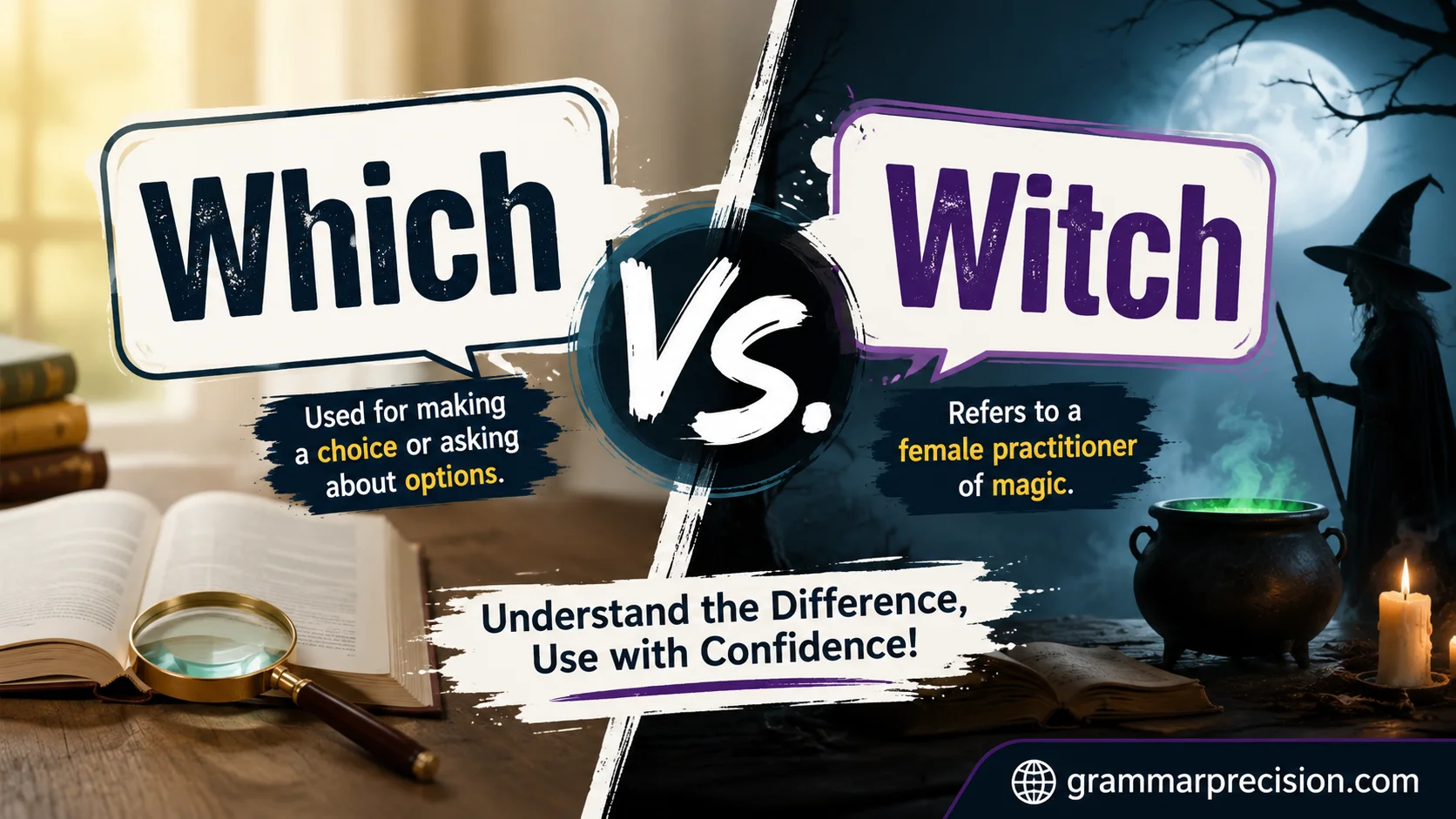
Which vs. Witch explains the difference between two homophones with distinct meanings that often confuse learners in English writing and speech because they sound identical but have completely different uses.
The word witch refers to a person, traditionally a woman, believed to possess magical and supernatural powers while which is a pronoun used to introduce a clause or phrase by specifying one or more things from a particular set. Understanding this difference is crucial for clear communication because these homophones have separate meanings and roles.
Many learners mix these words up because their pronunciation is the same way even though their uses are totally different. Choosing the wrong spelling can change the whole meaning of a sentence in emails, essays, social media posts, or text messages. Learning their common usage patterns and grammatical roles makes the distinction easy to remember.
Which vs. Witch: Quick Difference at a Glance
The easiest way to understand which vs. witch is to look at what each word means and how it functions in a sentence.
| Word | Meaning | Part of Speech | Example |
| Which | Used to ask about choices or add information about something | Pronoun, determiner | Which dress do you like? |
| Witch | A person believed to practice magic or use supernatural powers | Noun | The witch appeared in the old story. |
The key difference is simple:
- Which = choosing, asking, or describing something
- Witch = a magical person or character
A useful memory trick is:
Which helps you pick. Witch belongs to magic.
Are Which and Witch the Same Word?
No. Which and witch are not the same word. They are homophones, meaning they sound alike but have different spellings and meanings.
English contains many homophones because its spelling system developed from several languages, including Latin, French, Germanic languages, and Old English. Over time, some words kept similar sounds even though their meanings moved in completely different directions.
Other common homophones include:
- Their / There / They’re
- Two / Too / To
- Right / Write
- Sea / See
- Flower / Flour
Just like these examples, which vs. witch shows why spelling matters. A single letter can completely change the meaning of your sentence.
For example:
- Which book should I read?
→ You are asking someone to choose. - The witch read an ancient book.
→ You are talking about a magical character.
The pronunciation stays similar, but the message changes entirely.
What Does Which Mean?
Which is a common English word used when you want to identify, choose, or describe something. It can work as a pronoun, determiner, or part of a relative clause.
The meaning depends on how you use it in a sentence.
Which as a Question Word
The most common use of which is asking someone to choose between options.
You normally use it when the number of choices is limited or known.
Examples:
- Which movie do you want to watch tonight?
- Which shirt should I wear to the interview?
- Which road leads to the airport?
In each sentence, the speaker expects a choice from available options.
Compare these:
- What movie do you want to watch?
- Which movie do you want to watch?
The difference is subtle:
- What often asks for general information.
- Which usually suggests specific options.
Example:
Imagine you have ten movies available.
You might ask:
“Which movie should we watch?”
because the choices already exist.
Which as a Determiner
A determiner comes before a noun and provides more information about it.
In this use, which appears directly before the thing being discussed.
Examples:
- Which phone belongs to you?
- Which restaurant serves the best pizza?
- Which answer is correct?
Here, which identifies a particular item from a group.
The structure is:
Which + noun
Examples:
- Which book
- Which person
- Which option
- Which idea
Which as a Relative Pronoun
Another important use of which is connecting extra information about a noun.
Examples:
- My laptop, which I bought last year, still works perfectly.
- The house, which has a large garden, belongs to my uncle.
In these sentences, which introduces additional details.
A helpful rule:
Use which when the information is not necessary to identify the noun.
Example:
My car, which is blue, needs repairs.
The listener already knows which car you mean. The color is extra information.
What Does Witch Mean?
A witch is a person who is traditionally believed to practice magic or use supernatural powers.
The word has a long history and appears in folklore, mythology, literature, and modern entertainment.
Examples:
- The witch lived alone in the forest.
- The children dressed as witches for Halloween.
- The story features a powerful witch with magical abilities.
Unlike which, the word witch is always a noun.
You cannot use it to ask a question or connect ideas.
The Historical Meaning of Witch
Throughout history, different cultures have viewed witches in different ways.
In many traditional stories, witches were described as people who could:
- Cast spells.
- Create magical potions.
- Communicate with supernatural forces.
- Predict the future.
Some societies feared witches, while others viewed magical practitioners as healers or wise individuals.
The meaning changed over centuries, especially through literature and popular culture.
The Modern Meaning of Witch
Today, the word witch often appears in fictional stories, movies, games, and books.
Modern examples include:
- Fantasy characters with magical powers.
- Halloween costumes.
- Folklore-inspired stories.
- Fictional heroes and villains.
The word does not always have a negative meaning anymore. Many modern stories portray witches as complex characters with unique abilities and personalities.
Which vs. Witch: Detailed Comparison
| Feature | Which | Witch |
| Meaning | Used for choices or descriptions | A person connected with magic |
| Pronunciation | Usually the same | Usually the same |
| Word type | Pronoun or determiner | Noun |
| Used for | Questions and information | People or characters |
| Example | Which color do you prefer? | The witch flew away. |
The biggest clue is context.
Ask yourself:
Am I choosing something?
If yes, you probably need which.
Am I talking about magic or a magical person?
If yes, you need witch.
Also Read This: Preventive vs. Preventative: The Complete Grammar Guide
Common Mistakes With Which and Witch
Many writers confuse these words because their pronunciation does not provide a clear clue. Here are some common mistakes and corrections.
| Incorrect Sentence | Correct Sentence | Explanation |
| Witch dress should I buy? | Which dress should I buy? | Asking about a choice |
| The which cast a spell. | The witch cast a spell. | Talking about magic |
| I don’t know witch one is better. | I don’t know which one is better. | Choosing between options |
| The story was about a powerful which. | The story was about a powerful witch. | Referring to a magical person |
These errors are easy to make, especially when writing quickly.
A simple proofreading habit can help:
Before submitting your writing, check whether the word refers to a choice or magic.
Easy Tricks to Remember Which vs. Witch
Memorizing grammar rules can feel difficult, but small tricks make learning easier.
Memory Trick 1: Which Means Choice
Think:
Which one will you pick?
Both “which” and “pick” connect with choosing.
Examples:
- Which color?
- Which option?
- Which answer?
Memory Trick 2: Witch Has Magic
Think about classic images of witches:
- Pointed hats.
- Magic wands.
- Spells.
- Potions.
The word witch belongs in the world of magic.
Memory Trick 3: Look at the First Letter
A fun reminder:
Witch = W for Wizard-like magic
Which = choice between things
This isn’t a grammar rule, but it can help you remember the difference quickly.
Which vs. Witch in Everyday Examples
Seeing these words in real situations makes the difference easier to understand.
At a Restaurant
Correct:
Which meal should I order?
You are choosing food.
Incorrect:
Witch meal should I order?
This suggests a magical meal.
In a Story
Correct:
The witch entered the dark castle.
You are describing a magical character.
Incorrect:
The which entered the dark castle.
The sentence loses meaning.
At School
Correct:
Which answer is correct?
You are selecting an answer.
Correct:
The book describes a witch from ancient legends.
You are discussing folklore.
Which vs. Witch Compared With Other Homophones
Understanding one homophone pair can make other confusing words easier.
| Word Pair | Difference |
| Which / Witch | Choice vs. magical person |
| Their / There | Possession vs. location |
| Two / Too | Number vs. also |
| Right / Write | Correct vs. create words |
| Hear / Here | Listening vs. location |
English spelling can feel tricky, but patterns become easier when you learn words in groups.
Practice Quiz: Which or Witch?
Test your knowledge.
1. ___ movie should we watch tonight?
Answer: Which
You are choosing a movie.
2. The old story included a powerful ___.
Answer: Witch
The sentence describes a magical person.
3. I cannot decide ___ shoes to buy.
Answer: Which
You are selecting from options.
4. The children dressed like a ___ for Halloween.
Answer: Witch
The sentence refers to a character.
5. Do you know ___ restaurant is open late?
Answer: Which
You are asking for information about a choice.
FAQs:
What is the main difference between which and witch?
Which is a pronoun used to identify or specify one or more things from a group, while witch refers to a person, traditionally a woman, who is believed to have magical powers. Although both words have the same pronunciation, their meanings and uses are completely different.
Are which and witch homophones?
Yes, which and witch are homophones because they sound exactly the same when spoken. However, they have different spellings, meanings, and grammatical roles. Homophones like these can create confusion in writing because the correct choice depends on the context of the sentence.
How can I remember the difference between which and witch?
You can remember that witch is connected with a woman who has supernatural powers, while which is used for making choices or adding information about things or people. Paying attention to the meaning of the sentence will help you choose the correct word.
Can using witch instead of which change a sentence’s meaning?
Yes, using the wrong word can completely change the meaning of a sentence. For example, asking “Which book do you prefer?” asks about a choice, but using “witch” would refer to a magical person instead of a selection.
Why do people confuse which and witch?
People often confuse which and witch because they have the same sound and pronunciation. Learners may accidentally choose the wrong spelling when writing emails, essays, or messages. Understanding their definitions, grammatical roles, and common usage patterns helps avoid mistakes.
Conclusion:
Understanding which vs. witch helps you improve your English writing and avoid common mistakes. While both words have the same pronunciation, their meanings are completely different. A witch describes a person with magical abilities, whereas which helps identify choices or information. Learning this simple difference makes your communication clearer and more accurate.