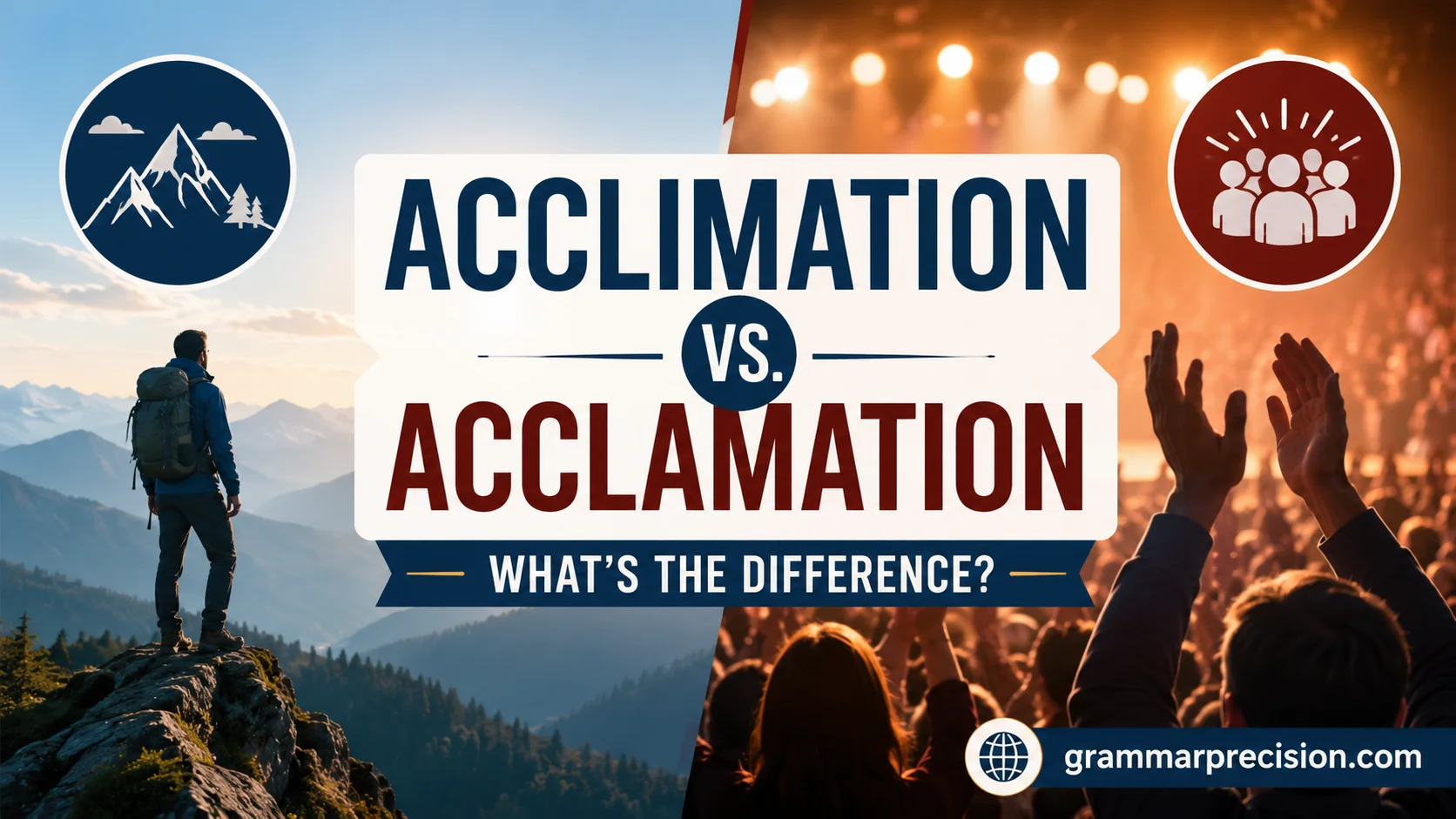
Acclimation vs. acclamation can confuse even experienced writers because these words look and sound remarkably similar. However, their meanings are completely different, and knowing that difference helps you choose correctly.
Acclimation describes the process of adjusting to new conditions, such as heat, altitude, climate, or surroundings. For example, athletes may need time for heat acclimation before competing in extreme temperatures. The word focuses on adaptation, not praise or recognition.
Acclamation, on the other hand, refers to enthusiastic approval, praise, or recognition. When an athlete wins a major competition and receives loud cheers from the crowd, that response can be called acclamation. Understanding this simple distinction makes these commonly confused words much easier to use correctly.
Acclimation vs. Acclamation at a Glance
| Word | Part of Speech | Main Meaning | Think Of | Example |
| Acclimation | Noun | Adjustment to new conditions | Adapting | The athlete needed time for heat acclimation. |
| Acclamation | Noun | Enthusiastic praise or approval | Applause | The scientist received widespread acclamation. |
Both words contain similar letters and share a very similar sound. In fact, in common American pronunciation, they can be homophones, meaning they may sound alike even though their meanings differ. That makes context especially important.
Acclimation generally concerns a person, animal, organism, or sometimes a system becoming accustomed to changed conditions. Acclamation, meanwhile, concerns the reaction of people who express approval, praise, welcome, or assent.
Here’s the quickest test:
- Getting used to something? Choose acclimation.
- Getting praised or approved? Choose acclamation.
That simple fork in the road can prevent most mistakes.
What Does Acclimation Mean?
Acclimation means the process or result of becoming accustomed to new environmental conditions or circumstances.
It commonly appears when something has to adjust to a change in temperature, altitude, climate, surroundings, workload, or another environmental factor. Merriam-Webster defines it as the process or result of acclimating and notes its use for physiological adjustment to environmental change.
Imagine someone from a cool coastal city traveling to a very hot region. During the first few days, the heat may feel exhausting. Over time, the body can adjust to repeated heat exposure. That adjustment is a form of acclimation.
The word also appears outside strictly biological contexts. You might talk about acclimation to a new workplace, a new routine, or a new technological system when the emphasis is on gradually becoming accustomed to unfamiliar conditions.
Acclimation in Science and Biology
In scientific writing, acclimation has a more precise meaning.
IUPAC describes acclimation as physiological or behavioral adjustment of an organism to its environment or circumstances. It gives examples such as thermoregulation and psychological adjustment.
This distinction becomes especially useful in experimental biology. Scientists may expose an organism to a changed environmental condition and allow time for it to adjust before collecting observations.
For example:
Researchers allowed the fish several days of acclimation before beginning the experiment.
Here, acclimation refers to the adjustment period.
A related term, acclimatization, can overlap with acclimation. In some scientific contexts, researchers distinguish the two based on whether the environmental changes occur under controlled conditions or in the natural environment. IUPAC notes this distinction, although everyday usage often treats the terms as synonyms.
Acclimation Examples
Here are several natural examples:
- The hikers needed time for acclimation to the high altitude.
- The horse underwent gradual acclimation to the colder climate.
- Heat acclimation can help athletes adjust to exercising in hot conditions.
- The fish showed poor acclimation to the sudden temperature change.
- After several weeks of acclimation, the new environment felt familiar.
- The climber planned several rest days for proper acclimation.
Notice the common thread. Each sentence involves adjustment.
What Does Acclamation Mean?
Acclamation means enthusiastic approval, praise, welcome, or recognition.
It’s usually a formal word, and it often appears when a crowd, audience, organization, or community expresses strong approval. Cambridge defines it as public approval and praise, while Merriam-Webster describes it as a loud, eager expression of approval, praise, or assent.
Picture an actor stepping onto a stage after a remarkable performance. The audience rises, applauds, cheers, and celebrates the achievement. That enthusiastic response can be described as acclamation.
The word can also describe strong public or professional recognition.
For example:
The author’s latest novel received international acclamation.
The sentence says that people widely praised the author’s work. It has nothing to do with physical adaptation.
Another Meaning of Acclamation
There’s another useful meaning that often catches readers off guard.
Acclamation can refer to a decision or election made through spoken approval rather than a formal written ballot. The phrase “by acclamation” is especially common in formal organizational, political, and institutional settings. Oxford defines this specialist use as electing someone through a spoken rather than written vote.
For example:
The committee elected Maria chair by acclamation.
This means the group approved her selection without conducting a conventional written vote.
So acclamation can involve more than applause. At its heart, however, the idea remains collective approval.
Acclamation Examples
- The singer received acclamation after her final performance.
- The scientist earned widespread acclamation for the discovery.
- Her speech was met with enthusiastic acclamation.
- The team’s championship victory brought national acclamation.
- The proposal passed by acclamation.
- The young artist received critical acclamation for her debut exhibition.
- The audience greeted the performers with loud acclamation.
Again, look for the common idea: approval, praise, or assent.
Acclimation vs. Acclamation: What’s the Difference?
The difference becomes crystal clear when you compare what each word describes.
Acclimation describes an adjustment. Acclamation describes a reaction of approval.
That means the two words usually have completely different subjects and contexts.
| Feature | Acclimation | Acclamation |
| Core idea | Adjustment | Approval |
| Typical context | Environment or circumstances | Praise or recognition |
| Common association | Climate and adaptation | Applause and acclaim |
| Usually involves | A person, animal, organism, or system adjusting | People expressing approval |
| Example | Acclimation to high altitude | Acclamation for a performance |
| Related verb | Acclimate | Acclaim |
Consider these two sentences:
The athlete needed acclimation before competing in the heat.
The athlete received acclamation after winning the race.
The athlete experiences acclimation before the competition. The athlete receives acclamation after the achievement.
That contrast is the entire story in miniature.
Acclimation vs. Acclamation Pronunciation
Here’s where the confusion gets particularly sneaky.
Both words can be pronounced essentially the same in American English:
Acclimation: /ˌæk.ləˈmeɪ.ʃən/
Acclamation: /ˌæk.ləˈmeɪ.ʃən/
Dictionary sources list the same or effectively identical American pronunciation for the two words.
That means you can’t always rely on sound alone to determine which word someone means.
Context has to do the heavy lifting.
If someone says:
“The team received tremendous ___ after the victory.”
The likely answer is acclamation, because a victory can earn praise.
If someone says:
“The team needed several days of ___ before playing in the extreme heat.”
The answer is acclimation, because the players need to adjust to the conditions.
When two words sound alike, spelling and context become your safety net.
Acclimation vs. Acclamation: The Easiest Memory Trick
Here’s a mnemonic worth keeping:
Acclimation → Acclimate → Adjust
The verb acclimate means to become accustomed to new conditions.
So when you see acclimation, think:
Acclimate → Adjustment → Acclimation
You can also connect the word to climate. Although this isn’t a strict etymological rule, it provides a useful memory hook because acclimation frequently involves environmental conditions.
Acclamation → Acclaim → Praise
Now look at acclamation.
It connects directly with acclaim, which means enthusiastic praise or approval.
So remember:
Acclaim → Approval → Acclamation
An even simpler trick is:
Acclimation = adaptation. Acclamation = applause.
One involves getting used to something. The other involves getting praised for something.
That distinction is small enough to memorize and powerful enough to settle most usage questions.
Also Read This: Imminent vs Immanent: Meaning With Examples
Acclimation vs. Acclamation in Real-Life Contexts
Context makes these words much easier to understand because each belongs to a different kind of situation.
Acclimation in Sports
Athletes often need time to adjust to unfamiliar environmental conditions.
A runner traveling from a mild climate to a very hot location may gradually adapt to the heat. A mountain athlete may need time to adjust to altitude.
For example:
The runners arrived early to allow enough time for heat acclimation.
Here, the athletes aren’t receiving praise. They’re adjusting physically to the environment.
Acclimation in Travel
Travel can involve more than jet lag.
A person moving from a cold region to a tropical climate may need time to become comfortable with the temperature and humidity. Similarly, someone visiting a high-altitude destination may experience physical challenges while adjusting to the thinner air.
That adjustment period can be called acclimation.
Acclimation in Technology and Work
The word can also appear in broader contexts.
The new employees needed a few weeks of acclimation to the company’s workflow.
Here, the employees are becoming accustomed to a new system.
This broader use is especially common when writers want to emphasize a gradual adjustment rather than a sudden change.
Acclamation in Entertainment
Entertainment provides an easy setting for acclamation.
The film received widespread critical acclamation after its premiere.
The movie isn’t adapting to anything. Critics and audiences are praising it.
Acclamation in Public Recognition
A successful leader, athlete, artist, scientist, or public speaker may receive acclamation when people respond enthusiastically to their achievements.
For example:
Her groundbreaking research earned international acclamation.
The recognition comes from other people. That’s your clue.
Acclimation, Acclimatization, and Acclimate
These related words often appear together, so understanding their relationship helps.
| Word | Part of Speech | Meaning |
| Acclimate | Verb | To become accustomed to new conditions |
| Acclimation | Noun | The process or result of acclimating |
| Acclimatization | Noun | The process of becoming adapted to environmental conditions |
| Acclimatize | Verb | To become accustomed or adapted to a climate or environment |
For example:
- Verb: The hikers needed to acclimate to the altitude.
- Noun: The hikers needed time for acclimation.
- Noun: The hikers underwent acclimatization.
- Verb: The hikers gradually acclimatized to the altitude.
In everyday American English, acclimation is particularly common. Cambridge labels it mainly US and notes acclimatization as a mainly UK equivalent.
Scientific terminology can be more nuanced. In controlled experiments, acclimation may refer specifically to adjustment under controlled environmental conditions, while acclimatization may describe adaptation to natural environmental changes.
Acclaim, Acclamation, and Acclaimed
The acclaim word family belongs on the praise side of the fence.
Acclaim
Acclaim can function as both a verb and a noun.
- Critics acclaimed the director’s latest film.
- The director received widespread acclaim.
Acclaimed
Acclaimed is an adjective meaning widely praised or highly regarded.
- She is an acclaimed novelist.
- The restaurant features an acclaimed chef.
Acclamation
Acclamation is the noun describing enthusiastic approval, praise, or public recognition.
- The novelist received international acclamation.
This gives you another useful memory chain:
Acclaim → Acclaimed → Acclamation
All three belong to the world of praise.
Common Mistakes With Acclimation and Acclamation
These errors usually happen because the words look almost interchangeable.
Mistake: Using Acclamation for Adaptation
Incorrect:
The hikers needed several days of acclamation at high altitude.
Correct:
The hikers needed several days of acclimation at high altitude.
The hikers are adjusting to their surroundings, so acclimation fits.
Mistake: Using Acclimation for Praise
Incorrect:
The actor received widespread acclimation for her performance.
Correct:
The actor received widespread acclamation for her performance.
The actor is receiving praise, so acclamation is correct.
Mistake: Assuming Similar Spelling Means Similar Meaning
The words look like linguistic twins, but they aren’t semantic twins.
Acclimation belongs to the world of adaptation.
Acclamation belongs to the world of approval.
Once you learn that split, their similar appearance becomes far less intimidating.
Acclimation vs. Acclamation: Quick Decision Guide
When you’re writing and hesitate between the two, ask yourself one question:
What is happening in the sentence?
If something is adjusting to changed conditions, use acclimation.
If someone is expressing praise or approval, use acclamation.
Use Acclimation When You Mean:
- Adjustment
- Adaptation
- Becoming accustomed
- Environmental change
- Physiological adjustment
- Getting used to a new situation
Use Acclamation When You Mean:
- Praise
- Approval
- Applause
- Recognition
- Enthusiastic welcome
- Public assent
- A spoken approving vote
This method works because it focuses on meaning rather than spelling.
Case Study: One Athlete, Two Words
Consider an athlete preparing for an international competition.
She travels from a cool region to a much hotter city several weeks before the event. Her coach schedules gradual training sessions so her body can adjust to the heat.
That process is acclimation.
After the competition, she wins the final and receives loud cheers from the crowd. Newspapers praise her performance and fans celebrate her achievement.
That response is acclamation.
The same person can experience both concepts within a single day.
Before the victory: acclimation. After the victory: acclamation.
That tiny story makes the distinction surprisingly easy to remember.
Quick Quiz: Acclimation or Acclamation?
Choose the correct word in each sentence.
- The climbers needed time for ___ before reaching the summit.
- The author received international ___ for her novel.
- The athletes began heat ___ several weeks before the race.
- The winner was greeted with enthusiastic ___.
- The fish required gradual ___ to the new water temperature.
- The proposal passed by ___.
- The hikers planned several rest days for altitude ___.
- The scientist’s discovery earned widespread ___.
Answers
- Acclimation
- Acclamation
- Acclimation
- Acclamation
- Acclimation
- Acclamation
- Acclimation
- Acclamation
The pattern is straightforward: adjustment calls for acclimation, while approval calls for acclamation.
FAQs:
What is the difference between acclimation and acclamation?
Acclimation means adjusting to new conditions, such as temperature, altitude, or a different environment. Acclamation means enthusiastic praise, approval, or recognition. For example, an athlete may need acclimation before competing at high altitude, while a championship victory may earn widespread acclamation from fans.
Is acclimation the same as acclimatization?
Acclimation and acclimatization have closely related meanings. Both can describe becoming accustomed to environmental conditions. In some scientific contexts, researchers distinguish them based on whether adjustment happens under controlled or natural conditions. In everyday American English, however, the terms are often used interchangeably.
What does acclamation mean in simple words?
In simple terms, acclamation means strong public approval or praise. It can describe enthusiastic applause, cheers, recognition, or agreement. For example, “The singer received widespread acclamation after her performance” means that people strongly praised and supported her work.
How can I remember the difference between acclimation and acclamation?
Use this simple memory trick: acclimation = adjustment, while acclamation = approval. You can also connect acclimation with “acclimate,” which means to become accustomed to something. Connect acclamation with “acclaim,” which means to praise or celebrate someone.
Are acclimation and acclamation pronounced the same?
In American English, acclimation and acclamation can have the same pronunciation: /ˌæk.ləˈmeɪ.ʃən/. Because they can sound identical, you should rely on spelling and context to determine which word belongs in a sentence. Their meanings, however, remain completely different.
Conclusion:
Acclimation and acclamation may look and sound similar, but they describe entirely different ideas. Acclimation refers to adjusting to new conditions, while acclamation means enthusiastic praise or approval. Remember the simple rule: acclimation means adjustment, and acclamation means approval.
Once you connect each word with its core meaning, choosing the correct term becomes much easier.