What Does PMP Stand For? If you have encountered PMP in project management, professional certifications, or workplace discussions, you may wonder what these three letters actually mean. Understanding this abbreviation can clarify career paths, training requirements, and business communication today.
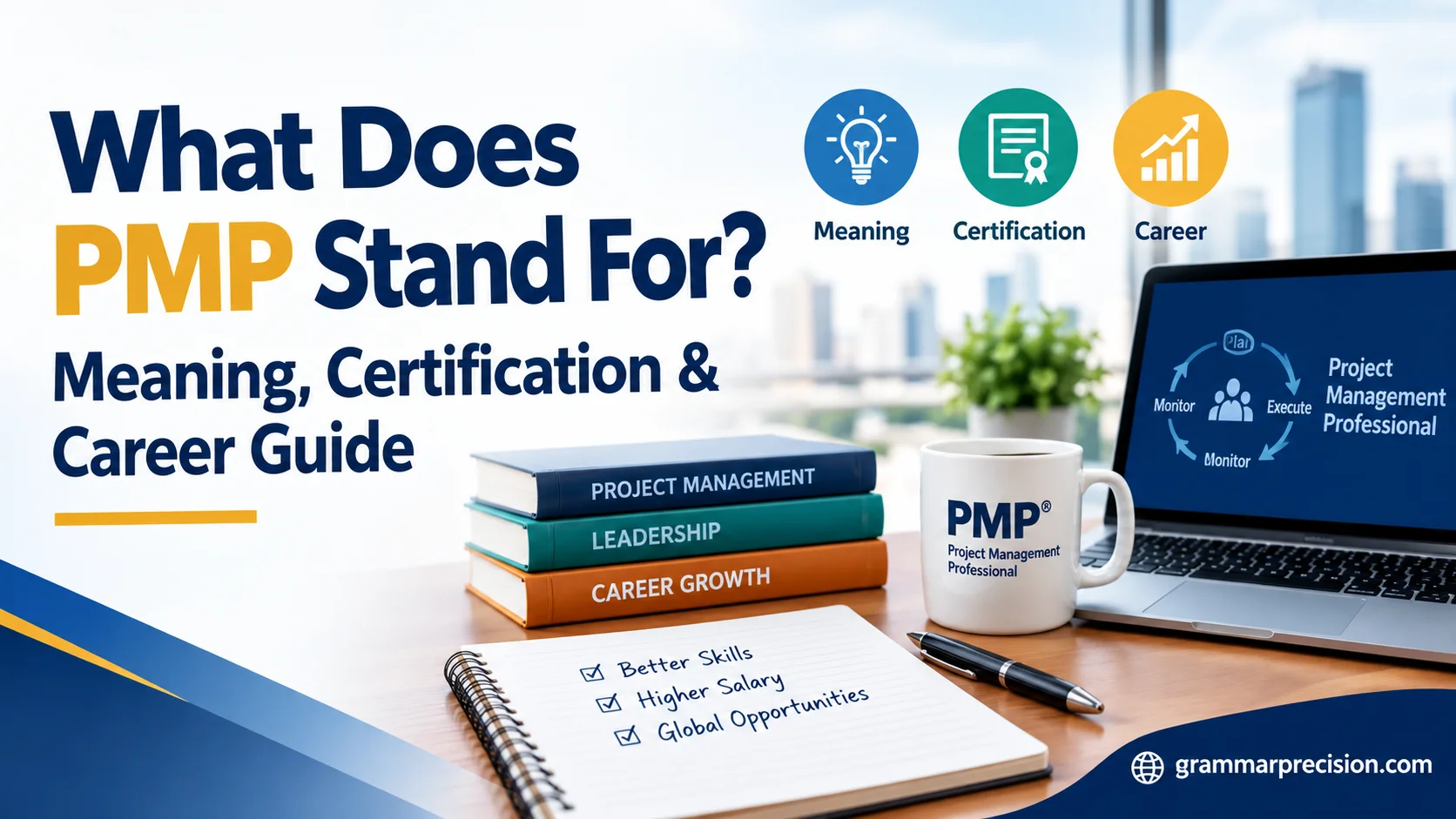
PMP stands for Project Management Professional, a globally recognized certification associated with project management expertise. It is awarded by the Project Management Institute (PMI) and demonstrates knowledge of planning, executing, monitoring, and completing projects. Whether you work in technology, construction, healthcare, finance, or business, understanding PMP can help you interpret professional titles, certification requirements, and project management terminology more confidently in modern professional settings today.
In professional settings, PMP certification often appears alongside discussions about project planning, scheduling, time management, risk management, budgeting, and team coordination. However, PMP is more than a collection of terms. It represents a structured and practical approach to managing projects and developing skills. Learning what PMP means also helps you understand why organizations value standardized project practices when managing deadlines, resources, stakeholders, and business objectives.
Although PMP has a specific meaning in project management, the abbreviation can occasionally appear in other contexts. Therefore, context matters when interpreting it in emails, job descriptions, training materials, or workplace conversations. This guide explains What Does PMP Stand For, what the certification involves, who uses it, and how the term connects with modern project management, professional development, and effective workplace communication in today’s workplace.
What Does PMP Stand For?
PMP stands for Project Management Professional. PMI awards the PMP certification to professionals who meet its eligibility requirements and successfully pass the certification examination.
In simple terms, the PMP credential shows that a professional has demonstrated knowledge and experience related to project leadership and delivery. It doesn’t mean that PMP is someone’s job title. Instead, it identifies a professional qualification.
For example, someone might write:
Maria Lopez, PMP
Here, PMP indicates that Maria holds the Project Management Professional credential. Her actual job might be project manager, program manager, operations manager, consultant, or another role involving project work.
What Does PMP Mean in Project Management?
In project management, PMP commonly refers to the Project Management Professional certification rather than project management itself.
Project management involves organizing people, resources, schedules, budgets, risks, and deliverables to achieve a defined objective. A PMP-certified professional may apply these practices across many industries.
The certification covers concepts that can apply to both traditional and modern project environments. That includes predictive, agile, and hybrid approaches, depending on the project and organization.
Why Is PMP Important to Professionals?
PMP has become a widely recognized project management credential because it gives employers a standardized way to identify professionals who have completed a formal certification process.
However, certification isn’t a substitute for practical experience. A successful project manager still needs communication, judgment, leadership, organization, and industry knowledge.
Think of PMP as a professional credential, not a magic key. It can demonstrate knowledge, but real projects still demand real-world decision-making.
What Does PMP Certification Mean?
PMP certification means that an eligible professional has earned the Project Management Professional credential through PMI.
The credential focuses on project management knowledge and professional experience. Candidates must satisfy PMI’s eligibility requirements before taking the exam.
PMP certification is relevant across industries because projects appear almost everywhere. A software company might use project managers to launch a new application. A construction company might use them to coordinate a building project. A hospital could use project leadership to implement a new information system.
What Does a PMP-Certified Professional Do?
A PMP-certified professional doesn’t necessarily perform one specific job. Instead, the credential can support many project-related career paths.
Typical responsibilities may include:
- Defining project goals and deliverables
- Building project plans and schedules
- Coordinating project teams
- Managing stakeholders
- Monitoring costs and resources
- Identifying and addressing risks
- Tracking project progress
- Managing changes
- Communicating project information
- Supporting successful project delivery
The exact responsibilities depend on the person’s position and industry.
What Does PMP Stand For on a Resume?
When PMP appears on a resume, it normally indicates that the person holds the Project Management Professional certification.
For example:
John Smith, PMP
Senior Project Manager
Technology and Digital Transformation
The credential can appear beside a person’s name or within a certifications section.
A resume might also include:
Certifications
- Project Management Professional (PMP)
- Certified ScrumMaster (CSM)
This placement makes the distinction clear. PMP is a certification, while “Senior Project Manager” describes the person’s role.
PMP on LinkedIn
Professionals commonly display PMP in their LinkedIn name or certification section.
For instance:
John Smith, PMP
The designation tells visitors that John has earned the PMP credential. It doesn’t automatically reveal his employer, salary, seniority, or specific project experience.
PMP in Job Descriptions
Employers sometimes mention PMP in job advertisements.
You may see language such as:
- PMP certification preferred
- PMP certification required
- PMP or equivalent project management credential
- PMP-certified project manager
These phrases can have different meanings depending on the employer. Always read the complete job description rather than assuming that every company uses the credential in exactly the same way.
Is PMP a Job Title?
No. PMP is not a job title.
This distinction causes confusion because people often see PMP written after a person’s name. The credential identifies certification status, while a job title describes someone’s position.
| Term | What It Means |
| PMP | Project Management Professional certification |
| Project Manager | A professional role responsible for managing projects |
| Program Manager | A role that coordinates related projects or initiatives |
| PMO | Project Management Office, an organizational function |
| CAPM | Certified Associate in Project Management certification |
A person can hold a PMP certification without having “Project Manager” as their official job title.
For example, an operations director might earn PMP certification to strengthen project leadership skills. The person remains an operations director.
What Is PMP Certification?
PMP certification is a professional credential administered by the Project Management Institute. PMI is a global professional association focused on project, program, and portfolio management.
The certification process includes eligibility requirements, an application, and an examination.
PMP isn’t limited to one particular industry. Its project management principles can apply to technology, healthcare, finance, construction, manufacturing, government, marketing, and many other fields.
Who Can Get PMP Certification?
PMP isn’t designed only for people with a particular college major. Eligibility is based primarily on education, project management experience, and project management education.
PMI’s eligibility pathways have traditionally included combinations such as:
- A four-year degree plus relevant project management experience
- A high school diploma or associate-level qualification plus additional project management experience
- Formal project management education or training requirements
PMI periodically updates certification requirements. Candidates should verify the current eligibility rules directly with PMI before submitting an application.
What Does PMP Certification Demonstrate?
The credential can demonstrate that a professional has met PMI’s certification requirements and passed its examination.
It can also signal familiarity with areas such as:
- Project planning
- Team leadership
- Stakeholder engagement
- Risk management
- Scheduling
- Delivery approaches
- Project performance
- Organizational and business considerations
Still, the credential doesn’t guarantee project success. Projects involve changing requirements, competing priorities, limited resources, and people. Those realities require more than exam knowledge.
What Does the PMP Exam Cover?
The PMP examination tests project management knowledge across major areas of professional practice.
PMI has updated the examination over time to reflect changes in the profession. Modern project management increasingly recognizes that organizations use different delivery methods rather than relying on one rigid approach.
Candidates should therefore understand concepts rather than memorize isolated definitions.
People
The People area focuses on the human side of project work.
Project leaders frequently coordinate individuals with different responsibilities, expectations, and communication styles. Strong leadership can help teams resolve conflict, collaborate effectively, and maintain focus.
Relevant skills include:
- Team development
- Communication
- Conflict management
- Leadership
- Collaboration
- Stakeholder engagement
Process
The Process area addresses how projects are planned, managed, monitored, and delivered.
This can involve scheduling, risk management, budgeting, quality, scope, resources, procurement, and project performance.
For example, imagine a company launching a new customer portal. The project team needs more than a launch date. It must define requirements, coordinate developers, monitor risks, test the system, communicate with stakeholders, and respond to changes.
Business Environment
Projects don’t operate in a vacuum.
The Business Environment component connects project work with organizational goals, compliance, strategy, value delivery, and changing business conditions.
A technically successful project can still fail to create useful business value. Project professionals therefore need to understand why the project exists and how its outcomes support organizational objectives.
What Skills Does PMP Validate?
PMP preparation covers a broad collection of project management concepts. However, the most useful skills often extend beyond terminology.
Planning and Scheduling
Projects need realistic plans. A project professional may break major deliverables into smaller activities, establish dependencies, estimate durations, and monitor progress.
Scheduling becomes especially important when one delayed activity affects several others.
Risk Management
Every project contains uncertainty.
Risk management involves identifying potential problems, analyzing their possible effects, and deciding how to respond.
For example, a software project might identify a shortage of specialized developers as a potential risk. The team could respond by cross-training employees or arranging additional resources.
Stakeholder Communication
Even a well-designed project can struggle when stakeholders don’t understand what’s happening.
Project professionals communicate expectations, progress, decisions, risks, and changes to different audiences. A technical team may need detailed information, while an executive may need a concise business summary.
Team Leadership
Project leadership involves more than assigning tasks.
Teams need clear goals, productive collaboration, conflict resolution, and support when obstacles appear. Effective leaders create conditions in which people can do their work well.
Also Read This: What Does RBT Stand For? Registered Behavior Technician Meaning
PMP vs. PM vs. PMO vs. CAPM
These terms often appear together, but they don’t mean the same thing.
| Term | Full Meaning | What It Represents |
| PMP | Project Management Professional | Professional certification |
| PM | Project Manager | Job role |
| PMO | Project Management Office | Organizational function |
| CAPM | Certified Associate in Project Management | Project management certification |
| Program Manager | Program management role | Coordinates related initiatives or projects |
The easiest way to remember the distinction is this:
PMP is a credential. PM is a role. PMO is an organizational function.
CAPM is also a credential, but it serves a different professional purpose and has different eligibility requirements.
PMP vs. CAPM
PMP and CAPM are both PMI certifications, yet they aren’t interchangeable.
The Certified Associate in Project Management (CAPM) is generally positioned as an entry-level project management credential. PMP is designed for professionals who can demonstrate substantially more project management experience.
| Feature | PMP | CAPM |
| Full name | Project Management Professional | Certified Associate in Project Management |
| General audience | Experienced project professionals | Entry-level or developing professionals |
| Experience | More substantial project experience required | Designed with lower experience barriers |
| Purpose | Demonstrate professional project management capability | Build foundational project management credibility |
Someone beginning a project management career may explore CAPM, while an experienced professional may pursue PMP if they meet the applicable requirements.
PMP Career Paths and Industry Uses
One reason PMP meaning appears frequently in career discussions is its broad industry relevance.
Projects exist wherever organizations introduce something new, improve an existing system, or pursue a defined objective.
Technology
Technology organizations use project management for software launches, cloud migrations, cybersecurity initiatives, system upgrades, and digital transformation.
A project manager might coordinate developers, designers, security specialists, vendors, and business stakeholders.
Construction
Construction projects require detailed coordination among contractors, engineers, suppliers, inspectors, owners, and other stakeholders.
Scheduling and resource management become particularly important because delays can affect several downstream activities.
Healthcare
Healthcare organizations also undertake projects involving technology implementation, facility improvements, process changes, and operational initiatives.
Project leaders must often coordinate technical requirements with patient, regulatory, financial, and operational considerations.
Finance and Banking
Banks and financial organizations may use project teams for technology upgrades, compliance initiatives, product launches, and process improvements.
These projects often involve strict deadlines and multiple stakeholder groups.
Marketing
Marketing teams run campaigns, product launches, website projects, events, and brand initiatives.
Although the work may look different from construction or software development, it still requires goals, timelines, resources, responsibilities, and measurable outcomes.
A Real-World PMP Case Study
Consider a fictional company preparing to launch an online ordering platform.
The company gives the project manager six months to coordinate development, testing, training, and launch.
At first, everything appears straightforward. Then several problems emerge.
A vendor misses a delivery deadline. Developers discover an integration issue. Marketing changes the launch campaign. Executives request additional reporting features.
A project professional can use structured project management practices to respond.
Step one: identify the impact of each change.
Step two: assess risks, dependencies, resources, and schedule effects.
Step three: communicate implications to the appropriate stakeholders.
Step four: coordinate decisions and update the project approach.
The example illustrates an important point: project management isn’t simply about creating a schedule. It’s about navigating people, processes, uncertainty, and business priorities while moving toward a defined outcome.
Common PMP Misconceptions
The acronym creates several misunderstandings. Clearing them up makes what does PMP stand for much easier to understand.
PMP Is Not a Degree
PMP is a professional certification, not a university degree.
A person can have a bachelor’s or master’s degree and also hold PMP certification. The two credentials serve different purposes.
PMP Isn’t Automatically a Job Title
Someone with PMP certification isn’t necessarily employed as a project manager.
The credential can support professionals working in many positions.
PMP Doesn’t Guarantee Project Success
Certification demonstrates that someone met defined certification requirements. It doesn’t guarantee that every project they lead will succeed.
Project outcomes depend on many variables, including resources, organizational support, market conditions, requirements, technology, and stakeholder decisions.
PMP Isn’t Limited to One Industry
Project management exists across many sectors. A PMP-certified professional might work in technology, construction, healthcare, finance, manufacturing, consulting, or another project-driven environment.
Why PMP Appears So Often in Professional Settings
The acronym has practical value because professional environments frequently need a quick way to identify credentials.
You’ll commonly encounter PMP in:
- Resumes
- LinkedIn profiles
- Job advertisements
- Email signatures
- Consulting profiles
- Professional biographies
- Business proposals
- Project management discussions
For a recruiter, the letters can immediately signal that a candidate holds a recognized project management credential. The recruiter still needs to examine the person’s experience, achievements, and qualifications.
PMP Facts at a Glance
| Question | Answer |
| What does PMP stand for? | Project Management Professional |
| What is PMP? | A professional project management certification |
| Who administers PMP? | Project Management Institute (PMI) |
| Is PMP a job title? | No |
| Is PMP a degree? | No |
| Where is PMP used? | Across many project-driven industries |
| What does PMP demonstrate? | Completion of PMI’s certification requirements and examination |
| What skills relate to PMP? | Leadership, planning, delivery, risk, communication, stakeholders, and business considerations |
FAQs:
What does PMP stand for in business?
PMP stands for Project Management Professional. In business settings, it generally refers to the PMI professional certification rather than a job position.
What does PMP mean after someone’s name?
When PMP appears after someone’s name, it generally indicates that the person holds the Project Management Professional certification. For example, “Alex Brown, PMP” identifies PMP as a professional credential.
Is PMP the same as a project manager?
No. Project manager describes a job role, while PMP identifies a professional certification. A project manager may hold PMP certification, but the terms aren’t synonymous.
Is PMP a degree?
No. PMP is a professional certification, not an academic degree. Candidates must meet certification requirements and pass the applicable examination.
What is the difference between PMP and CAPM?
PMP and CAPM are PMI certifications aimed at different stages of project management development. PMP generally requires more project management experience, while CAPM is designed as a more accessible entry-level credential.
Can PMP-certified professionals work outside project management?
Yes. Professionals in operations, consulting, technology, business analysis, and other areas may pursue project management credentials because their work can involve projects and cross-functional initiatives.
Is PMP certification useful for every professional?
Its relevance depends on a person’s career path, responsibilities, industry, and goals. It can be particularly relevant when someone’s work involves coordinating projects, teams, schedules, resources, risks, or stakeholders.
Conclusion:
So, what does PMP stand for? PMP stands for Project Management Professional, a certification administered by the Project Management Institute. It isn’t a job title or academic degree. Instead, it represents a professional credential connected with project management knowledge and experience.
The acronym can appear on resumes, LinkedIn profiles, job descriptions, and professional documents. Once you understand the distinction between PMP certification, project manager, PMO, and CAPM, the terminology becomes much easier to navigate. Whether you’re researching a career, reading a job posting, or evaluating professional credentials, that distinction gives you a clearer picture of what PMP actually means.