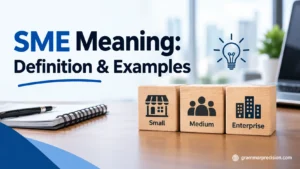
Have you ever come across SME in a business meeting, workplace email, or professional document and wondered what it means? The SME meaning can vary depending on the context, commonly referring to a Small and Medium-Sized Enterprise or a Subject Matter Expert. Understanding these meanings helps you communicate clearly in business communication, project management, and formal writing. It also prevents confusion when discussing scheduling, time management, online booking, broadcasting, or calendar management.
In this guide, you’ll discover the different meanings of SME, how to identify the correct definition, and how to use the abbreviation naturally. We’ll explore practical examples, common applications, and its role in professional conversations. You’ll also learn how context influences English usage, grammar, and writing consistency, including differences between US and UK style guides. Whether you’re preparing reports, organizing meetings, or improving workplace communication, this article will help you understand SME and use it with confidence.
What Does SME Mean?
SME stands for small and medium-sized enterprise in business. It describes a company that falls within a particular size category based on factors such as employee count, annual revenue, or total assets.
For example, a family-owned bakery with 18 employees might qualify as an SME under the rules of its country. A regional manufacturing company with 150 employees could also qualify, depending on its industry and local classification system.
However, SME has another common meaning in professional environments. It can stand for subject matter expert, which describes someone who has specialized knowledge of a particular topic.
Consider these examples:
- Business: “Our SME employs 45 people and serves customers across the state.”
- Workplace: “We need an SME to review the technical training materials.”
- Finance: “The bank offers financing options designed for SMEs.”
- Technology: “The project team consulted a cybersecurity SME before launching the software.”
Notice how the surrounding words clarify the intended meaning. When a sentence discusses employees, revenue, or business loans, SME probably refers to an enterprise. When it discusses knowledge, training, or consulting, it usually refers to an expert.
What Does SME Mean in Business?
In business, SME means small and medium-sized enterprise. Companies use this classification to distinguish smaller organizations from large corporations.
SMEs operate in almost every industry. You might find them in retail, construction, transportation, manufacturing, healthcare, hospitality, and technology.
Unlike large corporations, many SMEs operate with smaller teams, tighter budgets, and fewer management layers. Their owners often participate directly in daily decisions, customer service, hiring, and financial planning.
However, small size doesn’t necessarily mean limited ambition. An SME might serve a single neighborhood today and expand into international markets within a few years.
Examples of SMEs in Everyday Life
SMEs aren’t limited to traditional family businesses. They include many types of organizations that people encounter regularly.
Here are some common examples:
- Retail stores: Independent clothing shops, bookstores, and grocery stores.
- Professional services: Accounting firms, marketing agencies, and consulting businesses.
- Manufacturing companies: Small factories producing furniture, packaging, or machine parts.
- Technology companies: Software developers, cybersecurity firms, and IT support providers.
- Hospitality businesses: Independent hotels, restaurants, and catering companies.
- Online businesses: E-commerce stores, digital design studios, and specialized online retailers.
Imagine a company that manufactures custom wooden furniture. It employs 32 people, operates a small workshop, and sells products to customers and interior designers.
Depending on the country’s rules, this company could qualify as an SME. Its classification would depend on the applicable employee, revenue, or asset limits.
Why SMEs Matter to the Economy
SMEs contribute to employment, competition, innovation, and local economic activity. They also help larger businesses operate by supplying materials, professional services, transportation, and specialized products.
Their importance extends beyond the number of businesses they represent. Smaller companies can respond quickly to changing customer needs because they often have shorter decision-making processes.
For example, a small software company might develop a scheduling tool for local clinics. A large corporation could offer similar software, but the smaller company might adapt its product faster to meet the clinics’ specific requirements.
SMEs also create opportunities for entrepreneurs who want to build businesses around specialized skills, local demand, or new ideas.
What Does SME Mean at Work?
In the workplace, SME commonly stands for subject matter expert. An SME is someone who understands a specific subject deeply enough to guide others, solve complex problems, or verify technical information.
A subject matter expert might work in healthcare, engineering, accounting, software development, education, cybersecurity, or human resources.
For example, a company developing payroll software might hire an accountant who understands payroll taxes, deductions, and reporting requirements. That accountant could serve as the project’s SME.
The person doesn’t necessarily need to manage a team. Their value comes from their knowledge and ability to apply it correctly.
What Does a Subject Matter Expert Do?
An SME helps teams make informed decisions and avoid costly mistakes. Their exact responsibilities depend on the industry and project.
Common duties include:
- Providing technical guidance: Explaining complicated subjects in practical terms.
- Reviewing information: Checking documents, procedures, training materials, or software requirements.
- Solving problems: Identifying the causes of errors and recommending solutions.
- Training employees: Teaching colleagues how to perform specialized tasks.
- Supporting decisions: Helping managers understand technical risks and opportunities.
- Sharing industry knowledge: Explaining relevant standards, regulations, and best practices.
Suppose a hospital introduces a new patient-record system. A nurse with extensive clinical experience might act as an SME during implementation.
The nurse can explain how staff record patient information, what safety checks they need, and which features could disrupt daily care. Their input helps developers build a system that supports real clinical workflows.
How Do You Become an SME?
You don’t always need a particular job title to become a subject matter expert. People usually develop expertise through education, hands-on experience, continued learning, and demonstrated results.
A practical path includes these steps:
- Choose a subject: Focus on a specific field, such as digital marketing, accounting, or data analysis.
- Build foundational knowledge: Study the relevant concepts, tools, standards, and methods.
- Gain practical experience: Apply what you’ve learned to real projects and workplace challenges.
- Develop specialized skills: Learn to handle complex tasks that require deeper understanding.
- Document your results: Keep examples of successful projects, improvements, and problems you’ve solved.
- Share your knowledge: Mentor colleagues, write guides, or lead training sessions.
- Keep learning: Update your skills as technology, regulations, and industry practices change.
Certifications can help establish credibility in some fields. However, an impressive title alone doesn’t guarantee expertise. Consistent performance and sound judgment matter just as much.
SME Meaning in Text Messages and Emails
When someone uses SME in a message, the intended meaning usually depends on the conversation.
Unlike common texting abbreviations such as LOL or BRB, SME isn’t primarily casual internet slang. It appears more often in professional messages, business discussions, and industry-specific communication.
For example, a colleague might write:
- “Can you ask the SME to review this report?”
- “We’re looking for an SME to help with the software rollout.”
- “Our SME division is applying for a small-business loan.”
- “The meeting will cover funding opportunities for SMEs.”
The first two examples refer to subject matter experts. The final two refer to small and medium-sized enterprises.
How to Interpret SME in a Message
Use the surrounding information to determine what the sender means.
| Context | Likely meaning | Example |
| Hiring and job descriptions | Subject matter expert | “We need an SME in cybersecurity.” |
| Employee training | Subject matter expert | “The SME will lead the workshop.” |
| Business loans | Small and medium-sized enterprise | “SMEs can apply for financing.” |
| Company classification | Small and medium-sized enterprise | “The program supports eligible SMEs.” |
| Technical projects | Subject matter expert | “Ask the SME to validate the requirements.” |
If the meaning remains unclear, ask a quick question. For example, “Do you mean a small business or a subject matter expert?”
In professional communication, clarity matters more than assuming everyone understands the abbreviation.
What Qualifies as a Small or Medium-Sized Enterprise?
Not every small-looking company automatically qualifies as an SME. Governments, banks, and industry organizations use specific criteria to determine eligibility.
These criteria commonly include:
- Number of employees
- Annual revenue or turnover
- Total assets
- Ownership structure
- Relationships with larger companies
The exact requirements vary by country and sometimes by industry. A business that qualifies in one jurisdiction might fall outside the definition in another.
SME Definitions in Different Regions
The following examples illustrate how classification systems differ.
| Region | General classification approach | Important detail |
| United States | Industry-specific size standards | The Small Business Administration considers factors such as average annual receipts or employee count, depending on the industry. |
| European Union | Employee count, turnover, and balance-sheet total | An SME generally has fewer than 250 employees and meets the applicable financial limits. |
| United Kingdom | Employee count, turnover, and balance-sheet total | Company size rules can depend on the reporting framework and purpose. |
| India | Investment in plant, machinery, or equipment and annual turnover | The MSME classification system distinguishes micro, small, and medium enterprises using official financial thresholds. |
The European Union’s general SME definition includes three categories:
- Microenterprise: Fewer than 10 employees, with annual turnover or balance-sheet total not exceeding €2 million.
- Small enterprise: Fewer than 50 employees, with annual turnover or balance-sheet total not exceeding €10 million.
- Medium-sized enterprise: Fewer than 250 employees, with annual turnover not exceeding €50 million or a balance-sheet total not exceeding €43 million.
These financial limits and employee counts must be considered alongside the applicable ownership and independence rules.
In the United States, there is no single employee or revenue threshold that applies to every small business. The relevant Small Business Administration standard varies by industry and may use employee count or average annual receipts.
India uses a different framework for micro, small, and medium enterprises. Its official classification considers investment and turnover rather than relying solely on employee count.
The key lesson: Always check the rules that apply to the specific country, industry, or program. Don’t assume that one universal definition covers every SME.
SME vs. SMB vs. SMI: What’s the Difference?
SME, SMB, and SMI all describe smaller businesses in some contexts. However, organizations don’t always use these abbreviations in the same way.
Understanding their differences helps you interpret business reports and choose the right term for your audience.
| Abbreviation | Full form | Common meaning |
| SME | Small and medium-sized enterprise | Businesses classified as small or medium-sized |
| SMB | Small and medium-sized business | Often used similarly to SME, especially in the United States |
| SMI | Small and medium-sized industry or industries | Used in some contexts, but less standardized |
SME is common in international business, economic research, and government programs. SMB often appears in US business discussions, particularly in technology sales, marketing, and services aimed at smaller companies.
SMI has less consistent usage. Its meaning can vary by organization or industry, so readers should check the surrounding context.
SME vs. Startup
An SME and a startup aren’t necessarily different types of businesses. The terms describe different characteristics.
An SME classification generally concerns company size. A startup usually refers to a young business seeking to establish or scale a business model.
For example, a 20-year-old family-owned bakery might qualify as an SME without being a startup. A newly launched technology company might also qualify as an SME while pursuing rapid growth.
Some startups eventually become large corporations. Others remain small, stable businesses for years.
Remember: A startup describes a business’s stage or growth ambitions, while SME usually describes its size category.
Benefits and Challenges of Running an SME
SMEs offer several advantages, but their smaller size can also create operational challenges. Understanding both sides helps explain why these businesses need different strategies from large corporations.
Benefits of SMEs
Faster decision-making: Smaller teams often allow owners to make decisions without navigating several management layers.
Closer customer relationships: A business owner may speak directly with customers, understand their concerns, and adjust services quickly.
Specialized services: SMEs can focus on specific customer groups or niche markets that larger companies overlook.
Local economic impact: Smaller businesses often purchase supplies, hire workers, and provide services within their communities.
Room for innovation: A compact team may test new products or service models without coordinating across a large organization.
For example, an independent bakery can introduce a new product based on regular customer feedback. A large food manufacturer might need more extensive testing, planning, and distribution changes before launching something similar.
Challenges SMEs Face
Despite their advantages, SMEs often have fewer resources than large corporations.
- Limited financing: Banks may require strong credit histories, collateral, and detailed financial records.
- Staffing constraints: Smaller teams may struggle to recruit specialists or cover employee absences.
- Market competition: Large companies can benefit from established brands, bulk purchasing, and wider distribution.
- Technology costs: Modern software, cybersecurity tools, and digital infrastructure can strain budgets.
- Cash-flow pressure: Late customer payments can make it difficult to cover wages, rent, and supplier invoices.
Consider a small construction company that completes a major project but waits 60 days for payment. It may struggle to pay workers and suppliers even when the project itself generates a profit.
This example highlights an important distinction: profitability doesn’t always mean healthy cash flow. SMEs need sound financial planning to keep daily operations running smoothly.
Real-World SME Examples and a Practical Case Study
Realistic examples make SME meaning easier to understand because they show how the classification applies in everyday business situations.
Example: A Growing Digital Marketing Agency
Imagine a digital marketing agency with 28 employees. It manages advertising campaigns, website content, and social media accounts for local businesses.
The agency earns revenue through monthly client contracts and project-based fees. Its founder manages major accounts while department leads oversee content, advertising, and analytics.
Depending on the applicable rules, the agency could qualify as an SME.
Now imagine that the agency hires a specialist to review advertising data and measurement methods. That person might serve as the company’s subject matter expert in marketing analytics.
The same company could therefore use SME in two different ways:
- The agency itself could be an SME.
- Its analytics specialist could be an SME in the subject matter expert sense.
Context determines the correct interpretation.
Mini Case Study: How a Small Retailer Uses SME Resources
Consider a fictional family-owned clothing store with 12 employees. The store sells products through a physical location and an online shop.
Initially, the owners manage inventory, marketing, customer service, and bookkeeping themselves. As sales grow, they encounter stock shortages and delayed online orders.
They respond by introducing inventory software, improving sales forecasting, and documenting routine procedures.
They also consult an experienced e-commerce specialist who recommends clearer product descriptions and a more reliable order-tracking process.
This example demonstrates two important ideas:
- The retailer may qualify as a small enterprise under the relevant classification rules.
- The e-commerce specialist can act as a subject matter expert by helping the business solve a specific problem.
The improvements don’t guarantee success. However, they show how SMEs can combine practical experience, targeted expertise, and affordable technology to improve operations.
Common Misunderstandings About SME Meaning
SME seems straightforward, yet several common mistakes can lead to confusion.
Assuming SME Always Means a Small Business
SME usually includes both small and medium-sized enterprises. It doesn’t necessarily refer to a very small company or a business with only a handful of employees.
Confusing an Enterprise With an Expert
In a project meeting, SME might mean subject matter expert. In a banking document, it may refer to a small or medium-sized enterprise.
Always consider the subject of the conversation.
Treating Every Country’s Definition as Identical
Countries use different standards for classifying businesses. Employee counts, financial limits, ownership rules, and eligibility requirements can vary.
Assuming Every SME Is a Startup
Many SMEs have operated successfully for decades. They don’t need to pursue rapid growth or venture capital to qualify as SMEs.
Believing That SME Status Guarantees Funding
Some governments and financial institutions offer programs for qualifying businesses. However, eligibility depends on the program’s rules and other requirements, such as creditworthiness, business activity, and documentation.
How to Use SME Correctly in a Sentence
You can use SME naturally in professional writing once you understand the intended meaning.
For clarity, spell out the full term when you first introduce it, especially if your audience may not know the abbreviation.
For example:
“Our company provides accounting services to small and medium-sized enterprises (SMEs).”
After that first explanation, you can use SMEs throughout the document.
When discussing a subject matter expert, you might write:
“We consulted a subject matter expert (SME) before finalizing the technical specifications.”
If a document discusses both meanings, define each one carefully or avoid the abbreviation where it could confuse readers.
SME Examples in Sentences
Here are additional examples showing how SME works in different contexts.
- “The government introduced a program to support eligible SMEs.”
- “Our company hired an SME to review its cybersecurity policies.”
- “The bank offers financial products designed for small and medium-sized enterprises.”
- “Please ask the subject matter expert to verify the training materials.”
- “Many SMEs use digital tools to manage customer relationships.”
- “The project manager invited an SME to explain the system’s technical requirements.”
Notice that the plural form for small and medium-sized enterprises is SMEs. In ordinary writing, you generally don’t need an apostrophe to form the plural.
For example, write “SMEs contribute to economic activity,” not “SME’s contribute to economic activity.”
FAQs About SME Meaning
What Does SME Stand For?
SME most commonly stands for small and medium-sized enterprise in business. In workplace settings, it can also mean subject matter expert, a person with specialized knowledge of a particular topic.
What Does SME Mean in Business?
In business, SME refers to a small or medium-sized enterprise. The classification helps distinguish smaller companies from larger organizations and may affect eligibility for financing, support programs, or reporting requirements.
What Does SME Mean at Work?
At work, SME usually means subject matter expert. This person provides specialized knowledge, answers technical questions, reviews information, and helps teams make informed decisions.
Is an SME the Same as a Startup?
No. SME generally describes business size, while startup usually describes a young company or one pursuing a scalable business model. A startup can qualify as an SME, but an established SME isn’t necessarily a startup.
What Is the Difference Between SME and SMB?
SME means small and medium-sized enterprise, while SMB means small and medium-sized business. Both terms often describe similar businesses, although regional and industry preferences differ.
How Many Employees Does an SME Have?
There isn’t one universal employee limit. The European Union’s general definition covers enterprises with fewer than 250 employees, subject to additional criteria. Other countries use different standards, including industry-specific rules.
Can One Person Be an SME?
Yes, if SME means subject matter expert. A single person can develop deep expertise in a field and serve as an SME. However, whether a one-person business qualifies as an SME depends on the relevant classification rules.
Why Are SMEs Important?
SMEs support employment, competition, innovation, and local economic activity. They also provide specialized products and services to consumers and larger companies. Their flexibility helps them respond to changing customer needs.
Conclusion:
The SME meaning helps you understand business discussions, professional documents, and workplace conversations. Knowing its different definitions improves communication, prevents confusion, and helps you use this abbreviation correctly in everyday situations.
Whether SME refers to a Small and Medium-Sized Enterprise or a Subject Matter Expert, context reveals its intended meaning. Understanding both definitions strengthens your English usage, improves professional writing, and supports clear communication across industries and everyday workplace interactions.