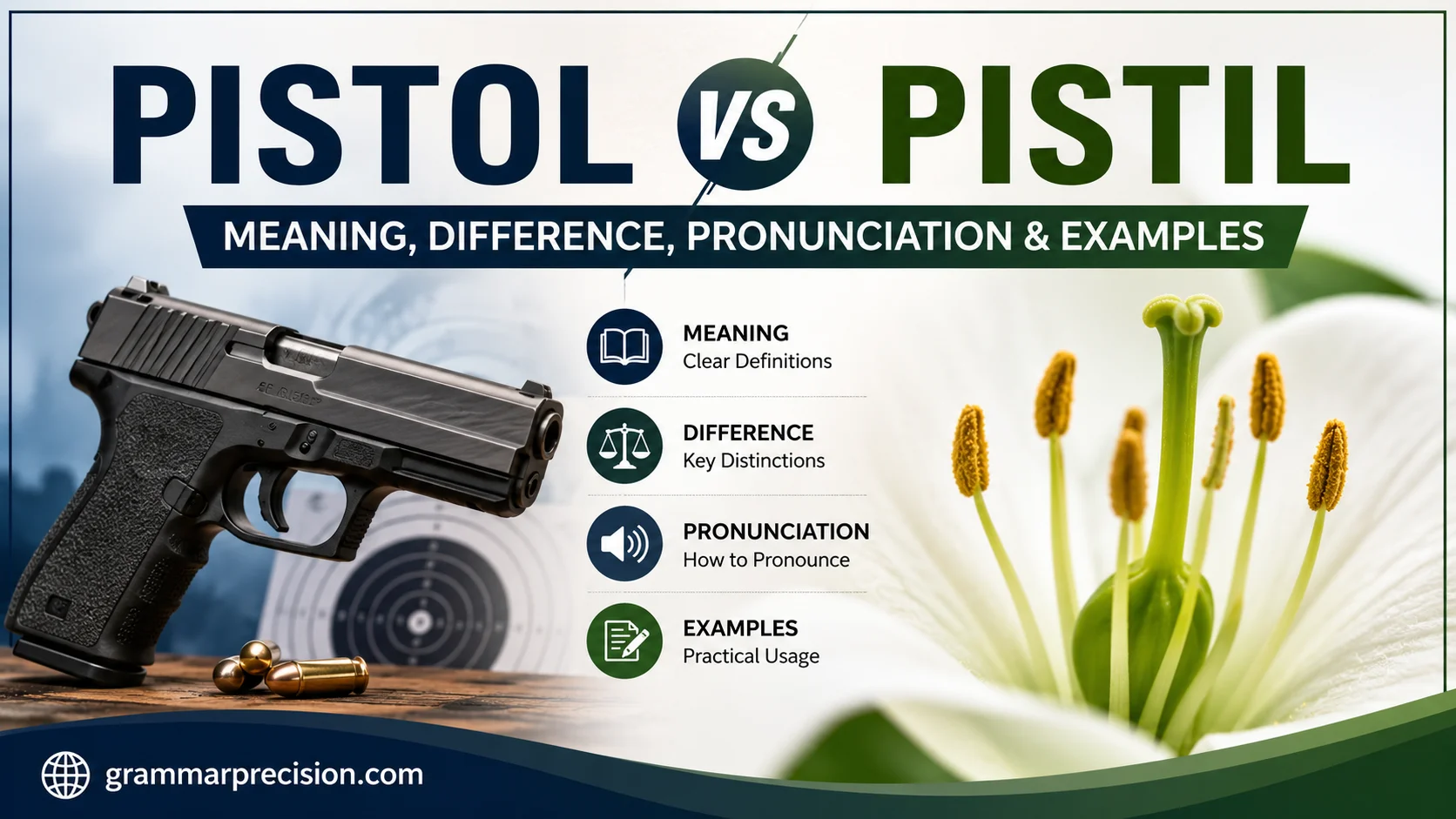
Have you ever seen pistol vs. pistil and wondered why two nearly identical words can mean completely different things? You’re not alone. A single vowel separates these words, yet their meanings live in entirely different worlds.
A pistol is a type of firearm, while a pistil is the female reproductive structure of a flower. One belongs to the vocabulary of weapons, while the other belongs to botany. Confusing them can create an amusing and sometimes very confusing—sentence.
The good news? Once you understand their meanings, pronunciation, spelling, and context, you’ll rarely mix them up again.
Pistol vs. Pistil: The Quick Answer
The easiest way to understand pistol vs. pistil is to focus on what each word describes.
| Word | Meaning | Part of Speech | Main Context |
| Pistol | A type of handheld firearm | Noun | Weapons, history, law enforcement |
| Pistil | The female reproductive structure of a flower | Noun | Botany, gardening, biology |
Here’s the simplest memory trick:
Pistol = firearm. Pistil = flower.
The spelling differs mainly in the vowel near the middle:
- Pistol → p-i-s-t-o-l
- Pistil → p-i-s-t-i-l
That small spelling change carries a completely different meaning.
Consider these examples:
- The officer secured the pistol.
- The bee landed near the flower’s pistil.
The first sentence concerns a firearm. The second describes part of a flower.
What Does “Pistol” Mean?
A pistol is a handheld firearm designed to be held and operated with one hand. The word commonly refers to a compact firearm with a chamber and barrel incorporated into a relatively short weapon.
In everyday American English, pistol often refers specifically to a handgun. However, firearm terminology can become more precise depending on the historical or technical context.
Pistol Definition
A simple definition is:
Pistol: a small firearm designed primarily for use with one hand.
The word can appear in several contexts, including history, military discussions, law enforcement, competitive shooting, literature, and news reporting.
For example:
- The museum displayed an antique pistol.
- The historical reenactor carried a replica pistol.
- The novel describes a character reaching for a pistol.
The surrounding words usually make the meaning obvious.
Pistol Pronunciation
In American English, pistol is commonly pronounced approximately:
PISS-tuhl
The first syllable receives the stronger emphasis. The final syllable has a relaxed vowel sound.
Don’t pronounce it as if it were spelled pist-all. English pronunciation often reduces unstressed vowels, which explains why the spoken form doesn’t perfectly match the spelling.
Pistol as a Noun
Pistol functions primarily as a noun.
It names a physical object, much like rifle, hammer, or camera names an object.
Examples include:
- He placed the antique pistol in a display case.
- The detective examined the pistol as evidence.
- The historical account mentions a cavalry pistol.
The plural form is pistols.
Where You’ll Commonly See “Pistol”
You may encounter pistol in:
- Historical writing
- Fiction and novels
- Museum descriptions
- Military history
- News reports
- Firearms discussions
- Sports involving target shooting
- Legal or law-enforcement contexts
The word can also appear in historical names and descriptions of particular firearm designs.
What Does “Pistil” Mean?
A pistil is a central reproductive structure of a flower. It plays a crucial role in the plant’s reproductive process.
If you’re learning basic botany, think of the pistil as one of the flower’s key reproductive structures. It can receive pollen and contain the ovary where ovules develop.
Pistil Definition
A straightforward definition is:
Pistil: the female reproductive structure of a flower, typically consisting of the stigma, style, and ovary.
The pistil may consist of one carpel or several fused carpels, depending on the plant.
That’s where the botanical side becomes more interesting.
A pistil isn’t simply a decorative part of a flower. It has a functional role in reproduction.
The Three Main Parts of a Pistil
A typical pistil contains three major parts:
- Stigma — the receptive surface that receives pollen
- Style — the stalk-like structure connecting the stigma to the ovary
- Ovary — the enlarged basal structure containing ovules
These structures work together during the reproductive process.
The stigma often has a sticky or textured surface that helps capture pollen. After compatible pollen reaches the stigma, a pollen tube can grow through the style toward an ovule inside the ovary.
Pistil Pronunciation
In American English, pistil is generally pronounced approximately:
PISS-tuhl
Here’s the interesting part: pistol and pistil are often pronounced very similarly in American English.
That means pronunciation alone may not always help you distinguish them. Context becomes extremely important.
If someone says:
“The botanist examined the pistil.”
you can use botanist and the surrounding context to understand the intended word.
Pistil in Flower Biology
The pistil participates in sexual reproduction in flowering plants.
After pollination, pollen from an appropriate source can interact with the stigma. A pollen tube may then develop and grow toward an ovule. Fertilization eventually leads to seed development.
The ovary has particular importance because, after fertilization, it can develop into a fruit in many flowering plants. The ovules develop into seeds.
So the pistil isn’t just another flower part. It’s deeply connected to how many flowering plants reproduce and produce seeds.
Inside a Flower: Understanding the Pistil
To remember pistil, it helps to understand what you’re actually looking at when you examine a flower.
Stigma
The stigma sits at the top of the pistil in many flowers.
Its job begins when pollen lands on it. Its surface may be sticky, rough, or otherwise adapted to capture pollen.
Think of the stigma as the flower’s pollen-receiving surface.
Style
The style connects the stigma with the ovary.
It often looks like a slender stalk. Once compatible pollen germinates on the stigma, the pollen tube can grow through the style toward an ovule.
The style therefore provides an important pathway during fertilization.
Ovary
The ovary sits at the base of the pistil.
It contains one or more ovules, which can develop into seeds following fertilization. In many flowering plants, the mature ovary contributes to the fruit.
For instance, what you casually call a fruit in everyday life often develops from floral structures after fertilization. Apples, tomatoes, and peaches provide familiar examples of fruits formed from flowers.
Pistol vs. Pistil: What’s the Difference?
The biggest difference between pistol and pistil is their meaning.
A pistol is a firearm. A pistil is a botanical structure.
Their spelling looks remarkably similar, but their meanings don’t overlap.
| Feature | Pistol | Pistil |
| Meaning | Handheld firearm | Flower’s female reproductive structure |
| Field | Firearms and history | Botany and biology |
| Part of speech | Noun | Noun |
| First letters | pist- | pist- |
| Key vowel | o | i |
| Common association | Gun | Flower |
| Plural | Pistols | Pistils |
The contrast is easy to remember:
Pistol → weapon
Pistil → plant
Why Are They So Easy to Confuse?
English contains many words that differ by only one letter but have unrelated meanings. Pistol and pistil fit that pattern perfectly.
They share the sequence p-i-s-t- and end with a similar -l sound. Their middle vowels create the spelling distinction.
For readers moving quickly through text, that tiny difference can disappear at a glance.
This problem becomes especially common when proofreading because the incorrect word may look visually plausible.
Also Read This: Annunciate vs Enunciate: Meaning, Difference & Pronunciation
Pistol vs. Pistil Spelling
If spelling causes trouble, focus on the middle vowel.
Pistol contains an o:
p-i-s-t-o-l
Pistil contains an i:
p-i-s-t-i-l
A useful association is:
- Pistol → O → object
- Pistil → I → inside a flower
The second mnemonic isn’t a scientific rule. It’s simply a memory device.
When you write a sentence, ask yourself what you’re describing. If you’re talking about a firearm, choose pistol. If you’re discussing a flower’s reproductive structure, choose pistil.
Are Pistol and Pistil Pronounced the Same?
In many varieties of American English, pistol and pistil are pronounced essentially alike or extremely similarly.
That’s one reason the distinction can be tricky in conversation.
You can’t always rely on hearing the word. You need to interpret its context.
For example:
“The pistol was stored safely.”
The word stored and the surrounding context point toward a firearm.
Now compare:
“The pistil receives pollen.”
The word pollen immediately places the sentence in botany.
This makes context clues your best tool when pronunciation doesn’t provide a clear distinction.
Common Pronunciation Mistake
A common mistake is assuming that because the spellings differ, the words must sound dramatically different.
They don’t necessarily.
Instead of trying to force an exaggerated pronunciation difference, focus on saying each word naturally. Then use the surrounding sentence to determine which meaning applies.
Pistol vs. Pistil in Real Sentences
Seeing the words in context makes the difference much easier to remember.
Pistol Examples
- The collector carefully restored an antique pistol.
- The historical exhibit included several early pistols.
- The fictional character carried a pistol during the scene.
- The museum label explained the pistol’s historical significance.
- The detective found a pistol near the abandoned building.
These examples all involve firearms or historical objects.
Pistil Examples
- The pistil occupies the central part of many flowers.
- Bees can transfer pollen to a flower’s pistil.
- The stigma forms the upper portion of the pistil.
- The ovary forms the lower part of a typical pistil.
- Students examined the pistil during their biology lesson.
Every example belongs to the world of plants.
Pistol vs. Pistil: Correct and Incorrect Examples
Sometimes the easiest way to understand a confusing pair is to see what goes wrong.
| Incorrect | Correct | Why |
| The flower’s pistol receives pollen. | The flower’s pistil receives pollen. | A flower has a pistil. |
| The antique pistil was displayed. | The antique pistol was displayed. | A firearm is a pistol. |
| Bees interact with the flower’s pistol. | Bees interact with the flower’s pistil. | Pollination involves the pistil. |
| The museum displayed several pistils from the collection. | The museum displayed several pistols from the collection. | The collection contains firearms. |
The mistake isn’t grammatical in the usual sense. It’s a word-choice and spelling error. Both words are legitimate English nouns, so a spell-checker may not catch the problem.
That’s an important point: A correctly spelled word can still be the wrong word.
How to Never Confuse Pistol and Pistil Again
The best memory tricks connect each word with something concrete.
Pistol → Firearm
Picture a pistol in a museum or historical display.
Think:
Pistol = weapon
Pistil → Flower
Picture a flower cut open so you can see its reproductive structures.
Think:
Pistil = flower
Use the “O” and “I” Trick
Look at the middle vowel:
Pist-O-l → pistol → object
Pist-I-l → pistil → inside a flower
Again, this is only a mnemonic. It isn’t an etymological rule.
Use Context Instead of Pronunciation
Because the words can sound very similar, context provides a stronger clue.
Words such as gun, firearm, trigger, museum, weapon, and shooting suggest pistol.
Words such as flower, pollen, stigma, ovary, style, seed, and botany suggest pistil.
Pistol vs. Pistil and Related Words
Understanding related vocabulary can strengthen the distinction.
Words Related to Pistol
Depending on context, you might encounter:
- Handgun
- Firearm
- Revolver
- Rifle
- Weapon
- Ammunition
- Barrel
- Trigger
- Holster
Not all of these are synonyms. For example, a revolver is a specific type of firearm, while handgun is a broader category.
Words Related to Pistil
Botanical vocabulary includes:
- Stigma
- Style
- Ovary
- Ovule
- Carpel
- Pollen
- Pollination
- Stamen
- Flower
- Fertilization
One especially important distinction is pistil vs. stamen.
The stamen is generally the flower’s male reproductive structure, while the pistil represents the female reproductive structure in traditional botanical terminology.
Pistil vs. Stamen: Don’t Mix Them Up
The pistil and stamen perform different reproductive roles.
| Flower Part | General Role | Main Structures |
| Pistil | Female reproductive structure | Stigma, style, ovary |
| Stamen | Male reproductive structure | Anther, filament |
The anther produces pollen, while the stigma receives pollen.
That distinction makes the pistil easier to remember. It belongs to the reproductive side of the flower and contains the ovary.
A Closer Look at Pistol and Pistil Origins
The similarity between these words doesn’t mean they share the same meaning or botanical history.
Pistol entered English through European languages and is associated historically with the development of handheld firearms. The word has a long history connected with firearms and weapon terminology.
Pistil, meanwhile, comes from botanical terminology and ultimately traces back to Latin pistillum, meaning a pestle or pounding instrument. The botanical term relates to the shape of certain flower structures.
Their similar modern appearance is therefore a classic example of how English can place unrelated words side by side.
You don’t need to memorize their full etymologies to use them correctly. Still, knowing that they developed from different linguistic paths explains why their meanings are so far apart.
Pistol vs. Pistil: A Simple Memory Formula
When you’re in a hurry, remember this:
Pistol = pew-pew. Pistil = petal.
It’s intentionally simple.
The pistol belongs to the world of firearms. The pistil belongs to the world of flowers.
If you see pollen, stigma, style, or ovary, choose pistil.
If you see firearm, handgun, holster, or weapon, choose pistol.
That context-based approach works better than trying to memorize an isolated spelling difference.
Test Yourself: Pistol or Pistil?
Choose the correct word for each sentence.
The botanist examined the flower’s _____.
- A. pistol
- B. pistil
Answer: B. pistil
The sentence discusses a flower, so pistil is correct.
The museum displayed an antique _____.
- A. pistol
- B. pistil
Answer: A. pistol
A firearm can appear in a museum display, so pistol fits.
The _____ includes the stigma, style, and ovary.
- A. pistol
- B. pistil
Answer: B. pistil
Those are the principal parts of a typical pistil.
The historical account described the soldier’s _____.
- A. pistol
- B. pistil
Answer: A. pistol
The historical context concerns a firearm.
Quick Challenge
Try these without looking at the answers:
- Bees transfer pollen to the flower’s _____.
- The antique _____ belonged to the collection.
- The _____ contains the ovules.
- The officer secured the _____.
- Students labeled the flower’s _____ during class.
Answers: pistil, pistol, pistil, pistol, pistil.
Pistol vs. Pistil: Final Takeaway
The difference between pistol and pistil is tiny in spelling but enormous in meaning.
A pistol is a handheld firearm. A pistil is a flower’s female reproductive structure. Although their pronunciation can be very similar in American English, their contexts couldn’t be more different.
Keep this simple formula in mind:
| If you’re talking about… | Use… |
| A handgun | Pistol |
| A firearm | Pistol |
| A weapon in a historical account | Pistol |
| A flower’s reproductive structure | Pistil |
| Stigma, style, and ovary | Pistil |
| Pollen and plant reproduction | Pistil |
The most reliable strategy is to look at the context first and the spelling second.
When the sentence involves guns, firearms, or weapons, reach for pistol. When it involves flowers, pollen, stigma, or ovaries, choose pistil.
One little vowel separates the words. Once you connect each word to its world, the confusion practically disappears.
FAQs:
What is the difference between pistol and pistil?
A pistol is a type of handheld firearm, while a pistil is the female reproductive structure of a flower. Their spellings differ by one vowel, but their meanings belong to completely different fields.
Are pistol and pistil pronounced the same?
In American English, pistol and pistil are often pronounced very similarly. Because their sounds can overlap, context helps you determine which word someone means.
What are the main parts of a pistil?
A typical pistil contains three main parts: the stigma, style, and ovary. The stigma receives pollen, the style connects the stigma to the ovary, and the ovary contains the ovules.
How can I remember the difference between pistol and pistil?
Use this simple trick: pistol = firearm, pistil = flower. You can also associate pistil with words such as pollen, petals, and plant to make the spelling easier to remember.
Is pistil the same as stamen?
No. The pistil is generally the female reproductive structure of a flower, while the stamen is generally the male reproductive structure. The pistil includes the stigma, style, and ovary, while the stamen includes the anther and filament.
Conclusion:
Pistol and pistil look almost identical, yet their meanings couldn’t be more different. A pistol is a firearm, while a pistil is a flower’s reproductive structure. Remember the simple connection: pistol means weapon, pistil means flower. Once you learn that distinction, you’ll avoid this common spelling and vocabulary mistake with ease.