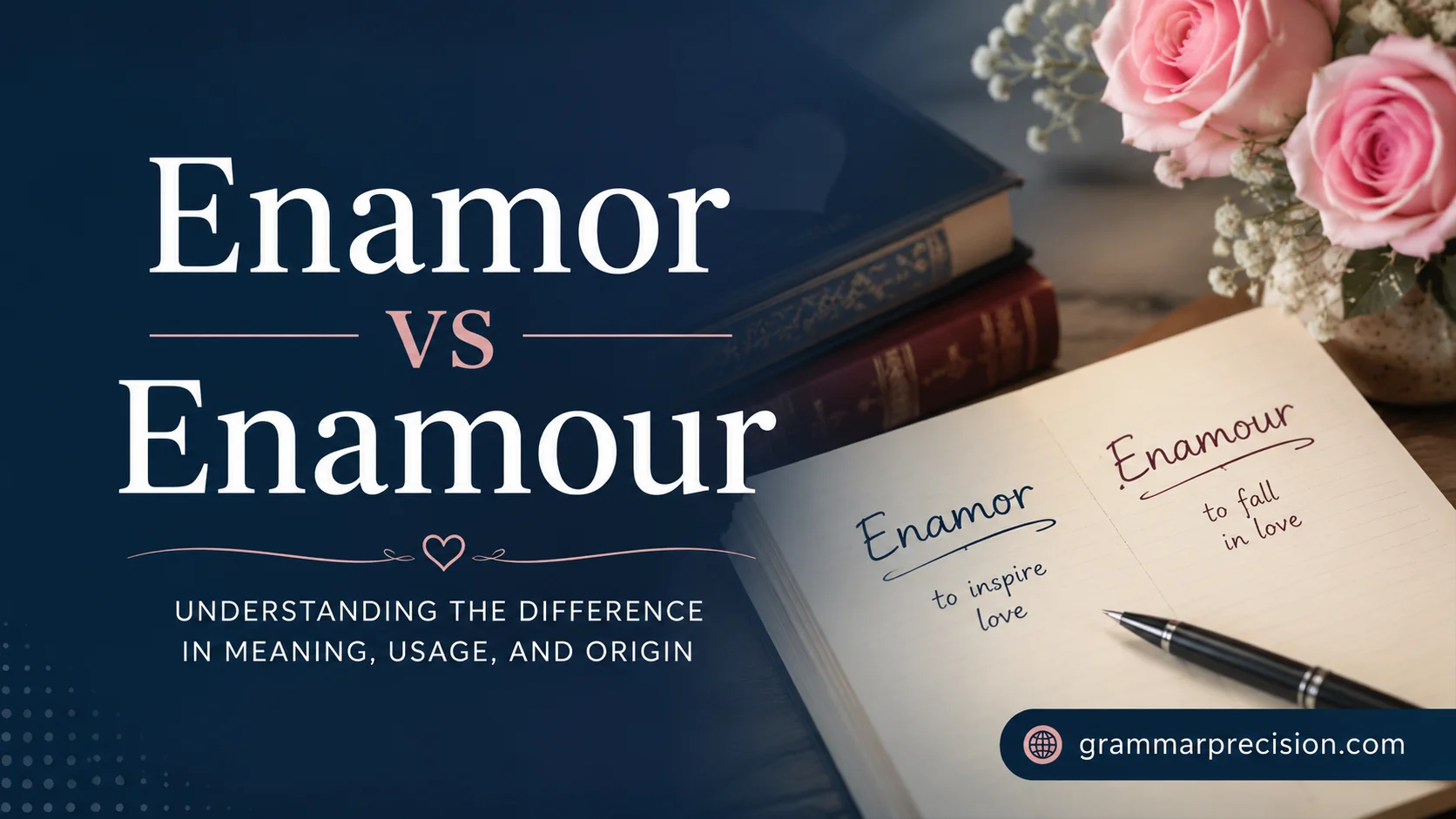
Enamor vs Enamour often confuses writers because both spellings share the same meaning, pronunciation, and emotional tone, but their usage depends on American English and British English writing styles.
Many confident writers struggle with these spelling variations in the English language because both forms express deep affection, admiration, and emotional connection. In my experience, choosing the right form improves professional tone, strengthens grammar accuracy, and helps content appear more polished for academic writing, blogs, and formal communication across different audiences worldwide.
A memorable example appeared in Cook’s Country magazine, where Americans were described as becoming enamored with international cooking. This discussion highlights regional English usage, language preference, and historical linguistic evolution between American English and British English. Understanding these subtle distinctions can improve clarity, consistency, and overall English writing skills for modern communication.
Enamor vs Enamour Meaning Explained in Simple Terms
Let’s start with the core idea.
Both enamor and enamour mean the same thing:
To fill someone with love, admiration, or strong attraction toward something or someone.
They describe that emotional moment when something captures your attention so deeply that you feel drawn toward it.
Simple breakdown:
- Enamor → American English spelling
- Enamour → British English spelling
That’s it. The meaning does not change at all.
Example usage:
- She was enamored by the mountain view.
- He was enamoured with the idea of traveling alone.
Same emotion. Different spelling. Different region.
Why Two Spellings Exist in the First Place
This is where things get interesting.
English is not a “fixed” language. It evolved across regions, especially between the UK and the US.
When American English began standardizing spelling in the 18th and 19th centuries, simplification became a priority. Many words were shortened or adjusted.
Key historical shift:
| British English | American English | Reason |
| colour | color | simplified spelling |
| honour | honor | removed “u” |
| enamour | enamor | streamlined pronunciation spelling |
So enamour lost its “u” in American English, becoming “enamor.”
The British version preserved the older spelling tradition.
Enamor vs Enamour: The Real Difference That Matters
Here is the truth most writers miss:
There is no difference in meaning, grammar, or emotional intensity.
The only real difference is:
- Geography
- Writing standards
- Audience expectation
Think of it like this:
It is the same recipe cooked in two different kitchens. The ingredients stay identical, but the presentation style changes slightly.
Where Each Version Is Used Today
Even in modern writing, both versions still exist. But they dominate different spaces.
Enamor (American English)
Common in:
- US blogs
- American newspapers
- SEO content targeting global audiences
- Social media captions
Enamour (British English)
Common in:
- UK literature
- Academic writing in Commonwealth countries
- Editorial books
- Formal British publications
Real world observation:
If you open a major US news site, you will almost always see “enamor.”
If you read UK novels or publications, “enamour” still appears occasionally.
Enamor vs Enamour in Modern Writing Trends
Language usage is slowly shifting toward simplification.
Here is what current trends show:
- “Enamor” is more dominant globally in digital content
- “Enamour” is declining in everyday use but still survives in formal writing
- Search engines favor “enamor” due to American English dominance online
SEO insight:
If your goal is traffic, “enamor” has stronger global search volume.
But if your audience is UK based, “enamour” may still feel more natural and authoritative.
Pronunciation Guide (Often Overlooked but Important)
Both words are pronounced the same way:
/ih NAM er/ or /ih NAM uh/
The spelling does not change how it sounds.
Quick tip:
Writers often assume pronunciation differences exist, but they don’t.
That makes this pair even more interesting it is purely a written variation.
The Emotional Psychology Behind “Enamor”
Let’s go deeper than spelling.
The word “enamor” carries emotional weight. It is not just about liking something it implies deep attraction or fascination.
Emotional triggers it conveys:
- Admiration
- Romantic attraction
- Intellectual fascination
- Aesthetic appreciation
Example in context:
- She was enamored by the old library not just for its books, but for its silence, its smell, and the feeling that time moved differently inside it.
That is the power of the word it creates emotional depth.
Enamor vs Enamour Usage in Real Sentences
Seeing examples helps lock in understanding.
Everyday usage:
- I was enamored with the simplicity of the design.
- They were enamoured with the small coastal town.
Romantic context:
- He became enamored with her kindness.
- She was enamoured by his sense of humor.
Abstract usage:
- Investors were enamored with the startup’s potential.
- Readers were enamoured by the storytelling style.
Side by Side Comparison Table
| Feature | Enamor | Enamour |
| Meaning | To charm or attract deeply | Same meaning |
| Region | US English | UK English |
| Usage frequency | High | Moderate |
| Modern usage | Digital, SEO, media | Literature, formal writing |
| Tone | Neutral modern | Slightly traditional |
| SEO strength | Stronger globally | Lower but niche |
Which One Should You Use? Practical Writing Guide
This is where most confusion disappears.
Your choice depends on your goal.
Use “Enamor” if:
- You write for global or US audiences
- You publish SEO content
- You want maximum search visibility
- You write blogs, ads, or marketing content
Use “Enamour” if:
- You write for UK readers
- You publish academic or literary content
- You follow British editorial guidelines
- You want a more traditional tone
Simple rule:
Pick your audience first. The spelling follows the audience not the other way around.
Common Mistakes Writers Make
Even experienced writers sometimes slip up.
Mistake 1: Mixing both spellings in one article
This creates inconsistency and reduces credibility.
Mistake 2: Thinking they have different meanings
They don’t. It’s purely regional.
Mistake 3: Overcorrecting usage
Some writers replace one with the other randomly, which confuses readers.
Mistake 4: Ignoring SEO impact
Search engines treat “enamor” and “enamour” differently in keyword volume.
SEO Perspective: Why This Keyword Matters
From a search standpoint, this topic is valuable because:
- It targets spelling confusion queries
- It attracts language learners
- It draws writers and editors
- It has low competition but clear intent
Keyword variations to include:
- enamor meaning
- enamour meaning
- enamor vs enamour difference
- enamor spelling
- enamour definition
- enamored vs enamoured usage
Also Read This: It’s vs. Its
Real World Writing Case Study
Let’s look at how this plays out in practice.
Scenario:
A travel blogger writes about Paris:
Version A (US audience):
“Visitors often become enamored with the city’s architecture and atmosphere.”
Version B (UK audience):
“Visitors often become enamoured with the city’s architecture and atmosphere.”
Outcome:
- Version A performs better on global search engines
- Version B feels more localized and formal in UK publications
Key takeaway:
Same sentence. Different audience. Different spelling strategy.
Synonyms That Can Improve Your Writing
Sometimes, you may want variation instead of repetition.
Alternatives to “enamor/enamour”:
- Captivate
- Fascinate
- Charm
- Attract
- Enthrall
- Mesmerize
Example upgrade:
Instead of:
She was enamored with the story.
Try:
She was completely captivated by the story’s emotional depth.
Why This Word Still Matters in Modern English
Even though it is not used in daily conversation, “enamor/enamour” still matters in writing because:
- It adds emotional tone
- It appears in literature and media
- It enhances descriptive storytelling
- It improves expressive vocabulary
Language thrives on emotional precision, and this word delivers exactly that.
Expert Insight: What Style Guides Say
Most modern style guides lean toward simplicity.
- AP Style (US): prefers enamor
- Oxford/British English: accepts enamour
- Digital publishing platforms: mostly favor enamor
Practical reality:
Digital content is shifting toward American spelling because of global internet dominance.
Quick Cheat Sheet
- Same meaning
- Different spelling
- US = enamor
- UK = enamour
- Choose based on audience
- Do not mix both in one piece
FAQs:
What is the difference between Enamor and Enamour?
The main difference between Enamor and Enamour is their regional spelling. Enamor is commonly used in American English, while Enamour is preferred in British English. Both words share the same meaning and express feelings of love, admiration, or strong attraction.
Is Enamour considered incorrect in American English?
No, Enamour is not incorrect in American English, but it is less common. Most American writers and style guides prefer Enamor because it matches standard American spelling conventions and modern communication styles.
Why do writers get confused between Enamor and Enamour?
Many writers become confused because both spellings have the same pronunciation, meaning, and emotional tone. The confusion mainly comes from regional differences, spelling variations, and different writing traditions in British English and American English.
Can both Enamor and Enamour be used in formal writing?
Yes, both forms can be used in formal communication, academic writing, and professional content. The best choice depends on your audience, language preference, and the style guide you follow for your writing project.
Which spelling is more common in literature and poetry?
In classic British literature and poetic writing, Enamour often appears more frequently because it reflects older linguistic traditions and historical etymology. Modern American publications usually prefer Enamor for simplicity and consistency.
Conclusion:
Understanding the difference between Enamor and Enamour can improve your English writing skills, grammar accuracy, and overall professional tone. Although both words carry the same emotional meaning, their usage changes according to regional English usage and audience expectations.
Learning these subtle spelling distinctions helps writers create more polished, clear, and consistent content in both formal and creative writing.