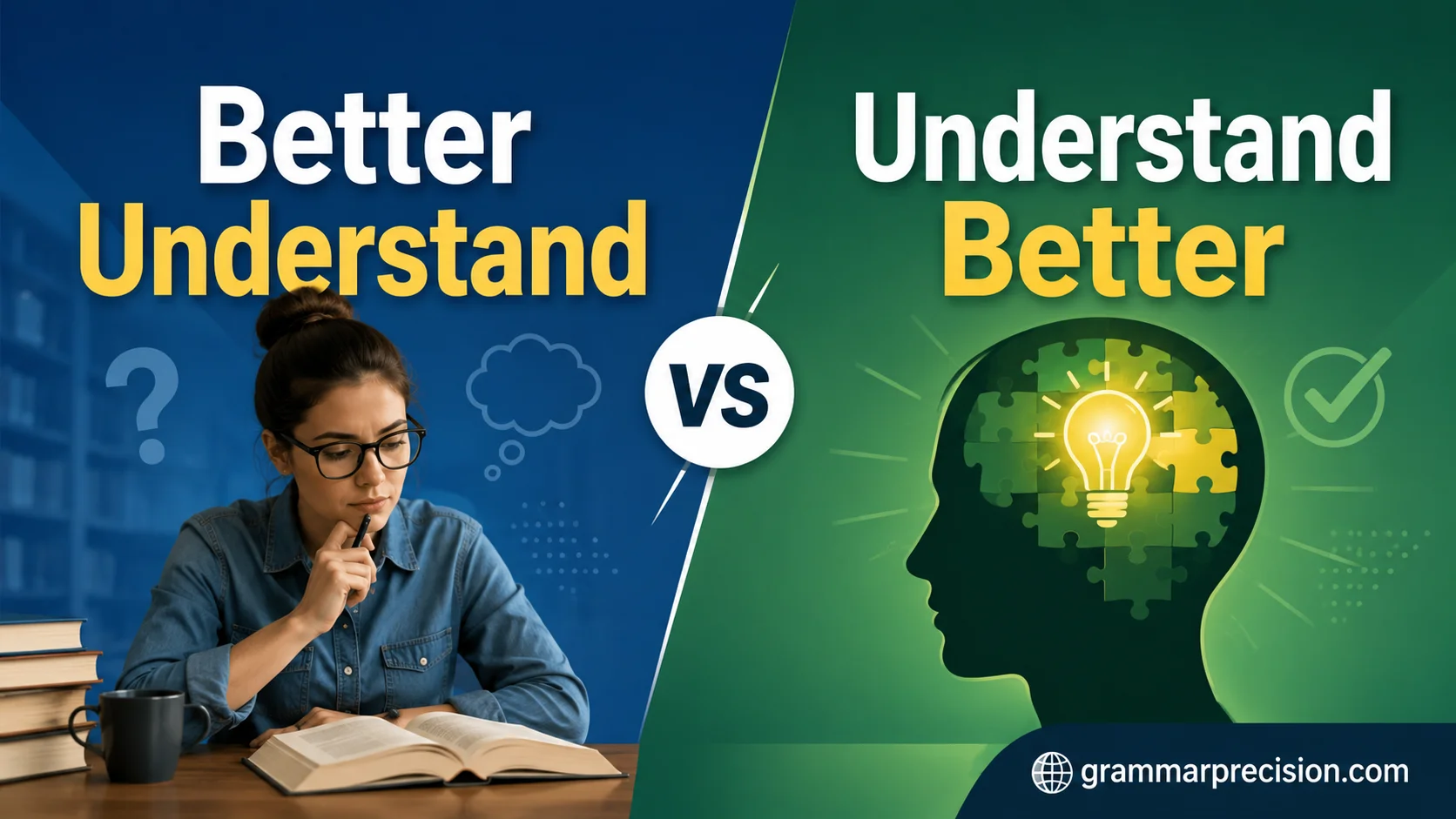
Better Understand vs Understand Better highlights how word order changes meaning in English. These similar phrases differ in tone, context, and purpose, helping learners communicate ideas more clearly and naturally.
Many learners struggle with word order, but understanding the main distinction between these phrases improves communication. Better Understand often appears near the beginning of a sentence, while Understand Better fits naturally at the end. Correct placement increases clarity, strengthens expression, improves sentence flow, and supports effective communication in writing and speech.
The discussion about split infinitives, grammar rules, and language usage often creates confusion. Research by Lunsford, Leonard, and Gilsdorf suggests that most readers, writers, and workplace readers focus more on clarity and meaningful communication than strict rules. Good language guidance helps learners achieve grammatical correctness and confidence.
What Does Better Understand vs Understand Better Mean in English?
Before comparing them, you need to understand each phrase separately. That’s where clarity starts.
What “Better Understand” Really Means
Better Understand vs Understand Better (Meaning of “Better Understand”)
The phrase “better understand” usually means:
To improve your level of understanding about something
It often appears in more formal or written English. You’ll see it in explanations, instructions, or reflective writing.
Example sentences:
- I read the article to better understand climate change.
- She asked questions to better understand the problem.
- We need data to better understand customer behavior.
Key idea:
“Better understand” focuses on the process of improving understanding, not the action of understanding itself.
It sounds slightly structured, almost academic. That’s why textbooks and reports use it more often.
What “Understand Better” Really Means
Better Understand vs Understand Better (Meaning of “Understand Better”)
The phrase “understand better” means:
To have improved understanding compared to before
It feels more natural in everyday speech.
Example sentences:
- I can understand better after your explanation.
- She listens carefully so she can understand better.
- You’ll understand better with practice.
Key idea:
This version focuses on the result of improved understanding, not the process.
It sounds smoother, more conversational, and more native like.
Key Grammar Difference Between Better Understand vs Understand Better
This is where things get interesting. The difference is not meaning—it’s structure and emphasis.
Let’s simplify it.
Word Order Matters More Than You Think
English uses word order to show what you want to emphasize.
- “Better understand” → emphasizes improving understanding
- “Understand better” → emphasizes the ability to understand
Even though both feel similar, they guide attention differently.
Simple Grammar Breakdown
| Phrase | Structure | Emphasis | Naturalness | Usage Type |
| Better understand | Adverb + verb | Process of improvement | Slightly formal | Writing, academic |
| Understand better | Verb + adverb | Result of improvement | Very natural | Speaking, daily use |
Why “Understand Better” Sounds More Natural
Here’s the key insight most learners miss:
English prefers verb first clarity.
So when you say:
I understand better now
It feels direct and natural.
But when you say:
I better understand the topic now
It feels slightly off in casual speech.
Not wrong. Just less common.
Think of it like wearing a suit to a picnic. It works, but it feels formal.
Context Changes Everything in Better Understand vs Understand Better
Grammar rules alone don’t decide which phrase you should use. Context does.
Let’s explore real life situations.
Formal Contexts (Better Understand Preferred)
You’ll often see “better understand” in:
- Academic writing
- Business reports
- Research papers
- Professional emails
Example:
- The survey helps us better understand consumer behavior.
Why it works here:
It sounds structured and professional.
Informal Contexts (Understand Better Preferred)
You’ll hear “understand better” in:
- Daily conversations
- Casual explanations
- Friendly discussions
Example:
- Now I understand better what you meant.
Why it works here:
It feels smooth and natural.
Also Read This: Attend or Tend? Meaning And Differences With Examples
Real Life Case Study: Classroom Conversation
Imagine a teacher explaining math.
Student A says:
I better understand the formula now.
It sounds slightly textbook like.
Student B says:
I understand better now.
This feels natural and conversational.
Both are correct. But Student B sounds more fluent.
That’s the subtle difference.
Common Mistakes with Better Understand vs Understand Better
Even advanced learners mess this up. Let’s fix that.
Mistake 1: Overthinking Word Order
Many learners pause and try to “translate” from their native language. That creates awkward phrasing.
Fix:
Think in meaning, not structure.
Mistake 2: Using “Better Understand” in Speech Too Often
It sounds stiff in casual talk.
Fix:
Use “understand better” when speaking.
Mistake 3: Mixing Formal and Informal Styles
Example:
I understand better the report.
This feels unnatural.
Fix:
Say:
I understand the report better.
Quick Rule to Remember
Here’s a simple mental shortcut:
- If you’re talking about improvement process → better understand
- If you’re talking about result of understanding → understand better
Comparison in Real Communication Scenarios
Let’s see how both phrases behave in real life.
Workplace Communication
- We need reports to better understand market trends.
- After training, I understand better how the system works.
Education Context
- Teachers use visuals to better understand lessons.
- Students understand better with practice.
Casual Conversation
- I think I understand better now.
- That explanation helped me understand better.
Table: Natural Usage Breakdown
| Situation | Preferred Phrase | Why |
| Academic writing | Better understand | Formal tone |
| Business report | Better understand | Structured language |
| Casual speech | Understand better | Natural flow |
| Learning explanation | Understand better | Easy rhythm |
Linguistic Insight: Why Word Order Feels Important
English depends heavily on syntax (word order) to show meaning.
Even small shifts change tone:
- “Only I saw him” vs “I only saw him”
The same idea applies here.
Word placement changes:
- Focus
- Rhythm
- Naturalness
That’s why “understand better” wins in everyday speech.
Expert Quote on Language Naturalness
Linguists often describe English as a “rhythm first language”.
“Natural English prioritizes flow over strict structural symmetry.”
That’s exactly what you see in this comparison.
Practice Section: Train Your Brain
Try filling in the blanks:
- I need to ______ the topic before the exam.
- After watching the video, I ______ now.
- The explanation helped me ______ the idea.
Answers:
- better understand
- understand better
- understand better
Related Confusing English Pairs
Once you understand this concept, others become easier.
- more clear vs clearer
- explain better vs better explain
- understand fully vs fully understand
English often flips word order depending on emphasis.
Mini Flowchart for Quick Decision
Use this mental path:
- Are you talking about learning/improving? → better understand
- Are you talking about result or experience? → understand better
- Still unsure? → use “understand better” (safer in speech)
Why Most Native Speakers Prefer “Understand Better”
Native speakers tend to:
- Speak faster
- Prefer smoother rhythm
- Avoid slightly formal phrasing in casual talk
That’s why “understand better” dominates conversations.
Final Summary: Better Understand vs Understand Better Made Simple
Let’s keep it crystal clear.
- Better understand → focuses on improving understanding, used in formal or written English
- Understand better → focuses on result, used in natural speech
Both are correct. But they live in different environments.
Think of them like two outfits:
- One is a suit (better understand)
- One is casual wear (understand better)
You wouldn’t wear a suit everywhere. Same idea applies here.
FAQs:
What is the difference between Better Understand and Understand Better?
The main difference is word order and placement within a sentence. Better Understand is often used before a verb phrase to introduce a concept, while Understand Better usually appears later in a sentence to highlight improvement in understanding.
Which phrase sounds more natural in English?
Both phrases are grammatically correct, but the most natural choice depends on the context, tone, and sentence structure. Native speakers use both forms, selecting the one that provides better clarity and communication.
Is “to better understand” a split infinitive?
Yes, “to better understand” is a split infinitive because the adverb better appears between “to” and the verb understand. However, modern grammar experts generally accept split infinitives when they improve readability and meaning.
Do professional writers avoid split infinitives?
Not always. Many writers, journalists, and language experts use split infinitives when they make a sentence sound more natural. Current language usage focuses more on effective communication than on following outdated rules.
Which phrase should English learners use?
English learners should use the phrase that best fits the message and context. Practicing both forms helps improve language learning, writing clarity, and overall communication skills.
Conclusion:
Understanding Better Understand vs Understand Better helps learners recognize how word order, sentence structure, and phrase placement affect meaning. Although the phrases are similar, their different positions can influence tone, clarity, and communication effectiveness.
Rather than focusing only on strict grammar rules, learners should prioritize natural expression, readability, and meaningful communication. With regular practice, both phrases can be used confidently to improve writing, speech, and overall English usage.