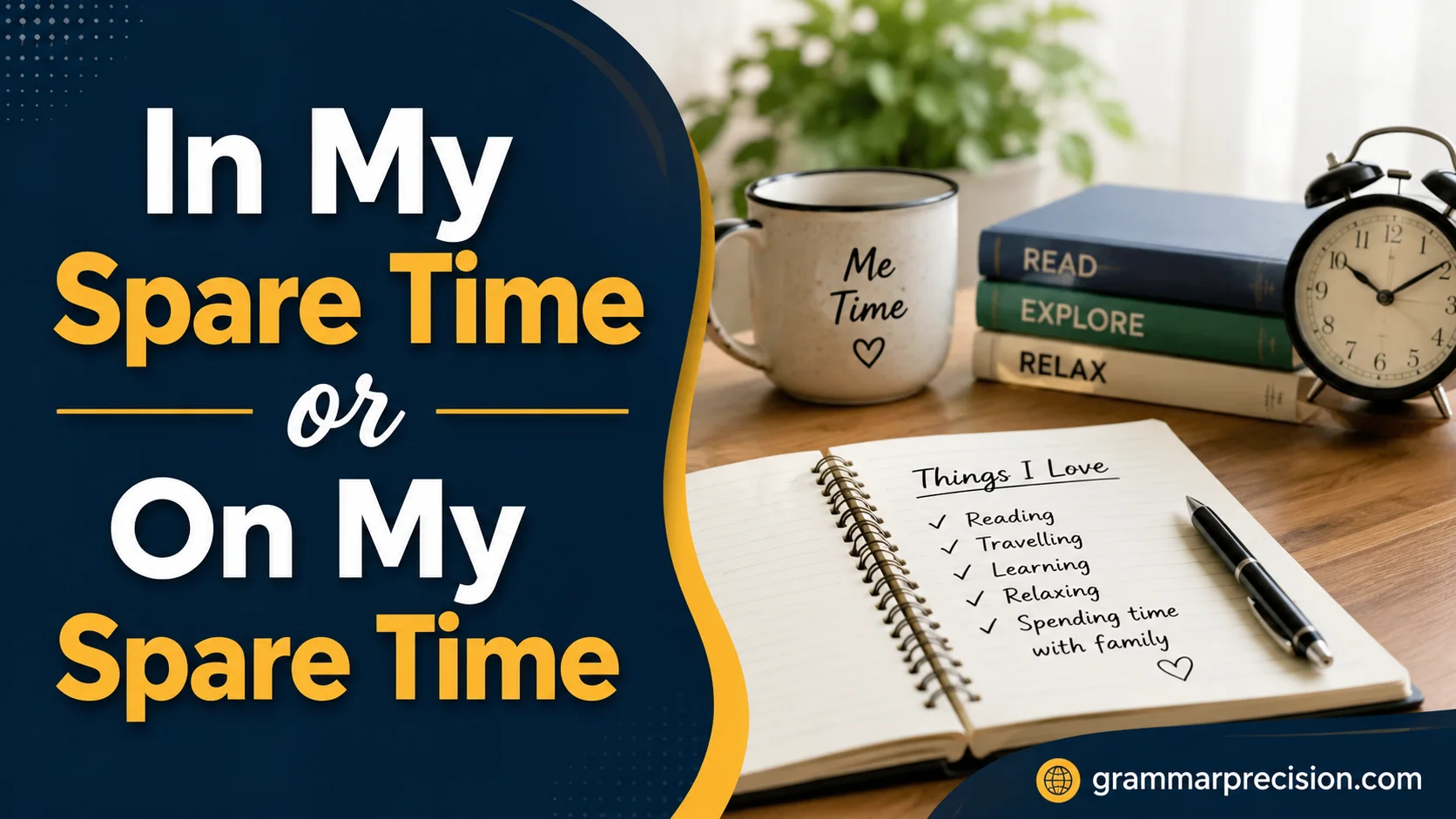
The phrase In My Spare Time or On My Spare Time often creates confusion among English learners. Understanding the correct phrase, its meaning, and usage can help you communicate more naturally in everyday conversations.
When talking about your free hours or activities outside your regular responsibilities, choosing the right expression is important. The phrase “in my spare time” is the standard and widely accepted form, while “on my spare time” is generally considered incorrect in English.
This article explains the meaning, differences, and proper usage of these phrases with clear examples. Learning this small grammar rule can improve your English fluency and help you avoid common mistakes in writing and speaking.
What Does “In My Spare Time” Mean?
“In my spare time” means during the free time you have when you are not working, studying, completing responsibilities, or handling important tasks.
Your spare time is the part of your day that belongs to you. It is when you choose what you want to do.
For example:
- I read books in my spare time.
- She learns French in her spare time.
- He plays basketball in his spare time.
In each example, the person does these activities outside their main responsibilities.
The phrase does not refer to a specific hour or day. Instead, it describes a general period when someone has free time.
Think of your daily schedule like a backpack. Work, school, and responsibilities fill most of the space. Your spare time is the extra room where you keep activities you enjoy.
Is “On My Spare Time” Correct?
The short answer is: No, “on my spare time” is not considered correct in standard English.
Although people sometimes say it because they translate directly from another language, native speakers usually find it unnatural.
The correct phrase is:
✅ I exercise in my spare time.
Not:
❌ I exercise on my spare time.
The reason comes down to English preposition rules.
We usually use “in” when talking about a period of time.
Examples:
- in the morning
- in the evening
- in the summer
- in my free time
- in my spare time
However, we use “on” for specific days, dates, and surfaces.
Examples:
- on Monday
- on my birthday
- on the weekend
- on the table
Because “spare time” represents a period, “in” fits naturally.
Why Do We Say “In My Spare Time” Instead of “On My Spare Time”?
The difference comes from how English views time.
English often divides time expressions into three categories:
| Preposition | Used For | Examples |
| In | Longer periods or general time periods | in my spare time, in the morning, in 2026 |
| On | Specific days or dates | on Friday, on July 10 |
| At | Exact times | at 5 PM, at midnight |
The phrase “spare time” does not describe a single point. It describes a flexible period.
For example:
“I watch movies in my spare time.”
This means:
- Maybe after work
- Maybe during weekends
- Maybe whenever free time appears
The exact moment does not matter. The activity happens somewhere inside that free period.
Breaking Down the Phrase “In My Spare Time”
Understanding each word makes the expression easier to remember.
Meaning of “In”
The word “in” shows that something happens inside a period, place, or situation.
Examples:
- I live in New York.
- She works in an office.
- They travel in summer.
With time, “in” creates the idea of being inside a period.
So:
In my spare time = inside the time that I have available.
Meaning of “Spare”
The word “spare” means extra, available, or unused.
Examples:
- a spare key = an extra key
- spare room = an extra room
- spare time = extra time
Your spare time is the time left after you complete your necessary tasks.
Meaning of “Time”
Here, “time” refers to free moments available for personal activities.
It does not mean a clock time like:
- 3:00 PM
- 7:30 AM
Instead, it means a period when you are free.
Real-Life Examples of “In My Spare Time”
Learning through examples makes grammar easier because you can see how people actually use the phrase.
Talking About Hobbies
Many people use this phrase when describing hobbies.
Examples:
- I paint pictures in my spare time.
- She writes short stories in her spare time.
- They play video games in their spare time.
These activities are not part of their main responsibilities.
Talking About Learning
People often mention spare time when discussing self-improvement.
Examples:
- I study coding in my spare time.
- He watches educational videos in his spare time.
- She practices English in her spare time.
Spare time is often where personal growth happens.
Talking About Relaxation
Not every free moment needs to be productive.
Examples:
- I listen to music in my spare time.
- I watch movies in my spare time.
- I spend time with my family in my spare time.
Relaxation is also a valuable use of free time.
“In My Spare Time” vs “Free Time”: Are They the Same?
Many learners wonder whether spare time and free time have the same meaning.
They are very similar, but there is a small difference.
| Phrase | Meaning | Example |
| Spare time | Extra time available after responsibilities | I read in my spare time |
| Free time | Time when you are not busy | I relax during my free time |
In daily conversation, people often use them interchangeably.
Examples:
- What do you do in your spare time?
- What do you do in your free time?
Both sentences sound natural.
However, “spare time” sometimes suggests that the time is limited or extra.
Common Mistakes With “In My Spare Time”
Many English learners make similar mistakes.
Using “On” Instead of “In”
Incorrect:
❌ I play football on my spare time.
Correct:
✅ I play football in my spare time.
Confusing “On Time” and “In Time”
These phrases look similar but have different meanings.
| Phrase | Meaning | Example |
| On time | Not late | She arrived on time |
| In time | Before it is too late | He finished in time |
| In my spare time | During free time | I read in my spare time |
A common mistake happens because learners remember “on time” and apply it everywhere. However, English expressions do not always follow direct patterns.
How Native Speakers Use “In My Spare Time” in Conversations
A common conversation question is:
“What do you do in your spare time?”
Here are natural answers:
Casual Answer
“I usually watch movies and spend time with my friends in my spare time.”
Professional Answer
“I enjoy learning new skills in my spare time, especially technology and writing.”
Student Answer
“I practice English and read articles in my spare time.”
Notice how people usually mention activities after the phrase.
Better Alternatives to “In My Spare Time”
Although “in my spare time” is the most common phrase, English offers several alternatives.
| Alternative | Example |
| In my free time | I exercise in my free time |
| During my downtime | I relax during my downtime |
| When I’m not working | I travel when I’m not working |
| Outside of work hours | I study outside of work hours |
These alternatives can make your writing and speaking more interesting.
How to Use “In My Spare Time” in Writing
This phrase works well in many situations.
In Essays
Example:
“Students can develop useful skills in their spare time by reading, practicing, and exploring new interests.”
In Job Interviews
Employers sometimes ask:
“What do you do in your spare time?”
A good answer can show personality.
Example:
“In my spare time, I enjoy reading business articles and improving my communication skills.”
In Daily Conversations
Example:
Friend: “What do you do after work?”
You: “I usually cook and exercise in my spare time.”
Also Read This: All Is vs All Are: Complete Grammar Guide
Quick Grammar Test
Choose the correct option:
I learn new skills ___ my spare time.
A) On
B) In
C) At
Correct answer:
✅ In
Sentence:
I learn new skills in my spare time.
FAQs:
What is the correct phrase: “In My Spare Time” or “On My Spare Time”?
The correct phrase is “in my spare time.” It is used when you talk about activities you do during your free time when you are not working, studying, or completing responsibilities. The phrase “on my spare time” is not considered grammatically correct in standard English.
What does “In My Spare Time” mean?
“In my spare time” means the time you have available after finishing your main duties and obligations. It refers to your personal free time when you can relax, enjoy hobbies, learn new skills, or do activities you like.
Why is “On My Spare Time” incorrect?
The phrase “on my spare time” is incorrect because the preposition “on” is not normally used with the word time in this situation. English speakers use “in” for periods of time, so the natural expression is “in my spare time.”
Can I use “In My Spare Time” in formal writing?
Yes, you can use “in my spare time” in both formal and informal writing. It is a common phrase used in essays, job applications, interviews, and everyday conversations to describe personal interests and activities.
What are some examples of “In My Spare Time”?
Examples of “in my spare time” include: “I read books in my spare time,” “She practices painting in her spare time,” and “They learn new languages in their spare time.” These examples show activities done during free hours.
Conclusion:
The phrase “in my spare time” is the correct and natural expression used in English to describe activities you do during your free time. Although “on my spare time” may sound understandable, it is not grammatically accepted. Using the correct phrase will make your English communication clearer, more accurate, and more fluent.