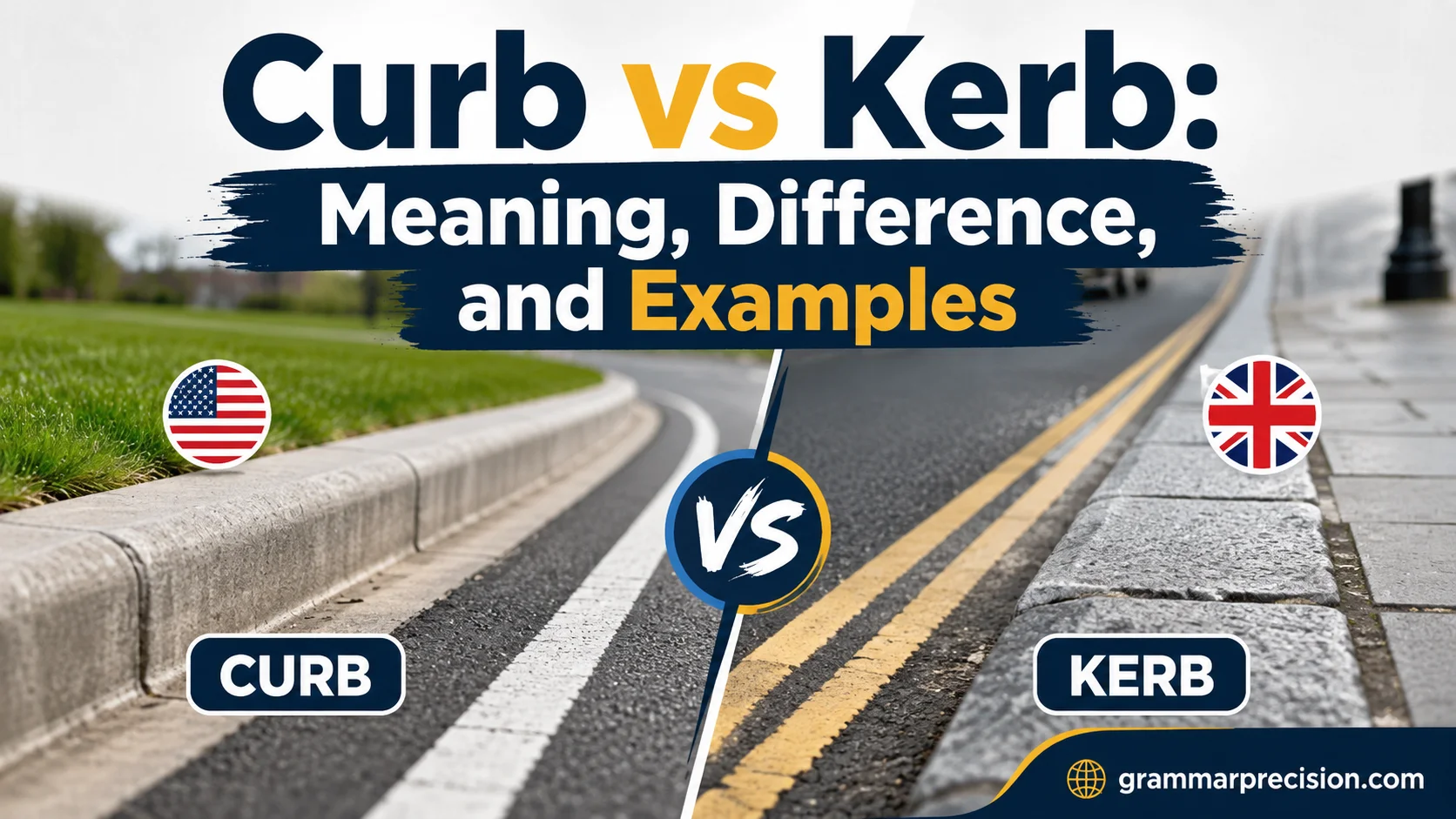
Curb vs Kerb explains how the same word can have different spellings in American English and British English, depending on regional usage and meaning.
In American English, curb is the preferred spelling for the stone, concrete, or edge beside a street or sidewalk. In British English, kerb is used for the same physical edge. This difference mainly reflects regional variation, while the basic meaning remains the same.
However, curb also works as a verb meaning to control, limit, check, or restrain something. This spelling stays the same in both varieties of English. For example, curbs on spending describe a limitation, while kerb refers only to the physical street edge.
Curb vs Kerb: Quick Answer
The simplest way to remember the difference is this:
- Curb is the standard American English spelling for the raised edge of a road.
- Kerb is the standard British English spelling for the same roadside feature.
- Curb also works as a verb meaning to control, limit, or restrain.
- Curb and kerb are pronounced the same in standard English.
- In British English, curb and kerb can have different meanings depending on the context.
For example:
American English: The car stopped beside the curb.
British English: The car stopped beside the kerb.
Both varieties: The government wants to curb unnecessary spending.
That final example is important. Even British English uses curb when the word means “restrain” or “control.”
So, the spelling isn’t simply a matter of personal preference. Your intended meaning and your audience both matter.
What Is a Curb?
A curb is the raised edge along a street where the roadway meets a sidewalk. In American English, this is the normal spelling for that roadside structure. A curb often consists of concrete or stone and creates a clear boundary between vehicles and pedestrians.
Imagine walking down a city street. The pavement rises slightly beside the road, creating a narrow boundary between the area where cars travel and the area where people walk. That raised boundary is the curb.
For example:
- The driver pulled over near the curb.
- Don’t park too close to the curb.
- She stepped off the curb and crossed the street.
- The delivery truck was parked along the curb.
However, curb has another important meaning.
Curb as a Verb
As a verb, curb means to control, restrain, reduce, or keep something within limits. This meaning appears in both American and British English.
For example:
- The city introduced new rules to curb pollution.
- He tried to curb his anger.
- The company needs to curb unnecessary spending.
- New measures could curb rising costs.
- She struggled to curb her enthusiasm.
Here, curb has nothing to do with roads.
Think of it as putting a brake on something. If you curb an action, emotion, habit, or trend, you stop it from getting out of control.
Curb as a Noun
The noun curb can also mean a restriction or restraint.
For example:
- The government placed curbs on excessive imports.
- New regulations introduced curbs on industrial pollution.
- The policy could put a curb on reckless spending.
This figurative sense comes from the broader idea of holding something back. Historically, the word developed from an older sense associated with restraining a horse.
That connection makes the modern meaning easier to understand: a curb physically marks an edge, while a figurative curb holds something back.
What Is a Kerb?
A kerb is the British English spelling for the raised edge separating a pavement from a road. In American English, the equivalent word is normally spelled curb.
For example:
- He sat on the kerb and waited for his friend.
- The driver mounted the kerb.
- Be careful when stepping off the kerb.
- The car was parked beside the kerb.
British English commonly uses pavement where American English uses sidewalk, which makes this vocabulary difference especially noticeable.
Is Kerb a Verb?
Kerb can function as a verb in specialized British usage, particularly in the sense of providing or enclosing something with a kerb. However, ordinary speakers are far more likely to encounter kerb as a noun for the roadside edge.
More importantly, don’t replace the figurative verb curb with kerb.
Correct:
The new policy aims to curb inflation.
Incorrect for standard everyday usage:
The new policy aims to kerb inflation.
When the meaning is control or restrain, stick with curb.
Curb vs Kerb: The Key Difference
At first glance, curb and kerb look like completely different words. They aren’t.
The roadside meanings developed from the same historical word. Kerb emerged as a spelling variant of curb and later became the preferred British spelling for the pavement edge in particular. Etymological sources trace the word back through Old French to Latin roots associated with bending or being curved.
Here’s the practical distinction:
| Feature | Curb | Kerb |
| American English roadside spelling | Yes | No |
| British English roadside spelling | No | Yes |
| Means “raised road edge” | Yes | Yes |
| Means “restrain/control” | Yes | Generally no |
| Common as a verb meaning “control” | Yes | No |
| Pronunciation | /kɜːrb/ or /kɝːb/ | /kɜːb/ |
| Common phrase | curb appeal | kerb appeal |
The most useful rule is simple: use the spelling that matches your variety of English, but use curb for the verb meaning “restrain.”
Curb vs Kerb in American English
American English keeps the spelling curb for both major everyday meanings.
That means an American writer can say:
The cyclist stopped at the curb.
And:
The government wants to curb illegal dumping.
Nothing changes in the spelling.
This makes American English slightly easier for learners because one spelling covers both the physical and figurative senses.
You’ll also see curb in common American expressions such as:
- curb appeal
- curbside pickup
- curbside service
- curb parking
- curb weight
- curb market
For example:
The restaurant offers curbside pickup for online orders.
The word curb can therefore appear in everyday speech, real estate, transportation, retail, government, and business writing.
Curb vs Kerb in British English
British English usually draws a clearer spelling distinction.
When referring to the edge between a pavement and roadway, use kerb:
The taxi pulled up beside the kerb.
When meaning restrain or control, use curb:
The company needs to curb costs.
This distinction is especially useful when writing for a British audience. A US-style curb for the roadside edge may look out of place in British prose, particularly in formal writing.
For instance:
British English:
The cyclist fell off the kerb.
American English:
The cyclist fell off the curb.
Neither sentence is inherently more correct. The correct choice depends on the English variety you’re following.
Curb vs Kerb Pronunciation
Here’s one reason this pair causes so many mistakes: they sound the same.
In standard pronunciation, both words use essentially the same sound. Cambridge lists the American pronunciation of curb as /kɜrb/, while British dictionary entries give kerb as /kɜːb/.
That means you generally can’t hear whether someone means curb or kerb.
The difference appears when the word is written.
This makes the pair a classic example of a spelling-based regional distinction. Think of it like two road signs pointing to the same destination but using different lettering.
Are Curb and Kerb Homophones?
In practical terms, yes. They share the same pronunciation while differing in spelling.
That creates a problem for learners because listening won’t always tell you which spelling to choose. Context and regional English do the heavy lifting.
If you’re writing American English, curb is the safe choice for the roadside feature.
If you’re writing British English, kerb is normally the right choice for that meaning.
Curb vs Kerb: Why Does English Have Two Spellings?
The difference comes from the long, messy history of English spelling.
English didn’t develop from one tidy source. It absorbed vocabulary from languages such as Latin, French, Norse, and Germanic languages. Spelling also changed gradually across centuries and regions.
Historical evidence shows that kerb appeared as a spelling variant of curb in the 1660s. Later, British English favored kerb for the stone edging along a pavement.
Interestingly, the older word had several related meanings. The sense connected with restraining a horse helped produce the later figurative meaning of curb as something that holds back or controls. The roadside meaning developed separately from the physical idea of an edge or raised boundary.
So, today’s difference isn’t random.
It’s the result of historical spelling development plus regional language change.
Curb Appeal vs Kerb Appeal
One of the most searched and commonly confused expressions is curb appeal versus kerb appeal.
The phrase refers to how attractive a property looks from the street.
In American English:
The house has excellent curb appeal.
In British English:
The house has excellent kerb appeal.
The meaning remains essentially the same. Only the regional spelling changes.
Real estate writers use the phrase when discussing features such as:
- Landscaping
- Exterior paint
- Front doors
- Windows
- Driveways
- Fences
- Lighting
- Gardens
- Overall street-facing appearance
For example, a freshly painted front door and neatly trimmed garden can improve a home’s curb appeal.
A British property listing would normally call the same quality kerb appeal.
Why Is Curb Appeal So Useful?
The phrase demonstrates a larger lesson about regional English: language differences often extend beyond isolated words.
Once you choose American or British English, related expressions should usually follow the same convention.
If your article uses American English throughout, write curb appeal.
If it follows British English, use kerb appeal.
Consistency matters more than choosing one variety as “better.”
Also Read This: In the Park or At the Park: The Complete Guide
Curb vs Kerb in a Sentence
Seeing the words side by side makes the distinction much easier.
American English Examples
The bus stopped close to the curb.
Please don’t leave your bicycle on the curb.
She stepped onto the curb before crossing.
The new rules aim to curb air pollution.
The homeowner improved the property’s curb appeal.
British English Examples
The bus stopped close to the kerb.
Please don’t leave your bicycle on the kerb.
She stepped onto the kerb before crossing.
The new rules aim to curb air pollution.
The homeowner improved the property’s kerb appeal.
Notice something important: curb remains unchanged when it means “control.”
That’s the detail many learners miss.
Common Collocations With Curb and Kerb
Learning common word combinations can make the distinction stick faster.
Common Curb Expressions
- curb appeal
- curbside pickup
- curbside service
- curb parking
- curb weight
- curb spending
- curb demand
- curb inflation
- curb pollution
- curb enthusiasm
- curb an impulse
- curb behavior
Common Kerb Expressions
- kerb appeal
- kerbside
- kerbside collection
- kerb stone
- kerb markings
- mount the kerb
- drop kerb
- high kerb
- low kerb
These combinations also reveal regional patterns. Curbside is strongly associated with American usage, while British English commonly uses kerbside.
Curb vs Kerb vs Related Road Vocabulary
English learners often encounter several US-versus-UK differences in the same sentence.
| American English | British English |
| curb | kerb |
| sidewalk | pavement |
| crosswalk | pedestrian crossing |
| parking lot | car park |
| apartment | flat |
| elevator | lift |
| truck | lorry |
| windshield | windscreen |
| trunk | boot |
Consider this sentence:
The truck stopped beside the curb near the parking lot.
A British writer might naturally phrase it:
The lorry stopped beside the kerb near the car park.
Neither version is wrong. They’re simply built from different regional vocabularies.
This matters when you’re editing an article, website, novel, or educational resource. Mixing varieties can make the writing feel inconsistent even when every individual word looks familiar.
How to Remember Curb vs Kerb
Here’s a quick memory trick.
Think “K = Kingdom.”
If you’re writing British English and you’re talking about the roadside edge, remember:
K = Kingdom → kerb
For American English:
C = curb → curb
Now add one more rule:
Control = curb
If you’re talking about controlling something, use curb regardless of whether your audience uses American or British English.
So:
Roadside edge + US → curb
Roadside edge + UK → kerb
Control or restrain → curb
That’s the entire system in three lines.
A Quick Practice Test
Choose the correct word:
- The car stopped beside the ___.
- The government wants to ___ pollution.
- The house has impressive ___ appeal.
- He accidentally drove onto the ___.
- The company needs to ___ spending.
For American English, the answers are:
curb, curb, curb, curb, curb
For British English:
kerb, curb, kerb, kerb, curb
The pattern becomes obvious once you separate roadside meaning from control meaning.
Common Mistakes to Avoid
Using Kerb for “Control”
This is perhaps the biggest mistake.
Don’t write:
The campaign will kerb unnecessary spending.
Write:
The campaign will curb unnecessary spending.
The verb meaning “control” is curb.
Assuming Curb Is Always American
That’s not quite right.
British English uses curb too when it means restraint or control.
For example:
The government introduced measures to curb inflation.
So, saying “curb is American English” oversimplifies the rule.
A better statement is:
American English uses curb for the roadside edge and for restraint. British English generally uses kerb for the roadside edge but curb for restraint.
Mixing Regional Spellings
A sentence such as this can look inconsistent in British English:
The property has great curb appeal and the car is parked beside the kerb.
A British publication would normally prefer:
The property has great kerb appeal and the car is parked beside the kerb.
Likewise, an American publication would normally use curb in both places.
Treating the Words as Completely Unrelated
They’re historically connected. Kerb developed as a spelling variant of curb, rather than appearing as an entirely separate unrelated word.
Understanding that connection makes the spelling difference much easier to remember.
Which Spelling Should You Choose?
The answer depends on your audience.
If You’re Writing for Americans
Use curb for the roadside edge.
The cyclist stopped at the curb.
Use curb for the verb.
The new law could curb pollution.
If You’re Writing for Britons
Use kerb for the roadside edge.
The cyclist stopped at the kerb.
Use curb for the verb.
The new law could curb pollution.
If You’re Writing for an International Audience
Choose one English variety and stick with it.
For an American-focused website, use American spelling consistently. For a British publication, use British conventions throughout.
The worst approach isn’t choosing American English or British English. It’s switching between them without a reason.
Consistency helps readers understand your writing quickly and makes your editorial style look deliberate.
Curb vs Kerb: A Practical Decision Guide
When you’re unsure, ask yourself these questions:
Are you talking about the edge of a road?
- American English → curb
- British English → kerb
Are you talking about controlling something?
- American English → curb
- British English → curb
Are you describing property appearance?
- American English → curb appeal
- British English → kerb appeal
Are you writing a British article?
Keep your roadside vocabulary British.
Are you writing an American article?
Keep your roadside vocabulary American.
This simple decision tree handles almost every everyday use.
FAQs:
What is the difference between curb and kerb?
Curb and kerb have the same basic meaning when referring to the edge of a street or sidewalk. Curb is standard in American English, while kerb is standard in British English.
Is curb American or British English?
Curb is the preferred spelling in American English and is also commonly used in Canadian English. In British English, kerb is normally used for the physical edge of a road.
Does curb have another meaning?
Yes. Curb can also be a verb meaning to control, limit, check, or restrain something. For example, “The government introduced measures to curb spending.”
Is kerb only used for a street edge?
In standard usage, kerb refers to the raised edge between a road and a sidewalk or pavement. Unlike curb, it isn’t normally used as the verb meaning to control or limit something.
Are curb and kerb interchangeable?
They are interchangeable only when referring to the same physical street edge, and the choice depends on regional English. Use curb in American English and kerb in British English.
Conclusion:
Curb vs Kerb mainly depends on regional spelling rather than a major difference in meaning. Use curb in American English and kerb in British English for a road or sidewalk edge.
Remember that curb can also mean to control, limit, or restrain something. Understanding this simple distinction will help you avoid confusion and use the correct word confidently.