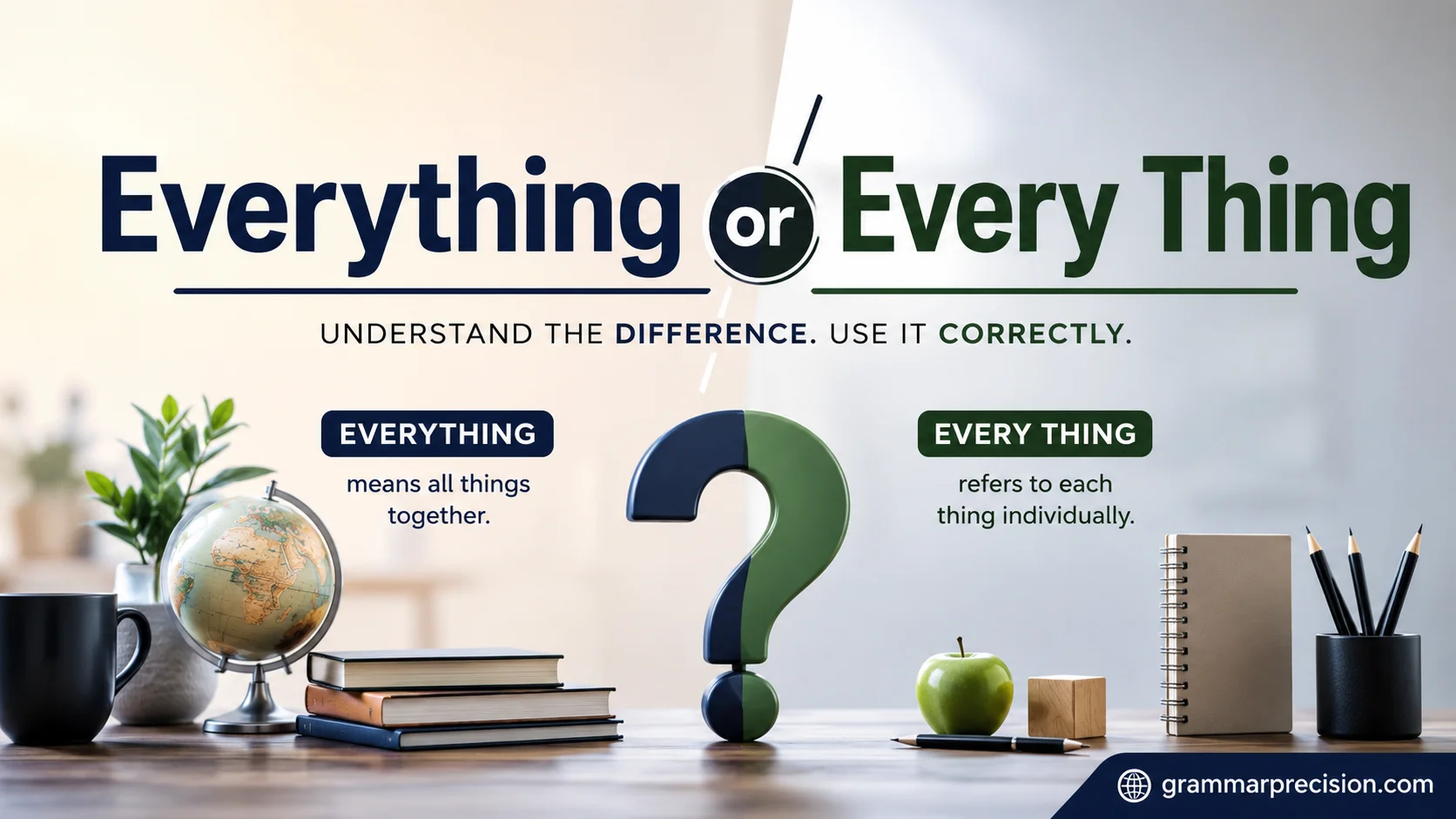
Understanding Everything or Every Thing can solve a common English grammar confusion that many writers face today. This guide explains the meaning, differences, and usage with simple examples for readers.
Many people confuse everything and every thing because the small space changes the meaning completely. This article explores the grammar rules, real-life examples, and practical tips to help you choose the correct form confidently. You will discover when to use each phrase and avoid common writing mistakes that affect clarity in everyday English communication skills.
English has many compound words that look similar but carry different meanings. Learning the difference between everything and every thing improves your writing accuracy and makes your sentences sound more natural. Whether you are writing emails, essays, or professional content, this simple guide provides clear explanations and useful examples to strengthen your overall language skills.
What Does Everything Mean?
Everything is an indefinite pronoun that means all things, all objects, all situations, or all ideas as a group.
It combines two words:
- Every = all individual items in a group
- Thing = an object, idea, event, or matter
Over time, these words merged into one compound word with a broader meaning.
Examples of Everything in Sentences
- Everything is ready for the meeting.
- I packed everything I need for the trip.
- She told me everything about her experience.
- Everything changed after that decision.
In these examples, the speaker does not focus on individual items. They mean the entire group.
For example:
“I cleaned everything in my room.”
This means the entire room was cleaned. The speaker is thinking about the room as a whole.
What Does Every Thing Mean?
Every thing means each individual thing separately.
Although it is grammatically possible, people rarely use it in normal conversation because everything already covers most situations.
You might see every thing when the writer wants to slow down the meaning and highlight separate items.
Examples of Every Thing
- Every thing on the checklist must be completed.
- The scientist examined every thing inside the container.
- She carefully labeled every thing in the collection.
Here, the focus is not on the whole group. The focus is on each separate item.
Compare these:
| Sentence | Meaning |
| I checked everything on the list. | I checked the whole list. |
| I checked every thing on the list. | I checked each individual item one by one. |
The difference is small but meaningful.
Everything vs Every Thing: The Main Difference Explained
The easiest way to understand the difference is to ask one question:
Are you talking about the group as a whole or each item separately?
| Word | Meaning | Common Usage |
| Everything | All things together | Everyday English |
| Every thing | Each individual thing | Rare, specific situations |
Think of it like looking at a basket of apples.
If you say:
“I ate everything in the basket.”
You mean all the apples.
If you say:
“I inspected every thing in the basket.”
You are focusing on checking each apple individually.
Why Do People Confuse Everything and Every Thing?
The confusion happens because English has many words that combine over time.
For example:
- Everyone
- Everybody
- Everything
- Everywhere
These words started as separate words but developed into single units.
English does this often because language changes naturally.
Consider:
- Every day = each day separately
- Everyday = normal or common
Example:
✅ I exercise every day.
(Each day)
✅ These are my everyday shoes.
(Normal shoes I use regularly)
The same pattern appears with:
- Everyone vs every one
- Everybody vs every body
- Everything vs every thing
Everything as a Compound Word
Compound words are created when two words join together to create a new meaning.
Examples:
| Compound Word | Original Words | Meaning |
| Everything | Every + thing | All things |
| Bedroom | Bed + room | A room with a bed |
| Football | Foot + ball | A type of sport |
| Notebook | Note + book | A book for writing notes |
The word everything works as one complete idea.
You usually do not break it apart.
When Should You Use Everything?
You should use everything when you mean:
- All objects
- All information
- All experiences
- All situations
- All possibilities
Common Situations Where Everything Works
Daily Conversations
Example:
“Did you bring everything?”
The person means all necessary items.
Professional Writing
Example:
“Everything discussed during the meeting will be included in the report.”
This refers to all points together.
Emotional Statements
Example:
“You mean everything to me.”
This does not mean separate objects. It means the entire value or importance of someone.
Also Read This: In My Spare Time or On My Spare Time: The Correct Phrase With Meaning
When Should You Use Every Thing?
You should use every thing only when you want to emphasize individual items.
This usually appears in:
- Technical writing
- Detailed instructions
- Scientific explanations
- Situations requiring precision
Example: Inventory Checking
Imagine a warehouse manager checking thousands of products.
They might say:
“Every thing in this warehouse has a barcode.”
The emphasis is on each separate object.
However, most writers would naturally say:
“Everything in this warehouse has a barcode.”
The second version sounds smoother.
Everything vs Every Thing vs All Things
These phrases look similar but have slightly different uses.
| Phrase | Meaning | Example |
| Everything | All things generally | Everything is finished. |
| Every thing | Each separate item | Every thing was inspected. |
| All things | More formal or philosophical | All things must change. |
Everything sounds natural in most conversations.
All things often appears in formal writing.
Example:
- “Everything happens for a reason.”
- “All things considered, this plan works.”
Both are correct, but the tone changes.
Common Mistakes With Everything and Every Thing
Mistake: Using Every Thing in Normal Sentences
Incorrect:
I forgot every thing at home.
Correct:
I forgot everything at home.
Why?
Because the speaker means all belongings, not each item separately.
Mistake: Confusing Every Day and Everyday
Incorrect:
I wear my every day jacket.
Correct:
I wear my everyday jacket.
The first means each day. The second describes a normal jacket.
Mistake: Breaking Compound Words Apart
Incorrect:
She knows every one in the office.
Correct:
She knows everyone in the office.
The meaning changes:
- Everyone = all people
- Every one = each individual person
Simple Trick to Remember Everything vs Every Thing
Use this memory trick:
Everything = One Big Group
Imagine putting all items into one box.
Everything means:
“All of it together.”
Example:
“I packed everything.”
Every Thing = Separate Pieces
Imagine looking at each item one by one.
Every thing means:
“Each individual item.”
Example:
“I checked every thing on the shelf.”
Real-Life Examples of Everything vs Every Thing
Example: Traveling
Everything:
“I have everything ready for my vacation.”
Meaning:
All travel items are prepared.
Every Thing:
“I checked every thing inside my suitcase.”
Meaning:
Each separate item was checked.
Example: Studying
Everything:
“I learned everything about the topic.”
Meaning:
All information.
Every Thing:
“I reviewed every thing listed in the textbook.”
Meaning:
Each individual point.
A Quick Grammar Test
Choose the correct option:
Sentence 1
“I need to buy ______ before the trip.”
Answer:
✅ Everything
Because you mean all needed items.
Sentence 2
“The inspector examined ______ inside the machine.”
Answer:
✅ Every thing
Because the focus is on separate components.
Sentence 3
“She explained ______ clearly.”
Answer:
✅ Everything
Because she explained all information.
FAQs:
What is the main difference between everything and every thing?
Everything means all things together as a complete group, while every thing refers to each individual item separately. In most everyday conversations and writing, everything is the correct choice because it sounds more natural and common.
Is everything always written as one word?
Yes, everything is almost always written as one word when you mean all things, ideas, situations, or objects together. For example, “I packed everything for my trip” means all necessary items were packed.
When should I use every thing instead of everything?
You should use every thing only when you want to focus on each separate item. This usage is rare and usually appears in technical writing, detailed instructions, or situations where individual objects need special attention.
Can everything and every thing be used interchangeably?
No, they cannot always be exchanged. Although they look similar, their meanings are different. Using every thing instead of everything can make a sentence sound unnatural or change the intended meaning.
How can I easily remember the difference between everything and every thing?
A simple trick is to remember that everything means “all of it together,” while every thing means “each thing separately.” If you are talking about a whole group, use everything. If you are talking about individual items, use every thing.
Conclusion:
Understanding the difference between everything and every thing helps you write clearer and more accurate English. Although both forms are grammatically possible, everything is the word you will use most often in daily conversations, professional writing, and general communication.
The phrase every thing has a more specific purpose and works best when you want to highlight individual items one by one. By remembering this simple rule, you can avoid common grammar mistakes and make your writing sound more natural, confident, and polished.