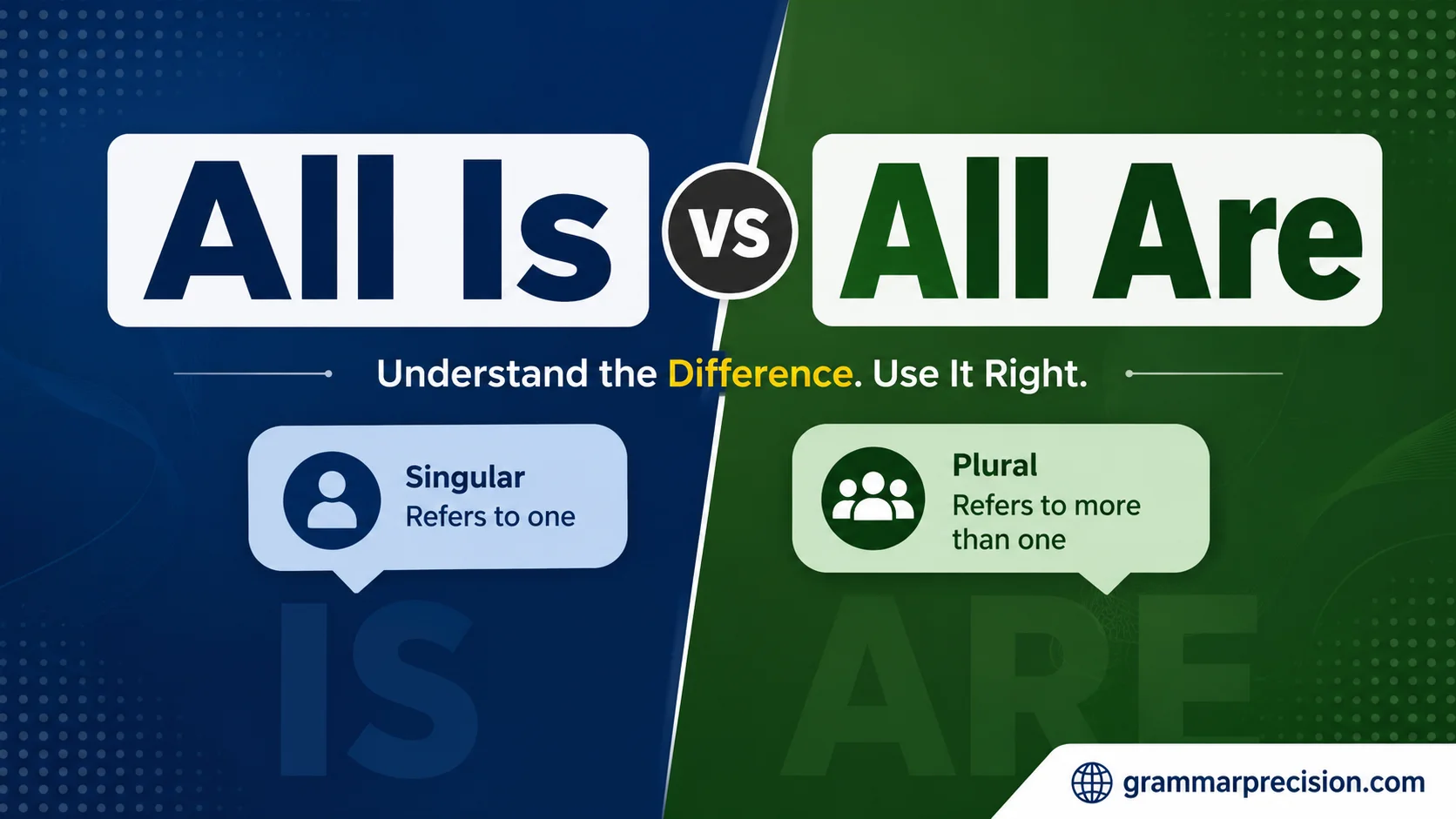
All Is vs All Are is a common grammar confusion that affects many writers. Understanding the correct usage helps you choose the right verb and improve your English accuracy in daily writing.
Many people struggle with All Is vs All Are because the word “all” can refer to one complete idea or multiple things. This guide explains the grammar rules, examples, and simple tricks to help you use both forms correctly.
Whether you are writing an email, essay, or professional document, knowing when to use “all is” and “all are” makes your sentences sound more natural, clear, and grammatically correct. Learn the difference with easy explanations and practical examples.
Is It “All Is” or “All Are”? The Quick Answer
The correct choice depends on whether the subject behind all is singular or plural.
| Phrase | When to Use | Example |
| All is | When “all” refers to one whole thing or an uncountable idea | All is well. |
| All are | When “all” refers to multiple people or things | All are ready. |
Think of “all” like a container. Sometimes the container holds one complete idea. Other times, it holds many separate items.
For example:
- All is lost.
Here, “all” means the entire situation. - All are invited.
Here, “all” means every person in a group.
The word “all” stays the same, but the verb changes because the meaning changes.
Why Do People Confuse All Is vs All Are?
The confusion happens because “all” does not always show whether the subject is singular or plural.
Words like:
- everyone
- somebody
- each
- many
- several
give clearer clues. But “all” can represent different ideas depending on the sentence.
Consider these examples:
All is expensive.
This sounds incomplete because we need to know what “all” means.
Now compare:
All is expensive when it comes to quality materials.
Here, “all” refers to the entire situation or concept.
But:
All are expensive.
This suggests multiple items.
Example:
All are expensive cars.
The cars are separate objects, so we use are.
What Does “All” Mean in English Grammar?
The word “all” is a determiner, pronoun, and sometimes part of an expression.
It generally means:
- the complete amount of something
- every person in a group
- every item in a category
Examples:
- All students passed the exam.
- All water contains minerals.
- All is forgiven.
The meaning changes depending on what comes after it.
When to Use “All Is”
All Is When “All” Represents One Complete Idea
Use “all is” when you talk about something as one whole unit.
Examples:
All is well.
This does not mean every individual thing is well separately. It means the overall situation is fine.
More examples:
- All is ready for the event.
- All is forgiven between them.
- All is lost after the accident.
- All is fair in love and war.
In these sentences, “all” acts like a single concept.
All Is With Uncountable Nouns
Uncountable nouns describe things we usually cannot count individually.
Examples:
- water
- money
- time
- information
- advice
- furniture
When “all” refers to an uncountable noun, use is.
Examples:
✅ All is water damage from the flood.
✅ All is information we already knew.
However, these sentences are less common in everyday English. Native speakers often rewrite them.
A more natural version:
- All of the damage is from the flood.
- All of the information is useful.
This brings us to an important point.
“All Of” Changes the Sentence Structure
Many mistakes happen because people ignore the noun after all of.
Look at these examples:
Singular noun:
All of the cake is gone.
Cake is one whole thing, so we use is.
Plural noun:
All of the cakes are gone.
Cakes are separate items, so we use are.
Uncountable noun:
All of the money is missing.
Money is uncountable, so we use is.
When to Use “All Are”
All Are When You Mean Multiple People or Things
Use “all are” when you refer to a group of separate items or people.
Examples:
- All are welcome.
- All are invited to the meeting.
- All are responsible for their actions.
- All are waiting outside.
Here, “all” means every individual member.
All Are With Plural Countable Nouns
Countable nouns have separate units.
Examples:
- books
- students
- cars
- houses
- ideas
Use are with these.
Examples:
✅ All books are useful.
✅ All students are prepared.
✅ All employees are working today.
Each student, book, or employee exists separately.
All Is vs All Are Comparison Table
| Sentence | Correct? | Reason |
| All is well. | ✅ Correct | Refers to one overall situation |
| All are ready. | ✅ Correct | Refers to multiple people |
| All students is ready. | ❌ Incorrect | Students are plural |
| All money are gone. | ❌ Incorrect | Money is uncountable |
| All money is gone. | ✅ Correct | Money acts as one amount |
| All the players are here. | ✅ Correct | Players are separate people |
| All the food is finished. | ✅ Correct | Food is one amount |
The Simple Trick to Choose Between All Is and All Are
Here is an easy method:
Step One: Find the Real Noun
Do not focus only on the word all.
Look at what it represents.
Example:
All of the students are studying.
Real noun: students
Students = plural
Answer: are
Step Two: Ask “Can I Count It?”
If yes → use are
Example:
- books
- people
- cars
If no → use is
Example:
- water
- money
- information
Step Three: Check If You Mean One Whole Idea
Sometimes “all” means everything together.
Example:
All is forgiven.
You are not counting forgiven things. You mean the entire situation.
Also Read This: Case in Point or Case and Point: Which Is Correct?
Common Mistakes With All Is vs All Are
Mistake 1: Using “All Are” With Uncountable Nouns
Incorrect:
❌ All the money are gone.
Correct:
✅ All the money is gone.
Why?
Because money is treated as one amount.
Mistake 2: Using “All Is” With Plural People
Incorrect:
❌ All students is ready.
Correct:
✅ All students are ready.
Students are individual people.
Mistake 3: Following the Word Closest to the Verb
This mistake is common.
Example:
All of the students in the classroom are ready.
Some people see “classroom” and think singular.
But the real subject is:
students
So:
Students → are
Real-Life Examples of All Is vs All Are
Everyday Conversation
All is good.
Meaning: Everything is fine.
All are welcome.
Meaning: Everyone can join.
Workplace Examples
All employees are required to attend the meeting.
The employees are separate people.
All is prepared for tomorrow’s presentation.
The whole situation is ready.
Academic Writing Examples
All research is based on reliable sources.
Research is uncountable.
All studies are reviewed before publication.
Studies are separate pieces of research.
Why Native Speakers Sometimes Use Both Forms
English is flexible. Sometimes speakers choose a verb based on meaning rather than strict grammar.
For example:
All is lost.
This sounds natural because it refers to an entire situation.
But:
All are lost.
This means multiple people or things are missing.
Compare:
- The team lost everything. → All is lost.
- The hikers disappeared. → All are lost.
Same word. Different meaning.
Case Study: How Small Changes Affect Meaning
Consider these sentences:
Example 1:
All is ready.
Meaning:
The entire preparation is complete.
Example 2:
All are ready.
Meaning:
Every person or item is prepared.
Example 3:
All of the equipment is ready.
Equipment is uncountable.
Example 4:
All of the machines are ready.
Machines are countable.
A tiny change creates a completely different grammar choice.
Quick Practice Quiz: All Is vs All Are
Choose the correct option.
1. All ___ invited to the party.
A) is
B) are
Answer: are
2. All ___ well now.
A) is
B) are
Answer: is
3. All of the information ___ correct.
A) is
B) are
Answer: is
4. All students ___ required to register.
A) is
B) are
Answer: are
5. All of the food ___ finished.
A) is
B) are
Answer: is
All Is vs All Are Cheat Sheet
Remember these simple rules:
| If “all” refers to… | Use |
| One complete situation | is |
| Uncountable nouns | is |
| Multiple people | are |
| Plural countable nouns | are |
A quick memory trick:
One whole thing = IS
Many separate things = ARE
Related Grammar Rules You Should Know
Understanding all is vs all are helps with similar grammar patterns.
None Is vs None Are
Example:
- None is better than this option.
- None of the students are absent.
Each Is vs Each Are
“Each” always takes a singular verb.
Example:
- Each student is ready.
Not:
- Each student are ready.
Everyone Is vs Everyone Are
“Everyone” always uses is.
Example:
- Everyone is happy.
Not:
- Everyone are happy.
FAQs:
What is the difference between All Is and All Are?
The difference between All Is and All Are depends on what the word “all” refers to. Use “all is” when you talk about one complete idea, situation, or an uncountable amount. Use “all are” when you refer to multiple people, objects, or countable things.
Is “All Is” always grammatically correct?
No, “all is” is only correct in specific situations. It works when all represents a single concept or whole situation. For example, “All is well” means the entire situation is good. It is not used for separate people or items.
When should I use “All Are” in a sentence?
You should use “all are” when you are talking about multiple people or things. For example, “All students are ready” is correct because students are separate individuals. The plural subject requires the verb are.
Can “All Is” and “All Are” both be correct?
Yes, both forms can be correct depending on the meaning of the sentence. For example, “All is lost” refers to one overall situation, while “All are lost” means multiple people or things are missing. The context decides the correct choice.
How can I easily remember the difference between All Is and All Are?
A simple trick is to check whether you mean one whole thing or many separate things. If it is one complete idea or uncountable noun, use is. If it refers to multiple countable items or people, use are.
Conclusion:
Understanding All Is vs All Are becomes much easier when you focus on the meaning behind the word “all.” The choice between is and are depends on whether you are describing a single idea, uncountable amount, or multiple separate things. By identifying the real subject in a sentence, you can avoid common grammar mistakes and make your writing more clear, natural, and professional.