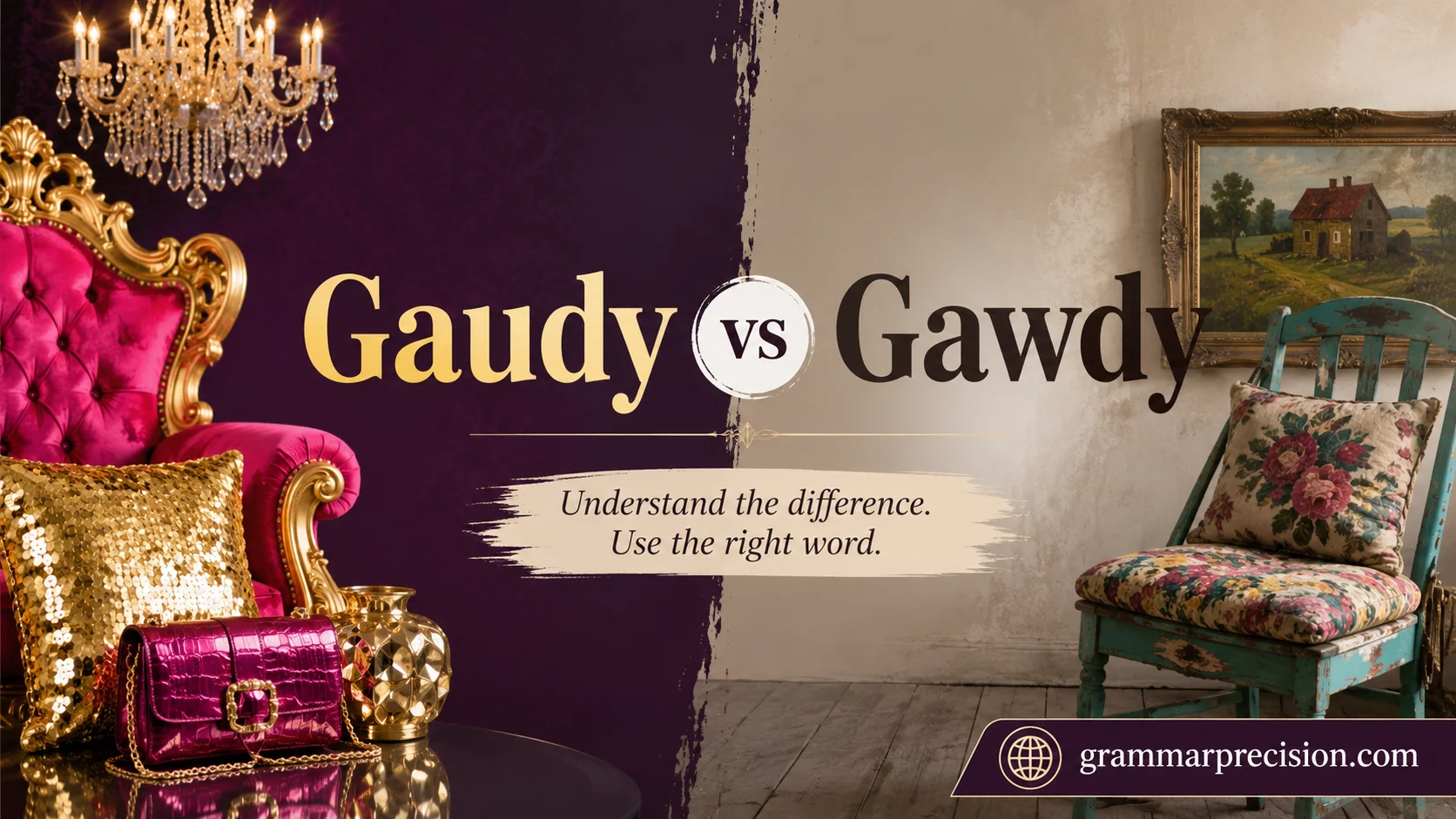
Gaudy vs Gawdy is a confusing pair of words that sound similar but have distinct meanings, often causing confusion among learners when they encounter them in writing, speaking, and everyday informal language usage.
Gaudy is a legitimate English adjective meaning something extravagantly, bright, showy, or even tasteless, often seen in neon lights, casino displays, visible for miles, creating a bold visual impression in real-life situations.
Gawdy is a common misspelling not found in standard dictionaries, so it should be avoided in writing and speaking, as it reduces clarity, weakens communication, and can lead to embarrassing mistakes in formal and informal contexts.
Gaudy vs Gawdy: The Quick Answer You Actually Need
Let’s start with the truth, no fluff.
- Gaudy = the correct word
- Gawdy = a common misspelling
That’s it.
But here’s where it gets more interesting. Most people don’t just misspell it by accident. They think “gawdy” looks right because of pronunciation habits and visual guessing.
Before we go deeper, here’s a simple breakdown:
| Word | Status | Meaning | Usage |
| Gaudy | Correct English word | Bright, flashy, overly decorated | Formal + informal writing |
| Gawdy | Incorrect spelling | Not recognized in standard English dictionaries | Avoid |
So if you are writing anything important, gaudy is the only correct choice.
What “Gaudy” Really Means in English
The word gaudy describes something that is overly bright, showy, or excessively decorated.
It often carries a slightly negative tone, but not always.
Simple meaning
Something that tries too hard to look attractive but ends up looking loud or excessive.
Everyday examples
- A room filled with neon lights and gold decorations might look gaudy
- A dress covered in glitter, sequins, and bold colors could be described as gaudy
- A website overloaded with animations, colors, and pop ups might feel gaudy
Tone matters
“Gaudy” is flexible. Depending on context, it can mean:
- Negative: Too flashy, tasteless, overwhelming
- Neutral: Just visually bold
- Creative praise: Intentionally dramatic or artistic
Example sentences
- The mansion looked gaudy, with gold trim on every surface.
- Her outfit was bold, not exactly gaudy, but definitely attention grabbing.
- The shop’s signage felt a bit gaudy for a luxury brand.
Is “Gawdy” Even a Word?
Here’s where things get interesting.
The word gawdy is not recognized in standard English dictionaries like:
- Oxford English Dictionary
- Merriam Webster Dictionary
- Cambridge Dictionary
It is simply a misspelling of gaudy.
But if it is not a real word, why does it appear so often?
The answer is simple: human behavior + digital writing habits.
Why People Confuse Gaudy and Gawdy
This confusion doesn’t happen randomly. It comes from a few predictable patterns.
Pronunciation illusion
When spoken aloud, gaudy sounds like:
“gaw dee”
So the brain naturally assumes the spelling should match the sound, leading to “gawdy.”
Influence of similar words
English already has words like:
- tawdry
- bawdy
- rawdy (informal slang usage in some dialects)
So “gawdy” feels like it should exist.
Autocorrect and informal typing
Sometimes:
- Autocorrect doesn’t flag it immediately
- People reuse incorrect spellings they see online
- Social media spreads the mistake quickly
Visual guessing habit
Many people spell based on how a word “looks right,” not actual rules.
That’s a big reason this confusion survives.
The Origin and History of “Gaudy”
To really understand gaudy vs gawdy, it helps to look at where the word actually comes from.
Etymology of “Gaudy”
The word gaudy has roots in older English usage tied to celebration and ornamentation.
Historically, it was linked to:
- Bright decorations
- Festive events
- Elaborate design styles
Over time, the meaning shifted slightly toward “overly decorated” or “flashy in excess.”
Historical usage shift
| Era | Meaning of Gaudy |
| Early usage | Festive, celebratory, bright |
| Middle usage | Decorative, ornamental |
| Modern usage | Overly flashy, sometimes tacky |
So the word didn’t always sound negative. It evolved over centuries.
Why “Gawdy” Spread Online
Even though it is incorrect, “gawdy” still spreads across the internet.
Here’s why:
Social media repetition
One misspelling gets copied thousands of times.
Example:
- A caption says “gawdy outfit”
- Others repeat it without checking
- Algorithms reinforce visibility
Informal communication
In texting and casual posts, accuracy often takes a back seat to speed.
Lack of correction pressure
Unlike formal writing, social media rarely corrects spelling errors.
Gaudy vs Gawdy in Real Life Usage
Let’s look at how these show up in actual writing environments.
Common real world mistakes
- “Her dress was very gawdy at the wedding.”
- “The room decor looks gawdy and bright.”
- “I like simple designs, not gawdy stuff.”
All of these should be corrected to gaudy.
Case Study: Why This Mistake Appears in Student Writing
A review of common writing errors in academic essays shows patterns like this:
Observed behavior
Students often:
- Spell words phonetically
- Depend on speech rather than spelling memory
- Copy peer writing errors
Example correction flow
| Student Version | Correct Version |
| The hall was gawdy and colorful | The hall was gaudy and colorful |
| She wore a gawdy dress | She wore a gaudy dress |
Key takeaway
Most errors are not knowledge gaps they are habit errors.
Synonyms of Gaudy (Better Word Choices for Writers)
Sometimes you don’t just want to avoid the misspelling you want better vocabulary.
Here are strong alternatives:
- Flashy
- Overdone
- Loud
- Ornate
- Showy
- Garish
- Excessive
- Flamboyant
When to use each one
| Word | Best Use Case |
| Flashy | Neutral or slightly positive style |
| Garish | Strong negative tone |
| Ornate | Artistic or decorative context |
| Flamboyant | Fashion or personality descriptions |
Gaudy in Fashion, Design, and Culture
The word appears frequently in creative industries.
Fashion
A “gaudy outfit” usually means:
- Too many colors
- Excessive shine
- Over accessorized look
Interior design
A gaudy interior might include:
- Gold plated furniture
- Heavy patterns
- Bright mismatched colors
Marketing and branding
In branding, being gaudy can hurt credibility.
However, in some industries like entertainment or stage performance, it can be intentional.
Psychological Reason People Like “Gaudy” Things
Here’s something interesting most articles miss.
Even though “gaudy” often sounds negative, people are still drawn to it.
Why?
- Bright colors grab attention quickly
- Over stimulation can feel exciting
- Visual complexity can feel luxurious in some cultures
- Social media rewards bold visuals
So what looks “gaudy” to one person might feel “luxurious” to another.
How to Never Confuse Gaudy vs Gawdy Again
Let’s make this stick in your memory.
Easy memory tricks
- Gaudy = G is for “Good spelling”
- Think “aUdy” → like “audience” → correct English structure
- Remember: dictionaries only accept gaudy
Quick checklist before writing
- Did I use “gawdy”? → Fix it
- Does it appear in dictionary tools? → No = incorrect
- Am I writing formally? → Always use gaudy
Also Read This: Breath vs. Breathe
Comparison Table: Gaudy vs Gawdy Explained Simply
| Feature | Gaudy | Gawdy |
| Dictionary status | Valid | Invalid |
| Meaning | Flashy or overly decorated | None |
| Usage in writing | Correct | Incorrect |
| Academic acceptance | Yes | No |
| SEO relevance | High | Negative (misspelling signal) |
Why This Confusion Matters for Writers
You might think this is a small spelling issue, but it matters more than you expect.
SEO impact
Search engines:
- Recognize correct spelling better
- Penalize consistent misspellings in content quality signals
Credibility impact
Readers may assume:
- Lack of attention to detail
- Low writing accuracy
Professional writing impact
Editors and clients expect:
- Clean spelling
- Standard vocabulary usage
- No repeated errors
So fixing “gaudy vs gawdy” isn’t just grammar it’s professionalism.
Expert Insight: Language Experts on Misspellings
Linguists often point out a simple truth:
“Most spelling errors survive because they feel visually or phonetically correct, not because they are logically correct.”
That perfectly explains why “gawdy” spreads even though it’s wrong.
FAQs:
What does Gaudy mean in simple English?
Gaudy means something bright, showy, or too colorful, often in a way that looks tasteless or over-decorated, especially in visual design or appearance.
Is Gawdy a correct English word?
No, Gawdy is a common misspelling of Gaudy. It is not accepted in standard English dictionaries, so it should be avoided in writing and speech.
Why do people confuse Gaudy and Gawdy?
People get confused because both words sound similar and look almost identical, which creates spelling confusion in informal writing and learning stages.
Where is Gaudy commonly used?
Gaudy is often used to describe neon lights, decorations, or anything that is excessively bright or visually overwhelming, especially in descriptive writing.
How can I avoid using Gawdy by mistake?
You can avoid it by remembering the correct spelling Gaudy, practicing it in writing, and checking reliable dictionaries to improve language accuracy.
Conclusion:
Gaudy vs Gawdy is an important language distinction that improves writing clarity and communication skills. Understanding that Gaudy is the correct English word while Gawdy is a misspelling helps avoid confusion and embarrassing mistakes.
With proper practice, learners can strengthen their vocabulary, improve accuracy, and use language more confidently in both formal and informal contexts.