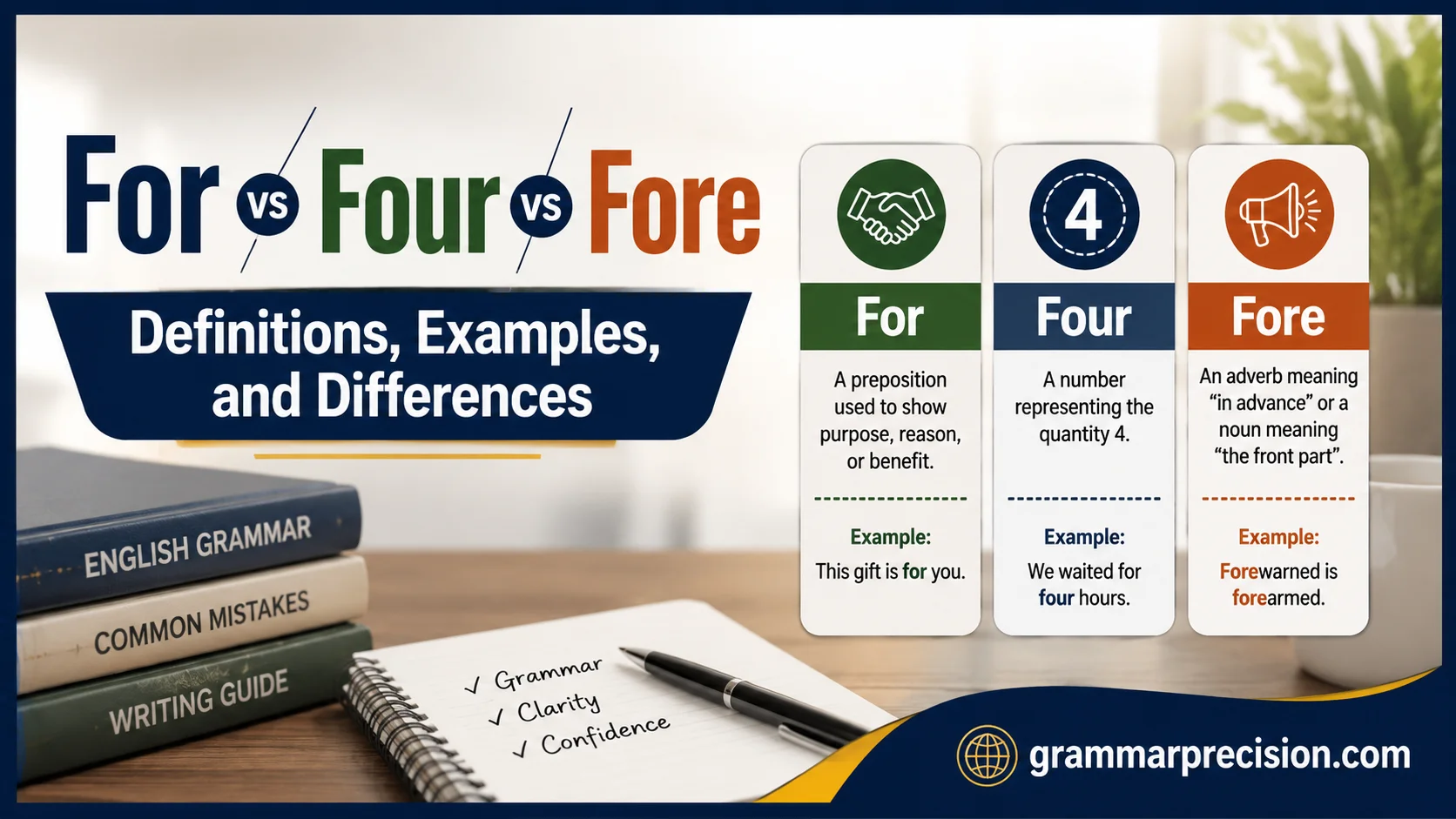
For vs Four vs Fore can be confusing because these homophones sound alike but have different spellings, meanings, and uses. Learning their roles makes your writing clearer and more accurate.
For is a preposition used to show purpose, time, exchange, or reasoning. Four is a number representing a quantity between three and five. Fore refers to the front or serves as a warning on golf courses when an errant golf ball may approach.
Remember that For, Four, and Fore aren’t interchangeable. Use For for purpose or exchange, Four for the number 4, and Fore for the front or a golf warning. Understanding this simple distinction helps you avoid common spelling mistakes and communicate your intended meaning clearly.
For vs Four vs Fore: What’s the Difference?
The simplest distinction is based on meaning.
| Word | Main meaning | Common role | Example |
| for | purpose, benefit, reason, duration, or connection | Preposition; sometimes conjunction | This gift is for you. |
| four | the number 4 | Noun, determiner, pronoun | She bought four apples. |
| fore | front, earlier position, or a golf warning | Noun, adjective, prefix, or interjection | The golfer shouted fore! |
Although the words share a pronunciation in most varieties of modern English, spelling carries the meaning. That matters especially in writing because a spell-checker may not catch the mistake. A sentence such as “I have four you” can contain correctly spelled English words while still making no sense.
The quick rule
Think of the three words this way:
- FOR → connects something to a purpose, person, reason, or time.
- FOUR → means 4.
- FORE → points to the front or warns people on a golf course.
For example, compare these sentences:
I waited for four hours.
Here, for introduces a duration while four gives the number.
The golfer yelled fore!
Here, fore is a warning that a ball may be heading toward someone.
That tiny spelling difference can completely change the sentence.
What Is “For”?
For is one of the most common words in English. It usually works as a preposition, although it can also appear as a conjunction in formal or literary constructions.
As a preposition, for often shows a relationship between an action or thing and its purpose, recipient, reason, duration, or intended use.
For shows purpose
Use for when you explain why something is intended or used.
- This knife is for cutting bread.
- She went to the library for research.
- We need a container for storing rice.
- He bought a notebook for class.
In these examples, for answers a question such as “What is it for?” or “Why is it being used?”
For shows benefit or a recipient
You can also use for when something is intended to benefit someone.
- I bought this present for my brother.
- There’s a message for you.
- She cooked dinner for her family.
- This seat is for senior passengers.
A useful test is to replace for with “intended for.” If the meaning still works, for may be the right choice.
For shows duration
One of the most familiar uses of for involves time.
- We stayed there for four days.
- She worked for three hours.
- I’ve lived here for ten years.
- They talked for a few minutes.
Notice the relationship between the two target words in the first sentence: for tells you the duration, while four tells you the number.
For shows reason or cause
For can also explain a reason, particularly in expressions involving gratitude, apology, or explanation.
- Thank you for your help.
- I’m sorry for the confusion.
- He was praised for his honesty.
- They blamed the delay for the missed connection.
In everyday American English, other structures such as “because of” may sound more natural in some contexts. Still, for remains extremely common.
For appears in fixed expressions
English contains hundreds of phrases built around for.
Common examples include:
- for example
- for now
- for sure
- for free
- for good
- for a while
- for the first time
- for this reason
Because these expressions are so common, mastering for gives you a major advantage in everyday writing.
What Is “Four”?
Four is the written form of the number 4. It represents a quantity greater than three and less than five.
Unlike for, which often connects ideas grammatically, four identifies a specific number.
Four as a quantity
Use four when you mean exactly 4 things, people, units, or events.
- We need four chairs.
- She has four brothers.
- The box contains four batteries.
- He ordered four pizzas.
A quick substitution test works well here. If you can replace the word with the numeral 4, you almost certainly need four.
She bought four books.
becomes:
She bought 4 books.
The meaning stays the same.
Four in measurements, scores, and data
You’ll encounter four throughout practical writing.
- The meeting lasted four hours.
- The temperature dropped by four degrees.
- The team won four to two.
- He scored four points.
- The package weighs four kilograms.
In formal writing, spelling out small whole numbers is often a style choice rather than an absolute grammar rule. The important point here is meaning: when the word represents 4, spell it four.
Four in common expressions
Several familiar English expressions contain four:
- four times
- four days
- four corners
- four seasons
- four wheels
- four-year-old
- four out of five
These phrases all refer to the number.
What Is “Fore”?
Fore is the least common of the three words, which makes it especially easy to overlook.
It has several related uses. The most familiar one appears in golf, where fore! acts as a warning that a struck ball may hit someone.
Fore in golf
A golfer may shout:
Fore!
when a ball is traveling toward other people.
The word functions like a warning signal. Someone who hears it should immediately pay attention and protect their head and face.
Importantly, fore is not interchangeable with for in this situation.
Incorrect:
The golfer shouted for!
Correct:
The golfer shouted fore!
Fore meaning “front”
Fore can also refer to something at the front or toward the forward part of something.
You may encounter it in specialized or older vocabulary, especially in nautical and technical contexts.
For example:
- foredeck = the forward part of a ship’s deck
- forearm = the part of the arm between the elbow and wrist
- forehead = the front part of the head
In many everyday words, however, fore- appears as a prefix rather than as a standalone word.
Fore as a prefix
The prefix fore- can suggest before, in front of, or earlier.
Examples include:
- foresee — see or understand something beforehand
- forecast — predict what is likely to happen
- foreword — an introductory section placed before a book’s main text
- foretell — predict or announce something beforehand
This use creates an interesting connection between position and time. Something that comes before can be thought of as being “in front” of what follows.
Also Read This: Isle or Aisle? Meaning, Difference, Pronunciation, and Easy Examples
For vs Four vs Fore Pronunciation
The words for, four, and fore are generally pronounced alike in standard American English. They are therefore commonly classified as homophones: words that sound the same but have different meanings and spellings.
However, pronunciation can vary slightly depending on speech rate, emphasis, accent, and sentence position.
For example, for often has a weaker pronunciation in natural conversation. In a sentence such as “This is for you,” the word may sound less prominent than four when someone deliberately says “four.”
That difference doesn’t change the spelling rule.
Why pronunciation causes mistakes
When you hear “four,” you can’t reliably know which spelling the speaker means without context.
Imagine hearing:
“I bought four books for school.”
The first four refers to a number. The second for introduces purpose.
Writing requires you to recover that meaning from context. That’s why understanding the word’s grammatical function is more useful than simply remembering its sound.
For vs Four vs Fore in Real Sentences
Context makes the distinction much easier.
| Sentence | Correct word | Why? |
| I waited ___ hours. | for | Shows duration. |
| I waited for ___ hours. | four | Represents the number 4. |
| The golfer shouted ___. | fore | Golf warning. |
| This gift is ___ Sarah. | for | Shows the recipient. |
| We need ___ tickets. | four | Shows quantity. |
| The ship’s ___ section was damaged. | fore | Refers to the forward section. |
Workplace example
Consider this sentence:
The manager reserved four seats for the visiting clients.
The words sound alike, but their jobs are completely different. Four identifies the number of seats. For identifies who will use them.
Everyday conversation example
I’ve been waiting for four days.
This is one of the best sentences for learning the distinction because the two words appear side by side. The first for establishes duration. The second four supplies the quantity.
Sports example
The golfer shouted fore before the ball reached the spectators.
Here, fore has a specialized meaning. Replacing it with for would create a spelling error even though the pronunciation remains similar.
Compare These Sentences
Sometimes seeing nearly identical sentences side by side reveals the difference better than a definition.
For and four
- I bought four notebooks for school.
- She saved four seats for her friends.
- We traveled for four days.
- He practiced for four hours.
In each sentence, four represents a number. For expresses purpose, intended use, recipient, or duration.
For and fore
- This gift is for my father.
- The golfer shouted fore.
- The fore section of the boat was damaged.
The meanings have no real connection in modern everyday usage. Their similar sound is the source of confusion.
All three together
Here’s a memorable example:
Four golfers waited for their turn after someone shouted fore.
One sentence contains all three words. That makes it a useful mental snapshot.
Easy Tricks to Remember For, Four, and Fore
You don’t need a complicated mnemonic. Three simple associations usually do the job.
Think “four = 4”
This is the easiest rule.
If you mean the number 4, choose four.
She has four cats.
Try replacing the word with 4. If the sentence still makes sense, you’ve found the answer.
Think “for = connection”
When the word connects an action or thing to a purpose, recipient, reason, or duration, think for.
This tool is for cleaning.
I stayed for two hours.
This letter is for you.
Think “fore = front or warning”
Associate fore with the front of something or the famous golf warning.
Fore!
The ship’s foredeck is near the front.
This gives each spelling its own mental “home.”
FAQs:
What is the difference between For, Four, and Fore?
For is usually a preposition used for purpose, time, or exchange. Four is the number 4. Fore refers to the front or is a warning shouted on golf courses.
Are For, Four, and Fore homophones?
Yes. For, Four, and Fore are homophones because they sound the same but have different spellings, meanings, and uses.
When should I use For?
Use For when you want to express purpose, reason, time, exchange, or support. For example, “I bought this gift for my sister.”
When should I use Four?
Use Four when you mean the number 4 or a quantity of four. For example, “She has four books on her desk.”
When should I use Fore?
Use Fore when referring to the front or when giving a golf warning. For example, “The golfer shouted Fore! when the ball flew toward other players.”
Conclusion:
Understanding For vs Four vs Fore becomes easy when you remember their distinct roles. For expresses purpose, time, or exchange, Four represents the number 4, and Fore refers to the front or warns golfers. Although these words sound alike, their meanings and spellings differ. Learning this simple distinction will help you avoid common mistakes and make your writing more accurate and clear.