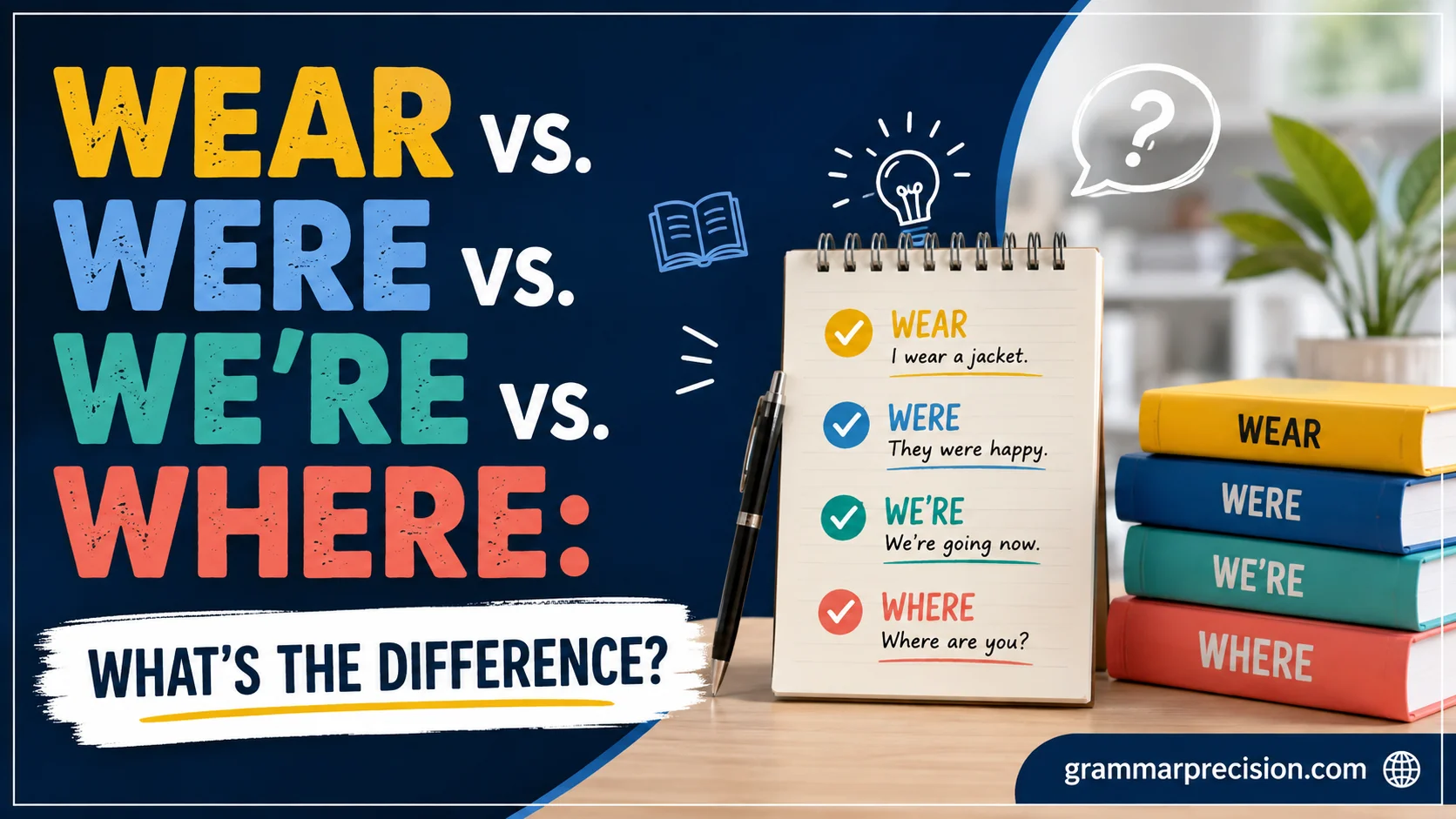
Wear vs. Were vs. We’re vs. Where can confuse readers because these four words have similar sounds but completely different meanings, uses, and grammatical roles in everyday English.
Wear relates to clothing, accessories, and dressing, while were is the past tense of “are.” We’re is short for “we are,” and where identifies a place or location. Understanding their usage helps you avoid common mistakes and makes your sentences clearer and more accurate.
These homophones may sound alike, but their context reveals the correct choice. Wear can describe using something or its condition after prolonged use; were describes the past. We’re means “we are,” while where often works as a question word or conjunction connecting ideas.
Wear, Were, We’re, and Where: What Do They Mean?
Before comparing the words, separate them by meaning. That one step removes most of the confusion.
| Word | Meaning | Main grammatical role | Example |
| Wear | To have clothing or something on your body | Verb; sometimes noun | I wear glasses every day. |
| Were | Past form of be | Verb | They were late. |
| We’re | Short for we are | Contraction | We’re ready to leave. |
| Where | Refers to a place or position | Adverb, conjunction, or relative word | Where is my phone? |
The key is to avoid relying only on pronunciation. Wear and where usually sound alike in standard American English, while were and we’re can also sound similar in casual speech.
Writing gives you another clue: meaning and sentence structure.
What Does “Wear” Mean?
Wear usually describes having clothing, jewelry, glasses, shoes, or another item on your body.
It is most often a verb. Unlike put on, which describes the action of placing clothing on your body, wear describes the state of having it on.
- I wear a jacket in winter.
- She wore her favorite dress yesterday.
- He is wearing new shoes.
- They wear uniforms at work.
The word changes form depending on tense. The common forms are wear, wore, worn, wearing, and wears.
Wear as a Verb
As a verb, wear can describe clothing and many other things you carry or have on your body.
You can wear:
- a shirt
- a watch
- glasses
- a hat
- perfume
- makeup
- a uniform
- a seat belt
It can also describe gradual damage. For example, “The tires wear quickly on rough roads.”
Notice the difference between wear and put on:
You put on your shoes before leaving. You wear them while walking.
That distinction becomes useful when you build more precise sentences.
Wear as a Noun
Wear can also function as a noun, especially in phrases describing clothing or damage.
Examples include:
- sportswear
- formal wear
- everyday wear
- wear and tear
In “wear and tear,” wear refers to damage caused by ordinary use.
Wear in Example Sentences
Consider these examples:
- Please wear a coat tonight.
- I usually wear contact lenses.
- She wore a blue sweater yesterday.
- These shoes show signs of wear.
- The machine experiences heavy wear during winter.
A quick clue helps: if the sentence involves clothing, accessories, or gradual damage, wear may be the word you need.
What Does “Were” Mean?
Were is a past-tense form of the verb be. It commonly appears with you, we, they, and plural subjects.
Examples:
- You were right.
- We were exhausted.
- They were at home.
- The students were excited.
In ordinary past-tense statements, were often describes a past condition, location, identity, or situation.
Were as a Past-Tense Verb
Compare the present and past:
| Present | Past |
| You are tired. | You were tired. |
| We are busy. | We were busy. |
| They are outside. | They were outside. |
This comparison gives you a reliable test. If you are describing something that was true in the past, were may fit.
However, there is an important grammar detail. Were can also appear with singular subjects in certain hypothetical or unreal constructions.
For example:
- If I were you, I’d apologize.
- If she were here, she could help.
- I wish he were more careful.
This use is associated with the subjunctive mood. It expresses something hypothetical, wished for, or contrary to fact.
Were in Example Sentences
- We were late for the meeting.
- You were very helpful.
- The children were playing outside.
- If I were you, I’d wait.
- They were surprised by the result.
If you can replace the word with an appropriate past form of be, you probably need were, not we’re.
What Does “We’re” Mean?
We’re is a contraction of we are.
The apostrophe matters because it signals that letters have been omitted.
- We’re = we are
- We’re not = we are not
- We’re ready = we are ready
This makes we’re easy to test. Expand it.
We’re vs. We Are
Try replacing we’re with we are. If the sentence still makes sense, we’re is probably correct.
For example:
We’re going home.
becomes:
We are going home.
The meaning remains unchanged.
Now consider:
We’re at the restaurant.
Replace the contraction:
We are at the restaurant.
Again, it works perfectly.
That substitution test is one of the fastest ways to distinguish we’re vs. were.
We’re in Example Sentences
- We’re ready to begin.
- We’re meeting them tonight.
- We’re working on the project.
- We’re not sure about the answer.
- We’re happy with the results.
Apostrophes often look tiny, but they can carry substantial grammatical information.
What Does “Where” Mean?
Where refers to a place, position, or location. It commonly appears in questions.
Examples:
- Where are you?
- Where is the station?
- Where did she go?
- Where should we meet?
Unlike wear, which often connects with clothing, where connects with location.
Where as a Question Word
The easiest use to recognize is a location question.
- Where do you live?
- Where is my wallet?
- Where did they park?
- Where can I buy tickets?
If you are asking about place, where is usually the obvious choice.
Where in Statements
Where does not only appear in questions. It can introduce clauses that identify a place or situation.
For example:
- This is the house where I grew up.
- We found a café where everyone could sit.
- I remember where we met.
In these sentences, where still carries a connection to place, even though no direct question appears.
Where in Example Sentences
- Where are your keys?
- I know where she lives.
- That’s the store where I bought my laptop.
- Do you remember where we parked?
- Tell me where you found it.
When you see a clear connection to place or location, where should immediately come to mind.
Wear vs. Were: What’s the Difference?
The biggest difference is meaning.
Wear relates mainly to having something on your body or experiencing gradual use. Were is a past form of be.
Compare:
- I wear glasses every day.
- I were glasses every day. ❌
The second sentence fails because were cannot describe the act of putting glasses on your body.
Now reverse the situation:
- They were tired after work.
- They wear tired after work. ❌
Again, the meaning makes the choice obvious.
A Simple Test
Ask:
Am I talking about clothing, accessories, or use?
Use wear.
Am I describing a past state or condition?
Use were.
Were vs. We’re: What’s the Difference?
This pair causes trouble because the words can sound very similar.
The easiest distinction is grammatical:
- Were = a past form of be
- We’re = we are
Try the expansion test.
We’re busy. → We are busy. ✓
Were busy. → We are busy. ✗
You need a subject before were in ordinary statements:
We were busy.
Now compare these:
- We were tired yesterday.
- We’re tired today.
The first sentence describes a past condition. The second means we are tired now.
We’re vs. Where: What’s the Difference?
These words differ sharply in meaning even though fast speech can blur them.
We’re means we are.
Where refers to a place.
Compare:
- We’re going to the beach.
- Where are we going?
The first tells you what the subject is doing. The second asks about location.
The Best Replacement Test
Replace we’re with we are.
If the sentence still works, choose we’re.
If you are talking about a location, choose where.
This simple test catches many mistakes.
Also Read This: For vs Four vs Fore: Definitions, Examples, and Differences
Wear vs. Where: What’s the Difference?
Wear and where are classic homophones in American English. They generally have the same pronunciation but different meanings and spellings.
That means listening alone won’t always help.
Compare:
- What should I wear?
- Where should I go?
The sounds may be similar, but the context tells you which word belongs.
Think of wear as something connected to clothing. Think of where as something connected to place.
That mental pairing makes the distinction easier to remember.
Wear vs. Were vs. We’re vs. Where: Complete Comparison Table
| Word | Pronunciation clue | Meaning | Quick test |
| Wear | Sounds like “where” | Have clothing or something on | Is it about clothing or use? |
| Were | Similar to “we’re” in many accents | Past form of be | Is it a past state? |
| We’re | Sounds like “were” in many accents | We are | Can you say “we are”? |
| Where | Sounds like “wear” | Place or location | Is it about a place? |
The table reveals the central lesson: meaning beats sound.
How to Remember the Difference Between All Four
You don’t need four complicated grammar rules. Use four mental hooks.
- Wear → clothes: You wear a shirt.
- Were → past: They were there yesterday.
- We’re → we are: We’re ready = we are ready.
- Where → place: Where are you?
Another useful memory chain is:
Wear it. Were there. We’re ready. Where is it?
Each phrase gives the word a distinct job.
Common Spelling and Grammar Mistakes
These errors often appear in texts, messages, school assignments, and workplace communication.
“Where” vs. “Wear”
Incorrect:
Where your blue jacket tonight.
Correct:
Wear your blue jacket tonight.
Why? The sentence gives an instruction about clothing.
“Were” vs. “We’re”
Incorrect:
Were going to finish this today.
Correct:
We’re going to finish this today.
Why? The intended meaning is we are going.
“Were” vs. “Where”
Incorrect:
Were did you park?
Correct:
Where did you park?
Why? The sentence asks about a location.
“Wear” vs. “We’re”
Incorrect:
Wear almost finished.
Correct:
We’re almost finished.
Why? The intended meaning is we are almost finished.
Pronunciation: Why These Words Cause So Much Confusion
Sound creates the problem before grammar gets a chance to help. In many varieties of American English, wear and where are homophones, meaning they share the same pronunciation but have different meanings. Were and we’re can also sound extremely similar in ordinary conversation.
That makes listening alone unreliable. You might hear a sentence correctly yet still need context to know which spelling belongs on the page.
For example, imagine hearing:
“Where are you going?”
The listener must use meaning and sentence structure to recognize where. The spelling isn’t encoded in the sound.
This explains why these mistakes often appear in texting. People write what they hear instead of checking what the word means.
A Better Strategy Than Listening
When two words sound alike, ask three questions:
- What does the sentence mean?
- What grammatical role does the word perform?
- Can I replace it with a simpler phrase?
The third question works especially well with we’re. Expand it to we are. If the sentence remains logical, you have your answer.
For where, look for location. For wear, look for clothing or use. For were, look for a past or hypothetical form of be.
Real-World Examples You Can Use
Context becomes much clearer when these words appear naturally.
At Work
We’re meeting the client at two.
Here, we’re means we are.
The team were discussing the issue yesterday.
Here, were describes a past activity.
While Shopping
What should I wear to the interview?
The sentence concerns clothing.
Where can I find the fitting rooms?
The sentence asks about location.
While Traveling
Where is the hotel?
This asks about a place.
We were at the hotel earlier.
This describes a past location.
In Everyday Conversation
We’re already late.
Were you at the store?
What did you wear to the party?
Where did you buy that jacket?
These four sentences show how context separates words that sound deceptively alike.
Case Study: One Sound, Four Different Meanings
Imagine someone says:
“Where were we’re wear?”
Spoken quickly, a listener may struggle to identify the intended words.
Written language removes that ambiguity through spelling and context. Consider four separate sentences:
- Where were you yesterday?
- We were at home.
- We’re leaving now.
- What will you wear tonight?
The pronunciation overlap doesn’t make these words interchangeable. Each one performs a different grammatical job.
This is why spelling accuracy matters. Homophones sound alike, but they don’t mean alike.
Practice Questions: Wear, Were, We’re, or Where?
Choose the correct word in each sentence.
- ___ are we meeting tonight?
- They ___ exhausted after the trip.
- ___ going to the movies later.
- What should I ___ to the wedding?
- I know ___ she lives.
- We ___ excited about the results.
- He likes to ___ dark colors.
- If I ___ you, I’d wait.
- ___ not ready yet.
- ___ did you put the keys?
Answers Explained
- Where — asks about a location.
- Were — describes a past condition.
- We’re — means we are.
- Wear — refers to clothing.
- where — identifies a location.
- were — describes a past state.
- wear — refers to clothing.
- were — used in a hypothetical construction.
- We’re — means we are.
- Where — asks about location.
The trick isn’t memorizing isolated spellings. It is identifying what the sentence means.
FAQs:
What does “wear” mean?
Wear usually refers to having clothing or accessories on your body. It can also describe the deterioration or condition of an item after prolonged use. For example, “I wear a jacket” describes clothing, while “The shoes show wear” describes their condition.
What does “were” mean?
Were is the past tense of “are.” It’s used with subjects such as you, we, they, and plural nouns. For example, “They were happy yesterday” describes a past situation. Remembering its connection with the past makes its usage easier to understand.
What is the difference between “we’re” and “were”?
We’re is a contraction that means “we are,” while were is the past tense of “are.” For example, “We’re ready” means “We are ready,” whereas “We were ready” describes a situation in the past.
When should you use “where”?
Use where when talking about a place or location. It often appears in questions, such as “Where do you live?” It can also function as a conjunction that connects information about a location within a sentence.
Are “wear,” “were,” “we’re,” and “where” homophones?
Wear, were, we’re, and where can have similar pronunciation, particularly in many varieties of English. However, they have different meanings, spellings, and grammatical functions. Learning each word’s context and purpose is the best way to avoid confusion when writing.
Conclusion:
Understanding wear, were, we’re, and where becomes easier when you focus on their meaning and function. Wear relates to clothing or deterioration, were describes the past, we’re means “we are,” and where refers to a location. Although their sounds can cause confusion, their different roles make them easier to identify.
Practice using each word in clear sentences, and these common homophones will become much more familiar.