Confused about Envelop or Envelope and their meanings? This guide explains the key differences, uses, and examples to help you choose the right word confidently in everyday English writing today.
Many writers mix up these similar-looking words because they share the same roots but have different roles in sentences. Envelop works as a verb describing an action of surrounding something, while envelope is a noun for a paper container used for letters and documents. Learning this difference makes your writing clearer and more accurate today.
Understanding envelop and envelope helps you avoid common grammar mistakes and communicate with confidence. This complete guide provides simple explanations, practical examples, and useful tips to remember each word easily. Whether you are writing emails, essays, or creative content, knowing the correct usage will improve your vocabulary and make your writing stronger and more effective.
Quick Answer: Envelop or Envelope — Which One Is Correct?
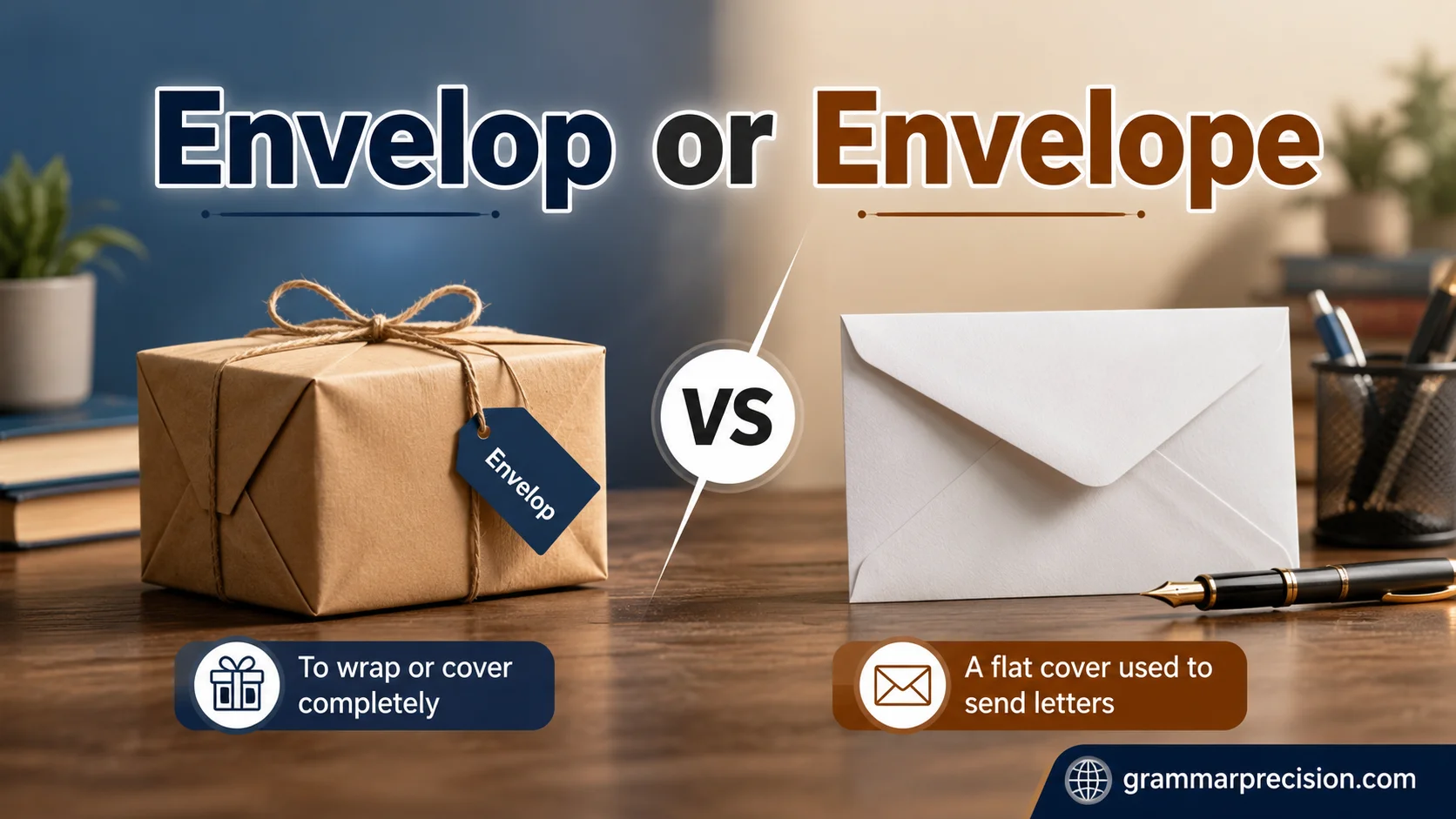
Both envelop and envelope are correct English words, but they are used in different situations.
- Envelop is a verb that means to cover, surround, wrap, or completely contain something.
- Envelope is a noun that means a paper container used to hold a letter, card, or document.
Here is the easiest way to remember:
| Word | Meaning | Part of Speech | Example |
| Envelop | To surround or cover something completely | Verb | Dark clouds began to envelop the city. |
| Envelope | A paper cover for letters or documents | Noun | She placed the invitation inside an envelope. |
Think of it this way:
Envelop = an action
Envelope = an object
If you can replace the word with “surround” or “cover,” use envelop. If you mean the paper holder used for mailing, use envelope.
What Does Envelop Mean?
Envelop is a verb that means to completely surround, cover, or hide something. It describes an action where one thing spreads around another thing.
The word often appears in situations involving:
- Physical surroundings
- Emotions
- Weather
- Darkness
- Smoke
- Sounds
- Abstract ideas
For example:
- The thick fog began to envelop the mountain.
- A feeling of excitement enveloped the crowd.
- Flames quickly enveloped the building.
In each example, something surrounds or covers something else.
Envelop Definition and Meaning
According to standard English usage, envelop means to wrap around or completely cover something.
The word suggests that something becomes surrounded from all sides.
Imagine placing a gift inside wrapping paper. The paper covers the entire object. That wrapping action is similar to what envelop describes.
Simple Meaning:
Envelop = to surround completely
Synonyms of Envelop:
- Surround
- Cover
- Wrap
- Encircle
- Hide
- Consume
- Embrace
- Enclose
However, these words are not always perfect replacements.
For example:
- The darkness enveloped the forest.
You could say:
- The darkness covered the forest.
But enveloped creates a stronger image. It suggests that darkness spread around everything like a blanket.
Examples of Envelop in Sentences
Understanding examples makes the meaning much easier to remember.
Physical Examples
- A thick layer of snow enveloped the village overnight.
- Smoke enveloped the room after the fire started.
- The ocean mist enveloped the coastline.
Emotional Examples
- Happiness enveloped her after hearing the good news.
- Fear suddenly enveloped him during the storm.
- A sense of peace enveloped the quiet garden.
Creative Writing Examples
Writers often use envelop because it creates strong visual images.
For example:
“The golden sunlight enveloped the valley, turning the hills into a glowing landscape.”
The word does more than say “covered.” It helps readers imagine the scene.
What Does Envelope Mean?
Envelope is a noun that refers to a flat paper container used for holding letters, cards, checks, invitations, and documents.
Most people use envelopes when sending physical mail.
Examples:
- Put the letter inside the envelope.
- She sealed the envelope before mailing it.
- The company sent the contract in a sealed envelope.
Unlike envelop, this word does not describe an action. It names an object.
Envelope Definition and Meaning
An envelope is usually made of paper and has a flap that closes over an opening.
Common types of envelopes include:
- Business envelopes
- Greeting card envelopes
- Invitation envelopes
- Document envelopes
- Security envelopes
- Padded envelopes
The main purpose of an envelope is to protect and contain written materials.
Examples of Envelope in Sentences
Here are some everyday examples:
- I wrote my address on the envelope before mailing the package.
- The wedding invitation arrived in a beautiful white envelope.
- He opened the envelope and found an important document inside.
- Please place your application in a sealed envelope.
Notice that every example refers to a physical item.
Envelop vs Envelope: Side-by-Side Comparison
The easiest way to understand these words is by comparing them directly.
| Category | Envelop | Envelope |
| Word type | Verb | Noun |
| Meaning | To surround or cover something | A paper container for letters |
| Usage | Describes an action | Names an object |
| Pronunciation | in-VEL-up | EN-vuh-lope |
| Common context | Literature, descriptions, emotions, nature | Mail, documents, invitations |
| Example | Clouds envelop the mountains | Put the card in an envelope |
Why Do People Confuse Envelop and Envelope?
The confusion happens because these words look almost the same.
They share the same root, which comes from the French word envelopper, meaning “to wrap up” or “to cover.”
Over time, English developed two separate words:
- Envelop became the verb.
- Envelope became the noun.
The extra -e at the end changed the role of the word.
A helpful comparison:
- Drive → a verb describing an action
- Driver → a person or thing connected to that action
Similarly:
- Envelop → the action
- Envelope → the object connected to the idea of wrapping
Envelop or Envelope Pronunciation Guide
Pronunciation creates another challenge because the two words sound different.
How to Pronounce Envelop
Envelop sounds like:
in-VEL-up
The stress falls on the second syllable.
Example:
The clouds will envelop the mountains.
How to Pronounce Envelope
Envelope has two common pronunciations:
American English:
EN-vuh-lope
Example:
Please put the check inside the envelope.
British English:
Some speakers may pronounce it closer to:
EN-vuh-lup
Both pronunciations can be correct depending on the region.
Envelop and Envelope as Different Parts of Speech
Understanding grammar roles makes these words much easier.
Envelop as a Verb
A verb shows an action.
Examples:
- The fog enveloped the road.
- Silence enveloped the room.
- The crowd was enveloped by excitement.
Common verb forms:
| Form | Example |
| Base form | Clouds envelop the mountain. |
| Past tense | Clouds enveloped the mountain. |
| Present participle | Clouds are enveloping the mountain. |
Envelope as a Noun
A noun names a person, place, thing, or idea.
Examples:
- The envelope is on the desk.
- I bought several envelopes.
- The blue envelope contains my certificate.
Plural form:
Envelope → Envelopes
Example:
- She purchased fifty wedding envelopes.
When Should You Use “Envelop”?
Knowing the definition of envelop is helpful, but understanding where it naturally fits makes your writing much stronger. You should use envelop when you want to describe something that surrounds, covers, or completely takes over another thing.
The word often creates a sense of movement. Something spreads outward and wraps around something else.
For example:
- The warm sunlight enveloped the garden.
- A strange silence enveloped the house.
- Thick smoke enveloped the entire street.
In each sentence, something moves around or covers another thing.
Envelop in Descriptive Writing
Writers frequently use envelop because it creates vivid pictures in the reader’s mind.
Compare these two sentences:
Basic:
The fog covered the town.
More descriptive:
The fog enveloped the town.
The second sentence feels more dramatic. It suggests that the fog did not simply appear. Instead, it slowly wrapped around everything like a soft blanket.
This makes envelop especially useful in:
- Novels
- Essays
- Travel writing
- Poetry
- News descriptions
Examples:
- A golden glow enveloped the countryside at sunset.
- The scent of fresh flowers enveloped the room.
- The peaceful atmosphere enveloped everyone at the ceremony.
Envelop in Everyday English
Although envelop sounds slightly formal, people still use it in everyday conversations.
You might hear it when someone describes:
- Weather conditions
- Strong emotions
- Surroundings
- Situations that become overwhelming
Examples:
- The storm clouds began to envelop the sky.
- Excitement enveloped the fans before the concert.
- A wave of sadness enveloped him after the announcement.
The word works best when something spreads around a person, place, or object.
When Should You Use “Envelope”?
You should use envelope when you are talking about the physical item used to hold something, especially paper documents.
Common situations include:
- Sending letters
- Mailing invitations
- Storing paperwork
- Delivering official documents
- Protecting important papers
Examples:
- Please write the address on the envelope.
- She placed the check inside an envelope.
- The lawyer handed him a sealed envelope.
If you can touch it, open it, or put something inside it, you probably mean envelope.
Common Types of Envelopes
Envelopes come in different shapes and sizes depending on their purpose.
| Type of Envelope | Common Use |
| Business envelope | Office letters and professional documents |
| Invitation envelope | Weddings, parties, and special events |
| Security envelope | Protecting private information |
| Padded envelope | Mailing fragile items |
| Airmail envelope | International mailing |
| Document envelope | Large papers and certificates |
For example, a company may send a job offer inside a professional envelope, while a couple may use decorative envelopes for wedding invitations.
Envelop vs Envelope: Real-Life Examples
Seeing both words in context helps you recognize the difference quickly.
Example One: Weather
Correct:
Dark clouds began to envelop the city before the storm.
Why?
The clouds are surrounding the city. They are performing an action.
Incorrect:
Dark clouds began to envelope the city.
Why?
Clouds are not a paper container.
Example Two: Mailing a Letter
Correct:
She placed the letter inside the envelope.
Why?
The paper container holds the letter.
Incorrect:
She placed the letter inside the envelop.
Why?
Envelop is not an object.
Example Three: Emotions
Correct:
A feeling of happiness enveloped her after the announcement.
Why?
Happiness surrounds her emotionally.
Incorrect:
A feeling of happiness envelope her after the announcement.
Why?
The sentence needs a verb, not a noun.
Common Mistakes With Envelop and Envelope
Many writers make small mistakes because the words look nearly identical. Here are the most common errors and how to fix them.
Mistake: Using Envelope as a Verb
Incorrect:
The darkness will envelope the forest.
Correct:
The darkness will envelop the forest.
Why?
Darkness is covering the forest, so you need the verb envelop.
Mistake: Using Envelop for a Mailing Item
Incorrect:
I put the card inside an envelop.
Correct:
I put the card inside an envelope.
Why?
The paper holder is an envelope.
Mistake: Forgetting the Final “E”
Many people accidentally write:
- envelop instead of envelope
- envelops instead of envelopes
A simple spelling check can prevent this mistake.
Remember:
The extra “e” creates the object.
Easy Memory Tricks to Remember Envelop vs Envelope
Learning a simple trick can save you from confusion.
Memory Trick One: Action vs Object
Ask yourself:
Am I describing something happening?
If yes, use:
✅ Envelop
Example:
The mist will envelop the valley.
Am I talking about something I can hold?
If yes, use:
✅ Envelope
Example:
The document is inside the envelope.
Memory Trick Two: The Extra Letter Means Extra Space
Think of the extra “e” in envelope as creating a container.
An envelope holds something inside.
ENVELOP = Action
↓
Surrounds something
ENVELOPE = Object
↓
Holds something
Envelop vs Envelope: Synonyms Comparison
Understanding related words helps you choose the correct term.
| Word | Similar Meaning | Example |
| Envelop | Surround | Darkness surrounded the village. |
| Envelop | Cover | Snow covered the mountain. |
| Envelop | Wrap | The blanket wrapped around her. |
| Envelope | Packet | The documents came in a packet. |
| Envelope | Cover | The letter had a paper cover. |
| Envelope | Holder | The card was inside a holder. |
However, remember that synonyms do not always carry the same feeling.
For example:
“The music surrounded the audience.”
This is correct.
But:
“The music enveloped the audience.”
This sounds more powerful and suggests that the music completely filled the space.
Also Read This: It Worth It or It Is Worth It? Which One Is Grammatically Correct?
Similar Word Pairs People Commonly Confuse
English contains many words that look or sound similar but have different meanings.
Affect vs Effect
- Affect = usually a verb meaning to influence.
- Effect = usually a noun meaning a result.
Example:
The weather affected our plans.
The effect of the decision was unexpected.
Stationary vs Stationery
- Stationary = not moving.
- Stationery = writing materials.
Example:
The car remained stationary.
She bought new stationery.
Compliment vs Complement
- Compliment = praise.
- Complement = something that completes or improves something.
Example:
She gave me a nice compliment.
The shoes complement the dress.
Quick Decision Guide: Envelop or Envelope?
Use this simple decision tree:
Are you talking about an action?
|
Yes
|
Use ENVELOP
OR
Are you talking about a paper container?
|
Yes
|
Use ENVELOPE
This small test works in most situations.
Practice Quiz: Envelop or Envelope?
Choose the correct word.
The thick fog began to ______ the village.
Answer:
Envelop
Explanation:
The fog surrounds the village, so it describes an action.
Please place the documents inside the ______.
Answer:
Envelope
Explanation:
The document goes inside a physical container.
A sense of calm ______ the room.
Answer:
Enveloped
Explanation:
Calmness surrounds the room emotionally.
The invitation arrived in a beautiful ______.
Answer:
Envelope
Explanation:
The invitation came inside a paper holder.
The smoke started to ______ the building.
Answer:
Envelop
Explanation:
Smoke covers and surrounds the building.
FAQs:
What is the main difference between envelop and envelope?
Envelop is a verb that means to surround, cover, or completely wrap something. Envelope is a noun that refers to a paper container used for holding letters, cards, or documents. The key difference is that one describes an action, while the other names a physical object.
How can I easily remember the difference between envelop and envelope?
A simple trick is to remember that envelop means an action and envelope means an item. If something is surrounding or covering another thing, use envelop. If you are talking about a paper holder for mail, use envelope.
Can envelop be used to describe feelings or emotions?
Yes, envelop can describe emotions, feelings, or situations that completely surround someone. For example, you can say, “A feeling of happiness enveloped her after the good news.” It shows that the emotion strongly affected or surrounded the person.
Is envelope only used for mailing letters?
No, an envelope has many uses beyond mailing letters. People use envelopes for invitations, checks, certificates, business documents, and important papers. Any paper container designed to protect or hold documents can be called an envelope.
Why do people confuse envelop and envelope?
People often confuse these words because they have similar spelling and come from the same historical root. However, their meanings developed differently over time. Remembering that envelop is a verb and envelope is a noun will help you avoid mistakes.
Conclusion:
Knowing the difference between envelop and envelope can make your writing more accurate and professional. Although these words look almost identical, they have completely different meanings. Envelop describes the action of surrounding or covering something, while envelope refers to a physical container used for holding letters and documents.
By remembering the simple rule of action versus object, you can quickly choose the correct word in any sentence. Whether you are writing an email, an essay, or a creative piece, using the right term shows strong grammar skills and improves the clarity of your communication.