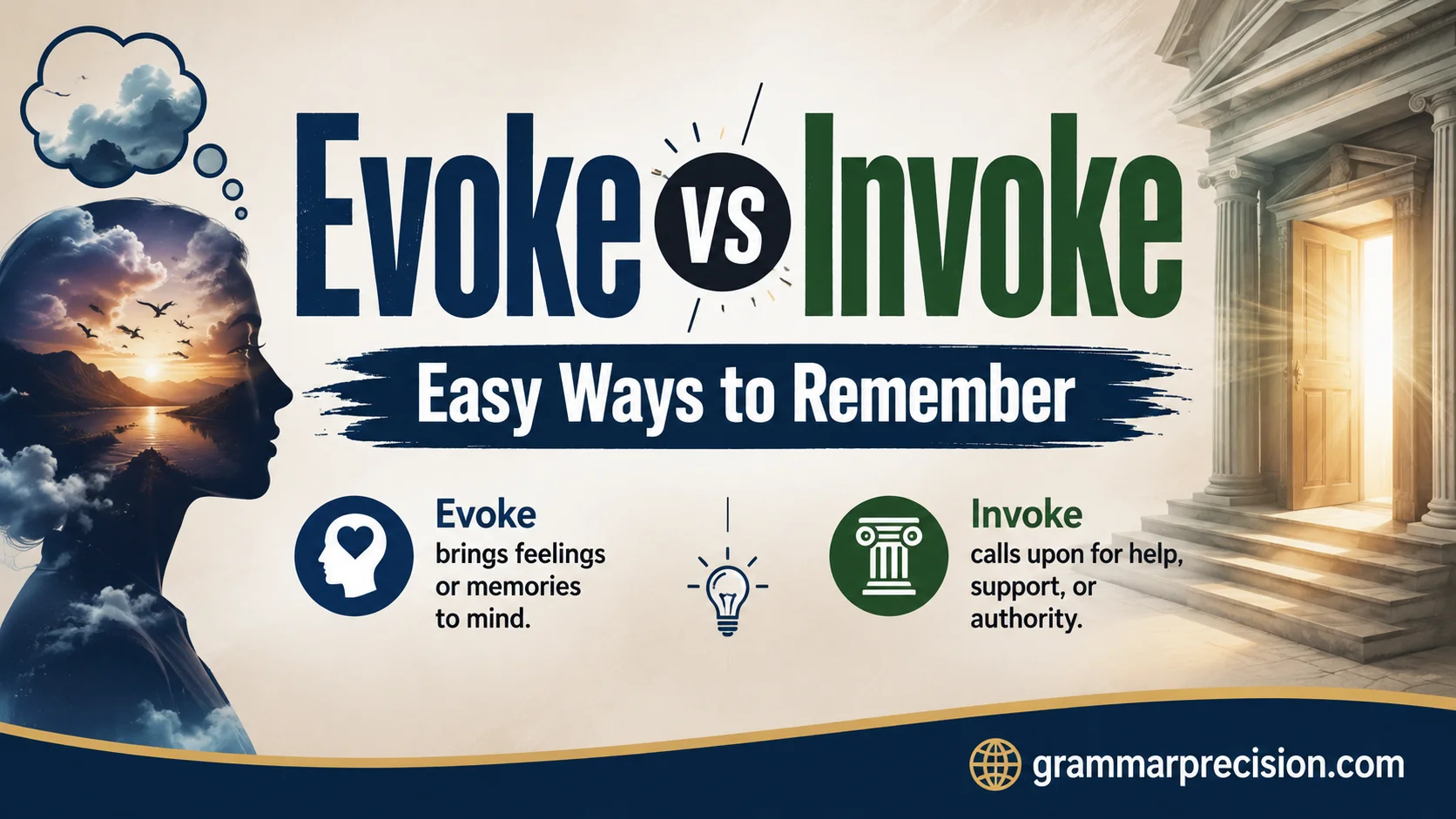
Evoke vs Invoke can seem confusing because both words sound similar, but their meanings differ. Learning this simple distinction makes them easier to use correctly.
The words invoke and evoke share the Latin root vox, meaning voice. Invoke usually means calling upon someone or something for help, support, power, or authority. For example, you can invoke your rights in a court of law, or invoke a genie to grant your wishes. It normally describes an active and direct action.
By contrast, evoke means to call forth an emotion, thought, memory, or feeling. It can recreate something through imagination without any physical action. For example, pumpkins and corn mazes may evoke a sense of autumn, while Mozart’s music can evoke his style. Remember: invoke asks for something, while evoke brings something to mind.
Evoke vs Invoke in 10 Seconds
Here’s the quickest way to separate these commonly confused words:
Evoke = bring something to mind or draw out a response.
Invoke = call upon something for help, authority, support, or effect.
Think of evoke as reaching out from within. Something triggers a memory, feeling, image, or reaction that’s already available in your mind.
Think of invoke as deliberately calling upon something. You might appeal to a law, principle, authority, deity, right, or source of support.
| Word | Basic meaning | Common objects |
| Evoke | Bring to mind or draw out | Memories, emotions, images, reactions |
| Invoke | Call upon, appeal to, or put into effect | Laws, rights, authority, principles, powers |
| Evoke | Often describes a response | “The smell evoked memories.” |
| Invoke | Often describes deliberate appeal | “She invoked her legal rights.” |
Both words are transitive verbs, which means they normally take a direct object.
For example:
- The photograph evoked memories.
- The attorney invoked the law.
- The melody evoked sadness.
- The defendant invoked the Fifth Amendment.
The nouns that follow the verbs often give you an immediate clue.
What Does Evoke Mean?
Evoke means to bring something into someone’s mind or to draw out a particular feeling, image, memory, or response. Cambridge defines it as making someone remember something or feel an emotion.
The important idea is mental or emotional recall.
Something acts as the trigger. You encounter it, and it causes something else to surface in your mind.
A smell might evoke a childhood memory. A painting might evoke sadness. A familiar street might evoke nostalgia. A powerful speech might evoke anger or hope.
Evoke Definition and Pronunciation
Evoke is pronounced /ɪˈvoʊk/ in US English.
Its common forms are:
- Base form: evoke
- Third-person singular: evokes
- Past tense: evoked
- Present participle: evoking
Examples:
- The old song evokes memories of summer.
- The photograph evoked a strong emotional response.
- The novel is evoking a sense of nostalgia.
The word can describe something positive, negative, or neutral. You can evoke joy, fear, anger, sympathy, nostalgia, curiosity, memories, images, or reactions.
When Should You Use Evoke?
Use evoke when one thing causes another idea, memory, feeling, or reaction to appear in someone’s mind.
Common combinations include:
- evoke a memory
- evoke an emotion
- evoke nostalgia
- evoke a feeling
- evoke an image
- evoke sympathy
- evoke a reaction
- evoke interest
- evoke a response
- evoke memories of the past
For example:
The scent of fresh bread evoked memories of her grandmother’s kitchen.
The bread isn’t calling on anyone for assistance. Instead, its smell triggers a memory.
Here’s another:
The director used muted colors to evoke a feeling of loneliness.
Again, the color scheme brings a feeling to the surface.
What Does Invoke Mean?
Invoke usually means to call upon something or someone, especially as a source of authority, assistance, protection, justification, or power. It can also mean to use a law or rule in order to achieve something.
This word often carries a stronger sense of deliberate appeal.
You don’t merely experience something internally. You actively call upon it.
For instance, a person might invoke a law, invoke a right, invoke authority, or invoke divine protection.
Invoke Definition and Pronunciation
Invoke is pronounced /ɪnˈvoʊk/ in US English.
Its common forms include:
- Base form: invoke
- Third-person singular: invokes
- Past tense: invoked
- Present participle: invoking
Examples:
- The lawyer invoked the defendant’s constitutional rights.
- The judge invoked an existing legal principle.
- The ceremony was intended to invoke divine protection.
Cambridge also notes that invoke can mean using a law to accomplish something, requesting help, or making something have a particular feeling or memory.
When Should You Use Invoke?
Use invoke when someone deliberately calls upon something for support, authority, assistance, or effect.
Common combinations include:
- invoke a law
- invoke a right
- invoke authority
- invoke a principle
- invoke a rule
- invoke a clause
- invoke a power
- invoke a deity
- invoke someone’s name
- invoke a precedent
For example:
The employee invoked her right to remain silent.
The employee isn’t merely remembering the right. She is deliberately relying on it.
Another example:
The judge invoked an established legal principle when making the decision.
Here, the principle serves as authority or support.
The Biggest Difference Between Evoke and Invoke
The clearest distinction comes down to what is being called and why.
Evoke generally brings something to mind.
Invoke generally calls upon something.
Imagine two doors.
Behind the first door sits a memory, emotion, or mental image. Something opens that door and brings the contents into your awareness. That’s evoke.
Behind the second door sits a law, authority, principle, deity, or source of help. You deliberately reach for it. That’s invoke.
This distinction explains why these sentences work:
The photograph evoked memories of childhood.
The defendant invoked her constitutional rights.
The photograph triggers an internal response. The defendant deliberately appeals to a right.
Evoke vs Invoke: A Simple Comparison
| Situation | Correct word | Example |
| Bring back a memory | Evoke | The smell evoked childhood memories. |
| Produce an emotion | Evoke | The speech evoked hope. |
| Create a mental image | Evoke | The description evoked a peaceful landscape. |
| Produce a reaction | Evoke | His remarks evoked anger. |
| Appeal to a law | Invoke | The attorney invoked the law. |
| Claim a legal right | Invoke | She invoked her constitutional rights. |
| Appeal to authority | Invoke | The researcher invoked an earlier study. |
| Call upon a deity | Invoke | The ritual invoked the ancient gods. |
| Put a rule into effect | Invoke | The clause was invoked during the dispute. |
Think “Memory” vs “Authority”
If you’re stuck between the two words, look at the noun after the verb.
If you’re talking about memories, emotions, feelings, images, or reactions, evoke will often be the better choice.
If you’re talking about laws, rights, rules, authority, principles, powers, or divine help, invoke will usually fit better.
A useful shortcut looks like this:
Evoke → emotion, experience, image
Invoke → institution, instruction, influence
It isn’t a rigid grammar rule. English has overlapping meanings, and dictionaries recognize that invoke can sometimes mean to cause a feeling or memory too.
Still, the shortcut works remarkably well in everyday writing.
Evoke vs Invoke Examples You’ll Actually Remember
Let’s put the distinction into realistic sentences.
Examples With Evoke
- The familiar song evoked memories of high school.
- The photograph evoked a sense of nostalgia.
- Her story evoked sympathy from the audience.
- The dark hallway evoked a feeling of unease.
- The painting evoked images of the countryside.
- His voice evoked memories of home.
- The speech evoked strong emotions.
- The scent of cinnamon evoked memories of the holidays.
Notice the pattern. Something causes a mental, emotional, or sensory response.
Examples With Invoke
- The attorney invoked the Fifth Amendment.
- The company invoked a clause in the contract.
- The judge invoked legal precedent.
- She invoked her right to appeal.
- The speaker invoked the Constitution to support his argument.
- The ceremony invoked the protection of an ancient deity.
- The manager invoked company policy during the dispute.
- The researcher invoked a well-known principle to explain the result.
Here, someone deliberately appeals to a source of authority, assistance, or support.
Evoke vs Invoke in Different Fields
Context can make the distinction even clearer.
In Literature
Writers frequently use evoke when discussing imagery, atmosphere, memory, and emotion.
The author evokes the loneliness of a deserted town.
The writing causes readers to imagine or feel something.
Invoke can appear in literary criticism when a writer deliberately calls upon a concept, tradition, historical figure, or cultural reference.
The poem invokes classical mythology to deepen its meaning.
Here, the poem deliberately calls upon mythology as a reference or source.
In Law
Invoke dominates legal contexts.
You can invoke:
- a constitutional right
- a statute
- a legal principle
- a contractual clause
- attorney-client privilege
- a legal precedent
For example:
The defendant invoked her right to remain silent.
That’s a deliberate legal appeal.
Using evoke in that sentence would change the meaning and sound incorrect.
In Religion and Spirituality
Invoke can mean to call upon a deity, spirit, or supernatural power.
The ceremony invoked the protection of the ancestors.
The speaker is deliberately calling upon that power.
Evoke can work when describing the feeling or imagery produced by religious art.
The cathedral’s architecture evokes a sense of awe.
The architecture creates an emotional response.
In Business and Academic Writing
Both verbs appear in formal writing, but they serve different purposes.
You might evoke confidence through a strong presentation.
You might invoke industry standards to support a recommendation.
That difference is subtle but useful. One creates a response. The other appeals to an established source.
Also Read This: Friendlier or More Friendly? Which Is Correct?
Evoke vs Invoke: Common Collocations
Learning common word partnerships can help you choose correctly without memorizing complicated definitions.
Common Collocations With Evoke
- evoke memories
- evoke emotions
- evoke feelings
- evoke nostalgia
- evoke sympathy
- evoke fear
- evoke an image
- evoke a reaction
- evoke interest
- evoke a response
- evoke laughter
- evoke sadness
Common Collocations With Invoke
- invoke a law
- invoke a right
- invoke authority
- invoke a principle
- invoke a rule
- invoke a clause
- invoke a power
- invoke precedent
- invoke protection
- invoke divine assistance
- invoke someone’s name
- invoke constitutional rights
These combinations aren’t absolute rules. They’re patterns. The more you read, the more naturally you’ll recognize them.
Why Do People Confuse Evoke and Invoke?
The confusion isn’t surprising.
Both words contain -voke, which traces back to the Latin verb vocare, meaning “to call.” The two words therefore share a historical family resemblance.
That same root appears in other English words, including provoke and revoke.
The prefixes help create different shades of meaning. Historically, evoke developed from Latin evocare, associated with calling out or calling forth, while invoke comes from Latin invocare, associated with calling upon.
So the words aren’t random look-alikes. They’re linguistic cousins.
That connection also gives you a powerful memory trick: both involve calling, but they differ in what gets called and in what role that “calling” plays.
Evoke vs Invoke vs Elicit vs Conjure
Sometimes the real choice isn’t between two words.
You may also wonder about elicit and conjure.
Elicit means to draw out a response, answer, reaction, or information.
The question elicited an angry response.
Evoke often focuses on bringing a memory, feeling, image, or association to mind.
The photograph evoked an angry memory.
Conjure often suggests bringing something vividly to mind, imagining it, or summoning something. It can also carry a magical or supernatural sense.
The description conjured an image of a quiet village.
Here’s the practical comparison:
| Word | Main idea | Example |
| Evoke | Bring to mind | The song evoked memories. |
| Invoke | Call upon | She invoked the law. |
| Elicit | Draw out a response | The question elicited laughter. |
| Conjure | Bring vividly to mind or summon | The story conjured a vivid image. |
| Provoke | Cause a reaction, often deliberately | His comment provoked anger. |
This distinction becomes especially valuable in polished writing because choosing the exact verb can sharpen your meaning.
Common Mistakes With Evoke and Invoke
Mistake: “The Smell Invoked Childhood Memories”
You may encounter this construction, and dictionaries do recognize broader uses of invoke. Still, evoked is usually the more natural choice when you’re simply describing a smell bringing memories to mind.
Better:
The smell evoked childhood memories.
Mistake: “The Lawyer Evoked the Constitution”
If the lawyer deliberately appeals to the Constitution as authority, use invoke.
Better:
The lawyer invoked the Constitution.
Mistake: “The Painting Invoked Sadness”
This isn’t impossible in every context, because invoke has broader senses. However, evoked is the clearer and more idiomatic choice for an artwork producing an emotion.
The painting evoked sadness.
Mistake: Treating the Words as Perfect Synonyms
They overlap, but they’re not interchangeable in every sentence.
Compare:
The speech evoked anger.
with:
The speaker invoked the law.
The first describes an emotional response. The second describes a deliberate appeal.
A Practical Case Study: One Story, Two Verbs
Imagine a courtroom.
A lawyer presents an old photograph showing the defendant with his family. The image evokes painful memories for everyone who sees it.
Later, the lawyer refers to a constitutional protection and invokes that right during the proceeding.
Same courtroom. Same speaker. Two completely different actions.
The photograph evokes something from the mind.
The lawyer invokes something as authority.
That contrast captures the difference better than a dictionary definition alone.
A Simple Trick to Remember Evoke vs Invoke
Use this mnemonic:
Evoke = Elicits something.
Invoke = Invites or calls upon something.
Imagine evoke reaching into your memory.
Imagine invoke raising a hand and saying, “I call upon this.”
You can also remember the typical objects:
Evoke:
Memory → Emotion → Image → Reaction
Invoke:
Law → Right → Authority → Principle
When in doubt, ask yourself one question:
“Am I bringing something to mind, or am I calling upon something?”
If you’re bringing it to mind, choose evoke.
If you’re deliberately calling upon it, choose invoke.
Mini Quiz: Evoke or Invoke?
Test yourself before moving on.
Choose the Correct Word
- The old photograph ___ memories of childhood.
- The attorney ___ the defendant’s constitutional rights.
- The music ___ a feeling of peace.
- The company ___ a clause in the agreement.
- Her speech ___ sympathy from the audience.
- The ritual was designed to ___ a protective spirit.
- The painting ___ images of rural life.
- The judge ___ an established legal principle.
Answers
- evoked
- invoked
- evoked
- invoked
- evoked
- invoke
- evoked
- invoked
The pattern should now look familiar.
Memories, emotions, and images generally point toward evoke. Laws, rights, principles, authority, and deliberate appeals generally point toward invoke.
Evoke vs Invoke: Quick Reference
When you need the answer fast, use this cheat sheet:
| If you mean… | Use |
| Bring a memory to mind | Evoke |
| Produce an emotion | Evoke |
| Suggest an image | Evoke |
| Create a mental association | Evoke |
| Produce a reaction | Evoke |
| Appeal to a law | Invoke |
| Claim a legal right | Invoke |
| Refer to authority for support | Invoke |
| Call upon a deity | Invoke |
| Put a rule or provision into effect | Invoke |
One caveat matters: invoke has a broader semantic range than the simple “law or authority” rule suggests. Dictionaries also record uses in which something invokes a feeling, image, or memory.
So treat the shortcut as a practical guide, not an ironclad grammatical law.
FAQs:
What is the main difference between evoke and invoke?
Evoke usually means to bring a memory, feeling, image, or reaction to mind, while invoke generally means to call upon someone or something for help, authority, or support. For example, a song can evoke memories, while a person can invoke a law or privilege.
Is it correct to say “evoke a memory”?
Yes. “Evoke a memory” is a natural and common expression. It means that something causes you to remember a person, place, event, or experience. For example, “That old photograph evoked memories of my childhood.”
When should I use “invoke”?
Use invoke when you mean to call upon, appeal to, or put something into effect. It commonly appears with laws, rules, rights, authority, or assistance. For example, “The lawyer invoked the defendant’s constitutional rights.”
Can evoke and invoke ever mean the same thing?
Yes, they overlap in some contexts, particularly when they mean to call forth or summon. Both can also relate to supernatural ideas. However, their most common uses differ: evoke usually involves memories or emotions, while invoke often involves authority, laws, help, or support.
What is an easy way to remember evoke vs. invoke?
Think of evoke as drawing something out, especially a feeling or memory: “The smell evoked memories.” Think of invoke as calling upon something, such as a law, authority, or person: “She invoked her legal rights.” This simple distinction will help you choose the right word in most situations.
Conclusion:
Evoke and invoke both relate to the idea of calling something forth, but their common uses are different. Use evoke for memories, emotions, images, and reactions that something brings to mind. Use invoke for laws, rights, authority, assistance, or support that someone calls upon.
Once you connect evoke with emotions and invoke with authority or assistance, the difference becomes much easier to remember. With regular practice, you’ll be able to use both words accurately and confidently.