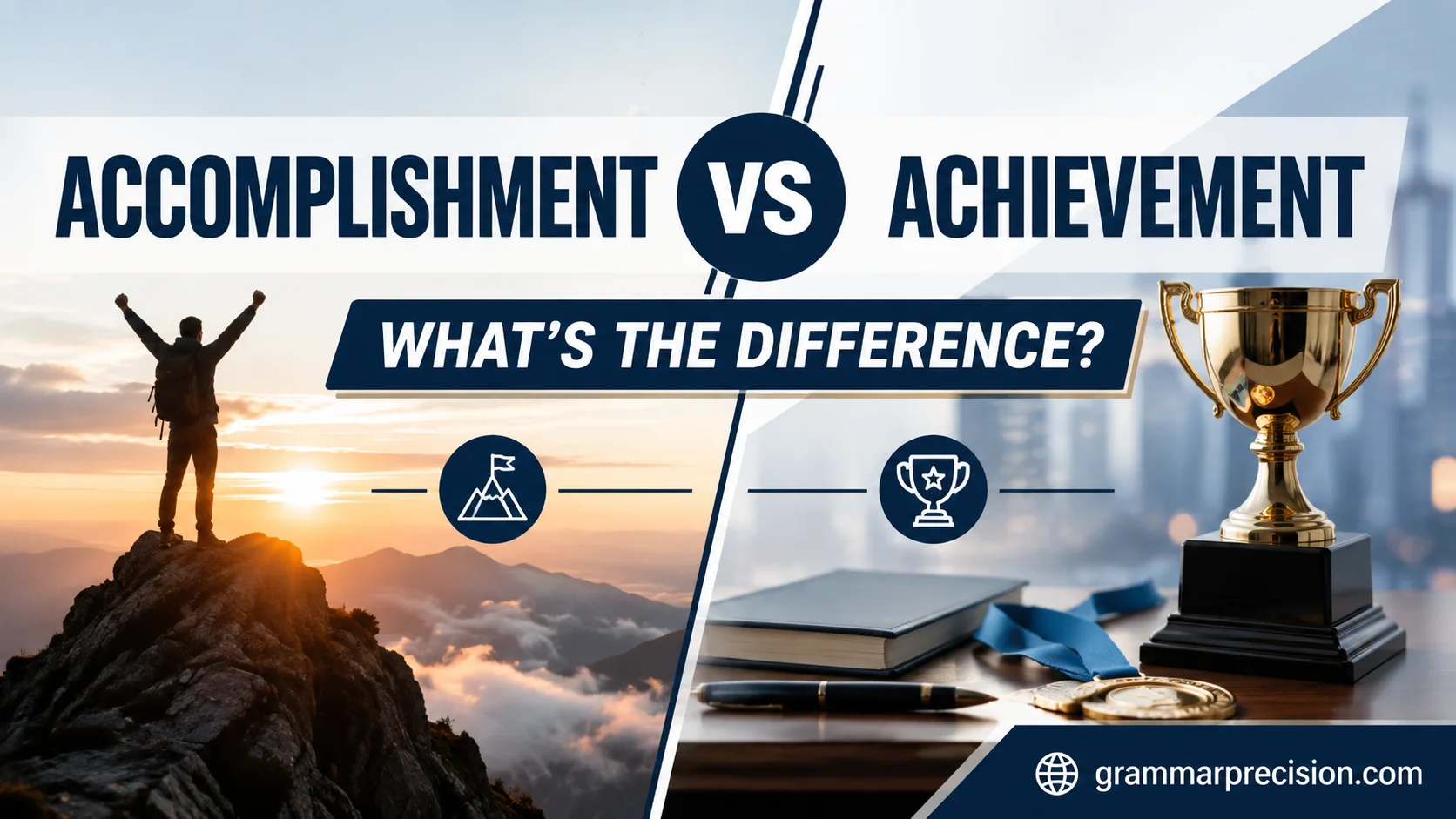
Accomplishment vs Achievement explains how achievement marks a goal reached, while accomplishment highlights a task or project completed successfully, showing two different ways to describe meaningful success and progress overall.
An achievement usually shows that you reached an important goal or objective. An accomplishment often shows that you completed a task, job, or project. Both can reflect progression and success, but they emphasize different results. Understanding this distinction helps you choose the right word when describing your progress or success clearly in your everyday writing.
In my experience, an achievement feels connected to reaching a desired result, while an accomplishment feels connected to taking action and finishing meaningful work. You may feel stuck when measuring only achievements, even though you’re moving forward. Recognizing smaller accomplishments can show that you’re still progressing toward something valuable and worthwhile every day with confidence.
Accomplishment vs. Achievement: The Core Difference
Here’s the easiest way to understand the distinction:
Accomplishment = something you successfully complete or do.
Achievement = something valuable or difficult you successfully reach or attain.
These meanings overlap heavily.
For example:
- Finishing the marathon was an accomplishment.
- Finishing the marathon was an achievement.
Both sentences are correct. However, achievement can place slightly more emphasis on the difficulty or significance of reaching the goal.
Likewise, consider this sentence:
Learning to play the piano is a great accomplishment.
The word accomplishment works particularly well because the sentence focuses on developing a skill.
Now consider:
Winning the national piano competition was a major achievement.
Here, achievement feels especially natural because the speaker emphasizes a concrete, noteworthy result.
| Feature | Accomplishment | Achievement |
| Basic meaning | Something successfully completed or done | Something successfully attained or achieved |
| Main emphasis | Completion, effort, ability, or result | Goal, success, difficulty, or significance |
| Common contexts | Personal, professional, creative | Academic, professional, competitive |
| Can describe skills? | Yes | Sometimes |
| Can describe major success? | Yes | Yes |
| Can be interchangeable? | Often | Often |
The important point is that these aren’t rigid grammatical categories. Context decides which word sounds more natural.
What Does “Accomplishment” Mean?
An accomplishment is something you successfully do, complete, or achieve, especially after effort or difficulty. It can describe a major success, a modest personal milestone, a completed task, or even a developed skill.
For example:
- Finishing the project ahead of schedule was a major accomplishment.
- Learning Spanish was one of her proudest accomplishments.
- Writing his first novel was a remarkable accomplishment.
- Getting everyone to agree was quite an accomplishment.
The word has a wonderfully broad range.
You don’t need a trophy, certificate, promotion, or headline-worthy result to call something an accomplishment. If you worked hard and successfully completed something meaningful, accomplishment can fit.
Accomplishment Can Also Mean a Skill
There’s another meaning that learners sometimes overlook.
Accomplishment can refer to a skill or ability, particularly one developed through training or practice. Cambridge Dictionary gives artistic and culinary skills as examples of this sense.
For instance:
- Her accomplishments include painting and classical piano.
- Cooking is one of his many accomplishments.
- She listed several artistic accomplishments on her portfolio.
This use makes accomplishment broader than achievement in certain contexts.
You can describe something you’ve mastered as an accomplishment even when there isn’t a single measurable target attached to it.
What Does “Achievement” Mean?
An achievement is something good, difficult, or worthwhile that you successfully accomplish, often through planning, effort, or persistence. Cambridge describes it as something very good and difficult that you’ve succeeded in doing.
Consider these examples:
- Graduating from medical school was a tremendous achievement.
- Winning the championship was her greatest achievement.
- The discovery was a major scientific achievement.
- Reaching the final round was an impressive achievement.
Achievement often carries a stronger sense of success against a goal or challenge.
That’s why phrases such as academic achievement, scientific achievement, outstanding achievement, and lifetime achievement sound so natural.
The word can also describe achievement in a broader, uncountable sense. For example:
The company has a long history of scientific achievement.
Here, achievement refers to successful accomplishments generally rather than one specific event.
The Biggest Difference Between Accomplishment and Achievement
The distinction becomes clearer when you look at what each word puts in the spotlight.
Accomplishment emphasizes successful completion
Imagine you spent six months writing a book.
You finally finish the manuscript.
You might say:
Completing the manuscript was a huge accomplishment.
The emphasis falls on the work you successfully completed.
Achievement emphasizes reaching a meaningful result
Now imagine that the book becomes a bestseller.
You could say:
Becoming a bestselling author was a major achievement.
The focus has shifted toward the result and its significance.
This isn’t a hard-and-fast rule. Completing the manuscript could also be an achievement, while becoming a bestselling author could certainly be called an accomplishment.
Think of the difference as a camera angle, not a brick wall.
Accomplishment often points the camera toward what you managed to do. Achievement often zooms in on the successful goal or noteworthy outcome.
The Overlap: When One Thing Is Both
Many real-life successes qualify as both accomplishments and achievements.
Consider graduating from college.
You could say:
Graduating from college was one of my greatest accomplishments.
You could also say:
Graduating from college was one of my greatest achievements.
Neither sentence is wrong.
The same applies to:
- Running a marathon
- Publishing a book
- Learning a difficult language
- Earning a degree
- Winning an award
- Building a successful business
- Completing a difficult project
- Getting a promotion
- Breaking a personal record
- Mastering a musical instrument
The overlap exists because both nouns describe successful outcomes.
Cambridge’s thesaurus explicitly treats accomplishment and achievement as closely related terms for things successfully completed, particularly after effort or difficulty.
A Simple Comparison
Suppose Maya trains for a marathon for eight months.
Accomplishment: She successfully completed the marathon.
Achievement: She finished among the top runners.
The first statement highlights successful completion. The second emphasizes a notable result.
Again, either noun could work in both sentences. The difference lies mostly in focus and nuance.
Accomplishment vs. Achievement in Everyday English
In everyday conversation, the two words frequently overlap.
If your friend finally finishes a difficult course, you might say:
That’s a great accomplishment!
You could also say:
That’s a great achievement!
Both sound natural.
However, accomplishment often feels particularly comfortable when you’re discussing personal progress.
For example:
- Getting back into shape was a personal accomplishment.
- Learning how to cook was a small but satisfying accomplishment.
- Finishing the renovation was quite an accomplishment.
Achievement often sounds slightly more prominent when the result carries recognition, difficulty, or measurable success:
- Winning the tournament was a major achievement.
- Earning the scholarship was an impressive achievement.
- Breaking the school record was an extraordinary achievement.
The difference is subtle enough that you shouldn’t force it.
Accomplishment vs. Achievement in Professional English
The workplace provides one of the clearest examples of the distinction.
A resume might use either term, but accomplishments often refers to the things you’ve delivered or improved in your career.
For example:
Reduced customer response time by 35% within six months.
That’s a concrete professional accomplishment.
Meanwhile, achievement can sound especially fitting when discussing a significant career milestone:
Received the company’s Outstanding Leadership Award.
That’s a professional achievement.
Resume Examples
Weak:
Responsible for managing the sales team.
Stronger:
Managed a 12-person sales team and increased quarterly revenue by 18%.
The second version identifies a measurable accomplishment.
A useful resume formula is:
Action + task + measurable result
For example:
- Launched a customer-support system that cut response times by 28%.
- Trained 40 employees and improved onboarding completion rates.
- Developed a reporting process that saved 10 hours of manual work each week.
These statements don’t merely announce that you worked hard. They show what you accomplished.
Accomplishment vs. Achievement in Academic Writing
Both words work in education, although academic achievement is an especially established phrase.
Examples include:
- academic achievement
- academic accomplishments
- educational achievement
- scholastic achievement
- student accomplishments
Consider:
Her academic achievements include graduating with honors.
That sounds polished and natural.
You could also write:
Her academic accomplishments include graduating with honors and completing an independent research project.
Here, accomplishments conveniently covers several completed successes.
Achievement also appears in educational measurement. Terms such as academic achievement and achievement tests are well established in educational contexts.
Also Read This: Evoke vs Invoke: Easy Ways to Remember
Accomplishment vs. Achievement in Personal Success
Personal success often favors accomplishment, particularly when the achievement matters mainly to the individual.
Imagine someone who has always wanted to learn how to swim.
After months of lessons, she finally swims a full mile.
Swimming a mile was a huge personal accomplishment.
That sentence feels warm and personal.
Now imagine an Olympic swimmer wins a gold medal.
Winning the gold medal was the greatest achievement of his career.
The difference in tone is striking.
One celebrates personal growth. The other highlights exceptional success.
Case Study: Two Ways to Describe the Same Success
Imagine Daniel spends a year learning computer programming.
He starts with no experience and eventually builds his own mobile application.
You could describe this as:
Accomplishment:
Building his first application was a significant accomplishment.
Achievement:
Developing and successfully launching the application was a major achievement.
Both descriptions work. The first emphasizes what Daniel managed to do. The second gives the result more weight.
That’s the practical distinction worth remembering.
Accomplishment vs. Achievement: Emotional Tone
Words carry emotional shading beyond their dictionary definitions.
Accomplishment often feels personal, grounded, and satisfying.
That’s why sense of accomplishment is such a natural phrase.
I felt a real sense of accomplishment after finishing the course.
Achievement can sound slightly more formal, prestigious, or goal-oriented.
Winning the award was an extraordinary achievement.
Neither word is inherently better.
The choice depends on the story you’re telling.
If you’re describing the satisfaction of completing something difficult, accomplishment often feels natural. If you’re highlighting a significant goal, distinction, or result, achievement may carry more force.
Common Collocations With “Accomplishment”
Collocations are words that naturally appear together. Learning them can help you sound more fluent.
Common combinations include:
- great accomplishment
- major accomplishment
- personal accomplishment
- significant accomplishment
- remarkable accomplishment
- impressive accomplishment
- sense of accomplishment
- career accomplishment
- professional accomplishment
- individual accomplishment
Examples:
Completing the renovation was a major accomplishment.
She felt an enormous sense of accomplishment after passing the exam.
His professional accomplishments impressed the hiring committee.
Cambridge Dictionary also records combinations such as great accomplishment, greatest accomplishment, and individual accomplishments.
Common Collocations With “Achievement”
Achievement has its own familiar word partners:
- major achievement
- great achievement
- significant achievement
- remarkable achievement
- outstanding achievement
- academic achievement
- scientific achievement
- career achievement
- lifetime achievement
- personal achievement
- sense of achievement
For example:
The discovery was a major scientific achievement.
She received an award for outstanding achievement.
Graduating at the top of her class was a significant academic achievement.
These combinations sound natural because English speakers commonly associate achievement with measurable success, distinction, and goals.
Accomplishment vs. Achievement vs. Success
Don’t confuse these three words.
Success describes a favorable outcome or the state of achieving what you wanted.
Achievement usually refers to something successfully attained, especially something worthwhile or difficult.
Accomplishment often refers to something successfully completed or done, particularly through effort or skill.
| Word | Main idea | Example |
| Success | Favorable outcome | The project was a success. |
| Achievement | Notable goal reached | Winning the award was an achievement. |
| Accomplishment | Something successfully completed or done | Finishing the project was an accomplishment. |
Here’s a useful mental picture:
Goal → Effort → Completion → Result
An accomplishment can highlight the completion.
An achievement can highlight the goal or result.
Success describes the favorable outcome more broadly.
These concepts overlap, but they aren’t identical in every sentence.
Related Words You Should Know
Several nearby words can create confusion.
Milestone
A milestone marks an important stage in progress.
Graduating from college was an important milestone.
A milestone doesn’t necessarily imply exceptional achievement. It simply marks a meaningful point along the journey.
Feat
A feat usually describes something impressive or difficult.
Climbing the mountain without assistance was an incredible feat.
It often emphasizes difficulty or remarkable ability.
Attainment
Attainment is more formal and often relates to reaching a level, goal, or status.
Educational attainment has increased significantly.
Triumph
A triumph suggests a dramatic or decisive victory.
The team’s comeback was a remarkable triumph.
Goal
A goal is something you want to accomplish.
Winning the championship was her goal.
Once you reach it, you can call that success an achievement or accomplishment.
Common Mistakes With Accomplishment and Achievement
These words rarely cause outright grammatical errors. The bigger problem involves unnatural word choice.
Mistake: Assuming they are completely different
Some learners memorize an artificial rule such as “accomplishment means completion while achievement means success.”
That’s too rigid.
Native speakers use these words interchangeably in many contexts. Cambridge explicitly lists them as synonyms.
Mistake: Thinking every accomplishment must be huge
Not at all.
You can say:
Finishing the report before lunch was a small accomplishment.
The accomplishment can be modest.
Mistake: Using achievement only for awards
Awards are achievements, but they’re not the only ones.
You can achieve:
- A goal
- A personal record
- A degree
- A milestone
- A difficult task
- A professional objective
- A long-term ambition
Mistake: Treating “goal” and “achievement” as identical
A goal describes something you want to reach.
An achievement describes something you successfully reached.
That distinction matters.
A Simple Mental Model
When you’re stuck between accomplishment vs. achievement, ask yourself one question:
What am I emphasizing?
If you’re emphasizing something you successfully completed, managed, or mastered, accomplishment may be the more natural choice.
If you’re emphasizing something you successfully reached, attained, or achieved, especially a difficult or notable goal, achievement may fit better.
Think of it this way:
Accomplishment: “Look what I managed to do.”
Achievement: “Look what I successfully reached.”
The two circles overlap considerably. Don’t treat the boundary as a concrete fence.
Accomplishment vs. Achievement: Quick Test
Choose the word that sounds more natural.
Winning the national championship was a remarkable ________.
Answer: achievement
Why? The sentence highlights an important competitive result.
Learning to bake bread was a satisfying ________.
Answer: accomplishment
Why? The sentence emphasizes successfully developing a skill.
She listed her professional ________ on her resume.
Answer: accomplishments
Why? The phrase commonly refers to successful work-related results and contributions.
The scientist’s discovery was a major scientific ________.
Answer: achievement
Why? Scientific achievement is a well-established collocation.
He felt a tremendous sense of ________ after completing the project.
Answer: accomplishment
Why? Sense of accomplishment is an especially natural expression.
Graduating from college was one of her greatest ________.
Answer: Either accomplishments or achievements works.
The choice depends on emphasis. Accomplishments sounds slightly more personal, while achievements can give the milestone a more notable tone.
FAQs:
What is the difference between accomplishment and achievement?
An achievement usually refers to reaching a specific goal or objective, while an accomplishment often refers to successfully completing a task, job, or project. Both describe success, but they focus on different aspects of progress.
Is an accomplishment the same as an achievement?
Not always. An accomplishment can be something you successfully complete, even if it isn’t a major goal. An achievement often carries a stronger sense of reaching an important result or milestone.
Which is better, accomplishment or achievement?
Neither word is automatically better. Achievement works well when you want to highlight a goal reached, while accomplishment is useful when emphasizing completed work or effort. The best choice depends on the context.
Can I use accomplishment and achievement interchangeably?
In some situations, you can use them interchangeably because both suggest successful progress. However, they aren’t always identical. Achievement emphasizes reaching a desired outcome, while accomplishment can emphasize completing something successfully.
How can I remember the difference between accomplishment and achievement?
A simple way to remember it is: achievement = reaching a goal, while accomplishment = completing something. For example, winning an award can be an achievement, while finishing a difficult project can be an accomplishment.
Conclusion:
Accomplishment vs Achievement can seem confusing because both words describe success and progress. An achievement focuses more on reaching a goal, while an accomplishment often focuses on completing a task or project.
Understanding this small difference helps you choose the right word with confidence. Once you know the distinction, using both terms naturally becomes much easier.