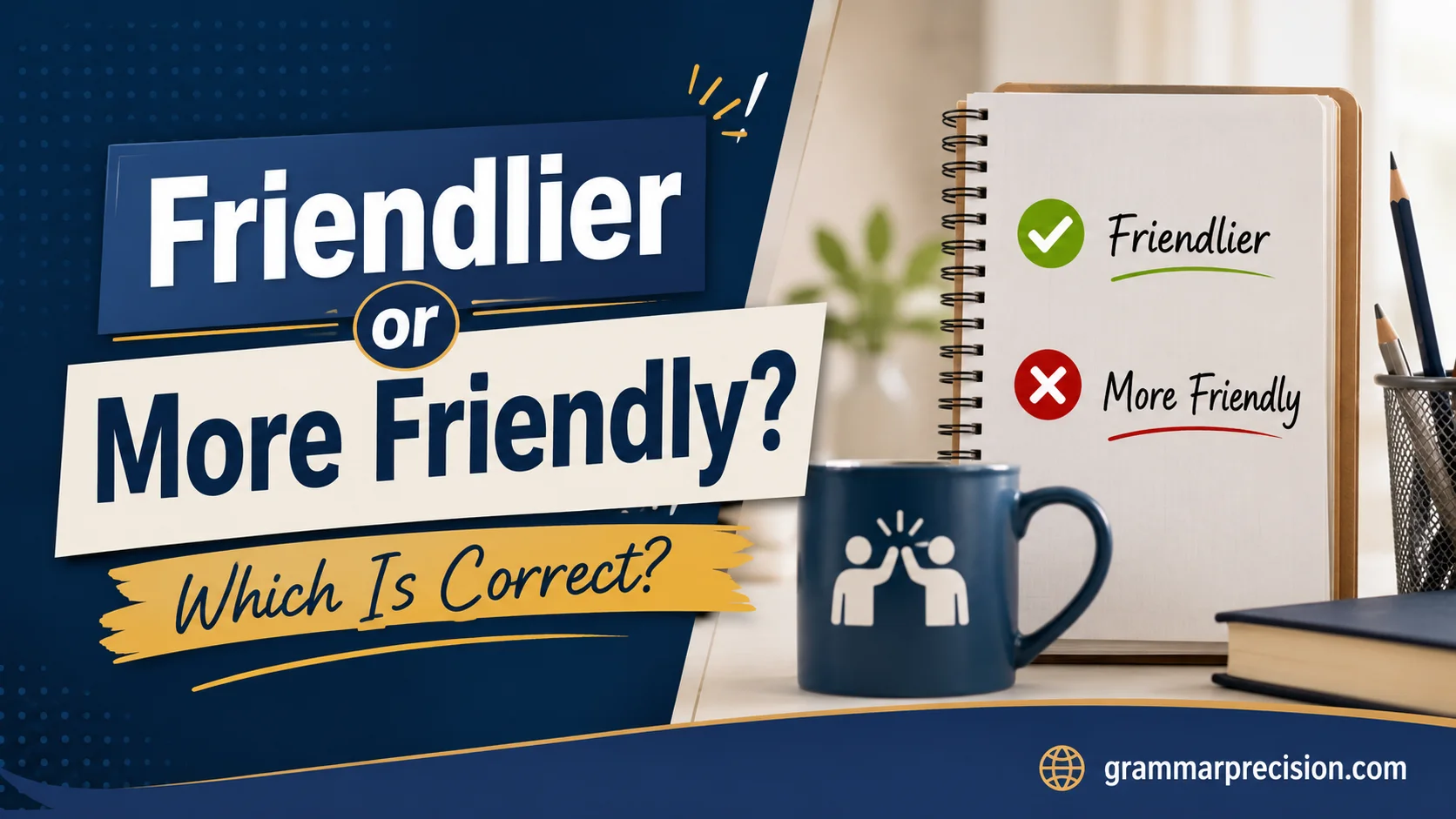
Choosing between friendlier or more friendly can feel surprisingly confusing, especially when both forms appear in everyday English. Fortunately, the difference becomes much clearer once you understand how comparative adjectives work.
Friendlier is the standard comparative form of friendly, following the common spelling pattern for adjectives ending in -y. However, more friendly can also be grammatically correct in many contexts. The best choice often depends on sentence structure, tone, and natural usage.
Whether you’re writing an email, describing someone’s personality, or comparing two places, knowing when to use friendlier and more friendly helps your writing sound polished and natural. Let’s explore the rules, examples, common mistakes, and simple ways to choose the right form confidently.
Friendlier or More Friendly: The Quick Answer
Here’s the answer at a glance:
| Form | Correct? | Example |
| Friendlier | Yes | This restaurant is friendlier than the old one. |
| More friendly | Yes | The new staff seem more friendly. |
| More friendlier | No | This form combines two comparative markers. |
| Friendliest | Yes | She’s the friendliest person here. |
| Most friendly | Yes | He was the most friendly member of the group. |
If you need a direct comparative form, friendlier is the traditional and straightforward choice.
For example:
This neighborhood is friendlier than I expected.
The word friendlier already means more friendly, so adding more before it creates a double comparative.
❌ This neighborhood is more friendlier than I expected.
✅ This neighborhood is friendlier than I expected.
✅ This neighborhood is more friendly than I expected.
That distinction is worth remembering because it prevents one of the most common errors surrounding this adjective.
What Does “Friendly” Mean?
Before comparing friendlier and more friendly, it helps to understand what friendly actually describes.
Friendly usually refers to someone or something that shows kindness, goodwill, warmth, or a lack of hostility. It can describe people, behavior, relationships, places, businesses, software, products, and even conditions. Merriam-Webster also lists meanings related to being helpful, easy to use, accommodating, or unlikely to cause harm.
Consider these examples:
- She has a friendly personality.
- Our new neighbors are very friendly.
- The hotel has a friendly atmosphere.
- This website is user-friendly.
- We need a more environmentally friendly solution.
- The receptionist gave us a friendly smile.
Notice something important: friendly doesn’t always describe friendship itself.
A friendly teacher may simply be warm and approachable. A friendly website may be easy to use. A friendly policy may be helpful or accommodating.
That broad meaning explains why comparative forms of friendly appear in many different contexts.
Why Is “Friendlier” Correct?
The answer comes down to a basic English spelling and grammar pattern.
When a two-syllable adjective ends in -y, English commonly changes the y to i and adds -er to form the comparative.
So:
- happy → happier
- easy → easier
- busy → busier
- funny → funnier
- noisy → noisier
- friendly → friendlier
The same pattern applies to the superlative:
- happy → happiest
- easy → easiest
- busy → busiest
- funny → funniest
- friendly → friendliest
Cambridge Grammar specifically identifies two-syllable adjectives ending in -y as adjectives that take -er and -est in their comparative and superlative forms.
That makes this progression perfectly standard:
friendly → friendlier → friendliest
Why Does the “Y” Change to “I”?
English spelling makes a small adjustment when you add -er or -est to an adjective ending in consonant + y.
The final y changes to i:
friendly + er → friendlier
Not:
❌ friendlyer
The same rule explains:
lovely → lovelier
lonely → lonelier
lively → livelier
pretty → prettier
Think of the spelling change as a tiny grammatical gear shift. The adjective keeps its meaning while its ending adjusts to fit the comparative form.
Is “More Friendly” Also Correct?
Yes.
More friendly is a valid comparative construction. It expresses the same basic idea as friendlier: having a greater degree of friendliness.
For example:
The new manager is more friendly with employees.
You could also write:
The new manager is friendlier with employees.
Both sentences communicate a comparison.
However, they don’t always feel identical stylistically. English speakers naturally choose between -er and more based on the adjective, sentence structure, rhythm, and personal preference.
Grammar isn’t always a neat row of identical boxes. Sometimes it behaves more like a toolbox: several tools can do the job, but one may fit your hand better.
Friendlier vs. More Friendly: Is There a Difference in Meaning?
In most ordinary sentences, friendlier and more friendly have essentially the same comparative meaning.
Compare:
The staff are friendlier this year.
The staff are more friendly this year.
Both suggest that the staff show a greater degree of friendliness than before.
The difference is mainly one of form and style, rather than meaning.
That said, sentence rhythm can influence which version feels more natural.
When “Friendlier” Sounds Natural
Friendlier often works especially well in short, direct comparisons:
- My new coworkers are friendlier.
- This café is friendlier than the one downtown.
- The receptionist became friendlier after we explained the problem.
- The neighborhood feels friendlier at night.
- Your dog seems friendlier today.
The compact comparative makes these sentences flow quickly.
When “More Friendly” Can Work Well
More friendly can also sound natural, especially when the sentence already contains several descriptive elements.
For example:
The new design creates a more friendly and welcoming environment.
Here, more friendly sits alongside another adjective, welcoming. The phrase can feel smooth because the writer is building a broader descriptive comparison.
You might also see:
We need a more friendly approach to customer support.
The choice isn’t necessarily about correctness. It’s often about which construction fits the surrounding words.
Friendlier vs. More Friendly in American English
For American English, friendlier is a safe and natural comparative form.
Major dictionaries explicitly list friendlier as the comparative of friendly. Merriam-Webster gives friendlier; friendliest directly in its entry for the adjective.
That doesn’t make more friendly incorrect.
English frequently permits variation with certain two-syllable adjectives. Cambridge notes that some two-syllable adjectives, especially those ending in -y, can use the -er/-est pattern.
So you don’t need to treat more friendly as a grammatical disaster. It isn’t.
A practical rule works better:
Use “friendlier” when you want the straightforward comparative form. Use “more friendly” when that construction sounds smoother or better suits the sentence.
For most everyday writing, friendlier is the cleanest choice.
Friendlier vs. More Friendly: A Practical Comparison
| Feature | Friendlier | More friendly |
| Grammar | Correct | Correct |
| Comparative meaning | Yes | Yes |
| Common in everyday English | Yes | Yes |
| Spelling pattern | friendly → friendlier | more + friendly |
| Superlative counterpart | friendliest | most friendly |
| Best for concise comparisons | Often | Sometimes |
| Can follow “more”? | No | Already uses more |
| Example | She is friendlier now. | She is more friendly now. |
The important point is that “more” and “-er” both perform the comparative job.
You normally don’t need both.
Can You Say “More Friendlier”?
No. In standard English, more friendlier is incorrect.
Why? Because more and -er both mark the comparative.
Look at the structure:
friendly → friendlier
The suffix -er has already changed the adjective into its comparative form.
Adding more creates unnecessary duplication:
❌ more + friendlier
It’s similar to saying:
❌ more better
❌ more happier
❌ more easier
The standard forms are:
✅ better
✅ happier
✅ easier
Cambridge Grammar explicitly warns against combining more/most with adjectives that already carry -er/-est endings.
A Simple Test for Double Comparatives
When you see more + adjective + -er, stop for a second.
Ask:
“Does this adjective already have a comparative ending?”
If yes, remove one comparative marker.
For example:
❌ This hotel is more friendlier.
Choose one:
✅ This hotel is friendlier.
or:
✅ This hotel is more friendly.
The same principle applies to superlatives:
❌ the most friendliest
Instead:
✅ the friendliest
or:
✅ the most friendly
Friendliest vs. Most Friendly
Once you understand friendlier vs. more friendly, the superlative forms become much easier.
The two standard possibilities are:
- friendliest
- most friendly
A comparative generally compares one person or thing with another. A superlative identifies the person or thing with the highest degree of a quality within a group.
Compare these sentences:
Sarah is friendlier than Emma.
This compares Sarah with Emma.
Now:
Sarah is the friendliest person in the office.
This places Sarah at the highest level of friendliness within the group.
The pattern looks like this:
| Degree | Form | Example |
| Positive | friendly | Sarah is friendly. |
| Comparative | friendlier | Sarah is friendlier than Emma. |
| Comparative | more friendly | Sarah is more friendly than Emma. |
| Superlative | friendliest | Sarah is the friendliest person here. |
| Superlative | most friendly | Sarah is the most friendly person here. |
Again, avoid double forms such as most friendliest.
Also Read This: Smelled or Smelt? Understanding the Distinctions in English
Friendlier or More Friendly With People
When you’re describing someone’s behavior or personality, friendlier often sounds especially natural.
Consider this mini case study.
Case Study: A New Workplace
Imagine that Maya starts a new job. During her first week, her coworkers seem polite but reserved. After several weeks, they begin chatting with her during lunch and inviting her to meetings.
You could say:
Her coworkers are friendlier now.
That sentence is short and natural.
You could also write:
Her coworkers are more friendly now.
The meaning remains virtually unchanged.
Now imagine a slightly different sentence:
The company has introduced a more friendly and supportive workplace culture.
Here, more friendly fits neatly into a coordinated descriptive phrase.
The lesson isn’t that one form is always right and the other is always wrong. Context matters.
Friendlier or More Friendly With Places and Businesses
Friendly has an especially broad range of uses when you describe places, services, and organizations.
For example:
- This hotel is friendlier than the one we stayed at last year.
- The new restaurant has a more friendly atmosphere.
- This bank is friendlier to small businesses.
- The redesigned website is more friendly to mobile users.
- The staff at the new store seem friendlier.
There is another interesting wrinkle here.
English often combines friendly with nouns to create compound adjectives:
- user-friendly
- customer-friendly
- family-friendly
- child-friendly
- business-friendly
- environmentally friendly
- reader-friendly
That means friendly can describe much more than someone’s personality.
Friendlier vs. More Friendly in Professional Writing
Professional writing rewards clarity above all else.
If you’re writing an email, report, website, proposal, or business document, friendlier is perfectly acceptable:
We need a friendlier tone in our customer emails.
However, more friendly can also work:
We need a more friendly and approachable tone in our customer emails.
Which should you choose?
Look at the complete sentence.
If friendlier makes the sentence leaner, use it. If more friendly fits naturally into a longer phrase, there’s no grammatical reason to reject it.
The goal isn’t to force one form into every sentence. Good writing chooses the form that communicates the idea cleanly.
Common Mistakes With Friendlier and More Friendly
A handful of mistakes appear again and again.
Mistake: “More Friendlier”
❌ The new staff are more friendlier.
Use:
✅ The new staff are friendlier.
or:
✅ The new staff are more friendly.
Mistake: “Most Friendliest”
❌ She is the most friendliest employee.
Use:
✅ She is the friendliest employee.
or:
✅ She is the most friendly employee.
Mistake: “Friendlyer”
❌ He became friendlyer over time.
The spelling changes from y to i:
✅ He became friendlier over time.
Mistake: Using “Then” Instead of “Than”
Comparatives normally use than when introducing the second element of a comparison:
✅ My new coworkers are friendlier than my old coworkers.
Don’t write:
❌ My new coworkers are friendlier then my old coworkers.
Than introduces the comparison. Then usually relates to time or sequence.
How to Make a Comparison Stronger
You don’t have to stop at friendlier.
English lets you strengthen or soften comparative adjectives with words such as much, far, a lot, even, a little, and a bit.
Examples:
- The new staff are much friendlier.
- This neighborhood is far friendlier than I expected.
- The new interface is a lot more friendly to beginners.
- She seems a little friendlier today.
- The receptionist was even friendlier than yesterday.
These additions give your writing more precision.
Compare:
The new manager is friendlier.
with:
The new manager is much friendlier with new employees.
The second sentence tells the reader that the difference is substantial.
20 Natural Examples of Friendlier and More Friendly
Examples With “Friendlier”
- My new neighbors are friendlier than the old ones.
- The receptionist became friendlier after our conversation.
- This café feels friendlier than the one across the street.
- Your dog looks friendlier today.
- The new teacher seems friendlier than our previous instructor.
- People become friendlier when they feel comfortable.
- The staff were friendlier than I expected.
- This neighborhood has become friendlier over the years.
- Her tone sounded friendlier after the meeting.
- The redesigned office feels friendlier and more welcoming.
Examples With “More Friendly”
- The new manager takes a more friendly approach.
- The website uses a more friendly design.
- We need a more friendly and welcoming atmosphere.
- The company adopted a more friendly customer-service policy.
- This version feels more friendly to beginners.
- The campaign uses a more friendly tone.
- They created a more friendly environment for visitors.
- The new layout looks more friendly and approachable.
- The organization wants to become more friendly toward small businesses.
- The updated instructions use a more friendly style.
The examples show an important pattern: both forms can communicate the same basic comparison.
A Quick Decision Rule for Writers
If you’re staring at the sentence and can’t decide, use this simple process.
Step one: Ask whether you need a comparative.
This restaurant is ___ than the other one.
Yes. You need a comparative.
Step two: Choose friendlier as your default.
This restaurant is friendlier than the other one.
Step three: Consider more friendly if it fits the sentence better.
This restaurant offers a more friendly and welcoming atmosphere.
Step four: Never combine the two.
❌ more friendlier
✅ friendlier
✅ more friendly
This approach keeps your writing grammatical without turning a simple adjective into a miniature grammar puzzle.
FAQs:
Is “Friendlier” Correct English?
Yes, friendlier is a correct and widely accepted comparative form of friendly. It follows the common spelling rule where adjectives ending in -y change the y to i before adding -er. For example, you can say, “My new coworkers are friendlier than my old coworkers.”
Is “More Friendly” Grammatically Correct?
Yes, more friendly is also grammatically correct. It uses more to create the comparative form rather than adding -er. You might use it when the phrase sounds smoother in context, such as, “The new website has a more friendly design.”
Which Is Better: “Friendlier” or “More Friendly”?
Friendlier is usually the better choice for a simple, direct comparison because it’s concise and natural. However, more friendly can work well in longer phrases or when it creates a smoother rhythm. Both forms can express the same basic comparative meaning.
Can I Say “More Friendlier”?
No, more friendlier is generally considered incorrect in standard English. The word friendlier already contains the comparative ending -er, while more also marks comparison. Use either friendlier or more friendly, but don’t combine both comparative forms.
What Is the Superlative Form of “Friendly”?
The standard superlative form is friendliest, while most friendly can also be used in suitable contexts. For example, “She is the friendliest person in the office” identifies her as having the highest degree of friendliness among the group.
Conclusion:
Both friendlier and more friendly can be correct, so the choice depends on the sentence and context. For a straightforward comparison, friendlier is usually the most natural and concise option. More friendly can also fit smoothly, especially within longer descriptive phrases.
Just remember to avoid the incorrect double comparative more friendlier. With these simple rules, you can use both forms confidently and naturally.