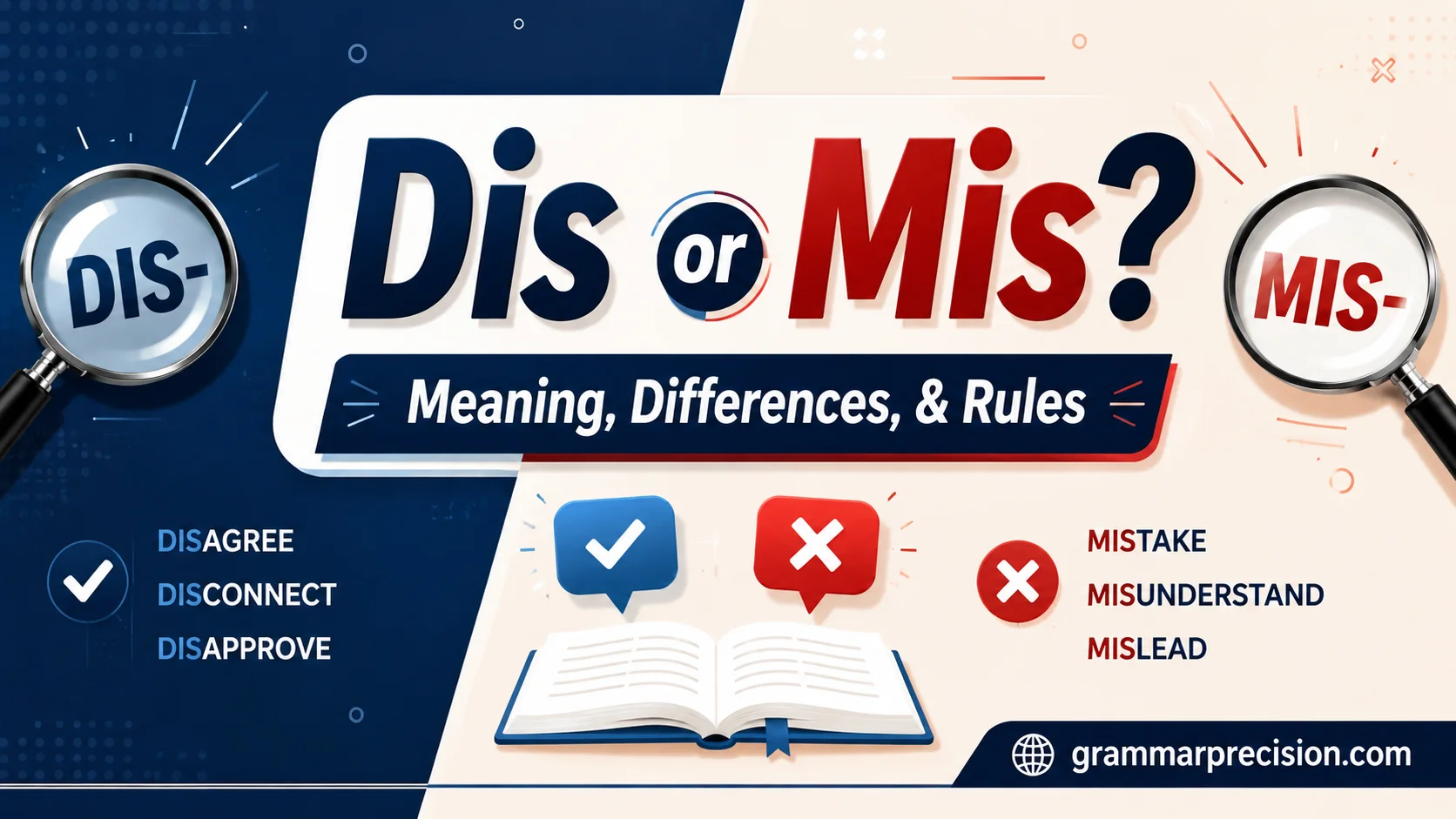
Dis or Mis can be confusing because both prefixes often create words with negative meanings. However, they serve different purposes. Dis- commonly shows opposition or separation, while mis- usually signals an incorrect action, understanding, or result.
The prefix dis- often expresses opposition, separation, reversal, or negation. Words such as disagree, disconnect, dislike, and dishonest demonstrate these meanings clearly. For example, when you disagree with someone, you hold a different opinion. When you disconnect something, you separate it from another object or system.
The prefix mis- usually indicates that something happened wrongly, incorrectly, or badly. Common examples include misunderstand, misread, misjudge, misuse, and miscalculate. If you misread instructions, you read them incorrectly. If you misuse equipment, you use it improperly. This simple distinction helps you choose the right word confidently.
Dis or Mis: The Quick Answer
Here’s the easiest distinction to remember:
| Prefix | Core idea | Simple question | Examples |
| dis- | opposite, apart, away, not | “Is this the opposite, absence, or reversal?” | disagree, disconnect, dislike |
| mis- | wrong, badly, incorrectly | “Was this done or understood wrongly?” | misunderstand, misread, misjudge |
Think of dis- as changing the relationship or status of something. Think of mis- as describing an error in an action, judgment, interpretation, or result.
For example, if you disagree, you hold an opposing view. If you misunderstand, you interpret something incorrectly. Those situations may both feel negative, but they aren’t the same.
That distinction is the heart of the dis vs. mis question.
What Is a Prefix?
Before comparing the two, it helps to understand what a prefix does. A prefix is a group of letters placed at the beginning of a word to modify its meaning. English uses prefixes to express ideas such as opposition, repetition, time, degree, location, and error.
Consider these simple examples:
- happy → unhappy
- write → rewrite
- possible → impossible
- spell → misspell
- agree → disagree
The base word remains recognizable while the prefix adds another layer of meaning.
That’s why prefixes are so useful for vocabulary building. Once you understand the meaning of a common prefix, unfamiliar words become easier to decode.
Dis- Meaning: Opposite, Apart, Away, or Not
The prefix dis- has several related functions. In many everyday words, it creates an opposite meaning or expresses negation. It can also suggest separation, removal, or reversal. Cambridge gives examples such as disagree and dishonest and describes dis- as a prefix used to form opposites.
Dis- as an Opposite or Negative
This is the meaning you’ll encounter most often.
- agree → disagree
- honest → dishonest
- satisfied → dissatisfied
- loyal → disloyal
- obedient → disobedient
For example:
I disagree with the proposed schedule.
The speaker doesn’t merely perform the act of agreeing incorrectly. The speaker holds a different position.
Likewise:
The employee was accused of being dishonest.
Here, dishonest describes the opposite of being honest.
Dis- as Separation or Removal
Sometimes dis- carries the sense of separating or taking something apart.
- connect → disconnect
- engage → disengage
- assemble → disassemble
- integrate → disintegrate
Consider a phone charger. When you disconnect it, you separate the connection. You haven’t connected it incorrectly. You’ve ended the connection.
That small distinction makes the prefix easier to recognize.
Dis- as Reversal
In some words, dis- suggests reversing an action or undoing a state.
- qualify → disqualify
- establish → disestablish
- arm → disarm
The exact meaning depends on the word. Prefixes don’t behave like mathematical symbols that always produce one identical result. English vocabulary develops through history, usage, and word formation.
Mis- Meaning: Wrong, Badly, or Incorrectly
The prefix mis- usually points toward an error, faulty action, poor result, or incorrect understanding. Cambridge defines mis- as a prefix added to a verb or a word formed from a verb to show that the action has been done wrongly or badly.
Common examples include:
- understand → misunderstand
- read → misread
- hear → mishear
- judge → misjudge
- calculate → miscalculate
- pronounce → mispronounce
- use → misuse
- lead → mislead
Look at the difference:
I misread the instructions.
The instructions were read incorrectly.
Now compare:
I disagreed with the instructions.
The reader understood the instructions but didn’t accept or support them.
Same general situation. Completely different meaning.
Mis- Often Describes an Error
When something goes wrong because someone performs an action incorrectly, mis- often fits naturally.
For example:
She miscalculated the total.
The calculation happened, but the result was wrong.
He mispronounced the name.
He attempted the pronunciation, but he said it incorrectly.
They misjudged the distance.
They made an incorrect judgment.
This gives you a useful mental picture: mis- puts a spotlight on the mistake.
Dis vs. Mis: The Golden Rule
If you remember only one idea from this guide, remember this:
Dis- often points to opposition, separation, reversal, or negation. Mis- often points to an incorrect action, interpretation, or result.
Here’s the difference in action:
| Situation | Better word | Why? |
| You hold the opposite opinion | disagree | You don’t share the same view |
| You understand something incorrectly | misunderstand | Your interpretation is wrong |
| You stop a connection | disconnect | You separate two connected things |
| You use something improperly | misuse | The use is wrong or unsuitable |
| You dislike something | dislike | You have a negative feeling toward it |
| You judge someone incorrectly | misjudge | Your judgment is mistaken |
| You remove someone’s qualification | disqualify | Their qualification or eligibility is canceled |
| You read something incorrectly | misread | Your reading produces an error |
This isn’t an absolute formula for every English word. It’s a high-value usage guide.
Dis vs. Mis Examples in Everyday English
Real sentences make the difference much easier to remember.
Examples With Dis-
- I disagree with that conclusion.
- Please disconnect the device before cleaning it.
- She disliked the restaurant’s noisy atmosphere.
- The manager disapproved of the proposal.
- His answer revealed a dishonest motive.
- The old system became dysfunctional after years of neglect.
- The referee disqualified the competitor.
- We had to discontinue the service.
- The two wires became disconnected.
- He showed disrespect toward the staff.
Examples With Mis-
- I misunderstood your question.
- She misread the email.
- He misheard the announcement.
- We miscalculated the budget.
- They misjudged the situation.
- Please don’t misuse this equipment.
- The article misrepresented the study.
- I mispronounced her surname.
- The advertisement misled customers.
- He misinterpreted the instructions.
Notice the pattern. The dis- examples often describe opposition, absence, separation, or a negative state. The mis- examples usually describe an error in doing, understanding, reading, judging, or representing something.
Common Dis- and Mis- Words
A strong vocabulary starts with familiar examples. The following list gives you a practical reference.
| Dis- word | Meaning | Mis- word | Meaning |
| disagree | have a different opinion | misunderstand | understand incorrectly |
| dislike | not like | misread | read incorrectly |
| disconnect | separate a connection | mishear | hear incorrectly |
| disapprove | not approve | misjudge | judge incorrectly |
| dishonest | not honest | mislead | lead someone wrongly |
| disobey | refuse to obey | misuse | use incorrectly |
| disqualify | make ineligible | miscalculate | calculate incorrectly |
| disrespect | lack of respect | mispronounce | pronounce incorrectly |
| disorganize | make less organized | misrepresent | represent inaccurately |
| discontinue | stop | misinterpret | interpret incorrectly |
| disarm | remove weapons or threat | mismanage | manage badly |
| disbelieve | refuse to believe | misbehave | behave badly |
| dislocate | move out of normal position | misplace | put in the wrong place |
| discontent | dissatisfaction | misinform | give incorrect information |
| disintegrate | break apart | misspell | spell incorrectly |
One important detail deserves attention: not every word can be created freely by attaching either prefix. You can’t simply invent a new word because its meaning seems logical. Established English vocabulary determines which formations are standard.
Also Read This: Fair vs. Just: How to Use Each Word
Tricky Cases: Dis or Mis Can Sometimes Overlap
English becomes especially interesting when two words seem close in meaning.
Consider distrust and mistrust. Both can describe a lack of confidence in someone or something. In ordinary modern English, their meanings overlap considerably.
That doesn’t mean you can replace every dis- word with a mis- word.
For instance, misunderstand is standard. Disunderstand isn’t standard modern English.
Likewise, disagree is standard. Misagree isn’t the normal word.
This is why prefix logic works best as a clue rather than a license to invent vocabulary.
Why the Rule Isn’t Perfect
English contains words inherited from different historical sources. Some prefixes also developed through older forms of English and other languages. As words entered English, their meanings shifted, narrowed, broadened, or became fixed through repeated use.
So if a word surprises you, don’t force the prefix rule.
Instead, ask:
- What does the whole word mean?
- What does the base word mean?
- Does the prefix add opposition or error?
- Is the resulting word actually established in modern English?
That approach prevents many awkward coinages.
Disuse vs. Misuse: A Perfect Example
These two words look deceptively similar, yet their meanings differ sharply.
Disuse means a state in which something is no longer used.
The old factory has fallen into disuse.
Misuse means using something incorrectly, improperly, or for the wrong purpose.
The company investigated the misuse of public funds.
The difference is almost visual:
- disuse = no use
- misuse = wrong use
That pair is worth memorizing because it captures the broader contrast beautifully.
Disagree vs. Misunderstand
Another common confusion appears when people disagree because they misunderstand one another.
Suppose your friend says:
“The meeting starts at six.”
You hear it as seven.
You’ve misheard the statement.
If you understand that your friend said six but think the meeting should start at seven, you disagree.
Here’s the sequence:
mishear → incorrect perception
misunderstand → incorrect interpretation
disagree → different opinion
These words describe three different stages of communication. Knowing that distinction can make your writing much more precise.
Misinform vs. Disinform
These terms deserve special care.
Misinform generally means giving someone incorrect information, whether deliberately or accidentally.
The report misinformed readers about the deadline.
Disinform is associated with deliberately spreading false or misleading information.
The campaign attempted to disinform the public.
The distinction often depends on intent. However, usage can vary by context, so writers should choose the term that accurately reflects what happened.
This example also shows why prefix meanings can’t always explain an entire word. Vocabulary has acquired specialized meanings through actual usage.
Dis or Mis: A Three-Step Decision Test
When you’re unsure, use this quick test.
Ask Whether the Idea Means “Opposite” or “Apart”
If the word describes opposition, negation, separation, removal, or reversal, dis- may be the right direction.
Examples:
- disagree
- disconnect
- disapprove
- disarm
Ask Whether Something Went Wrong
If the action happened incorrectly or produced a faulty result, mis- is often appropriate.
Examples:
- misread
- miscalculate
- misunderstand
- misjudge
Check Whether the Word Actually Exists
This final step matters most.
English doesn’t allow unlimited prefix combinations. A word can look perfectly logical and still sound wrong because native usage never established it.
For example, misunderstand is standard. Disunderstand isn’t.
The best grammar rule combines meaning + established usage.
Spelling Rules for Dis- and Mis-
Prefixes usually attach directly to the base word without adding a hyphen. Cambridge’s spelling guidance gives examples such as disobey, dissatisfied, misrule, and misspell.
Notice what happens with mis- before a word beginning with s:
mis + spell → misspell
The result contains ss.
Similarly:
mis + spelling → misspelling
This is a spelling detail that catches many writers off guard.
Common Mistakes With Dis and Mis
Mistake: Treating Them as Interchangeable
They aren’t.
Disagree means having a different opinion. Misunderstand means interpreting something incorrectly.
Mistake: Assuming Every Opposite Takes Dis-
English has several negative prefixes, including un-, in-, non-, and dis-. The correct form depends on the established word.
For example:
- happy → unhappy
- possible → impossible
- smoking → non-smoking
- honest → dishonest
You can’t choose a prefix solely because its general meaning seems appropriate.
Mistake: Creating Nonstandard Words
A logical-looking word isn’t automatically a real English word.
If you know misread, you might imagine disread means “not read.” That doesn’t make it standard vocabulary.
English vocabulary has boundaries. Respecting those boundaries produces natural writing.
How to Remember Dis or Mis
Use this compact memory trick:
DIS = Different, Divided, or Denied.
- different opinion → disagree
- divided connection → disconnect
- denied or opposite quality → dishonest
MIS = Mistake.
- wrong reading → misread
- wrong understanding → misunderstand
- wrong judgment → misjudge
- wrong use → misuse
It isn’t a perfect linguistic formula, but it’s an excellent practical shortcut.
When your brain hesitates between the two, ask one question:
“Is something opposite or separated, or did something simply go wrong?”
That question often points you toward the correct word immediately.
FAQs:
What does “dis-” mean?
Dis- commonly expresses opposition, separation, reversal, removal, or negation. Words such as disagree, disconnect, disapprove, and dislike show these meanings. The exact meaning depends on the word, but the prefix often changes the base word toward an opposite or negative idea.
What does “mis-” mean?
Mis- generally means wrongly, incorrectly, or badly. It often describes an action, interpretation, or result that contains an error. Examples include misunderstand, misread, misjudge, misuse, and miscalculate. Think of mis- as a clue that something went wrong.
What is the main difference between dis and mis?
The main difference is meaning. Dis- often suggests an opposite, separation, reversal, or lack of something. Mis- usually indicates an incorrect action, judgment, understanding, or result. For example, disagree means having a different opinion, while misunderstand means interpreting something incorrectly.
Is misuse different from disuse?
Yes, misuse and disuse have different meanings. Misuse means using something incorrectly or improperly, while disuse means something is no longer used. For example, someone can misuse equipment by handling it incorrectly, while an old building may fall into disuse after people stop using it.
Can dis and mis be used with any word?
No, you can’t simply attach dis- or mis- to any word. English has established vocabulary, so some combinations are standard while others aren’t. For example, misunderstand and disagree are correct, but disunderstand and misagree aren’t standard modern English.
Conclusion:
Understanding dis or mis becomes easier when you focus on meaning rather than spelling. Dis- commonly indicates opposition, separation, reversal, or negation, while mis- usually describes something done incorrectly or badly. Words like disagree, disconnect, misunderstand, and misjudge make the difference clear.
When unsure, consider the intended meaning and choose the established English word that fits the context best.