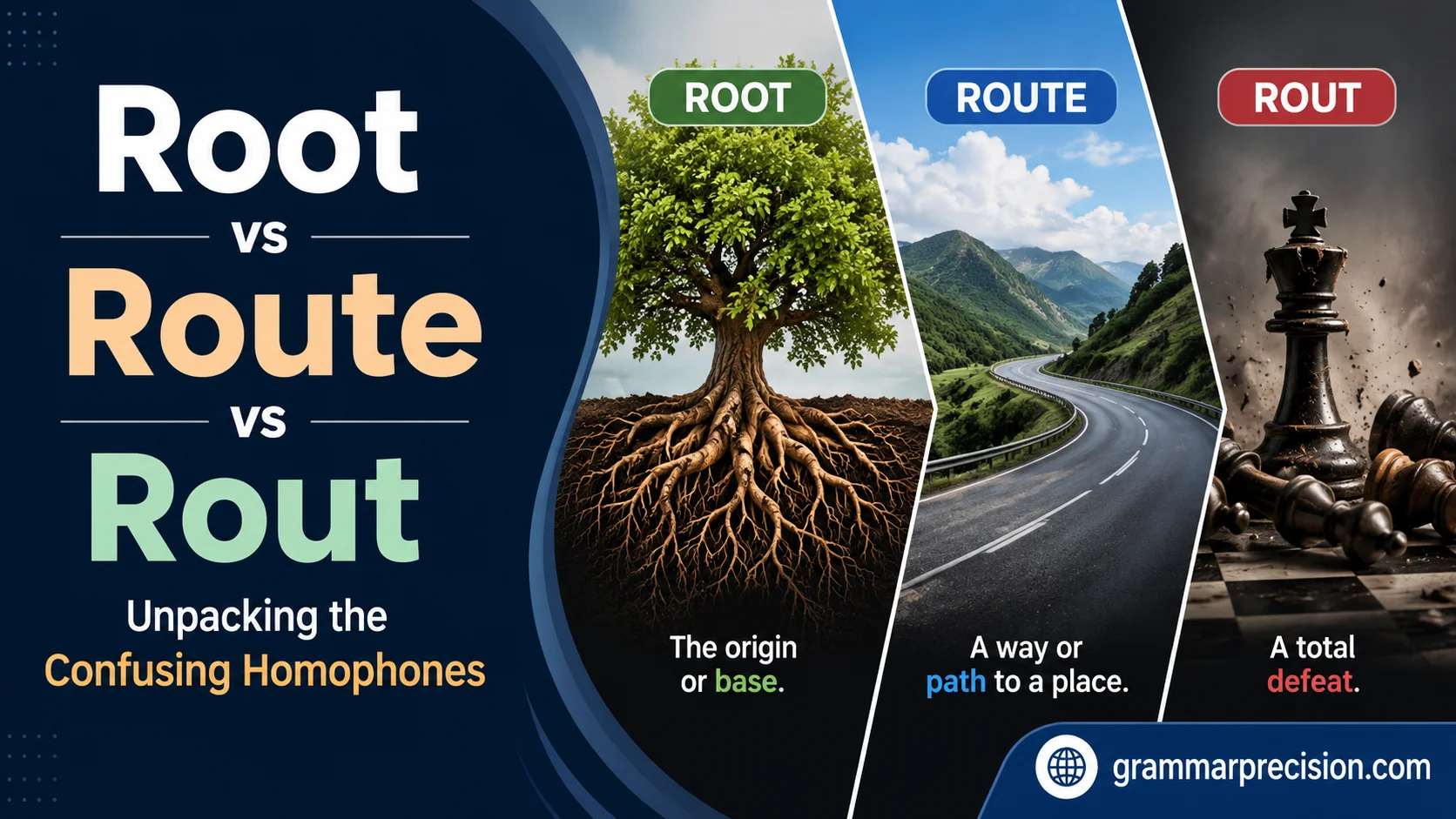
Root vs. Route vs. Rout can confuse even careful writers because these words have similar sounds and spellings. Yet each has a different meaning, usage, and role in everyday English and communication.
Root usually refers to the underground portion or base of a plant, helping it live and thrive. It can also mean to dig, rummage, or give audible encouragement to a sports team. For example, fans may root for their team during a ball game, adding excitement to sports.
Route describes a way, path, road, or direction from one place to another. It can also mean a regular course for a salesperson or delivery person. The French phrase en route means on the way. Depending on the speaker, route may have different pronunciations, which can cause confusion.
Rout generally means an overwhelming defeat or a disorderly retreat. As a verb, it means to defeat someone decisively. Although these words can sound alike, their contexts and meanings differ. Remembering these distinctions can strengthen your writing, improve communication, and give you more confidence when choosing the correct word.
The Fastest Way to Tell Root, Route, and Rout Apart
Before diving into the finer details, remember these three core meanings:
- Root = an origin, foundation, or part of a plant
- Route = a path, direction, or way to get somewhere
- Rout = a crushing defeat or a disorderly retreat
Think of them as three different pictures.
Root makes you think of something buried beneath the surface.
Route makes you think of a road leading from one place to another.
Rout makes you think of one side being thoroughly beaten.
| Word | Basic Meaning | Common Context |
| Root | Origin, foundation, or plant structure | Plants, causes, ancestry, math |
| Route | Path or direction | Travel, transportation, technology |
| Rout | Crushing defeat or chaotic retreat | Sports, battles, competition |
A useful memory trick is simple: root goes down, route goes somewhere, rout knocks someone down.
That isn’t a complete dictionary definition, of course. However, it gives you a reliable starting point when you’re choosing between these easily confused words.
Root: The Word of Origins and Foundations
The word root has several important meanings, but they all connect to the idea of a foundation or source.
Its most familiar meaning refers to the part of a plant that usually grows underground. Roots anchor plants in the soil and absorb water and minerals. From there, the word developed broader meanings involving origins, causes, ancestry, and basic structures.
Root as a Noun
As a noun, root can refer to the underground part of a plant.
The tree’s roots extend beneath the sidewalk.
It can also describe the fundamental cause or source of something.
We need to find the root of the problem.
Here, root doesn’t have anything to do with gardening. It means the underlying reason something exists or happens.
You can also use root when discussing ancestry, culture, or personal background.
She returned to Ireland to explore her family roots.
In mathematics, root has a specialized meaning. For example, the square root of 25 is 5 because 5 multiplied by itself equals 25.
So, depending on context, root can refer to:
- A part of a plant
- The source of something
- The fundamental cause of a problem
- Family ancestry
- Cultural origins
- A mathematical value
- A fundamental element of a system
Root as a Verb
Root can also function as a verb.
When a plant establishes itself firmly in soil, you can say it roots or takes root.
The young tree has finally taken root.
The expression take root has a figurative meaning too. It describes an idea, habit, belief, or movement becoming firmly established.
The new tradition quickly took root in the community.
In American English, root for has another familiar meaning: to support someone or something.
We’re rooting for our team tonight.
That meaning has nothing to do with plants. Context does the heavy lifting.
Common Expressions With Root
Several common expressions make root especially useful:
- Take root — become established
- Root cause — the underlying reason for something
- Get to the root of something — discover the fundamental cause
- Put down roots — establish a stable home or life
- Root for someone — support or cheer for someone
- Family roots — ancestry or heritage
The phrase root cause is particularly common in business, engineering, medicine, and problem-solving. If a machine repeatedly fails because of a faulty component, replacing the damaged surface part may not solve the problem. Finding the root cause means identifying what actually created the failure.
Route: The Word of Direction and Travel
If root is about origins, route is primarily about direction and movement.
A route is a way or path from one location to another. It can involve roads, highways, flights, buses, shipping networks, or even an abstract process.
We chose a scenic route through the mountains.
The word doesn’t always describe a physical road, either. You can use it metaphorically when describing a process or method.
There are several routes to solving the problem.
In that sentence, nobody is driving anywhere. Route means a possible course or approach.
Route as a Noun
The noun route is common in travel and transportation.
Examples include:
- A bus route
- A flight route
- A delivery route
- A hiking route
- A shipping route
- A driving route
- A trade route
Consider this sentence:
The bus follows the same route every morning.
The route is the established path the bus takes.
You might also say:
We planned our route before leaving.
Here, route refers to the journey’s planned direction.
Route as a Verb
Route can also function as a verb meaning to direct or send something along a particular path.
The system routes incoming calls to the appropriate department.
You may encounter this usage frequently in technology.
For example, a network can route data between computers. A customer-service system can route a call to a specialist. A delivery company can route a package through several distribution centers.
The underlying idea stays the same: something is being directed along a particular path.
Route Beyond Physical Travel
Modern English uses route in many technical and abstract settings.
For example:
The application routes users to the correct page.
Or:
The manager chose a different route for handling the complaint.
In both cases, route describes movement from one point to another. The points simply aren’t necessarily physical places.
That flexibility makes route far more versatile than it might first appear.
Rout: The Word of Defeat
Now we arrive at the word that causes some of the biggest spelling mistakes.
A rout refers to a decisive and overwhelming defeat. It can also describe a disorderly retreat by people who have been defeated.
The championship game ended in a rout.
This doesn’t merely mean that one team lost. It suggests that the winning side dominated the competition.
Rout as a Noun
As a noun, rout often appears in sports reporting, political commentary, and descriptions of battles.
The defending champions suffered a shocking rout.
The sentence suggests a severe loss rather than a close contest.
You might also see:
The election turned into a rout.
That means one candidate or party won by a very large margin.
Historically, rout has also been associated with military defeat.
The defeated army fled in a chaotic rout.
The word therefore carries a stronger sense than ordinary words such as loss or defeat.
Rout as a Verb
Rout can also work as a verb. It means to defeat someone thoroughly or drive them away.
The home team routed its rival 42–7.
Notice the difference between these two sentences:
The home team defeated its rival.
The home team routed its rival.
The first sentence simply states that the team won. The second emphasizes the size and force of the victory.
This distinction matters in strong descriptive writing. If the result was close, rout would sound exaggerated.
Rout in Sports and Military Contexts
Sports writers frequently use rout because it creates a vivid picture of domination.
Imagine a basketball game ending 118–72. Calling it a rout makes sense because the margin suggests a one-sided contest.
By contrast, a 101–99 victory wouldn’t normally qualify as a rout.
The same principle applies to military or political contexts. A rout implies that the losing side suffered a significant and often humiliating collapse.
Also Read This: In the Team or on the Team? Solve the Preposition Puzzle
Root vs. Route vs. Rout at a Glance
When you’re unsure which spelling belongs in a sentence, this comparison should settle the question quickly.
| Feature | Root | Route | Rout |
| Core idea | Origin or foundation | Path or direction | Crushing defeat |
| Common noun use | Plant part, cause, ancestry | Road, path, method | Severe defeat |
| Common verb use | Establish, support | Direct along a path | Defeat decisively |
| Example | Find the root cause. | Which route should we take? | They routed the opponent. |
| Typical context | Nature, causes, ancestry, math | Travel, systems, processes | Sports, battles, competition |
| Memory image | Underground foundation | Road or pathway | One-sided victory |
The most important distinction is semantic rather than visual.
If you’re talking about where something begins, choose root.
If you’re talking about where something goes, choose route.
If you’re talking about how badly someone lost, choose rout.
The Pronunciation Trap
Spelling isn’t the only reason these words cause confusion. Route has pronunciation variation that can make matters even more interesting.
In American English, route is commonly pronounced either like “root” or like “rowt.” Both pronunciations are widely recognized.
Root is generally pronounced like “root.”
Rout is pronounced like “rowt,” rhyming with words such as out.
That means these words can create an unusual situation:
- Root and one common pronunciation of route can sound identical.
- Rout sounds different from both.
- Spelling becomes especially important when context isn’t enough.
For example:
We took the scenic route.
If route is pronounced like root, its sound won’t tell you which spelling you’re hearing. You need to understand the sentence.
This is a good reminder that English spelling and pronunciation don’t always march in perfect formation.
The Context Test: A Simple Way to Choose
When you’re writing quickly, don’t stare at the three spellings and hope inspiration strikes. Instead, ask one question:
What idea am I trying to express?
Is It About an Origin?
Use root.
The root of the disagreement was a misunderstanding.
The sentence identifies the underlying source of the disagreement.
Is It About a Path?
Use route.
We took the fastest route home.
The sentence describes the path used for travel.
Is It About an Overwhelming Defeat?
Use rout.
The visiting team suffered a rout.
The sentence describes a severe, one-sided loss.
This three-question method works because it focuses on meaning instead of spelling.
Root, Route, and Rout in Real-World Examples
Seeing the words in realistic contexts makes their differences easier to remember.
Everyday Conversation
What route are you taking to work?
The roots of the old tree damaged the pavement.
Their team was routed in the final.
Each sentence creates a completely different mental picture.
Academic Writing
Researchers examined the root causes of the economic crisis.
Several routes can lead to the same conclusion.
The study does not describe the election as a political rout.
Academic writing often favors root in phrases involving causes and foundations.
Business and Technology
The company investigated the root cause of the software failure.
The network automatically routes requests to available servers.
The competitor’s sudden market rout surprised investors.
Here, all three words can appear in sophisticated professional contexts, but their meanings remain distinct.
A Quick Case Study: One Letter, Three Completely Different Ideas
Consider this short scenario.
A delivery company needs to send a package across the country. Its manager checks the best route and notices that heavy traffic could delay the shipment.
Meanwhile, the company investigates the root cause of recent delivery failures. It discovers that a scheduling error caused most of the problems.
Later, a rival company loses a major contract after repeated mistakes. Industry reporters describe the result as a rout.
Notice how naturally the three words can coexist:
- Route = the path taken by the package
- Root = the underlying cause of the company’s problems
- Rout = a dramatic defeat suffered by the rival
The spellings are similar. The concepts aren’t.
Common Mistakes With Root, Route, and Rout
These words often get mixed up because they look and sound related. Here are some mistakes worth avoiding.
Mistake: Using Rout for a Travel Path
Incorrect:
We selected the shortest rout to the airport.
Correct:
We selected the shortest route to the airport.
A travel path is a route, not a rout.
Mistake: Using Route for an Underlying Cause
Incorrect:
We need to identify the route cause of the problem.
Correct:
We need to identify the root cause of the problem.
The phrase is root cause because you’re looking for the source or foundation of the problem.
Mistake: Using Root for a Crushing Defeat
Incorrect:
The team suffered a root in the championship.
Correct:
The team suffered a rout in the championship.
A severe defeat is a rout.
Mistake: Assuming Route Always Has One Pronunciation
Because route has pronunciation variation in American English, don’t assume that everyone will pronounce it exactly the same way.
The important point is that the meaning and spelling remain the same regardless of which accepted pronunciation a speaker uses.
Useful Facts About These Three Words
A few facts make the distinction even clearer:
- Root can refer to both physical structures and abstract origins.
- Route can describe physical paths and abstract methods.
- Rout usually carries a strong sense of overwhelming defeat.
- Route has more than one established pronunciation in American English.
- Root cause is a common fixed expression in analytical and professional writing.
- Root has mathematical uses involving values such as square roots.
- Route works as both a noun and a verb.
- Rout works as both a noun and a verb.
- Context often matters more than pronunciation when distinguishing root from route.
Easy Memory Tricks for Root vs. Route vs. Rout
If you regularly confuse these words, attach each one to a memorable image.
Root → buried foundation
Picture the roots of a giant tree spreading beneath the ground. Think origin, source, foundation.
Route → road
Picture a highway connecting two cities. Think path, direction, journey.
Rout → knockout
Picture one sports team dominating another by a huge margin. Think crushing defeat.
Another useful trick is the phrase:
Root the cause. Route the journey. Rout the opponent.
It isn’t a formal grammar rule. It’s simply a compact memory hook.
Quick Practice Quiz
Choose root, route, or rout in each sentence.
- We need to find the ___ cause of the issue.
- Which ___ leads to the downtown area?
- The visitors ___ the defending champions.
- The tree’s ___ damaged the foundation.
- The flight follows a northern ___.
- The election became an unexpected ___.
Answers
- root
- route
- routed
- roots
- route
- rout
If you got all six right, you’ve captured the central distinction.
If you missed one, don’t worry. Focus on the idea behind the word, rather than memorizing isolated spellings.
FAQs:
What does “root” mean?
Root can refer to the underground part or base of a plant. It can also mean to dig, rummage, or cheer for a sports team. The correct meaning depends on the context.
What does “route” mean?
Route means a path, road, direction, or way used to travel from one place to another. It can also describe a regular course followed by a salesperson or delivery person.
What does “rout” mean?
Rout means an overwhelming defeat or a disorderly retreat. As a verb, it means to defeat someone decisively. It commonly appears when describing a team or opponent suffering a crushing loss.
Are root and route homophones?
Yes, root and route can be homophones because they may share the same pronunciation. However, route has another common pronunciation. Their spelling, meaning, and usage remain different.
Is rout the same as root?
No. Rout and root have different meanings, although they share some historical connections and certain meanings involving digging and rummaging. Always examine the context before choosing between them.
Conclusion:
Root vs. Route vs. Rout becomes easier when you connect each word with its specific meaning, context, and everyday usage instead of relying only on similar sounds or spelling patterns.
Root relates to plants, cheering, and digging, while route describes a path or way of travel. Rout describes an overwhelming defeat or disorderly retreat. Learning these differences can make your writing clearer.
Once you understand their distinct definitions, you can choose the right word with greater confidence. Pay attention to pronunciation, spelling, and context, especially when writing emails, essays, or other forms of professional communication.