Fair vs. Just explains how two similar words can express different ideas about equality, fairness, justice, and individual circumstances in everyday decisions.
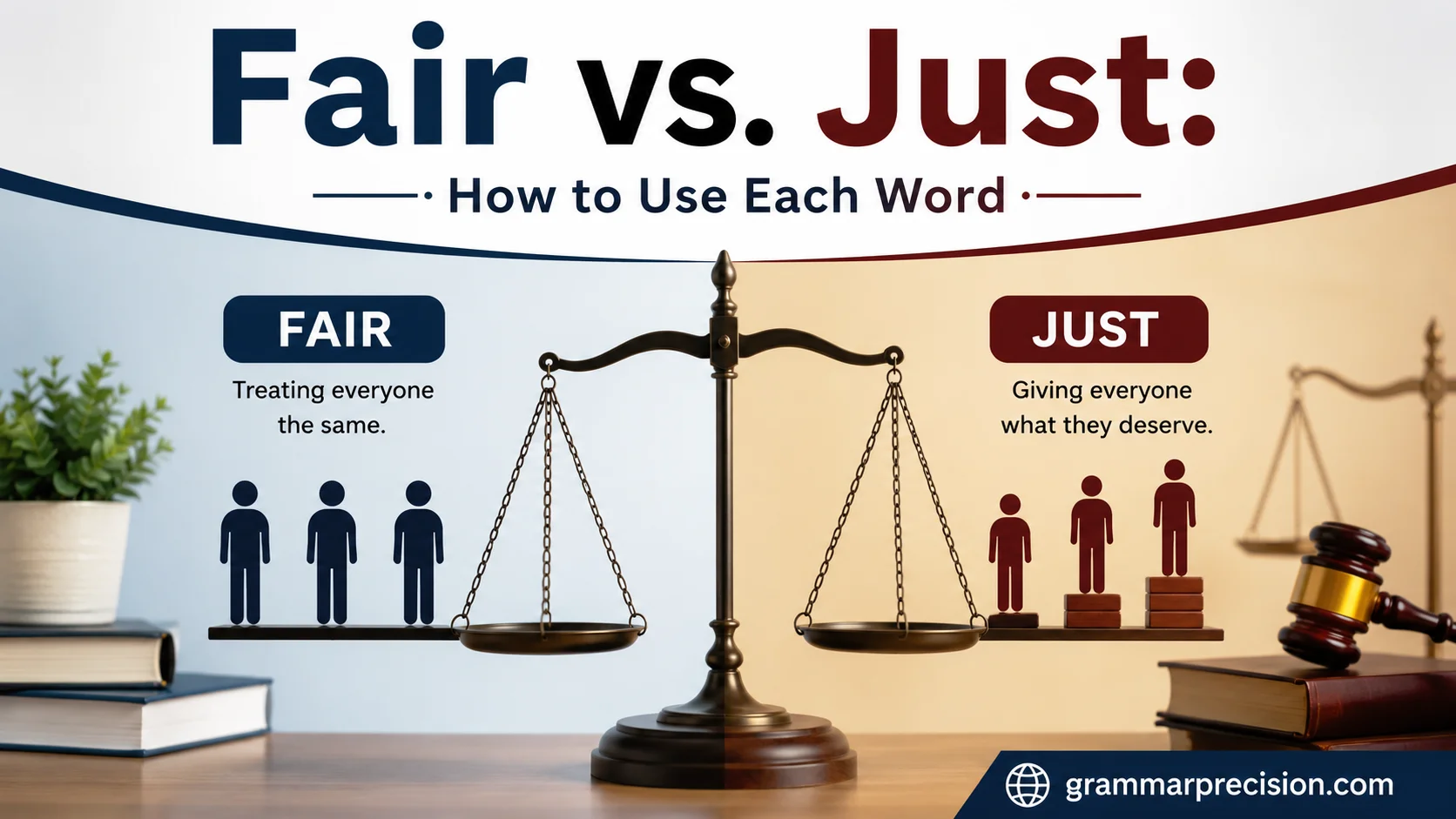
A fair choice often gives everyone the same treatment, follows same rules, and provides an equal opportunity. However, a just decision may consider individual needs, abilities, circumstances, and context. This distinction helps you understand why treating everyone equally isn’t always the most appropriate or balanced choice in every situation.
In everyday life, fairness can mean applying consistent rules, while justice may require considering individual circumstances and different needs. For example, a teacher might make a fair decision by following the same classroom rules, but a just decision could consider a student’s unique situation. Understanding this difference improves communication, reasoning, and word choice.
Fair vs. Just: The Quick Answer
Fair generally means reasonable, impartial, balanced, or equal in treatment.
Just generally means morally right, deserved, lawful, or consistent with justice.
Consider these examples:
- The teacher gave everyone a fair chance.
- The judge gave the defendant a just punishment.
- That price seems fair.
- The decision was just.
Both words can describe something right or acceptable. However, fair sounds more natural in everyday conversations, while just often carries a stronger sense of morality, law, principle, or deservedness.
| Word | Main idea | Common focus | Example |
| Fair | Reasonable or impartial | Treatment, opportunities, exchanges | Everyone received a fair chance. |
| Just | Morally right or deserved | Decisions, punishment, principles | The punishment was just. |
| Equal | The same in amount or status | Distribution or treatment | Everyone received an equal share. |
| Right | Correct or morally acceptable | Choices and behavior | You made the right decision. |
The distinction isn’t absolute. In many sentences, fair and just can function as close synonyms.
What Does “Fair” Mean?
The adjective fair commonly describes something that treats people reasonably or equally. It can also describe a situation in which personal opinions, favoritism, or prejudice don’t influence a decision.
For example:
The coach gave every player a fair opportunity to make the team.
Here, fair emphasizes equal opportunity and impartial treatment.
Cambridge notes that fair can describe treating people in a way that is right or reasonable, treating groups equally, or making judgments without personal opinions affecting the result.
Fair Can Mean Equal Treatment
Sometimes fair means giving people the same opportunity or share.
- Each employee received a fair share of the profits.
- The students deserved a fair chance to compete.
- We should give both candidates a fair hearing.
However, fair doesn’t always mean identical.
Imagine two runners preparing for a race. One has trained for years, while the other has never competed. Giving both exactly the same training might be equal, but it doesn’t automatically address every circumstance.
That’s why fair can also mean reasonable under the circumstances.
Fair Can Mean Reasonable
Consider this exchange:
“The repair will cost $200.”
“That sounds fair.”
The speaker isn’t necessarily saying that $200 is equal to something else. They mean the price seems reasonable and acceptable.
You can use fair this way in everyday situations:
- That’s a fair price.
- She made a fair point.
- He asked for a fair salary.
- That’s a fair question.
- You deserve a fair opportunity.
This everyday flexibility makes fair especially common in casual American English.
What Does “Just” Mean?
The word just has several meanings in English. In the context of fair vs. just, we’re mainly interested in its adjective meaning: morally right, deserved, or based on justice.
For example:
The court reached a just decision.
The sentence suggests more than simple balance. It implies that the decision aligns with principles of justice, morality, rights, or what the circumstances require.
Justice itself refers to fair and morally correct treatment, and the word also has a strong legal sense involving courts and the administration of law.
Just Can Mean Morally Right
Consider:
The community demanded a just solution.
Here, just suggests that the solution should satisfy a deeper standard of moral correctness.
You might see just in phrases such as:
- a just society
- a just cause
- a just decision
- a just punishment
- a just ruler
- a just law
The word often sounds more formal than fair, especially when discussing ethics, law, government, or serious moral questions.
Just Can Mean Deserved
Just can also describe something that someone deserves because of their actions or circumstances.
For example:
The athlete received a just reward for years of hard work.
The idea isn’t simply that everyone got the same reward. Instead, the reward fits the person’s effort and achievement.
That’s a useful distinction.
Fair may ask, “Did everyone receive reasonable treatment?”
Just may ask, “Did each person receive what they deserved?”
Fair vs. Just: The Core Difference
The simplest distinction looks like this:
Fair focuses more on reasonable or impartial treatment. Just focuses more on moral correctness or deserved outcomes.
That doesn’t mean fair has nothing to do with morality. It absolutely can. Likewise, just can describe an outcome that people consider fair.
The difference lies in what the speaker emphasizes.
| Question | More naturally associated with |
| Did everyone get a reasonable chance? | Fair |
| Was the treatment impartial? | Fair |
| Was the price reasonable? | Fair |
| Did the punishment fit the wrongdoing? | Just |
| Was the decision morally right? | Just |
| Did the person receive what they deserved? | Just |
| Was the ruling consistent with justice? | Just |
Think of fair as looking closely at the treatment or arrangement. Think of just as looking more closely at the principle behind the outcome.
Fair vs. Just: Equality Isn’t the Whole Story
Here’s where the distinction gets interesting.
People often assume that fair means giving everyone exactly the same thing. That’s not always true.
Suppose three employees work on a project. One works ten hours, another works twenty, and another works thirty. If the manager divides a bonus equally, some employees may call that fair because everyone receives the same amount.
Another manager might divide the bonus according to contribution. That manager could also argue that the system is fair because people receive rewards proportional to their work.
The disagreement isn’t really about vocabulary. It’s about which standard of fairness matters.
Justice can raise the same question.
A just outcome doesn’t necessarily mean everyone receives identical treatment. Instead, it can mean that the decision respects relevant differences, responsibilities, rights, and consequences.
This is why equal, fair, and just shouldn’t automatically be treated as synonyms.
Can Something Be Fair but Not Just?
Yes, depending on the standard you’re using.
Imagine a company has a rule stating that every employee who arrives late receives the same penalty. The manager applies that rule consistently.
That may seem fair because everyone faces the same rule.
But suppose one employee arrived late because they stopped to help an injured coworker. Another arrived late because they overslept.
Treating both employees identically follows the rule. Yet someone could argue that a more just decision would consider their different circumstances.
The lesson is important:
Equal treatment can sometimes produce an outcome that people still question morally.
Fairness often depends on the standard being applied. Justice may require a deeper look at why the situation happened and what each person deserves.
Can Something Be Just but Not Fair?
This question is trickier because people often use fair and just as near-synonyms.
Still, a decision can be described as just according to a particular moral or legal principle while someone affected by it considers the result unfair.
For example, imagine a student breaks an important school rule. The school imposes the published consequence.
The school may describe the punishment as just because the student violated a clearly established rule and the consequence matches the policy.
The student may still say:
“That doesn’t feel fair.”
Why?
The student might believe the rule doesn’t account for special circumstances.
This illustrates an important point: fairness can involve people’s perception of reasonable treatment, while justice can refer to a broader principle or established standard.
Neither concept exists in a vacuum.
Fair vs. Just in Real-Life Situations
The best way to understand these words is to see them in action.
In the Classroom
The teacher gave everyone a fair amount of time to complete the test.
Here, fair focuses on equal or reasonable treatment.
Now consider:
The teacher gave a just punishment for deliberate cheating.
Here, just focuses on deserved consequences.
In the Workplace
The company offers fair opportunities for promotion.
This suggests that employees receive reasonable opportunities without favoritism.
The manager made a just decision after reviewing the evidence.
This suggests the manager reached a morally or ethically appropriate conclusion.
In a Friendship
Imagine two friends order different meals.
One meal costs $20. The other costs $40.
Splitting the bill 50/50 might be called fair if both friends agreed to share equally. However, one friend might argue that paying for exactly what each person ordered is fairer.
In everyday speech, you’d naturally say:
“Let’s split the bill fairly.”
You wouldn’t normally say:
“Let’s split the bill justly.”
That sentence is grammatically possible, but it sounds unusually formal.
In Sports
The referee made a fair call.
This sounds natural because sports involve rules, impartiality, and equal treatment.
You can also say:
The referee made a just decision.
However, that version sounds more serious and emphasizes the correctness of the decision rather than the ordinary sporting fairness of the call.
In Law
The word just becomes especially useful in legal and ethical contexts.
The judge imposed a just sentence.
The sentence suggests that the punishment fits the wrongdoing.
At the same time, fair trial is an extremely natural phrase:
Everyone deserves a fair trial.
This shows why context matters. Even in legal language, fair and just perform slightly different jobs.
Also Read This: If I Was or If I Were? Meaning, Difference, & Examples
Fair vs. Just in Everyday English
In casual conversation, fair is usually the more natural choice.
For example:
- That’s fair.
- Fair enough.
- That’s not fair.
- Give me a fair chance.
- That’s a fair point.
- You have a fair argument.
Notice how natural these expressions sound.
Now compare:
- That’s just.
- Just enough.
- A just chance.
These don’t communicate the same everyday meaning.
In fact, “That’s fair” is a common conversational response when someone presents a reasonable argument, explanation, or request.
For instance:
“I can’t come tonight because I already promised my family I’d help.”
“That’s fair.”
The response means “I understand, and your reason is reasonable.”
You wouldn’t normally replace it with “That’s just.”
Fair vs. Just in Formal Writing
Just often fits better when the subject involves principles, morality, rights, or justice.
For example:
- The policy aims to create a just society.
- The court sought a just outcome.
- Citizens demanded just treatment.
- The punishment was considered just.
Meanwhile, fair remains perfectly appropriate in formal writing:
- The policy provides fair access to education.
- The process must remain fair and transparent.
- Employees deserve fair compensation.
So don’t assume that just is always more formal and fair is always informal. Context determines the best choice.
Fair vs. Just vs. Equal
These three words deserve separate treatment.
Equal means the same in amount, status, value, or treatment.
Fair means reasonable or impartial.
Just means morally right or deserved.
Consider three students receiving help with a difficult assignment.
- Equal: Each student gets exactly 30 minutes.
- Fair: Each student gets reasonable support based on the situation.
- Just: The support follows a defensible principle about what each student deserves.
These concepts can overlap, but they don’t always produce the same result.
A Simple Comparison
| Word | Main question |
| Equal | “Did everyone receive the same thing?” |
| Fair | “Was everyone treated reasonably?” |
| Just | “Was the outcome morally right or deserved?” |
That distinction can save you from using these words interchangeably.
Common Phrases With “Fair”
Learning common combinations makes usage much easier.
- fair chance
- fair treatment
- fair price
- fair share
- fair competition
- fair trial
- fair decision
- fair deal
- fair opportunity
- fair point
- fair game
- fair play
For example:
Everyone deserves a fair chance to explain their side.
The customer received a fair price for the service.
That’s a fair point, even though I disagree with it.
Common Phrases With “Just”
The following combinations are especially common in formal, legal, ethical, or serious contexts:
- just decision
- just punishment
- just cause
- just society
- just ruler
- just law
- just reward
- just outcome
- just treatment
- justice system
For example:
The court attempted to reach a just decision.
They believed the workers deserved a just reward.
One caution matters here: just has several unrelated meanings.
In “a just decision,” it means morally right or fair.
In “I just finished,” it means very recently.
In “just two dollars,” it can mean only.
So context does a lot of work.
Common Mistakes With Fair and Just
Mistake: Assuming They Always Mean Exactly the Same Thing
They overlap, but their emphasis differs.
Fair often sounds more natural when discussing everyday treatment.
Just often sounds stronger when discussing morality, law, or deserved consequences.
Mistake: Assuming Fair Means Identical
Fairness doesn’t always require identical treatment.
A reasonable decision can take circumstances into account.
Mistake: Replacing “That’s Fair” With “That’s Just”
In everyday American English, “That’s fair” is a natural conversational response.
“That’s just” usually sounds incomplete or unnatural in that situation.
Mistake: Confusing Just With Justice
Just is commonly an adjective:
The decision was just.
Justice is a noun:
The decision served justice.
Justice can refer to fair and morally correct treatment, the legal system, or the administration of law.
How to Choose Between Fair and Just
When you’re stuck, ask yourself what you want to emphasize.
Choose “Fair” When You Mean:
- reasonable
- impartial
- balanced
- equal opportunity
- equal treatment
- acceptable
- a reasonable price or deal
Example:
The manager gave everyone a fair opportunity to apply.
Choose “Just” When You Mean:
- morally right
- deserved
- lawful or principled
- consistent with justice
- ethically appropriate
Example:
The punishment was just because it matched the seriousness of the offense.
A quick memory trick helps:
Fair asks, “Was I treated reasonably?”
Just asks, “Was the outcome morally right or deserved?”
It won’t solve every borderline case, but it gives you a reliable starting point.
Mini Quiz: Fair or Just?
Test yourself with these sentences.
The restaurant charged us a reasonable price.
→ Fair
The judge imposed a punishment that matched the crime.
→ Just
Every candidate received the same opportunity to speak.
→ Fair
The community wanted a morally right solution.
→ Just
She made a reasonable point during the discussion.
→ Fair
The key isn’t memorizing isolated examples. Instead, identify the idea behind the sentence.
Is the speaker talking about reasonable treatment, balance, or impartiality? Choose fair.
Is the speaker emphasizing morality, justice, rights, or deserved consequences? Just will often fit better.
FAQs:
What is the difference between fair and just?
Fair usually means treating people equally by following the same rules. Just goes deeper by considering individual needs, circumstances, and what is morally right. Therefore, something can be fair in its treatment but not completely just in its outcome.
Is fair the same as just?
No, fair and just aren’t always the same. Fairness often focuses on equal treatment, while justice considers whether a decision is ethical, reasonable, and appropriate for the circumstances.
Can a decision be fair but not just?
Yes. A decision can be fair when everyone follows the same rules, but it may not be just if those rules ignore important individual circumstances. Justice may require different treatment to achieve a more balanced and appropriate outcome.
When should I use fair instead of just?
Use fair when you’re talking about equal treatment, reasonable behavior, or following consistent rules. Use just when discussing morality, ethics, legal principles, or whether an action is truly right and appropriate.
How can I remember the difference between fair and just?
A simple way to remember it is: fair often focuses on treating people equally, while just focuses on doing what is right. Think of fairness as consistent treatment and justice as considering the bigger picture.
Conclusion:
Understanding Fair vs. Just becomes easier when you remember their main focus. Fairness often involves equal treatment and consistent rules, while justice considers individual circumstances, ethics, and what is morally right. Although these words are closely related, choosing the right one improves your communication, word choice, and overall clarity.
With practice, you can confidently use both terms in everyday conversations.