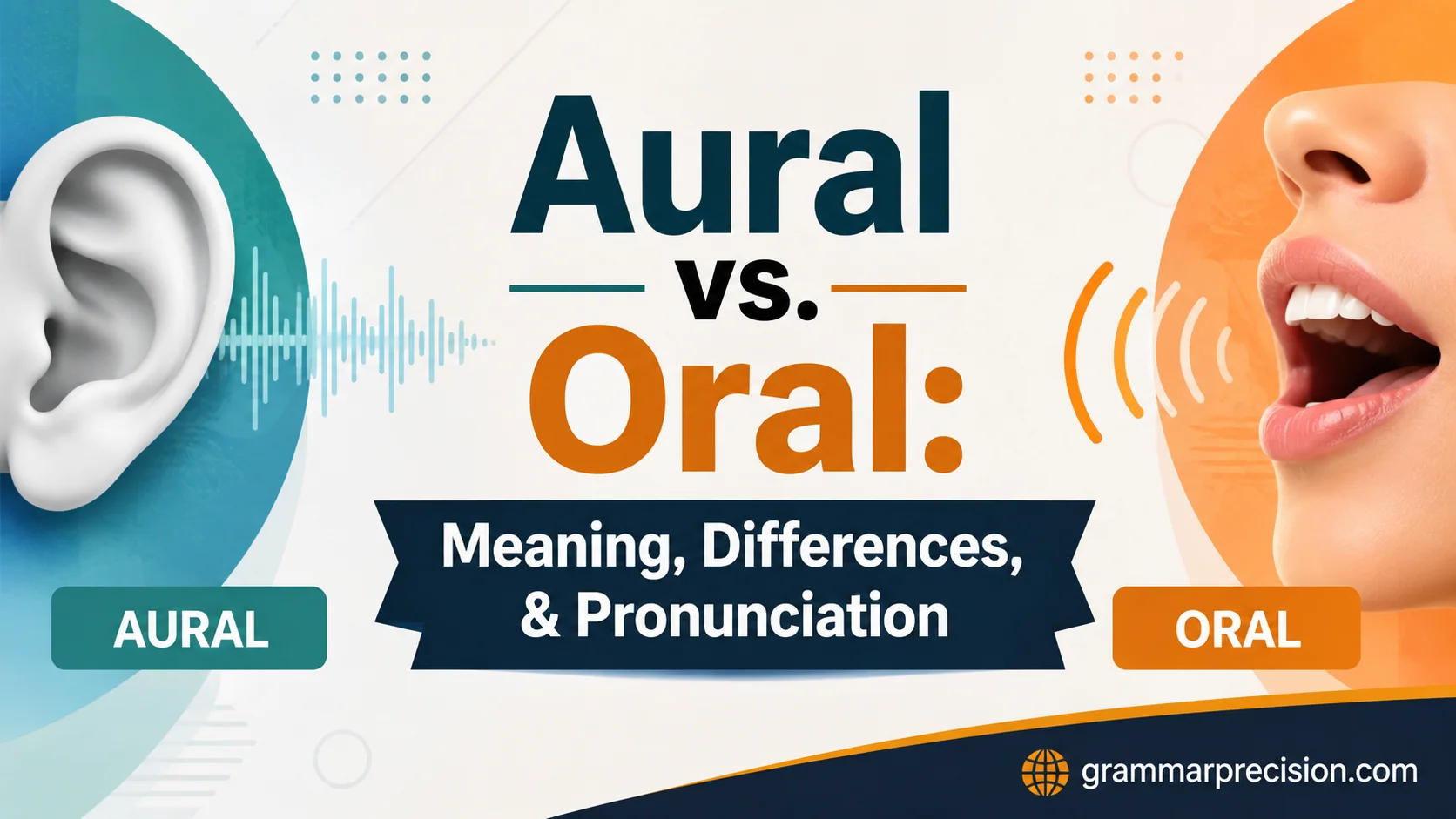
Aural vs. Oral can confuse writers because both words sound similar. However, aural relates to hearing, while oral relates to speaking, the mouth, or spoken communication in different contexts.
Aural describes things connected with hearing, listening, or sound. For example, aural skills help students understand spoken language or recognize musical patterns. If your ears receive the information, aural is usually the correct choice. Think of audio and hearing whenever you need to remember this useful distinction.
Oral generally refers to speaking, spoken language, or the mouth. An oral presentation requires you to speak, while oral hygiene concerns your mouth and teeth. Unlike aural, which focuses on hearing, oral focuses on producing speech or something involving the mouth. That simple contrast makes choosing easier.
Aural vs. Oral: What’s the Difference?
Aural means “of or relating to the ear or the sense of hearing.” Merriam-Webster lists auditory as a synonym. For example, aural skills involve listening and processing what you hear.
Oral, on the other hand, generally means “spoken” or “of, relating to, or involving the mouth.” You’ll see it in expressions such as oral presentation, oral examination, and oral hygiene.
Think of communication as a two-way street:
- Aural → receiving sound through the ears
- Oral → producing or using speech through the mouth
- Aural → listening
- Oral → speaking
- Aural → what you hear
- Oral → what you say
| Word | Basic meaning | Main connection | Example |
| Aural | Related to hearing | Ear | aural perception |
| Oral | Related to the mouth or speech | Mouth/speaking | oral presentation |
| Auditory | Related to hearing | Hearing system | auditory processing |
Here’s a quick test: If your ears are doing the main work, think “aural.” If your mouth or spoken words are central, think “oral.”
What Does “Aural” Mean?
Aural is an adjective describing something connected with the ear or sense of hearing. It comes from Latin auris, meaning “ear,” and Merriam-Webster records its first known English use as 1773.
The word often appears in contexts involving sound, listening, music, or auditory perception.
For example:
- The musician developed strong aural skills.
- The course includes extensive aural training.
- The film creates a powerful aural experience.
- Students practiced their aural comprehension.
- The room was designed to reduce unwanted aural stimuli.
Notice what these examples have in common. None of them focuses primarily on speaking. Instead, the emphasis falls on hearing or experiencing sound.
Aural in Music
Music education uses aural particularly often. Aural skills involve recognizing and understanding musical information by listening.
A student might listen to a melody and identify its rhythm, pitch, intervals, chords, or structure. That activity is aural because the student receives musical information through hearing.
You could therefore say:
The students completed an aural exercise before beginning the performance.
Calling it an oral exercise would suggest something involving spoken language instead.
Aural in Everyday Contexts
Although aural sounds technical, it isn’t limited to academic writing. It can describe almost any experience involving hearing.
Consider these examples:
- The concert created an unforgettable aural experience.
- The podcast offers a rich aural landscape.
- Background noise can create aural distractions.
- The recording preserves the site’s original aural atmosphere.
In each case, the focus rests on sound as experienced through hearing.
What Does “Oral” Mean?
Oral has two major everyday meanings. It can describe something spoken through the mouth, or something related to or involving the mouth itself.
That’s why oral appears in very different phrases:
- oral examination
- oral presentation
- oral communication
- oral tradition
- oral history
- oral hygiene
- oral medication
- oral health
The context tells you which meaning applies.
For instance, an oral exam involves speaking. An oral vaccine involves administration through the mouth. Oral hygiene concerns the mouth and teeth.
So don’t reduce oral to “spoken” in every situation. Its meaning is broader.
Oral and Spoken Language
When oral describes language, it usually refers to speech or spoken communication.
For example:
- She gave an oral presentation.
- The professor conducted an oral examination.
- The community has a rich oral tradition.
- The instructions were delivered orally.
- The researcher recorded an oral history.
Here, the word contrasts naturally with written.
An oral report is spoken. A written report appears in text.
Oral and the Mouth
The second major meaning involves the physical mouth.
Consider:
- oral health
- oral surgery
- oral hygiene
- oral medication
- oral cavity
In these expressions, oral doesn’t mean “spoken.” It means connected with the mouth or involving administration through it.
That distinction matters because context can completely change the interpretation.
Aural vs. Oral: Side-by-Side Comparison
The fastest way to see the difference is to put the words next to each other.
| Feature | Aural | Oral |
| Core meaning | Related to hearing | Related to the mouth or speech |
| Main sense | Hearing | Speaking or mouth-related activity |
| Main body part | Ear | Mouth |
| Common field | Music, listening, sound | Education, communication, medicine |
| Typical phrase | aural skills | oral exam |
| Related word | auditory | spoken |
| Opposite concept | visual, in some contexts | written, when discussing communication |
A helpful mental picture is simple:
Ear → Aural → Hear
Mouth → Oral → Speak
Once you connect each word to a body part, the distinction becomes much harder to forget.
Aural vs. Oral: Pronunciation
Pronunciation creates another layer of confusion because aural and oral can sound extremely similar.
Merriam-Webster gives aural as /ˈȯr-əl/ and lists several pronunciations for oral, including /ˈōr-əl/, /ˈȯr-/, and /ˈär-/.
In many American English accents, the words may sound identical or nearly identical. Other speakers distinguish them more clearly.
That’s why spelling becomes important.
If you’re writing and you’re unsure which word you heard, don’t rely on pronunciation alone. Instead, examine the meaning of the sentence.
For example:
- The class developed her aural comprehension.
- The class developed her oral communication.
The first concerns hearing. The second concerns speaking.
Why Do They Sound So Similar?
The similarity isn’t surprising. Both words contain closely related vowel-and-r sounds, and English accents vary considerably in how those sounds are produced.
Some speakers naturally distinguish aural and oral. Others pronounce them almost identically. Linguistic discussions also show that regional pronunciation patterns can affect whether listeners perceive a clear difference.
So if you’ve ever wondered, “Why does everyone keep saying these words the same way?” you’re not imagining it.
Context often does the heavy lifting.
Aural vs. Oral: Examples
Examples make this distinction much easier to recognize.
Aural Examples
- The course emphasizes aural comprehension.
- She has excellent aural memory.
- The musician developed strong aural skills.
- The documentary has an impressive aural design.
- Students completed several aural exercises.
- The building has unusual aural characteristics.
- The recording provides a detailed aural portrait of the performance.
Each example centers on hearing, sound, or listening.
Oral Examples
- She gave an oral presentation.
- The student passed his oral examination.
- The community maintains an oral tradition.
- The doctor discussed oral hygiene.
- The patient received an oral medication.
- The professor evaluated the student’s oral communication.
- The historian collected several oral histories.
Here, oral refers either to spoken communication or the mouth.
Examples Using Both Words
Now consider sentences where both concepts appear:
The language course develops aural comprehension before requiring an oral presentation.
The student first hears and understands the language. Then the student speaks it.
Another example:
Strong aural skills can help learners prepare for successful oral communication.
This distinction is useful in language learning because listening and speaking are connected skills, but they aren’t identical.
Also Read This: Dis or Mis? Meaning, Differences, & Rules
Aural vs. Oral in Education
Education provides one of the clearest examples of the difference.
An aural activity asks students to process information through hearing. They might listen to a recording, identify sounds, understand spoken language, or recognize musical patterns.
An oral activity asks students to produce spoken language. They might answer questions aloud, deliver a presentation, participate in an interview, or take an oral examination.
| Classroom activity | Correct term | Why |
| Listening to a recording | Aural | Students process sound |
| Identifying a melody by listening | Aural | Hearing drives the task |
| Giving a presentation | Oral | Students speak |
| Answering questions aloud | Oral | Speech is central |
| Listening comprehension | Aural | The learner hears information |
| Speaking assessment | Oral | The learner produces speech |
This difference can matter in course descriptions and exam instructions. A student who sees aural assessment should expect a listening-based task, while an oral assessment generally involves spoken responses.
Aural vs. Oral vs. Auditory
Here’s where things get even more interesting.
Aural and auditory overlap heavily. Both describe things connected with hearing. Merriam-Webster lists aural among the synonyms of auditory, while noting that auditory commonly refers to hearing or the hearing system.
Still, they aren’t always interchangeable in tone or context.
Aural often emphasizes the experience or perception of sound through the ear. It’s especially common in music, language learning, and discussions of sound.
Auditory frequently appears in scientific, medical, psychological, and technical contexts.
Compare:
- Aural skills in music education
- Aural perception in language learning
- Auditory processing in neuroscience
- Auditory nerve in anatomy
- Auditory stimuli in research
The words overlap, but their typical environments differ.
| Term | Main idea | Common contexts |
| Aural | Related to hearing or sound | Music, language, sound |
| Auditory | Related to hearing | Medicine, psychology, science |
| Oral | Related to speech or mouth | Communication, education, medicine |
A useful rule is this: aural and auditory belong to the hearing side; oral belongs to the speaking or mouth side.
Aural vs. Oral in Common Phrases
Certain phrases make the distinction almost automatic.
Aural Skills
Aural skills involve listening and recognizing information through hearing. Music students, for example, may identify intervals, melodies, rhythms, or chords by ear.
Aural Perception
Aural perception describes how a person receives and interprets sounds. The phrase appears naturally in discussions of music, language, and sound.
Oral Examination
An oral examination requires spoken answers. Instead of writing responses, the student communicates them aloud.
Oral Presentation
An oral presentation is a structured talk delivered to an audience.
Oral Tradition
An oral tradition passes stories, beliefs, knowledge, or cultural practices from person to person through spoken communication rather than relying solely on written records.
Oral Communication
Oral communication involves exchanging information through speech. Conversations, interviews, speeches, and spoken instructions all fit this category.
Aural vs. Oral: Common Mistakes
Because these words look and sound alike, writers sometimes swap them.
Mistake: Using “Oral” for Listening
Incorrect: The course focuses on oral comprehension.
Better: The course focuses on aural comprehension.
Why? The learner is expected to hear and understand information.
Mistake: Using “Aural” for Speaking
Incorrect: Students must complete an aural presentation.
Better: Students must complete an oral presentation.
A presentation normally involves speaking, so oral fits.
Mistake: Treating Oral as Meaning Only “Spoken”
Remember that oral can also refer directly to the mouth.
For example, oral hygiene doesn’t mean “spoken hygiene.” It concerns the health and cleanliness of the mouth.
That little detail prevents a surprisingly large number of misunderstandings.
Aural vs. Oral: A Simple Memory Trick
When two words look this similar, a clever memory hook can save you time.
Aural → Audio → Ear
The first letters don’t match perfectly, but the association works:
Aural → audio → hearing → ear
Oral → Orator → Mouth → Speaking
An orator speaks publicly. That gives you a bridge to oral.
So remember:
Aural is what you hear. Oral is what you say or what concerns your mouth.
If you can remember only one sentence, make it that one.
Aural vs. Oral: Can They Be Interchanged?
Usually, no.
Although both words can relate indirectly to communication, they describe different sides of the process.
Imagine a classroom discussion. One student listens while another speaks.
The listening student’s activity is aural.
The speaking student’s activity is oral.
That distinction becomes especially useful when describing language-learning skills. Listening and speaking work together, but they require different abilities.
Think of them as two gears in the same machine. They interact, but each performs a different job.
Aural vs. Oral: A Quick Quiz
Choose aural or oral in each sentence.
- The students practiced ___ comprehension.
- She gave an ___ presentation.
- The musician developed excellent ___ skills.
- The doctor discussed his ___ health.
- The class completed an ___ examination.
- The podcast created a fascinating ___ experience.
Answers
- Aural — comprehension through hearing.
- Oral — a spoken presentation.
- Aural — musical listening skills.
- Oral — health involving the mouth.
- Oral — an examination conducted through spoken responses.
- Aural — an experience centered on sound.
If you got all six right, you’ve got the core distinction down.
FAQs:
What Is the Difference Between Aural and Oral?
Aural relates to hearing, listening, and sound, while oral relates to speaking, spoken language, or the mouth. For example, aural comprehension involves listening, whereas an oral presentation requires speaking. Remember the simple rule: aural connects with the ears, and oral connects with the mouth or speech.
Does Aural Mean Spoken?
No, aural does not mean spoken. It describes something connected with hearing or sound. For example, an aural exercise may require you to listen carefully to a recording. If the main activity involves producing spoken words, oral is generally the more appropriate choice.
Does Oral Mean Listening?
No. Oral usually refers to speaking, spoken communication, or the mouth. An oral examination requires spoken answers, while an oral presentation involves speaking to an audience. For listening activities, aural is normally the better word because it specifically relates to receiving information through hearing.
Are Aural and Auditory the Same?
Aural and auditory have very similar meanings because both relate to hearing. However, they often appear in different contexts. Aural commonly occurs in music and language learning, while auditory frequently appears in scientific, medical, or technical discussions involving hearing and sound.
What Is an Easy Way to Remember Aural and Oral?
Use the ear-versus-mouth rule. Think aural = ears = hearing and oral = mouth = speaking. You can also connect aural with audio and oral with an orator, someone who speaks publicly. These simple associations can help you choose the correct word quickly.
Conclusion:
Understanding aural vs. oral becomes easy when you focus on their core meanings. Aural relates to hearing, listening, and sound, while oral concerns speaking, spoken language, or the mouth. When you listen, think aural.
When you speak, think oral. Remember the ear-versus-mouth rule, and you’ll avoid this common word-choice mistake in everyday and academic writing.