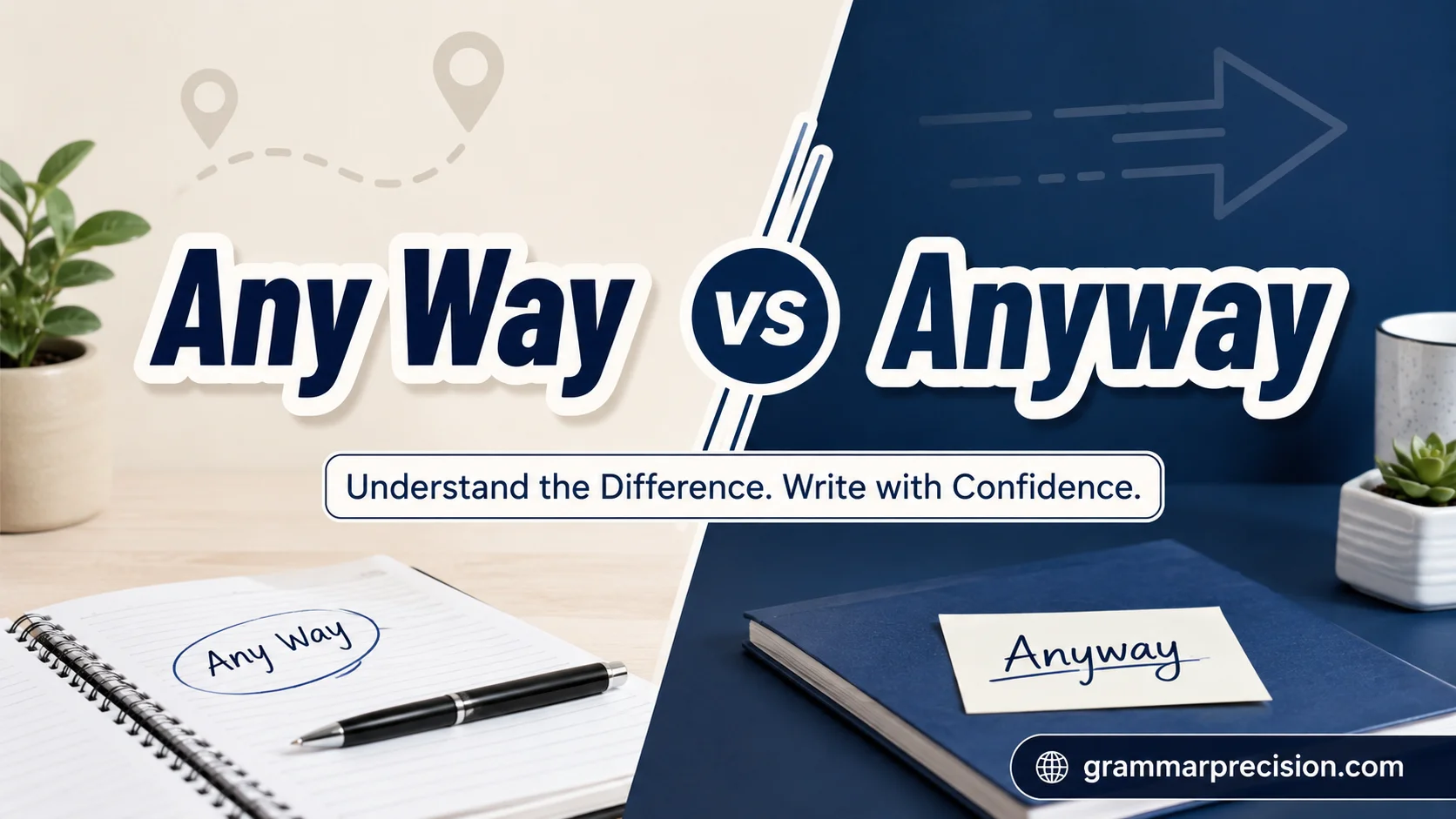
Any way vs anyway can confuse many English learners because these two phrases look almost identical. However, their meanings are different, and knowing the correct usage helps you write clearer, more accurate sentences every day.
English has many commonly confused words, and any way vs anyway is a perfect example. While any way refers to a method or option, anyway means regardless or moving forward. Understanding this small difference can improve your grammar skills.
Whether you are writing an email, essay, or casual message, choosing the right word matters. This guide explains the meaning, rules, examples, and common mistakes of any way and anyway so you can use both confidently.
Any Way vs Anyway: Quick Difference Explained
Before exploring each word deeply, let’s look at the main difference.
| Feature | Any Way | Anyway |
| Number of words | Two words | One word |
| Meaning | Any method, choice, or manner | Regardless, despite that, or moving on |
| Grammar role | Phrase | Adverb |
| Common use | Asking about possibilities | Changing direction or showing contrast |
| Example | “Is there any way to contact him?” | “I was tired, but I finished it anyway.” |
The easiest test is to replace the word with a similar phrase.
If “any method” makes sense, use any way.
Example:
“Is there any way to solve this problem?”
Replace it:
“Is there any method to solve this problem?”
The sentence still works, so any way is correct.
If “regardless” makes sense, use anyway.
Example:
“It was difficult, but I completed it anyway.”
Replace it:
“It was difficult, but I completed it regardless.”
The meaning stays the same, so anyway is correct.
What Does Any Way Mean?
Any way is written as two separate words because it combines two individual words:
- Any = one or more without a specific choice
- Way = method, direction, or manner
Together, any way means any possible method, route, or approach.
You usually use it when you are talking about choices, solutions, or different methods of doing something.
Any Way Meaning in Simple Words
The phrase any way answers questions like:
- Is there another method?
- Does any option exist?
- Can this happen through any approach?
For example:
“Is there any way to finish this project faster?”
The speaker wants to know whether a faster method exists.
Another example:
“You can arrange the furniture any way you like.”
This means the person has freedom to choose any arrangement.
When to Use Any Way in a Sentence
You should use any way when the sentence talks about a possible method or option.
Here are the most common situations.
Asking About a Solution
Many questions use any way because they ask about possibilities.
Examples:
- “Is there any way to improve my writing skills?”
- “Is there any way to reduce this cost?”
- “Is there any way we can meet earlier?”
In each example, the speaker wants to discover a possible solution.
Talking About Different Methods
You can use any way when someone has multiple choices.
Examples:
- “You can complete the assignment any way you prefer.”
- “She can explain the topic any way that helps students understand.”
- “Design the room any way that feels comfortable.”
Here, any way means any method or style.
Talking About Directions or Routes
The word way can also refer to a path or route.
Examples:
- “Is there any way to reach the airport without using the highway?”
- “Do you know any way around this traffic?”
The speaker wants to know if another route exists.
What Does Anyway Mean?
Anyway is a single word that works as an adverb.
It has several meanings depending on the context. Most commonly, it means:
- Regardless
- Despite something
- In any case
- Returning to the main topic
Unlike any way, it does not ask about a method. Instead, it shows a decision, transition, or continuation.
The Different Uses of Anyway
The word anyway is more flexible than many people realize.
Anyway Meaning: Regardless of Something
This is the most common use.
You use anyway when something does not change the final result.
Examples:
“It was raining, but we went for a walk anyway.”
Meaning:
The rain was a problem, but the walk still happened.
More examples:
- “The movie received bad reviews, but I watched it anyway.”
- “I wasn’t feeling well, but I finished the work anyway.”
- “The task was difficult, but they completed it anyway.”
Anyway as a Conversation Transition
People often use anyway to move back to a topic or introduce a new point.
Examples:
“Anyway, let’s discuss tomorrow’s meeting.”
Here, the speaker is changing direction.
More examples:
- “Anyway, what happened after that?”
- “Anyway, I wanted to ask you something.”
- “Anyway, let’s get back to work.”
This use is very common in everyday conversations.
Anyway to End a Discussion
Sometimes people use anyway to show that a topic is finished.
Example:
“I don’t think we can change the decision now. Anyway, we need to prepare for tomorrow.”
The speaker accepts the situation and moves forward.
Any Way vs Anyway Examples in Everyday Conversations
Understanding grammar rules becomes easier when you see natural examples.
| Sentence | Correct Word | Explanation |
| Is there any way to fix this issue? | Any way | Asking for a method |
| I’ll finish the task anyway. | Anyway | Continuing despite difficulty |
| You can solve it any way you want. | Any way | Talking about choices |
| It’s expensive, but I’ll buy it anyway. | Anyway | Means regardless |
| Anyway, what were you saying? | Anyway | Changing topic |
Common Mistakes With Any Way and Anyway
Many grammar mistakes happen because people focus on pronunciation instead of meaning.
Here are the most common errors.
Mistake: Using Anyway When Asking About a Method
Incorrect:
“Is there anyway to contact customer support?”
Correct:
“Is there any way to contact customer support?”
Why?
The sentence asks about a possible method, so you need two words.
Mistake: Using Any Way When You Mean Regardless
Incorrect:
“I don’t like the weather, but I’ll go any way.”
Correct:
“I don’t like the weather, but I’ll go anyway.”
Why?
The meaning is “I’ll go regardless,” so anyway is correct.
Also Read This: Upmost or Utmost? Which Word Is Correct?
Any Way vs Anyway vs Anyways: What Is the Difference?
Another confusing word is anyways.
Many people use it in casual speech, especially in some regions. However, standard English usually prefers anyway.
| Word | Standard English? | Meaning | Example |
| Any way | Yes | Any method | “Is there any way to help?” |
| Anyway | Yes | Regardless | “I’ll try anyway.” |
| Anyways | Informal | Same meaning as anyway | “Anyways, let’s leave.” |
For professional writing, academic work, and formal communication, choose anyway.
How Native Speakers Use Anyway Naturally
Native speakers often use anyway without thinking about grammar rules.
It appears frequently in:
- Conversations
- Emails
- Messages
- Presentations
- Storytelling
For example:
“I wasn’t planning to attend the event. Anyway, I ended up having a great time.”
The word connects two ideas:
- The original plan
- The unexpected result
It works like a bridge between thoughts.
Memory Tricks to Remember Any Way vs Anyway
Grammar becomes easier when you have a simple shortcut.
The Method Test
Ask yourself:
Can I replace it with “any method”?
If yes, use any way.
Example:
“Is there any way to improve this?”
→ “Is there any method to improve this?”
Correct: any way
The Regardless Test
Ask:
Can I replace it with “regardless”?
If yes, use anyway.
Example:
“I’ll do it anyway.”
→ “I’ll do it regardless.”
Correct: anyway
Any Way vs Anyway in Formal Writing
Both forms can appear in formal writing, but they serve different purposes.
Using Any Way in Professional Writing
Examples:
- “Is there any way to reduce production costs?”
- “The team explored any way possible to improve efficiency.”
This usage is completely acceptable.
Using Anyway in Professional Writing
Although anyway is correct, some uses are more conversational.
For example:
Casual:
“Anyway, let’s talk about the next topic.”
Formal:
“Moving forward, let’s discuss the next topic.”
However, anyway is still acceptable when it means regardless.
Example:
“The company continued the project anyway despite several challenges.”
Real-Life Case Study: Why the Difference Matters
Imagine a manager writing an email to a team.
Incorrect:
“Is there anyway we can complete this report today?”
The team might understand the meaning, but the grammar is incorrect.
Correct:
“Is there any way we can complete this report today?”
Now the message clearly asks for possible solutions.
Another example:
“The deadline was tight, but we completed the report anyway.”
Here, anyway shows determination despite difficulty.
A tiny space changes the meaning.
Quick Practice: Choose Any Way or Anyway
Test yourself.
Sentence One
“Is there ___ to solve this problem?”
Answer:
Any way
Reason:
The sentence asks about a solution.
Sentence Two
“I didn’t have enough time, but I finished it ___.”
Answer:
Anyway
Reason:
It means regardless.
Sentence Three
“You can organize the information ___ you want.”
Answer:
Any way
Reason:
It describes a choice or method.
Sentence Four
“___, we need to make a final decision.”
Answer:
Anyway
Reason:
It changes the topic or moves forward.
FAQs:
Is “any way” one word or two words?
Any way is written as two separate words when it refers to a method, option, or possible solution. For example, “Is there any way to fix this problem?” means you are asking if there is any possible method to solve it.
When should I use “anyway” in a sentence?
You should use anyway when you mean regardless, despite something, or in any case. It often shows that something will happen even if there is a problem. For example, “It was difficult, but I completed it anyway.”
Can “anyway” be used at the beginning of a sentence?
Yes, anyway can start a sentence, especially in casual conversations. It is often used to return to a topic, introduce a new idea, or move a discussion forward. For example, “Anyway, let’s continue with our plan.”
Is “anyways” correct English?
Anyways is used in some informal conversations, but anyway is the preferred choice in standard English. For formal writing, academic work, and professional communication, it is better to use anyway.
What is the easiest way to remember any way vs anyway?
A simple trick is to remember that any method = any way and regardless = anyway. If you can replace the phrase with “any method,” use two words. If you can replace it with “regardless,” use one word.
Conclusion:
Understanding any way vs anyway becomes much easier when you focus on the meaning instead of the spelling. Use any way when you talk about a method, choice, or option, and use anyway when you mean regardless or moving forward. Learning this small grammar difference will help you write with more clarity, confidence, and accuracy.