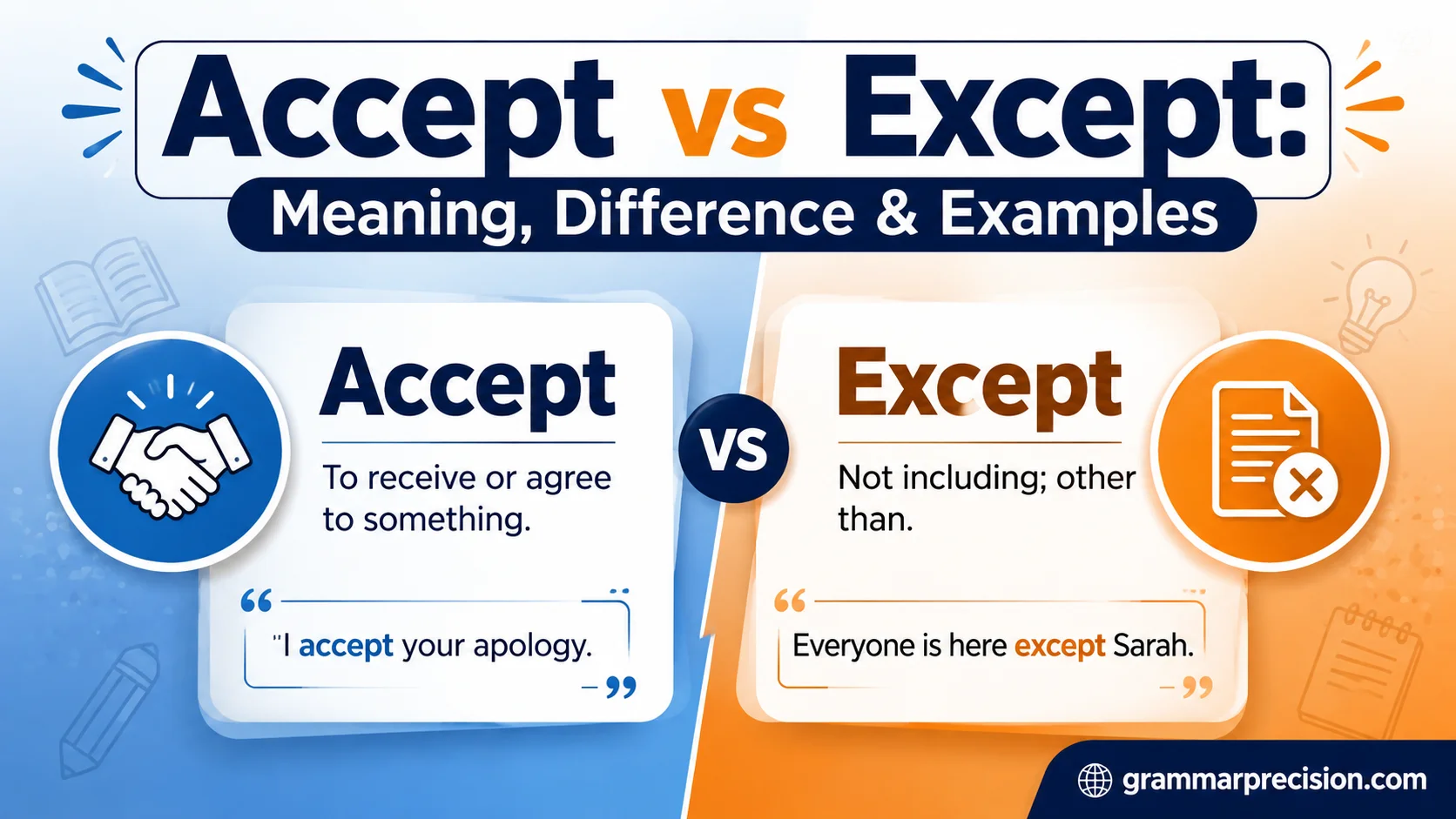
Accept vs Except can confuse English learners because both words look similar. However, accept means to receive or agree, while except means to exclude something from a group or statement.
Accept is a verb used when you receive, agree to, or welcome something. You can accept a job, gift, idea, or offer. For example, “She accepted the invitation.” Remember that accept focuses on receiving or agreeing to something.
Except usually means excluding or leaving out someone or something. For example, “Everyone attended except John.” It can also mean unless in some contexts. A simple memory trick is A for accept and X for except, helping you choose the correct word confidently.
Accept vs Except at a Glance
The quickest way to separate these words is to focus on their core ideas.
| Word | Main meaning | Typical use | Example |
| Accept | Receive, agree, approve | Verb | I accept your offer. |
| Except | Exclude, leave out | Preposition, conjunction, or verb | Everyone came except Maya. |
Think of accept as bringing something in. Think of except as keeping something out.
For example, if a manager accepts your proposal, the manager agrees to it. If the manager invites everyone except you, you’re the person left out.
What Does Accept Mean?
Accept is primarily a verb. It describes receiving something willingly, agreeing to something, approving something, or recognizing something as true or valid.
Accept Means “Receive”
You can accept something that another person gives, offers, or sends you.
- She accepted the award with a smile.
- Did you accept the package?
- He accepted the gift from his neighbor.
- The restaurant doesn’t accept cash.
Here, accept means receive or take willingly.
Accept Means “Agree”
You can also accept an idea, proposal, invitation, request, or offer.
- We accepted their invitation.
- The company accepted my job offer.
- She accepted his suggestion.
- They accepted the terms of the agreement.
In these examples, accept means agree to something.
Accept Means “Approve”
Accept can also describe approval or official recognition.
- The editor accepted the article for publication.
- The court accepted the evidence.
- The university accepted her application.
The word doesn’t always mean enthusiastic approval. Sometimes it simply means that something has been formally received or recognized as valid.
Accept Means “Admit or Recognize”
There’s another important use: recognizing something as true, real, or unavoidable.
- He finally accepted the truth.
- She accepted responsibility for the mistake.
- You need to accept that plans can change.
This meaning often appears in discussions about facts, responsibility, limits, and circumstances.
What Does Except Mean?
Except has a completely different core meaning. It usually signals exclusion.
It can work as a preposition, a conjunction, and in less common formal usage, a verb.
Except as a Preposition
When except comes before a noun or pronoun, it commonly means excluding.
- Everyone came except Daniel.
- I like all vegetables except spinach.
- The store is open every day except Sunday.
- The price includes everything except tax.
The easiest substitution test is excluding.
“Everyone came except Daniel” means “Everyone came excluding Daniel.”
Except as a Conjunction
Except can also introduce a clause or condition.
- I would go, except I’m working tonight.
- We would have arrived earlier, except the road was closed.
- You can borrow it, except you must return it tomorrow.
Here, except introduces an exception to what was just stated.
Except as a Verb
The verb except is much less common in everyday American English. It means to exclude or leave out.
- The rule excepts certain cases.
- Several groups were excepted from the requirement.
You’ll encounter this form more often in formal, legal, technical, or policy-related writing than casual conversation.
Accept vs Except: The Core Difference
The most useful distinction is simple:
Accept means receive or agree. Except means exclude or leave out.
Consider these two sentences:
- I accept everyone’s invitation.
- Everyone attended except John.
The first sentence describes receiving or agreeing to something. The second identifies someone who was left out.
Accept vs Except Comparison
| Feature | Accept | Except |
| Core idea | Receive or agree | Exclude |
| Usual role | Verb | Preposition or conjunction |
| Common phrase | Accept an offer | Everyone except me |
| Opposite idea | Reject | Include |
| Example | She accepted the invitation. | Everyone except Sam arrived. |
A useful mental picture can make this distinction stick. Imagine a party with a guest list.
When you accept an invitation, you say yes to the event. When someone is invited except for one person, that person stays outside the group.
Accept vs Except Examples
Real sentences make the difference easier to remember.
Everyday Examples
- I accept your apology.
- Everyone was invited except Tom.
- She accepted the package.
- We eat almost everything except mushrooms.
- He accepted the challenge.
- Nobody complained except Maria.
Workplace Examples
- The manager accepted the revised proposal.
- All employees attended except two interns.
- The client accepted the terms.
- The office is closed every holiday except New Year’s Day.
School Examples
- The teacher accepted my assignment.
- Everyone passed the test except one student.
- The college accepted her application.
- We studied every chapter except the final one.
Professional Writing Examples
- The committee accepted the recommendation.
- The policy applies to everyone except temporary contractors.
- The publisher accepted the manuscript.
- All expenses are covered except personal purchases.
Notice the pattern. Accept describes an action of receiving, agreeing, or recognizing. Except creates a boundary around what isn’t included.
Accept vs Except in Different Situations
Context can make these words easier to identify.
| Situation | Correct word | Example |
| Receiving a gift | Accept | She accepted the gift. |
| Agreeing to an offer | Accept | He accepted the offer. |
| Approving a proposal | Accept | They accepted the proposal. |
| Excluding a person | Except | Everyone except Alex came. |
| Excluding an item | Except | I like every flavor except mint. |
| Naming an exception | Except | The rule applies except in emergencies. |
Accept an Offer
Use accept when someone agrees to an offer.
Correct: She accepted the job offer.
Incorrect: She excepted the job offer.
The first sentence says she agreed to receive the position under the offered terms.
Everyone Except
Use except when you identify someone who is excluded.
Correct: Everyone except Mark attended.
Incorrect: Everyone accept Mark attended.
The phrase everyone except is especially common, so it’s worth memorizing as a unit.
Accept Responsibility
This phrase has a specific meaning. It means acknowledging that you are responsible for something.
- The driver accepted responsibility for the accident.
- She accepted responsibility for the error.
You wouldn’t use except here because nobody is being excluded.
Accept vs Except in Questions
Questions can make the difference harder to spot because the surrounding words change.
- Did you accept the invitation?
- Who came except Sarah?
- Will they accept the revised terms?
- Does this rule apply to everyone except employees?
A useful test is to ask what the sentence is doing.
If it describes receiving, agreeing, or approving, choose accept. If it identifies something left out, choose except.
Also Read This: To Confirm vs To Verify: Difference, Meaning & Examples
Accept vs Except in Negative Sentences
Negative sentences deserve extra attention because words such as not, nothing, and nobody can hide the central meaning.
Compare:
- I did not accept the offer.
- Nobody came except James.
In the first sentence, someone refused or did not receive an offer. In the second, James is the only person who came.
Another pair:
- She doesn’t accept late applications.
- She accepts every application except late ones.
The first says late applications aren’t accepted. The second identifies late applications as the exception.
“Except for” vs “Accept for”
This is one of the most useful expressions to understand.
Except for means excluding or apart from.
- The room was empty except for one chair.
- The trip was excellent except for the weather.
- Everyone agreed except for Ben.
Accept for usually isn’t the expression you want when you mean “excluding.” The spelling changes the meaning completely.
Why “Except for” Works
The phrase introduces something that differs from the general statement.
“The room was empty except for one chair” means the room was empty with one notable exclusion from that description.
That pattern appears constantly in everyday and formal writing.
Accepted vs Excepted: What’s the Difference?
Adding -ed creates another confusing pair.
Accepted is the past tense or past participle of accept.
- She was accepted into the program.
- They accepted the proposal.
Excepted comes from the verb except and means excluded.
- Certain cases are excepted from the rule.
- The regulation applies broadly, with a few categories excepted.
In ordinary conversation, accepted is far more common. Excepted tends to appear in formal, legal, or technical contexts.
A helpful contrast is:
Accepted = received or approved
Excepted = excluded
Acceptable vs Exceptable
Another word family can create confusion.
Acceptable means good enough, suitable, allowed, or satisfactory.
- Your explanation is acceptable.
- The quality is acceptable for this price.
- Jeans are not acceptable attire for the ceremony.
Exceptable is a real but uncommon word related to being capable of exclusion. It rarely appears in ordinary modern writing.
For most everyday situations, acceptable is the word you need.
Accept vs Except vs Expect
There’s a third word that often joins the confusion: expect.
| Word | Meaning | Example |
| Accept | Receive or agree | I accept your offer. |
| Except | Exclude | Everyone came except Leo. |
| Expect | Think something will happen | I expect Leo tomorrow. |
Try this three-word memory formula:
Accept = receive
Except = exclude
Expect = anticipate
For example:
- I accept the invitation.
- Everyone came except Nina.
- I expect Nina tomorrow.
Three similar-looking words. Three different jobs.
Common Accept vs Except Mistakes
“I Except Your Apology”
❌ I except your apology.
✅ I accept your apology.
You’re receiving or acknowledging the apology, so accept is correct.
“Everyone Accept Sarah”
❌ Everyone accept Sarah came.
✅ Everyone except Sarah came.
Sarah is excluded from the group. Therefore, use except.
“Please Except My Invitation”
❌ Please except my invitation.
✅ Please accept my invitation.
An invitation is something you can receive or agree to.
“I Accept Everyone Except John”
This sentence is grammatically possible, but its meaning depends on context. It says the speaker accepts everyone while excluding John.
If you mean you agree with everyone’s opinions apart from John’s, the sentence can work. If you mean you welcomed everyone except John, it also works.
Context matters.
How to Remember Accept vs Except
Memory tricks work best when they connect spelling to meaning.
Use the “Agree” Trick
Accept contains the idea of agreeing.
- Accept an offer.
- Accept an invitation.
- Accept responsibility.
Use the “Exclude” Trick
Except means exclude.
Both words start with ex in their meanings when you think of exclusion:
Except → exclude
That association can quickly bring the correct word to mind.
Use the Guest-List Trick
Picture a party.
If your name gets onto the guest list, you accept the invitation.
If everyone gets invited except you, you’re excluded.
It’s simple. More importantly, it mirrors how the words actually work.
A Quick Accept vs Except Decision Test
When you’re unsure, ask yourself one question:
Is the sentence about receiving or excluding?
If it’s about receiving, agreeing, approving, or acknowledging, use accept.
If it’s about excluding, leaving out, or identifying an exception, use except.
You can also substitute a synonym.
- “I ___ the offer.” → “I agree to the offer.” → accept
- “Everyone ___ Mia came.” → “Everyone excluding Mia came.” → except
This substitution test works surprisingly well.
Accept vs Except Quiz
Choose accept or except in each sentence.
- I gladly ___ your invitation.
- Everyone attended ___ Chris.
- The company will ___ credit cards.
- I like every fruit ___ grapefruit.
- She ___ responsibility for the mistake.
- Nobody knew the answer ___ David.
- Will you ___ this proposal?
- The store sells everything ___ fresh bread.
- They ___ the terms of the agreement.
- The rule applies to everyone ___ children under five.
Answers
- accept
- except
- accept
- except
- accept
- except
- accept
- except
- accept
- except
The pattern is consistent. Accept brings something into agreement or possession. Except removes something from a group.
Key Facts About Accept and Except
Keep these points handy:
- Accept is mainly a verb.
- Except commonly works as a preposition or conjunction.
- Accept can mean receive, agree, approve, or acknowledge.
- Except usually means exclude or leave out.
- Accepted means received, approved, or agreed to.
- Excepted means excluded and is more formal.
- Except for means excluding or apart from.
- Accept, except, and expect have different meanings despite their similar appearance.
- Accept often pairs with words such as offer, invitation, responsibility, apology, and proposal.
- Except commonly appears with phrases such as everyone except, everything except, and except for.
FAQs:
What is the difference between accept and except?
Accept means to receive, agree to, or approve something, while except means to exclude or leave someone or something out. For example, “I accept your offer” shows agreement, while “Everyone came except John” shows exclusion.
Is accept a verb or preposition?
Accept is always used as a verb. It describes an action, such as receiving something, agreeing to something, or approving an offer. For example, “She accepted the gift” shows that she received it willingly.
How can I remember accept and except?
Use a simple memory trick: Accept begins with A, so think of Agree or Accept something. Except begins with E, but you can remember its meaning as Exclude. This can help you avoid common mistakes.
Can except be used as a verb?
Yes, except can sometimes work as a verb, meaning to exclude or leave something out. However, it is more commonly used as a preposition or conjunction. For example, “The rule excepts certain cases” means those cases are excluded.
What is the difference between accept and expect?
Accept means to receive, agree to, or approve something. Expect means to believe that something will happen. For example, “I accepted the invitation” means I agreed to it, while “I expect him to arrive” means I believe he will arrive.
Conclusion:
Understanding accept vs except becomes easier when you remember their core meanings. Accept relates to receiving, agreeing, or approving, while except relates to excluding or leaving something out. Although these words look similar, they serve different purposes in a sentence. Practice using them in everyday English, and always check the context before choosing the correct word.