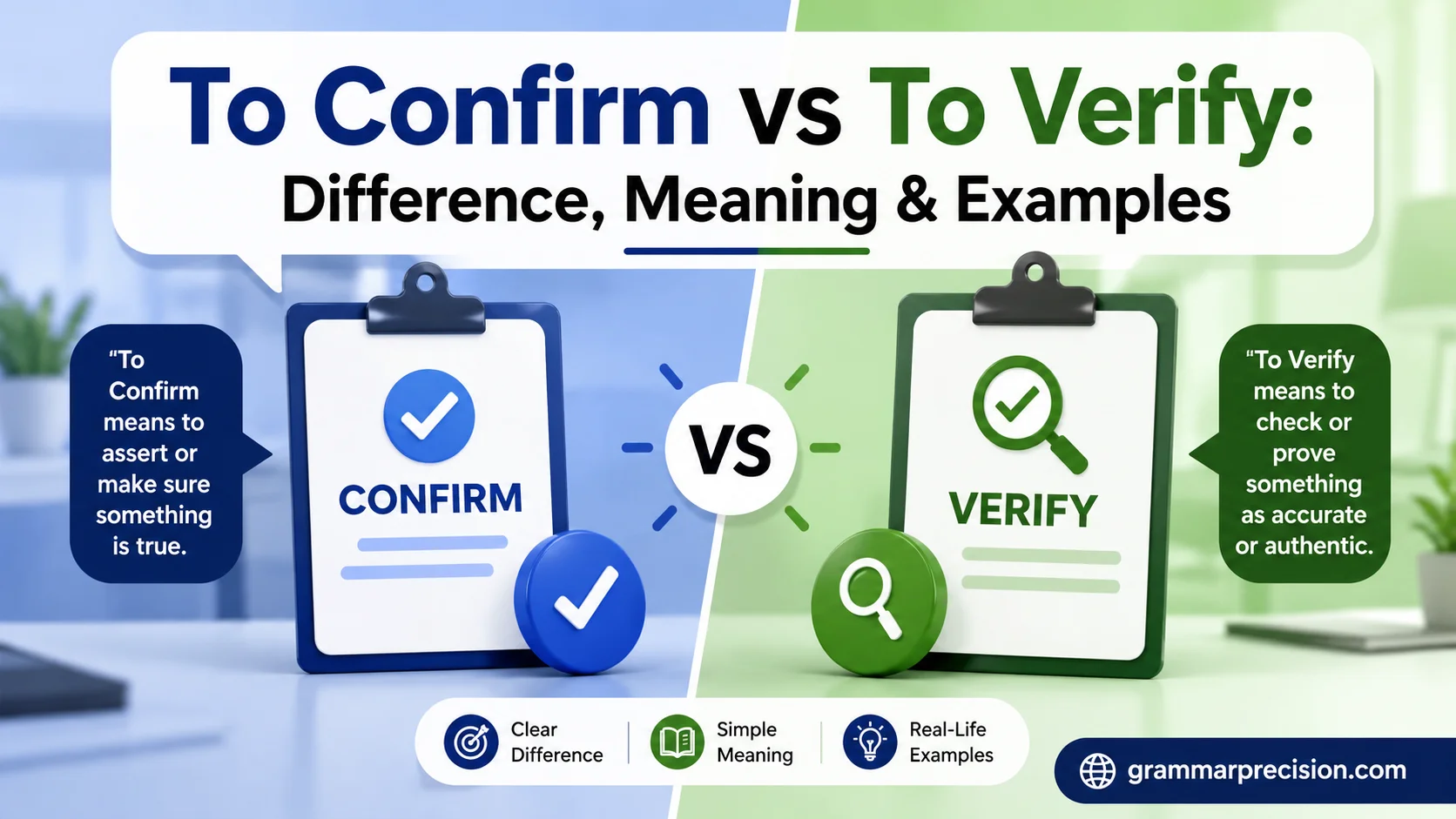
To Confirm vs To Verify can seem confusing, but the difference becomes clear when you understand their meanings. Confirm establishes truth, while verify checks accuracy through evidence.
Confirm is used when you want to establish the truth or validity of information. You might confirm your details, an appointment, or a decision. It often means accepting that something is true or correct. In everyday writing, business writing, and customer support emails, confirm sounds natural when no further checking is required.
Verify means to check accuracy, truthfulness, or facts using evidence. You may verify your details through an identity check or verify information in banking apps and legal documents. In technical writing, verification usually involves careful checking. So, choose confirm for established truth and verify when evidence supports accuracy.
To Confirm vs To Verify: Quick Answer
To confirm means to establish that something is true, correct, agreed upon, or still valid. You might confirm a meeting, reservation, appointment, decision, or piece of information.
To verify means to check something carefully to determine whether it is accurate, true, authentic, or valid. You might verify an identity, document, claim, address, payment, or set of data.
Here’s the shortcut:
Confirm = make sure something is true or settled.
Verify = check that something is accurate or genuine.
Both verbs can involve certainty. The difference lies mainly in how you reach that certainty and what kind of situation you’re describing.
Confirm vs Verify: Quick Comparison
| Feature | Confirm | Verify |
| Core idea | Establish or acknowledge truth | Check truth, accuracy, or authenticity |
| Main focus | Assurance or agreement | Examination or validation |
| Evidence required? | Not always | Often expected |
| Common objects | Plans, appointments, details, decisions | Facts, identities, documents, data |
| Typical tone | Everyday and professional | Often more formal or technical |
| Example | “Please confirm the meeting time.” | “Please verify your account details.” |
For example, “Please confirm your appointment” normally asks you to say whether the appointment still stands. “Please verify your appointment details” suggests that you should check the details for accuracy.
That small shift changes the task.
What Does “To Confirm” Mean?
The verb confirm has several related meanings, but they share one central idea: making something certain, settled, or officially recognized.
When you confirm something, you may show that information is correct. You may also acknowledge an arrangement or remove uncertainty.
Consider these examples:
- “Please confirm your attendance.”
- “Can you confirm the delivery date?”
- “The manager confirmed the decision.”
- “She called to confirm the reservation.”
- “The test confirmed his earlier suspicion.”
Notice how confirmation doesn’t always require a long investigation. Sometimes a simple response is enough.
If someone asks, “Are we still meeting at 3 p.m.?” you might answer, “Yes, I confirm that.” You’re not necessarily conducting an investigation. You’re establishing or acknowledging the status of the plan.
Confirming Plans and Arrangements
Confirm is especially natural when people need reassurance about an arrangement.
You can confirm:
- an appointment
- a reservation
- a booking
- a meeting
- attendance
- a schedule
- a deadline
- an agreement
- an order
- a decision
For example:
“Please confirm your attendance by Friday.”
The speaker probably doesn’t want you to investigate whether the event exists. They simply want you to state whether you’ll attend.
That’s why confirm feels natural in scheduling and coordination. It often turns uncertainty into a clear yes or no.
Confirming Information
You can also confirm information. In this use, the word means checking or establishing that information is correct.
For example:
“Could you confirm your mailing address?”
This sentence can mean “Please tell me whether this address is correct.” It doesn’t necessarily imply a formal evidence-based verification process.
What Does “To Verify” Mean?
Verify focuses more strongly on checking something against evidence, records, standards, or another reliable source.
When you verify something, you’re trying to establish that it is accurate, true, authentic, or valid.
For example:
- “Please verify your identity.”
- “The editor verified the figures.”
- “We need to verify the document.”
- “The technician verified the test results.”
- “Researchers attempted to verify the claim.”
Verification usually suggests a process. You don’t merely say something is correct. You check it.
You might verify a phone number by comparing it with a record. You might verify a person’s identity by checking official identification. A researcher might verify a claim by examining evidence.
Verification and Evidence
Evidence is the key idea that often separates verify from confirm.
Suppose someone gives you a bank account number. If you ask them to confirm it, you may simply want them to say whether the number is correct.
If you ask them to verify it, you’re emphasizing the need to check the number carefully.
“Please confirm your identity.”
This can work, but it may simply ask someone to state who they are.
“Please verify your identity.”
This strongly suggests an identity-checking process.
That’s why verify appears frequently in security, banking, technology, administration, and formal procedures.
To Confirm vs To Verify: The Main Difference
When you confirm something, you often establish that it is true, agreed, or still valid. When you verify something, you usually examine it to determine whether it meets a standard of truth or accuracy.
Imagine a hotel reservation.
The hotel might send this message:
“Please confirm your reservation.”
You respond that you’re still coming. The reservation is now confirmed.
Now imagine the hotel asks:
“Please verify the details of your reservation.”
You might check your name, dates, room type, and payment information.
Confirmation Often Starts With an Existing Expectation
Confirmation commonly deals with something already proposed, expected, suspected, or arranged.
For example:
“Please confirm that Tuesday works for you.”
Tuesday has already been suggested. The recipient only needs to establish whether the arrangement is correct.
Verification can begin with more uncertainty:
“Please verify that these figures are accurate.”
Here, the figures need examination. The speaker isn’t simply asking for agreement.
Verification Often Emphasizes Accuracy
Verification shines when accuracy, authenticity, or validity matters.
Common examples include:
- verifying identity
- verifying a signature
- verifying a document
- verifying a claim
- verifying data
- verifying an address
- verifying credentials
- verifying calculations
The word often carries a procedural flavor. It sounds like there is a standard, record, source, or method against which something can be checked.
The Easiest Way to Remember the Difference
Use this simple mental test:
Are you asking someone to acknowledge something? Choose “confirm.”
Are you asking someone to check something for accuracy or authenticity? Choose “verify.”
A useful memory trick is:
Confirm the plan. Verify the facts.
It won’t cover every possible context. However, it gives you a reliable starting point.
Compare:
- “Please confirm the meeting time.”
- “Please verify the meeting time.”
The first sounds like a request for acknowledgment. The second sounds like a request to check the time against another source.
Neither sentence is automatically wrong. Context determines the best choice.
Confirm vs Verify Examples
Examples make this distinction much easier to recognize.
Examples With “Confirm”
Here are natural examples:
- “Please confirm your attendance.”
- “Can you confirm the appointment?”
- “I’m calling to confirm our meeting.”
- “She confirmed the delivery date.”
- “Please confirm that you received the package.”
- “The company confirmed the new policy.”
- “He confirmed that the information was correct.”
In each case, the speaker wants certainty, acknowledgment, or an established position.
Examples With “Verify”
Now compare these:
- “Please verify your identity.”
- “The accountant verified the figures.”
- “We need to verify the address.”
- “The researcher verified the results.”
- “Please verify the information before submitting it.”
- “The system verifies the user’s credentials.”
- “The officer verified the authenticity of the document.”
These examples emphasize checking rather than merely acknowledging.
Side-by-Side Examples
| Sentence | Main intention |
| “Please confirm your address.” | Tell us whether the address is correct. |
| “Please verify your address.” | Check the address for accuracy. |
| “Confirm your appointment.” | Acknowledge that the appointment stands. |
| “Verify your appointment details.” | Check the details carefully. |
| “Confirm the payment.” | Establish that the payment occurred. |
| “Verify the payment.” | Check records to ensure the payment is valid. |
The contrast becomes especially useful in professional writing. A single verb can tell the reader exactly what action you expect.
Also Read This: Listen to Music vs. Listen to the Music: Grammar, Meaning, and Examples
Confirm vs Verify in Professional Emails
Workplace communication often exposes the difference clearly.
When to Use “Please Confirm”
Use please confirm when you need a response, acknowledgment, agreement, or clear status.
Examples:
“Please confirm whether you can attend Tuesday’s meeting.”
“Please confirm receipt of the attached document.”
“Please confirm that the proposed deadline works for your team.”
These requests usually expect a straightforward response.
When to Use “Please Verify”
Use please verify when the recipient needs to inspect information or establish its accuracy.
Examples:
“Please verify the figures before submitting the report.”
“Please verify your contact information.”
“Please verify that all account details are accurate.”
The difference is subtle but practical. Confirm often asks, “Is this right?” Verify often asks, “Have you checked whether this is right?”
Confirm vs Verify in Different Fields
Context can sharpen the distinction even further.
Business
Businesses frequently use confirm for meetings, orders, bookings, deadlines, and agreements.
They use verify for records, credentials, invoices, data, and claims.
Banking
Banking language often favors verify when security or identity is involved.
For example, a bank may ask customers to verify their identity. It may also ask them to confirm a transaction.
The first involves authentication. The second involves acknowledgment.
Healthcare
Healthcare professionals may confirm an appointment or diagnosis. They may verify patient information, test results, or medication details.
Because accuracy can carry serious consequences, verification often implies a careful checking process.
Technology
Technology systems commonly verify passwords, identities, email addresses, credentials, and security information.
Users may then confirm an action such as deleting an account or approving a transaction.
That distinction explains why interfaces often use phrases such as “Verify your email” and “Confirm your password.”
Education and Research
Researchers may verify data, calculations, sources, or experimental results. They may confirm a hypothesis, finding, or observation when evidence supports it.
The exact choice depends on what the writer wants to emphasize.
Confirm vs Verify vs Check vs Validate
These four verbs form a useful family, but they aren’t identical.
| Word | Main idea | Example |
| Confirm | Establish or acknowledge something | “Confirm the meeting time.” |
| Verify | Check accuracy or authenticity | “Verify the figures.” |
| Check | Look at something to find problems or information | “Check the figures.” |
| Validate | Establish that something meets requirements or is acceptable | “Validate the form.” |
Check is the broadest and most casual term. You can check almost anything.
Verify is more specific. It suggests determining whether something is accurate, true, or genuine.
Validate often goes one step further by asking whether something satisfies a defined condition, rule, or requirement.
For example, you might check a form for errors, verify the information on it, and validate the completed form against official requirements.
Can Confirm and Verify Be Used Interchangeably?
Sometimes, yes.
If someone asks:
“Can you confirm these details?”
They may simply want you to check them and say whether they’re correct.
If someone asks:
“Can you verify these details?”
They probably want you to examine them more carefully.
The practical difference comes from what the reader is expected to do.
Use confirm when the task centers on acknowledgment or establishing certainty. Use verify when the task centers on checking accuracy, truth, identity, or authenticity.
So, although dictionaries may show overlapping meanings, real-world usage gives each verb its own flavor.
Common Mistakes With Confirm and Verify
Even fluent speakers can blur these verbs. A few mistakes appear repeatedly.
Mistake: Treating Them as Perfect Synonyms
They overlap, but they aren’t always interchangeable.
If you need someone to inspect evidence, verify usually communicates that expectation better.
Mistake: Using “Verify” When You Only Need a Response
“Please verify that you’ll attend” sounds more procedural than necessary.
“Please confirm that you’ll attend” is usually more natural because the recipient simply needs to state whether they’ll attend.
Mistake: Using “Confirm” When Authentication Matters
If an online service needs proof of identity, verify your identity is the clearer expression.
The word signals a checking process rather than simple self-identification.
Mistake: Ignoring Context
No single rule works perfectly in every sentence.
English depends heavily on context and collocation. A phrase that sounds natural in an email may sound unnecessarily formal in conversation.
A Simple Confirm-or-Verify Decision Guide
When you’re stuck, ask what you actually want the other person to do.
Do you need acknowledgment?
→ Choose confirm.
Do you need agreement or a clear response?
→ Choose confirm.
Do you need someone to check accuracy?
→ Choose verify.
Do you need authentication or proof of identity?
→ Choose verify.
Do you need someone to inspect something generally?
→ Consider check.
Do you need to establish that something meets requirements?
→ Consider validate.
Here’s the shortest version:
Confirm the arrangement. Verify the information.
Final Verdict: Confirm or Verify?
The difference between to confirm vs to verify becomes much easier once you focus on intention.
Confirm usually establishes certainty, agreement, status, or acknowledgment. It works naturally with appointments, plans, reservations, decisions, attendance, and many kinds of information.
Verify usually involves checking accuracy, truth, authenticity, identity, or validity. It fits naturally with data, documents, credentials, claims, records, and security procedures.
When both words seem possible, ask yourself one question:
Do I need an answer, or do I need a check?
If you need an answer or acknowledgment, confirm is often the better choice. If you need a careful check against evidence or requirements, verify is usually more precise.
That small distinction can make your emails clearer, your instructions sharper, and your professional writing far more exact.
FAQs:
What is the main difference between confirm and verify?
Confirm means to establish that something is true, valid, or accepted, while verify means to check whether something is accurate or correct. Confirm often focuses on establishing a fact, whereas verify usually involves checking evidence or information.
Can confirm and verify be used interchangeably?
Sometimes, but not always. Although both words involve checking information, their meanings differ slightly. Use confirm when you want to establish or support something as true. Use verify when you need to check accuracy or truthfulness.
Should I say confirm my details or verify my details?
Both expressions can be correct, depending on the context. Use confirm my details when you’re simply stating that the details are correct. Use verify my details when you’re checking them against evidence, identification, or another reliable source.
When should I use verify in professional writing?
Use verify when accuracy matters and you need to check information carefully. It works especially well in technical writing, legal documents, banking apps, and business writing where information may need to be compared with evidence before being accepted as correct.
Is confirm or verify more accurate for checking facts?
Verify is generally better when you mean checking facts or accuracy. Confirm is better when you mean establishing or supporting the truth of something. The right choice ultimately depends on the specific context and what you’re trying to communicate.
Conclusion:
Understanding confirm vs verify becomes easier when you focus on their purpose. Confirm means establishing truth or validity, while verify means checking accuracy or evidence. Use confirm when something needs to be established as true, and choose verify when information requires careful checking. Knowing this difference helps you make better word choices in professional and everyday writing.