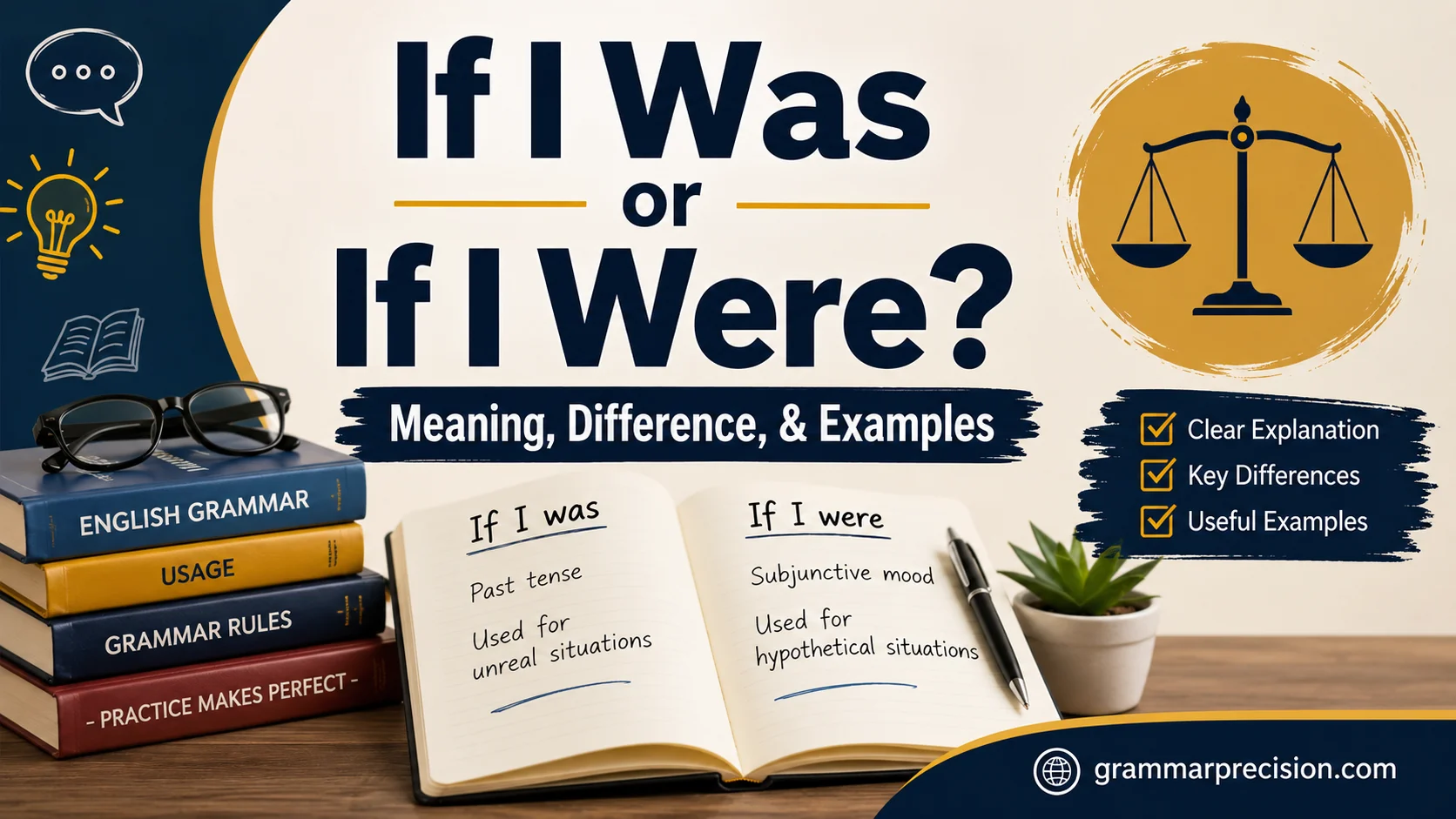
If I Was or If I Were? can be confusing, but the choice depends on whether you mean a real, possible, or imaginary situation. Understanding the difference makes your English grammar clearer and easier.
If I was usually refers to something that actually happened or was possible, while If I were often describes an unlikely, imaginary, or hypothetical situation. For example, “If I was rude, I should apologize” discusses a possible past action, while “If I were king” expresses an unreal idea.
Both forms come from the verb to be, but they follow different grammar rules. Was normally appears with I, while were is used for plural subjects and in the subjunctive mood. Learning this distinction helps you make the right choice and use each expression confidently.
If I Was vs. If I Were: The Quick Answer
Here’s the easiest starting point:
| Expression | Typical meaning | Example |
| If I was | A real or possible past situation | If I was late, I’m sorry. |
| If I were | A hypothetical, imagined, or contrary-to-fact situation | If I were rich, I’d travel the world. |
Traditionally, if I were is the preferred choice when you’re imagining a situation that isn’t true or is unlikely to be true.
For example:
If I were taller, I’d play basketball.
The speaker isn’t claiming to be taller. They’re imagining an alternative reality.
By contrast:
If I was too loud during the meeting, I apologize.
Here, the speaker is considering something that may genuinely have happened. The speaker doesn’t know whether they were too loud.
That’s the basic distinction. However, modern English makes the situation slightly more interesting. If I was can also appear in hypothetical constructions, especially in casual speech. Merriam-Webster notes that was has increasingly competed with the traditional subjunctive were in wishes and hypothetical statements.
For formal writing, tests, academic work, and situations where you want the traditional distinction to be unmistakable, if I were remains the safest choice for hypothetical situations.
What Does “If I Were” Mean?
If I were introduces a situation that you’re imagining rather than presenting as an established fact.
It commonly appears when you imagine having a different identity, condition, opportunity, or circumstance.
For example:
- If I were rich, I’d buy a house by the ocean.
- If I were invisible, I’d explore the city at night.
- If I were the manager, I’d change the schedule.
- If I were you, I’d wait another day.
- If I were more confident, I’d apply for the position.
Notice something important: the speaker isn’t necessarily saying the situation is logically impossible. It may simply be unreal, unlikely, or contrary to the speaker’s current circumstances.
That’s why you can say:
If I were offered the job, I’d accept it.
The job offer could theoretically happen. The speaker is simply imagining the possibility.
This use belongs to the broader world of conditional sentences. English uses if to introduce real, imagined, uncertain, and impossible conditions.
Why Is “Were” Used With “I”?
Normally, you learned the pattern:
- I was
- he was
- she was
- it was
- you were
- we were
- they were
So why does English suddenly say I were?
Because were can function as the traditional past subjunctive form of be.
In a sentence such as:
If I were a bird, I’d fly everywhere.
Were doesn’t simply describe past time. Instead, it helps mark the situation as hypothetical.
The Cambridge Dictionary gives “I wish I were rich” as a clear example of the subjunctive.
Think of were here as a grammatical signpost. It tells your reader, “We’re stepping away from ordinary reality for a moment.”
What Does “If I Was” Mean?
If I was usually refers to a past situation that might actually have happened.
For example:
If I was too harsh, I’m sorry.
The speaker isn’t imagining an impossible version of reality. They are considering whether something happened.
Here are more examples:
- If I was late yesterday, I apologize.
- If I was mistaken, please correct me.
- If I was rude to you, that wasn’t my intention.
- If I was at the store, I don’t remember seeing you.
- If I was responsible for the mistake, I’ll fix it.
The speaker doesn’t necessarily know whether the condition is true.
That uncertainty is important. If I was doesn’t mean “definitely happened.” It means the speaker is considering a past possibility as something that could have been true.
For example:
If I was asleep when you called, I didn’t hear the phone.
The speaker may not know whether they were asleep. They’re discussing a possible past state.
If I Was vs. If I Were: What’s the Difference?
The best way to understand the contrast is to focus on reality and imagination.
| Sentence | What it suggests |
| If I was wrong, I’ll fix it. | I may actually have been wrong. |
| If I were wrong, I’d admit it. | I’m imagining the possibility of being wrong. |
| If I was at the party, I don’t remember it. | I’m uncertain about a past event. |
| If I were at the party, I’d talk to Sarah. | I’m imagining being there. |
| If I was rude, I’m sorry. | I may have behaved rudely. |
| If I were rude, you’d probably tell me. | I’m considering a hypothetical situation. |
Here’s a useful mental test:
Ask yourself: “Am I looking back at a possible fact, or am I imagining an alternative?”
If you’re checking a possible past fact, was often fits naturally.
If you’re imagining an alternative reality, traditional grammar favors were.
However, don’t treat this as an ironclad rule for every sentence. Modern speakers sometimes use was in hypothetical constructions too. That’s one reason this topic causes so much confusion.
When Should You Use “If I Were”?
Use “If I Were” for Imaginary Situations
Imagine something that isn’t true right now:
If I were a professional chef, I’d open a restaurant.
You’re not saying you’re a chef. You’re creating an imaginary scenario.
More examples:
- If I were a superhero, I’d choose the power of teleportation.
- If I were invisible, I’d visit museums after closing time.
- If I were a dog, I’d spend all day sleeping.
- If I were a millionaire, I’d build a huge library.
The sentence temporarily creates a different world.
Use “If I Were” for Wishes and Dreams
Were also commonly appears when people express wishes.
I wish I were better at public speaking.
The person isn’t claiming to be good at public speaking. They’re describing a desired state.
Other examples include:
- I wish I were taller.
- I wish I were there.
- I wish I were more patient.
- I wish I were able to travel more.
The subjunctive often appears after wish because the speaker is discussing something that differs from current reality.
Use “If I Were” for Advice
One of the most familiar expressions is:
If I were you, I’d wait.
Of course, you can’t literally become the other person. The phrase imagines what you would do under their circumstances.
For example:
- If I were you, I’d save the money.
- If I were you, I’d call her tomorrow.
- If I were you, I’d read the contract carefully.
- If I were you, I wouldn’t rush the decision.
If I were you is so established that dictionaries specifically recognize it as a phrase used when giving advice or guidance.
When Should You Use “If I Was”?
Use “If I Was” for a Real Past Event
Suppose you don’t remember whether you said something.
If I was rude to you yesterday, I’m sorry.
You’re not imagining a completely different version of yourself. You’re investigating something that may have happened.
Another example:
If I was at the meeting, I don’t remember what happened.
The speaker is uncertain about a past fact.
Use “If I Was” When You Don’t Know What Happened
This pattern often appears when someone reconstructs a past event.
Imagine someone asks:
“Were you at the restaurant last night?”
You might say:
If I was there, I don’t remember seeing you.
The speaker isn’t deliberately creating a fantasy. They’re expressing uncertainty about the past.
“If I Was” Can Sound Natural in Casual Hypothetical Speech
Modern American English doesn’t always preserve the traditional distinction perfectly.
Native speakers frequently use was where older grammar guides would recommend were. Merriam-Webster specifically observes that the indicative was has competed with the older subjunctive were for centuries.
So you may hear:
If I was you, I’d take the offer.
Many speakers understand it immediately, and it occurs in ordinary conversation. Nevertheless, If I were you remains the traditional and more formal version.
For an essay, professional document, grammar test, or carefully edited article, were is the better choice when the meaning is hypothetical.
Why Do We Say “If I Were” Instead of “If I Was”?
The answer lies in grammatical mood.
English verbs can express different kinds of meaning. The indicative mood generally presents information as a fact or ordinary statement:
I was tired.
The subjunctive mood, by contrast, can express wishes, possibilities, proposals, demands, or imagined situations.
Compare:
I was the manager.
This presents a past fact.
Now change one word:
If I were the manager, I’d change the policy.
The sentence no longer describes reality. It imagines an alternative.
That’s why were survives in expressions such as:
- If I were you…
- If I were rich…
- If I were taller…
- I wish I were there.
- If he were here…
- If she were in charge…
The form gives the sentence a different grammatical flavor.
Also Read This: Ax or Axe: Which Is Correct in American English?
“If I Was” vs. “If I Were” Examples
The following pairs make the difference easier to see.
Example: Being Wrong
If I was wrong, I apologize.
This suggests the speaker may actually have been wrong.
If I were wrong, I would admit it.
This imagines the possibility of being wrong.
Example: Being Late
If I was late yesterday, I didn’t realize it.
The speaker is talking about a real past possibility.
If I were late tomorrow, I’d call you.
The speaker is imagining a future situation.
Example: Being Rich
If I was rich last year, I certainly didn’t show it.
This refers to a possible past fact.
If I were rich, I’d buy a cabin in the mountains.
This imagines a different present circumstance.
Example: Being at Home
If I was home when you called, I must have been asleep.
The speaker is discussing something that may have happened.
If I were home right now, I’d make dinner.
The speaker imagines being at home.
“If I Were You”: Why Is This Phrase So Common?
If I were you deserves special attention because it’s one of the most recognizable examples of the subjunctive.
The phrase means:
Imagine that I were in your situation.
It usually introduces advice.
For example:
If I were you, I’d accept the offer.
The speaker isn’t claiming to be the listener. Instead, they mentally place themselves in the listener’s position.
A useful pattern is:
If I were you + I would + base verb
Examples:
- If I were you, I would wait.
- If I were you, I would ask questions.
- If I were you, I would save the receipt.
- If I were you, I wouldn’t make that decision today.
The contraction I’d often makes the sentence sound more natural:
If I were you, I’d wait.
What About “I Wish I Was” vs. “I Wish I Were”?
This is another area where traditional grammar and everyday usage meet.
Traditional grammar favors:
I wish I were taller.
But you’ll also hear:
I wish I was taller.
The second version is common in modern speech and informal writing. Merriam-Webster notes that both were and was occur in wishes and hypothetical constructions, with was increasingly appearing where traditional grammar would use the subjunctive.
So what should you choose?
For formal or carefully edited writing, use:
I wish I were taller.
For casual conversation, I wish I was taller may sound completely natural to many American English speakers.
The important point isn’t that one sentence is incomprehensible and the other is magical. Both communicate the idea. The difference is largely about traditional grammatical convention, context, and style.
If I Was vs. If I Were in American English
American English speakers don’t always follow the traditional distinction in everyday conversation.
Language changes. Grammar isn’t frozen in a museum case.
In informal speech, you’ll sometimes hear if I was in situations where a traditional grammar guide would recommend if I were. This usage doesn’t usually create confusion because listeners understand the intended hypothetical meaning from context.
However, style still matters.
| Situation | Recommended choice |
| Grammar test | If I were for hypothetical meaning |
| Academic essay | If I were |
| Formal business writing | If I were |
| Carefully edited article | If I were |
| Casual conversation | If I was may occur naturally |
| Real past possibility | If I was |
| Traditional hypothetical construction | If I were |
This distinction gives you a practical rule: when in doubt and the situation is hypothetical, choose “were.”
It’s clear, conventional, and unlikely to attract criticism.
Conditional Sentences With “Was” and “Were”
Understanding conditionals makes the whole issue easier.
English uses different conditional patterns to talk about real, likely, unlikely, and impossible situations. Cambridge describes conditionals as constructions that can express real, imagined, uncertain, unlikely, or impossible conditions.
Consider these examples:
Possible situation:
If I have time, I’ll call you.
This could genuinely happen.
Hypothetical situation:
If I were free tomorrow, I’d join you.
The speaker isn’t currently presenting freedom tomorrow as a known fact.
Past possibility:
If I was asleep, I didn’t hear the phone.
The speaker is considering what may have happened.
Past unreal situation:
If I had known about the problem, I would have helped.
The speaker knows they didn’t know at the time.
The verb form works together with the overall meaning. Don’t choose was or were by looking at the word if alone.
Common Mistakes to Avoid
Mistake: Using “Was” Automatically Because the Subject Is “I”
A common learner instinct is:
I was → therefore if I was.
That logic works for ordinary past statements, but hypothetical English has a special construction.
Better:
If I were you, I’d apologize.
Mistake: Thinking “Were” Always Means Past Time
Not here.
If I were rich, I’d travel.
This sentence doesn’t necessarily describe the past. The were marks a hypothetical situation.
Mistake: Assuming “If I Was” Is Always Wrong
That’s too rigid.
If I was rude yesterday, I’m sorry.
This is perfectly natural when the speaker is referring to a possible past event.
Mistake: Choosing Based Only on Formality
Context matters more than simply labeling one word “formal” and the other “informal.”
Ask what the sentence means first.
Is it a possible past fact? Use was.
Is it a hypothetical or contrary-to-fact situation? Traditional grammar favors were.
A Simple Trick to Remember the Difference
Try this three-step test.
Step one: Ask whether the situation could have actually happened.
If you’re discussing a possible past event, was often works.
If I was late, I’m sorry.
Step two: Ask whether you’re imagining another version of reality.
If yes, choose were in traditional grammar.
If I were taller, I’d play basketball.
Step three: Look for familiar signals.
Words and phrases such as wish, if I were you, and imaginary descriptions often point toward the subjunctive.
A handy memory trick is:
Were = wonder.
When you’re wondering about an imagined version of life, were often fits.
If you’re checking what really happened, was is usually the natural choice.
Quick Decision Chart
Use this mental map whenever you’re stuck:
Are you talking about a possible past fact?
→ Yes → If I was
Are you imagining a different situation?
→ Yes → If I were
Are you giving advice with “If I ___ you”?
→ If I were you
Are you expressing a wish?
→ Traditional choice: I wish I were
Are you writing formally?
→ Prefer were for hypothetical meaning.
Are you having a casual conversation?
→ You may hear was in hypothetical contexts.
Practice: Choose “Was” or “Were”
Try these before checking the answers.
- If I ___ you, I’d wait.
- If I ___ rude yesterday, I’m sorry.
- If I ___ rich, I’d buy a beach house.
- If I ___ asleep when you called, I didn’t hear you.
- If I ___ more organized, I’d finish sooner.
- If I ___ responsible for the mistake, I’d fix it.
Answers
- were — You’re giving hypothetical advice.
- was — You’re considering a possible past event.
- were — You’re imagining a different financial situation.
- was — You’re considering what may have happened in the past.
- were — You’re imagining a different personal condition.
- were — You’re presenting a hypothetical situation.
The key isn’t memorizing six isolated answers. It’s recognizing the meaning behind each condition.
FAQs:
Is “If I Was” grammatically correct?
Yes, “If I was” is grammatically correct when you’re referring to a real, possible, or likely past situation. For example, “If I was rude, I should apologize.” Here, the speaker considers something that may have actually happened.
When should I use “If I Were”?
Use “If I were” for an imaginary, unlikely, or hypothetical situation. For example, “If I were rich, I would travel the world.” The situation isn’t presented as a known fact but as an unreal possibility or wish.
What is the main difference between “If I Was” and “If I Were”?
The main difference is meaning and mood. “If I was” commonly refers to a possible past event, while “If I were” is traditionally used for hypothetical or unreal situations. The latter reflects the subjunctive mood, especially in formal English.
Can I say “If I were” for a wish?
Yes. “If I were” is commonly used when expressing a wish, dream, or unreal condition. For example, “If I were you, I would accept the offer.” This sentence describes a situation that isn’t literally true but helps express advice or imagination.
Which is correct: “If I was” or “If I were”?
Both are correct, but they serve different purposes. Choose “If I was” when discussing a possible or real past situation. Choose “If I were” when describing an imaginary, unlikely, or hypothetical condition.
Conclusion:
Understanding If I Was or If I Were? becomes easier when you focus on the situation. Use “If I was” for possible or real past events, and “If I were” for hypothetical, imaginary, or unlikely conditions. Remember that “If I were” often follows the subjunctive mood.
With regular practice, you’ll make the right choice naturally and use both expressions with greater confidence.