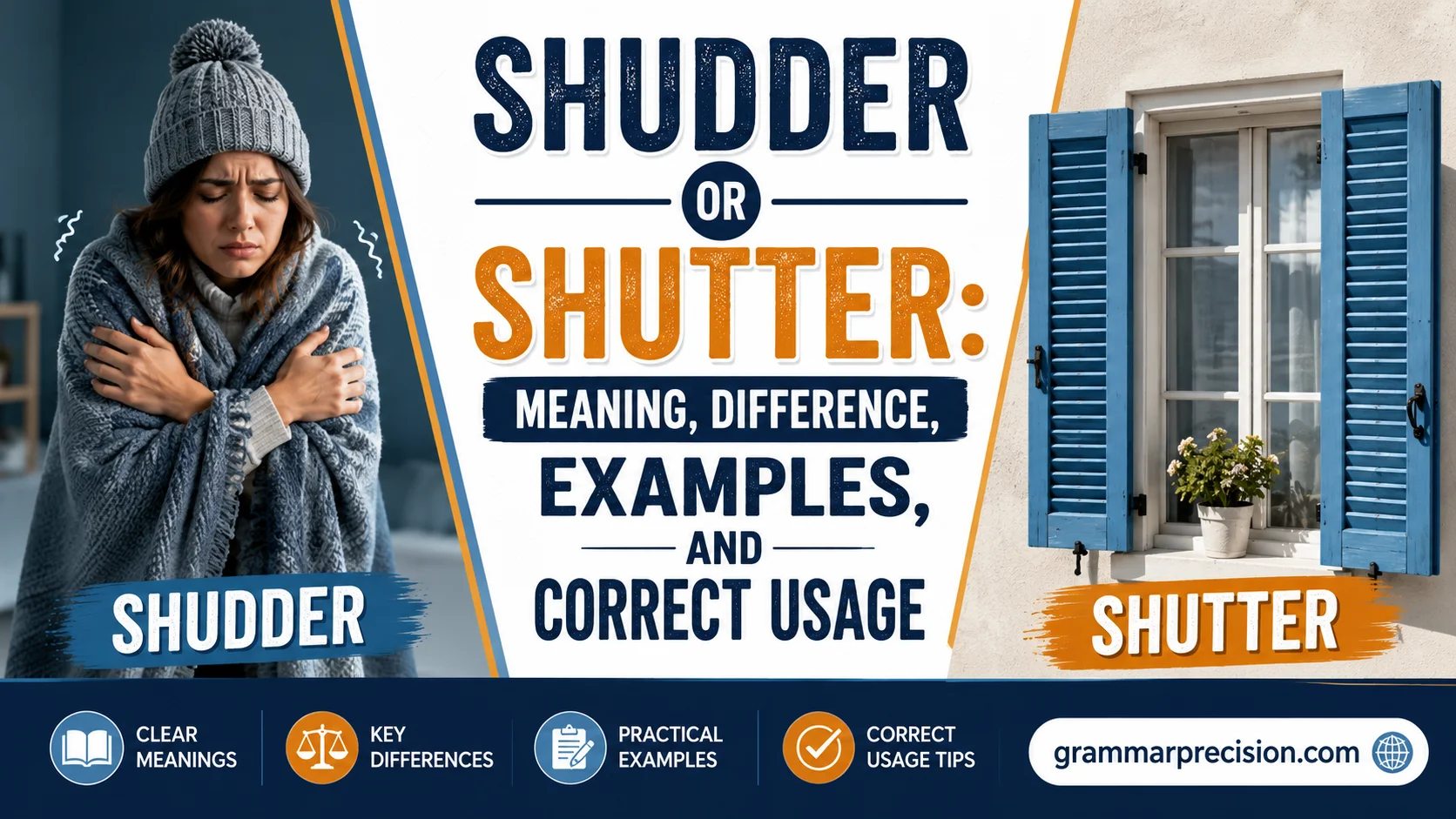
Shudder or Shutter can confuse English learners because these homophones sound alike but have different meanings. Shudder describes shaking or trembling, while shutter means closing or blocking something in context.
A shudder can happen because of cold, fear, terror, or an unpleasant memory. It may also describe a pleasant tingle or feeling of excitement. As a verb or noun, shudder relates to shaking, trembling, or an involuntary vibration in your body.
A shutter usually means closing, blocking, or covering something. A window shutter can close off a window, while a film camera shutter opens briefly to expose film and capture a moment. Remember, the words aren’t interchangeable; their context and meaning determine which one you need.
Shudder or Shutter: The Quick Answer
Shudder means to tremble or shake suddenly, usually because of fear, cold, excitement, disgust, or another strong reaction. It can function as both a verb and a noun.
Shutter usually refers to a movable covering for a window or opening. In photography, it also refers to the mechanism that controls how long light reaches a camera sensor. As a verb, shutter means to close something, especially a building, business, or operation.
Here’s the simplest way to remember them:
| Word | Core meaning | Common uses | Example |
| Shudder | Tremble or shake | Fear, cold, disgust, anxiety | I shudder at the thought. |
| Shutter | Cover or close | Windows, cameras, businesses | They shuttered the store. |
Think of shudder as a reaction from a person or body. Think of shutter as something that shuts.
That small connection makes the difference much easier to remember.
What Does “Shudder” Mean?
Shudder describes a sudden, often involuntary shaking movement. The movement may involve your entire body or only part of it. More importantly, the word often suggests an emotional or physical reaction rather than ordinary movement.
For example:
I shuddered when I heard the strange noise.
The sentence doesn’t simply mean that the person moved. It suggests a sudden reaction, probably caused by fear or uneasiness.
Shudder as a Verb
As a verb, shudder means to tremble or shake suddenly.
You can shudder because you’re frightened:
- She shuddered when she saw the abandoned house.
- I shudder whenever I remember that accident.
- He shuddered at the thought of going back.
You can also shudder because something feels unpleasant:
- She shuddered at the smell.
- He shuddered when he touched the slimy surface.
- I shudder just thinking about that terrible meal.
Cold can cause shuddering as well:
- The hikers shuddered in the freezing wind.
- He shuddered as the icy water touched his skin.
The word can also describe a figurative reaction. You might say that someone shudders at the memory of an embarrassing or painful experience.
Shudder as a Noun
Shudder can also work as a noun. In that form, it refers to a sudden shaking movement.
For example:
- A shudder ran through her body.
- He gave a shudder when he heard the news.
- The old machine stopped with a final shudder.
Notice the difference in structure. In “She shuddered,” the word describes an action. In “She gave a shudder,” it names the reaction itself.
What Causes Someone to Shudder?
A shudder can have several causes. The surrounding context usually tells you which one applies.
Common triggers include:
- Fear: A frightening sight can make you shudder.
- Cold: Low temperatures can trigger involuntary trembling.
- Disgust: A revolting smell or texture may cause a shudder.
- Anxiety: A stressful memory can produce a physical reaction.
- Excitement: Intense anticipation can sometimes make someone shudder.
- Pain or discomfort: A sudden unpleasant sensation may trigger shaking.
The key idea remains the same: shudder involves trembling or a sudden physical reaction.
What Does “Shutter” Mean?
Shutter has a very different meaning. As a noun, it commonly refers to a movable panel used to cover a window or opening.
Traditional shutters can protect windows from sunlight, weather, or damage. They can also provide privacy and security.
For example:
- The wooden shutters covered the windows.
- She opened the shutters to let in sunlight.
- The storm damaged several shutters.
The word also appears frequently in photography.
Shutter in Photography
A camera shutter is the mechanism that controls the period during which light reaches the camera’s image sensor or film.
That timing matters enormously in photography. A faster shutter speed can help freeze movement. A slower shutter speed can allow more light into the camera and may create intentional motion blur.
For example:
- The photographer used a fast shutter speed to freeze the athlete.
- A slow shutter helped capture the movement of the waterfall.
This meaning has nothing to do with trembling. If you’re talking about a camera, shutter is the correct word.
Shutter as a Verb
Shutter can also function as a verb meaning to close.
You may use it literally:
- They shuttered the windows before the storm.
- The caretaker shuttered the building at sunset.
However, modern English often uses shutter figuratively when discussing businesses, factories, offices, websites, or other operations.
For example:
- The company shuttered three stores.
- The factory was shuttered after years of losses.
- The restaurant shuttered its doors last winter.
In these examples, shuttered means the operation closed, usually permanently or indefinitely.
Shudder vs. Shutter: The Key Difference
The easiest distinction is surprisingly visual.
Shudder = shake.
Shutter = shut or close.
A person might shudder because a horror movie scares them. A homeowner might shutter a window before a storm.
Here’s a broader comparison:
| Feature | Shudder | Shutter |
| Main idea | Tremble or shake | Cover or close |
| Noun | A trembling movement | A window covering or camera mechanism |
| Verb | To tremble | To close |
| Common context | Fear, cold, disgust | Windows, cameras, businesses |
| Past tense | Shuddered | Shuttered |
| Related word | Tremble | Shut |
| Example | She shuddered with fear. | They shuttered the shop. |
The extra d in shudder can help you associate the word with a physical jolt or tremble. Meanwhile, shutter begins with the same “shut” idea that appears in shut.
Shudder or Shutter in Common Sentences
Context makes these words much easier to separate. Compare the following sentences.
“I Shudder at the Thought”
This phrase means that the idea of something causes a strong negative reaction.
- I shudder at the thought of falling from that height.
- She shuddered at the thought of returning to the scene.
- He shudders at the thought of public speaking.
The expression often communicates fear, dread, or intense discomfort.
“Close the Shutters”
Here, shutters refers to physical coverings.
- Please close the shutters before the storm arrives.
- She opened the shutters early in the morning.
- The old house had blue wooden shutters.
You could replace “shutters” with another type of window covering in some contexts, but the meaning remains physical.
“The Business Was Shuttered”
In business writing, shuttered often means closed permanently or for an extended period.
- The company shuttered its smallest branch.
- Several stores were shuttered during the restructuring.
- The theater remained shuttered for months.
This usage is especially common in news reports and business discussions.
Real-World Situations: Which Word Fits?
Sometimes the fastest way to understand a vocabulary difference is to place it inside a realistic situation.
Talking About Fear
Imagine walking into a dark basement and hearing footsteps.
You might say:
I shuddered when I heard the footsteps.
You wouldn’t use shutter because nothing is being closed.
Talking About Windows
Imagine preparing a house for a hurricane.
You might say:
We shuttered the windows before the storm.
Here, shuttered means covered or closed with shutters.
Talking About Photography
Imagine photographing a race car.
You might say:
The photographer adjusted the shutter speed to freeze the car.
Again, shudder would be incorrect because the sentence concerns a camera mechanism.
Talking About a Closed Business
Imagine a restaurant that has permanently stopped operating.
You could read:
The restaurant shuttered after fifteen years in business.
The word describes closure rather than trembling.
Talking About an Unpleasant Memory
Imagine remembering an extremely disturbing event.
You could say:
She shuddered at the memory.
That sentence describes an emotional response.
Shudder and Shutter: Common Examples Side by Side
Seeing the words together can make the distinction stick.
| Correct sentence | Why it works |
| I shuddered when I saw the spider. | The person reacted with fear or disgust. |
| The workers closed the shutters. | The sentence concerns window coverings. |
| She shuddered at the horrible memory. | The memory caused an emotional reaction. |
| The store was shuttered last month. | The business closed. |
| He changed the camera’s shutter speed. | The sentence concerns photography. |
| The cold made everyone shudder. | The people were trembling. |
A useful trick is to replace the word mentally. If tremble fits, choose shudder. If close or cover fits, choose shutter.
Also Read This: Accept vs Except: Meaning, Difference & Examples
Shudder vs. Shutter Pronunciation
The two words are pronounced differently even though they look similar.
Shudder is generally pronounced like “SHUD-er.”
Shutter is generally pronounced like “SHUT-er.”
The vowel sound changes. In shudder, the first syllable has the vowel sound heard in words such as “mud” and “under.” In shutter, the first syllable uses the shorter vowel sound heard in “cut” or “shut.”
That distinction matters because pronunciation can reinforce meaning.
Try saying these pairs aloud:
- shudder / shut
- shuddered / shuttered
- shuddering / shuttering
The connection becomes clearer after repetition.
Shudder vs. Shutter: Parts of Speech
Both words can function as nouns and verbs. That similarity can make them even easier to confuse.
Shudder as a Verb
The child shuddered in the cold.
Here, shuddered describes an action.
Shudder as a Noun
A sudden shudder passed through him.
Here, shudder names the physical reaction.
Shutter as a Noun
The wooden shutter was damaged.
Here, shutter identifies a physical object.
Shutter as a Verb
The company shuttered the facility.
Here, shuttered describes an act of closing.
Understanding these grammatical roles helps you recognize the correct word faster.
Why Do People Confuse Shudder and Shutter?
The confusion is understandable. Both words begin with sh-, contain similar letters, and have nearly identical syllable patterns.
They also sound close enough that a fast conversation can blur the distinction.
Spelling creates another problem. The difference between shudder and shutter is only one letter in the middle.
Yet their meanings developed along completely different paths.
Shudder connects with trembling and shaking. Shutter connects with shutting or closing. Once you focus on meaning instead of appearance, the confusion fades quickly.
A Simple Memory Trick for Shudder vs. Shutter
Use this two-word rule:
Shudder shakes. Shutter shuts.
It’s short, rhythmic, and hard to forget.
If someone shudders, imagine their body suddenly shaking.
If someone shutters something, imagine them shutting it.
You can also use these associations:
- Shudder → shake
- Shutter → shut
- Shudder → fear
- Shutter → window
- Shutter → camera
- Shutter → business closure
One quick mental picture can save you from repeatedly checking the dictionary.
Common Mistakes With Shudder and Shutter
These mistakes usually happen when writers choose a word based on sound rather than meaning.
Mistake: “I Shuttered at the Thought”
Incorrect:
I shuttered at the thought of the accident.
Correct:
I shuddered at the thought of the accident.
The person is reacting emotionally. Nothing is being closed.
Mistake: “Close the Shudders”
Incorrect:
Please close the shudders.
Correct:
Please close the shutters.
The sentence refers to window coverings.
Mistake: “The Company Shuddered Its Stores”
Incorrect:
The company shuddered several stores.
Correct:
The company shuttered several stores.
The company closed those locations, so shuttered is appropriate.
Mistake: “The Camera Shudder”
Incorrect:
Adjust the camera shudder.
Correct:
Adjust the camera shutter.
Photography uses shutter, not shudder.
Shudder vs. Shutter: A Quick Decision Test
When you’re unsure, ask one question:
Is something trembling, or is something closing?
Choose shudder when the idea involves:
- trembling
- shaking
- fear
- cold
- disgust
- dread
- an intense physical reaction
Choose shutter when the idea involves:
- windows
- coverings
- cameras
- closing
- businesses
- buildings
- operations
This test works because it focuses on meaning rather than spelling.
Quick Quiz: Shudder or Shutter?
Test yourself before moving on.
The freezing wind made everyone _____.
The answer is shudder because the people are trembling from cold.
The homeowners closed the wooden _____.
The answer is shutters because the sentence refers to window coverings.
The company decided to _____ its downtown location.
The answer is shutter because the company decided to close the location.
She _____ when she remembered the frightening experience.
The answer is shuddered because she experienced an emotional reaction.
The photographer increased the camera’s ____ speed.
The answer is shutter because the sentence concerns photography.
If you got all five, you’ve mastered the central distinction.
FAQs:
What does “shudder” mean?
Shudder means to shake or tremble, usually because of cold, fear, terror, or an unpleasant feeling. It can also describe a sudden tingle or pleasurable sensation.
What does “shutter” mean?
Shutter means to close, block, or cover something. A window shutter can close a window, while a camera shutter opens briefly to control exposure and capture an image.
Are shudder and shutter homophones?
Yes. Shudder and shutter are homophones because they have similar sounds but different meanings, spellings, and uses. They aren’t interchangeable in sentences.
How can I remember the difference?
Think of shudder as a physical shake or tremble. Think of shutter as something that closes or blocks. This simple connection makes the difference easier to remember.
Is “shuddered his blog” correct?
No. If someone closed down or blocked access to a blog, shuttered his blog is correct. Shuddered would suggest that the person or thing shook or trembled.
Conclusion:
Understanding Shudder or Shutter becomes easier when you focus on their meanings. Shudder relates to shaking, trembling, fear, cold, or sensations, while shutter refers to closing, blocking, or covering something. Although these words sound similar, their uses are different. Remember the context, and you’ll quickly know which spelling belongs in your sentence.