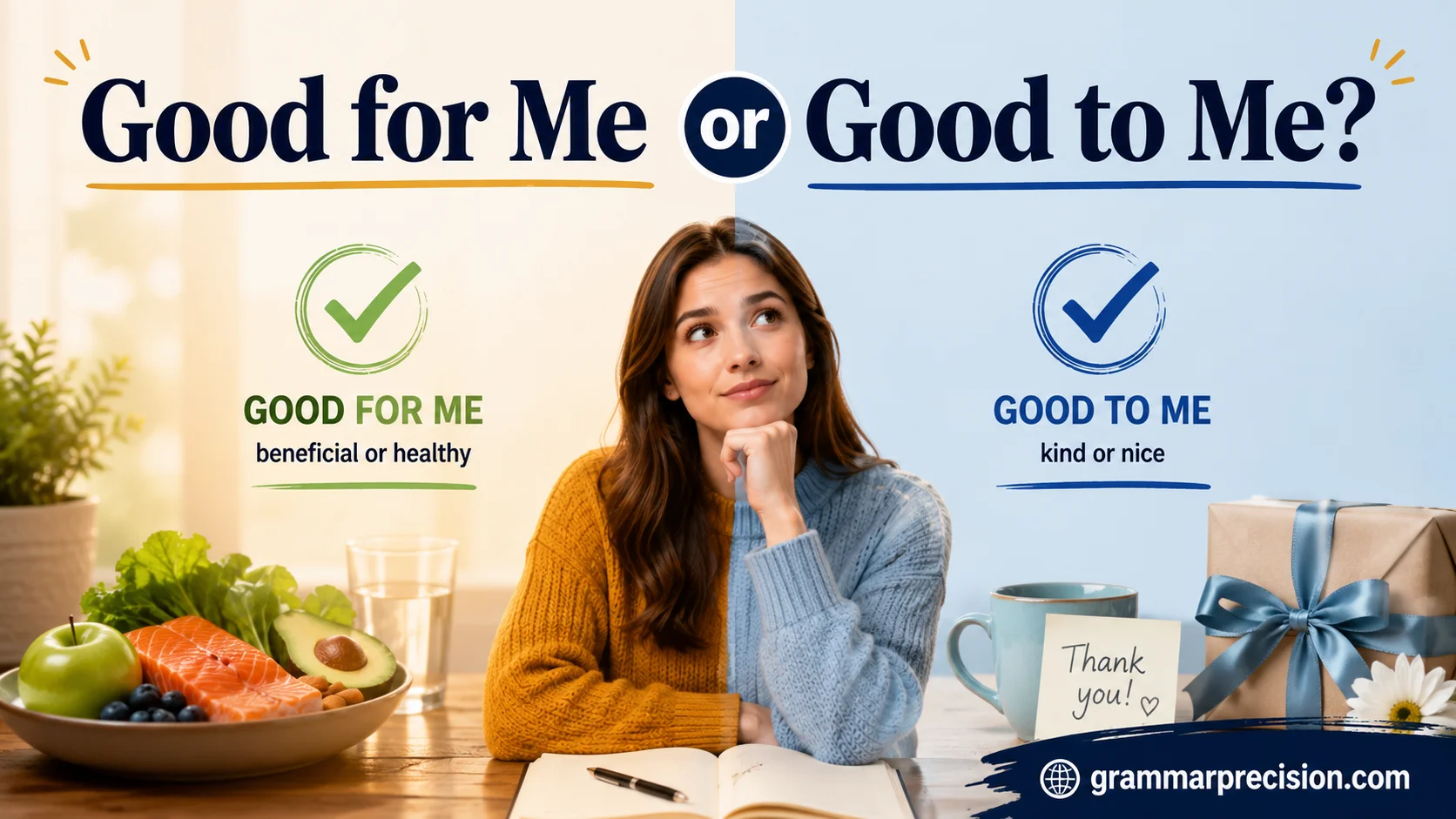
Have you ever wondered whether Good for Me or Good to Me is the correct phrase? Understanding this common grammar difference helps you communicate clearly and confidently in everyday English.
Although these expressions look almost identical, they convey different meanings. Good for Me refers to something that provides a benefit, improves your health, or supports your success. In contrast, Good to Me describes how someone treats you with kindness, respect, or care. Knowing this distinction helps you avoid common mistakes.
In this guide, you’ll discover the grammar rules, practical examples, and simple memory tricks that make choosing the right phrase easy. You’ll also learn common mistakes to avoid, compare both expressions side by side, and build the confidence to use Good for Me or Good to Me correctly in everyday conversations and writing.
Quick Answer: Good for Me or Good to Me?
Here’s the simple rule:
| Phrase | Meaning | Example |
| Good for me | Something benefits or improves you. | Walking every morning is good for me. |
| Good to me | Someone treats you kindly or respectfully. | My grandparents have always been good to me. |
Remember this simple shortcut:
- For = Benefit
- To = Treatment
If you’re talking about health, success, learning, money, or improvement, choose good for me.
If you’re talking about kindness, respect, love, generosity, or behavior, choose good to me.
Why One Small Word Changes the Meaning
Many English learners assume these expressions are interchangeable because only one word changes.
They’re not.
The prepositions for and to perform completely different jobs in English.
Think of them this way:
- For points toward a benefit, purpose, or positive result.
- To points toward how someone acts toward another person.
Consider these two sentences:
Eating vegetables is good for me.
Here, vegetables improve your health.
Now compare it with:
My teacher has always been good to me.
Your teacher isn’t improving your health. Instead, your teacher treats you with kindness and respect.
That tiny change completely shifts the meaning.
What Does “Good for Me” Mean?
The phrase good for me means something is beneficial, healthy, helpful, or advantageous.
It answers questions like:
- Does this help me?
- Will this improve my life?
- Is this healthy?
- Is this beneficial?
If the answer is yes, good for me is probably the correct choice.
Common Situations
You usually hear good for me when discussing:
- Health
- Exercise
- Food
- Education
- Career
- Finances
- Habits
- Personal growth
- Mental well-being
Examples
- Drinking enough water is good for me.
- Reading every day is good for me.
- Saving money is good for me.
- Sleeping eight hours is good for me.
- Meditation is good for me.
- This course is good for me because it improves my skills.
- Quitting smoking was good for me.
- Learning another language is good for me.
Notice something?
Every sentence focuses on a positive outcome.
Health Examples
Health is probably the most common context.
| Sentence | Why It Works |
| Apples are good for me. | They improve health. |
| Yoga is good for me. | It benefits the body and mind. |
| Less sugar is good for me. | It reduces health risks. |
| Swimming is good for me. | It strengthens muscles and the heart. |
| Fresh air is good for me. | It supports physical and mental wellness. |
Career Examples
The phrase also works in professional settings.
Examples:
- Networking is good for me because it creates opportunities.
- Learning Excel is good for me at work.
- Accepting feedback is good for me.
- This internship is good for me.
Again, the emphasis is on benefit.
Education Examples
Students frequently use this phrase.
Examples include:
- Taking notes is good for me.
- Studying every evening is good for me.
- Practicing grammar is good for me.
- Reading novels is good for me because it expands my vocabulary.
The Grammar Behind “Good for Me”
Let’s examine the grammar.
The structure is straightforward:
Subject + be verb + good for + person/pronoun
Examples:
- Coffee is good for me.
- Exercise is good for you.
- Vegetables are good for children.
- Reading is good for everyone.
Notice that for introduces the person who receives the benefit.
Synonyms for “Good for Me”
Instead of repeating the same phrase, you can vary your language.
Some alternatives include:
- beneficial
- healthy
- advantageous
- worthwhile
- valuable
- helpful
- productive
- positive
- useful
Examples:
Instead of saying:
Running is good for me.
You could say:
- Running is beneficial.
- Running improves my health.
- Running has positive effects.
- Running supports my fitness goals.
These alternatives enrich your writing without changing the meaning.
What Does “Good to Me” Mean?
Unlike good for me, the phrase good to me focuses on behavior.
It describes how someone treats another person.
Think of words like:
- kind
- respectful
- caring
- generous
- thoughtful
- compassionate
- supportive
If someone behaves positively toward you, they’re good to you.
Everyday Examples
- My parents have always been good to me.
- My boss has been good to me.
- She was very good to me during difficult times.
- My neighbors are always good to me.
- Everyone at work has been good to me.
Each sentence describes someone’s treatment.
Relationship Examples
Relationships often use this phrase.
Examples:
- He has always been good to me.
- My wife is incredibly good to me.
- My children are always good to me.
- My coach was good to me throughout the season.
- My mentor has been good to me since my first day.
Notice that none of these describe a benefit like better health.
Instead, they describe kindness.
Workplace Examples
Professional conversations also use this phrase.
Examples:
- My manager has been good to me.
- The company has been good to me over the years.
- My coworkers are always good to me.
These examples focus on treatment rather than advantage.
The Grammar Behind “Good to Me”
The pattern is equally simple.
Subject + be verb + good to + person
Examples:
- She is good to me.
- They were good to us.
- He has always been good to his employees.
- My grandparents are good to everyone.
The preposition to identifies the person receiving the kindness.
Synonyms for “Good to Me”
Here are several natural alternatives.
Instead of saying:
She is good to me.
You can say:
- She is kind to me.
- She treats me well.
- She respects me.
- She supports me.
- She cares about me.
- She is generous toward me.
These expressions all communicate positive treatment.
Good for Me vs. Good to Me: Side-by-Side Comparison
| Feature | Good for Me | Good to Me |
| Main Meaning | Benefit | Kind treatment |
| Focus | Positive effect | Positive behavior |
| Talks About | Health, learning, success, habits | Relationships and respect |
| Usually Refers To | Things, activities, choices | People or organizations |
| Question Answered | Does it help me? | How do they treat me? |
| Example | Exercise is good for me. | My trainer is good to me. |
This comparison highlights why confusing these phrases changes the intended message.
The Biggest Difference Explained
A simple way to remember the distinction is to think about cause and action.
When something improves your life, it is good for you.
When someone behaves kindly toward you, they are good to you.
Imagine these situations:
Situation 1
You start eating more vegetables.
Result?
They’re good for you because they improve your health.
Situation 2
Your grandmother cooks your favorite meal every weekend and always encourages you.
She is good to you because of how she treats you.
Same adjective.
Different relationship.
Different meaning.
Decision Tree: Which One Should You Use?
Ask yourself:
Are you talking about…
│
▼
A benefit, health, success,
or positive result?
│
Yes ─────────► Good for Me
│
No
▼
Someone’s behavior,
kindness, or respect?
│
Yes ─────────► Good to Me
Whenever you’re unsure, this simple test usually leads you to the correct answer.
Real-Life Examples in Everyday Conversations
Understanding grammar is important, but hearing these expressions in everyday situations makes them much easier to remember.
Talking About Food
Correct:
- Fish is good for me.
- Green vegetables are good for me.
- Fast food isn’t good for me.
- Drinking water is good for me.
Incorrect:
- Pizza is good to me. ❌
Unless you’re joking that the pizza somehow treats you kindly, this sounds unnatural.
Talking About Friends
Correct:
- My best friend is good to me.
- Everyone in my class is good to me.
- My neighbors have always been good to me.
Incorrect:
- My friend is good for me.
This sentence can be correct, but it has a different meaning. It suggests your friend has a positive influence on your life rather than describing how they treat you.
Talking About Exercise
Exercise is one of the easiest contexts for good for me because it describes a positive effect on your body or mind.
Examples:
- Walking every morning is good for me.
- Strength training is good for me because it builds muscle.
- Stretching after work is good for me.
- Swimming is good for me during the summer.
- Yoga is good for me because it reduces stress.
Notice that each activity provides a benefit, not kindness.
Talking About Work
Both phrases can appear in workplace conversations, but they carry different meanings.
Using Good for Me
You’re talking about something that benefits your career.
Examples:
- This promotion is good for me.
- Taking this certification course is good for me.
- Learning new software is good for me professionally.
- Working remotely is good for me because it saves time.
Using Good to Me
You’re describing how people treat you.
Examples:
- My manager has always been good to me.
- The company has been good to me over the years.
- My teammates are always good to me.
The difference is subtle but important.
Talking About Family
Family conversations often use good to me because they focus on relationships.
Examples:
- My grandparents have always been good to me.
- My sister is always good to me when I need help.
- My uncle has been incredibly good to me.
However, if you’re discussing influence or benefits, switch to good for me.
Example:
- Spending time with my family is good for me because it improves my mental health.
Both phrases appear in the same topic, but they express different ideas.
Talking About School
Education offers another excellent comparison.
Good for Me
- Reading every day is good for me.
- Practicing grammar is good for me.
- Joining debate club is good for me.
- Learning another language is good for me.
Good to Me
- My English teacher has always been good to me.
- The school staff were good to me when I transferred.
- My classmates have been good to me since the first day.
Again, one phrase describes benefits while the other describes behavior.
Also Read This: Whether It Be vs. Whether It Is: Meaning, Grammar Rules and Examples
Can Both Phrases Be Correct?
Yes. In some situations, both “good for me” and “good to me” are grammatically correct, but they mean different things.
Let’s compare them.
| Sentence | Meaning |
| My girlfriend is good for me. | She has a positive influence on my life. |
| My girlfriend is good to me. | She treats me kindly and respectfully. |
| This job is good for me. | The job benefits my career or finances. |
| My employer is good to me. | The employer treats me well. |
| My dog is good for me. | The dog improves my happiness or health. |
| My dog is good to me. | The dog is affectionate and loving. |
This distinction is one of the biggest reasons learners become confused.
The grammar stays the same, but the focus changes.
Real-Life Conversation Examples
Seeing these phrases in conversations helps you understand how native speakers naturally use them.
Example 1: Healthy Lifestyle
Sarah: I’m thinking about eating more vegetables.
Emma: That’s a great idea. They’re really good for you.
Example 2: Relationships
David: You’ve known Mike for years.
John: Yes. He’s always been good to me.
Example 3: Career
Anna: Why did you accept the new position?
Mark: It’s good for me because it offers better opportunities.
Example 4: Family
Lisa: Your grandmother sounds wonderful.
Emily: She really is. She’s always been good to me.
These conversations sound natural because each phrase matches its intended meaning.
Common Mistakes English Learners Make
Many learners make the same errors when using these expressions.
Understanding these mistakes can help you avoid them.
Mistake 1: Using “Good to Me” for Health
❌ Vegetables are good to me.
✅ Vegetables are good for me.
Vegetables don’t choose how to treat you.
They provide health benefits.
Mistake 2: Using “Good for Me” to Describe Kindness
❌ My grandmother is good for me.
This isn’t always wrong, but it changes the meaning.
It suggests she positively influences your life.
If you mean she’s caring and loving:
✅ My grandmother is good to me.
Mistake 3: Assuming Both Mean the Same Thing
Many learners memorize both phrases without understanding the difference.
Instead, ask yourself:
Am I talking about a benefit or someone’s behavior?
That simple question usually leads you to the right answer.
Mistake 4: Translating Directly from Another Language
Many languages use one expression for both ideas.
English separates them.
That’s why direct translation often produces mistakes.
Learning the meaning instead of translating word for word leads to much better English.
Good for Me vs. Good to Me vs. Good With Me
Another phrase that causes confusion is good with me.
Although it looks similar, it has a completely different meaning.
| Phrase | Meaning | Example |
| Good for me | Benefits me | Exercise is good for me. |
| Good to me | Treats me kindly | My parents are good to me. |
| Good with me | Acceptable to me or skilled at handling something | Friday is good with me. / She’s good with children. |
Notice how good with has two common uses.
Meaning 1: Acceptable
- Monday is good with me.
- That’s perfectly good with me.
- Any time after lunch is good with me.
Here, it means acceptable or okay.
Meaning 2: Skilled
- She’s good with children.
- He’s good with computers.
- My brother is good with numbers.
- The mechanic is good with engines.
This meaning refers to ability, not kindness or benefit.
Similar Expressions You Should Know
Expanding your vocabulary makes your English sound more natural.
Here are several related expressions.
| Expression | Meaning |
| Good for you | Beneficial or congratulations depending on context |
| Nice to me | Kind toward me |
| Kind to me | Caring toward me |
| Helpful to me | Gives assistance |
| Beneficial for me | Provides an advantage |
| Healthy for me | Improves health |
| Positive for me | Produces favorable results |
Examples:
- Drinking water is beneficial for me.
- My coach is kind to me.
- My neighbor is always helpful to me.
- This routine is healthy for me.
Using a variety of expressions keeps your writing engaging and avoids repetition.
Memory Trick You’ll Never Forget
One of the easiest ways to remember these phrases is to connect each preposition with a keyword.
| Preposition | Remember | Think About |
| For | Benefit | Health, growth, improvement |
| To | Treatment | Kindness, respect, generosity |
You can even remember this short rhyme:
“For means benefit. To means treatment.”
It’s simple, memorable, and works almost every time.
Another trick is to picture two arrows.
GOOD FOR ME
│
▼
Helps Me
GOOD TO ME
│
▼
Treats Me Well
Visual associations often help learners remember grammar rules much faster.
Quick Practice Quiz
Test your understanding before moving on.
Question 1
Fresh fruit is ________.
- A. good to me
- B. good for me
✅ Answer: B
Question 2
My aunt has always been ________.
- A. good to me
- B. good for me
✅ Answer: A
Question 3
Reading every evening is ________.
- A. good for me
- B. good to me
✅ Answer: A
Question 4
My boss has been incredibly ________.
- A. good for me
- B. good to me
✅ Answer: B
Question 5
Regular exercise is ________.
- A. good to me
- B. good for me
✅ Answer: B
If you answered all five correctly, you’ve mastered the core difference between these expressions.
Expert Tips to Avoid Confusion Forever
Keep these practical tips in mind whenever you write or speak English:
- Think about the meaning before choosing the preposition.
- If something helps you, use good for me.
- If someone treats you kindly, use good to me.
- Read your sentence aloud. It often becomes obvious which phrase sounds natural.
- Learn the phrases through everyday examples instead of memorizing grammar rules alone.
- Practice by creating your own sentences about your family, work, school, and hobbies.
- Notice how native speakers use these expressions in books, podcasts, movies, and conversations.
The more real examples you encounter, the more automatic your choice will become.
Key Takeaways
Before you finish, here’s a quick recap of the most important points.
| Situation | Correct Phrase |
| Healthy food | Good for me |
| Exercise | Good for me |
| Education | Good for me |
| Career opportunity | Good for me |
| Helpful habit | Good for me |
| Caring parent | Good to me |
| Kind teacher | Good to me |
| Respectful boss | Good to me |
| Loving friend | Good to me |
| Supportive spouse | Good to me |
If you remember that “for” points to benefits and “to” points to treatment, you’ll rarely make a mistake.
In everyday English, these two small prepositions carry a big difference in meaning. Mastering them will help you communicate more clearly, sound more natural, and avoid one of the most common grammar mistakes made by English learners.
FAQs:
What is the difference between Good for Me and Good to Me?
Good for Me refers to something that provides a benefit, improves your health, or has a positive effect on your life. Good to Me, on the other hand, describes how a person treats you with kindness, respect, or care. Although the phrases look similar, they have different meanings and should be used in different contexts.
Can both Good for Me and Good to Me be correct?
Yes, both phrases are grammatically correct, but they express different ideas. For example, saying “My mentor is good for me” means they have a positive influence on your life. Saying “My mentor is good to me” means they treat you with kindness and respect.
When should I use Good for Me?
Use Good for Me when talking about something that improves your health, well-being, education, career, or overall quality of life. It is commonly used for healthy habits, beneficial decisions, and activities that produce positive results.
When should I use Good to Me?
Use Good to Me when describing how someone behaves toward you. This phrase emphasizes kindness, generosity, support, and respect. It is most often used when talking about family members, friends, teachers, coworkers, or anyone who treats you well.
How can I easily remember the difference?
A simple memory trick is to remember that “for” means benefit and “to” means treatment. If something helps or improves your life, choose Good for Me. If someone behaves kindly or respectfully toward you, choose Good to Me. This easy rule will help you select the correct phrase with confidence.
Conclusion:
Understanding the difference between Good for Me or Good to Me can make your English more accurate, natural, and confident. Remember that Good for Me focuses on benefits, health, and positive outcomes, while Good to Me describes kindness, respect, and the way someone treats you. By practicing these expressions in everyday conversations and writing, you’ll avoid common grammar mistakes and communicate your ideas more clearly and effectively.