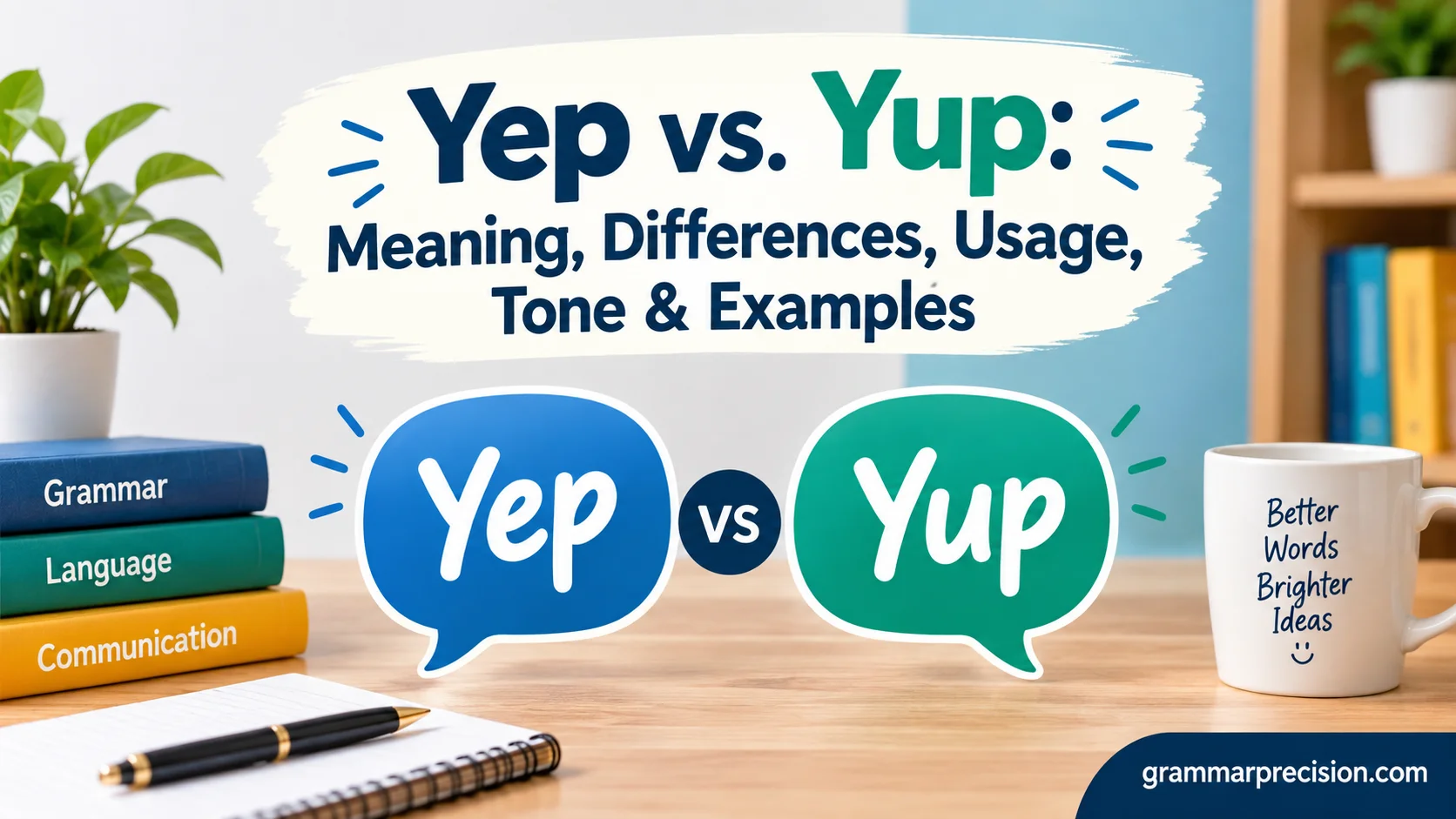
If you’ve ever wondered whether “yep” or “yup” sounds better, you’re not alone. The difference is small, but each word can create a different tone in casual English. This guide explains Yep vs. Yup with simple examples and usage rules.
At first glance, yep and yup seem almost identical. Both are informal ways to say “yes”, and speakers often use them interchangeably in everyday conversations. Still, their tone, context, and level of casualness can vary slightly. Understanding these subtle differences helps you choose the right expression for texts, conversations, workplace chats, and other forms of American English communication more effectively today with confidence and clarity.
The choice between yep and yup usually depends more on style and context than grammar. “Yep” often sounds straightforward and neutral, while “yup” may feel more relaxed, friendly, or conversational. Neither form is automatically rude or incorrect. However, a short reply can sometimes sound cold, depending on the situation. That’s why context matters when interpreting these common affirmative expressions in everyday English online and clearly.
Whether you’re writing a text, answering a question, or choosing words for dialogue, knowing the difference can make your English sound more natural. This guide covers meaning, pronunciation, formality, tone, examples, texting habits, and professional usage. You’ll also see how yep, yup, yeah, and yes compare, so you can select the expression that best matches your audience, purpose, and conversation with confidence every time effectively.
Yep vs. Yup: What’s the Difference?
The simplest answer is that “yep” and “yup” both mean “yes.” They are informal affirmative responses that people use to agree, confirm information, or answer a question positively.
The main difference lies in tone and personal usage, rather than grammar or meaning. “Yep” often sounds a little more neutral, while “yup” may feel more relaxed or folksy. Still, plenty of speakers use the two interchangeably.
| Feature | Yep | Yup |
| Basic meaning | Yes | Yes |
| Part of speech | Informal interjection | Informal interjection |
| Formality | Informal | Informal |
| Common setting | Conversation, texting | Conversation, texting |
| General tone | Casual, direct | Casual, relaxed |
| Professional writing | Usually avoid | Usually avoid |
| Standard formal English | No | No |
Consider this conversation:
“Are you coming to dinner tonight?”
“Yep.”
You could replace that response with “Yup” without changing the basic answer:
“Are you coming to dinner tonight?”
“Yup.”
The information stays the same. The conversational flavor changes slightly.
The Key Difference in One Sentence
“Yep” tends to sound like a casual version of “yes,” while “yup” can sound even more relaxed.
That distinction isn’t universal. A speaker’s age, region, personality, and texting habits can influence how each word feels.
Are “Yep” and “Yup” Synonyms?
Yes. In ordinary conversation, “yep” and “yup” function as near-synonyms because both commonly replace “yes.”
They can confirm facts:
“Did Sarah call you?”
“Yep.”
They can express agreement:
“That movie was surprisingly good.”
“Yup.”
They can confirm plans:
“We’re meeting at six, right?”
“Yep.”
They can also answer simple questions:
“Do you want coffee?”
“Yup.”
However, synonyms don’t always have identical register or emotional associations. Think about “child” and “kid.” Both can refer to a young person, but “kid” sounds more casual.
The same principle applies here. “Yes” is neutral and broadly acceptable. “Yep” and “yup” are casual alternatives.
Yep Meaning: Definition and Examples
“Yep” means “yes” and usually appears in informal spoken or written communication.
It works particularly well when someone wants to give a quick affirmative answer without sounding overly formal. You might hear it between friends, relatives, coworkers, classmates, or acquaintances.
When to Use “Yep”
Use “yep” when you want to:
- Confirm information.
- Agree with someone’s statement.
- Answer a yes-or-no question.
- Confirm an appointment or plan.
- Give a quick response in conversation.
- Sound casual without using slang heavily.
For example:
“Did you send the email?”
“Yep, it’s already gone.”
Or:
“Is this your jacket?”
“Yep, that’s mine.”
“Yep” can also appear inside a longer sentence:
“Yep, I’ll be there around eight.”
This construction often sounds natural because the speaker gives immediate confirmation before adding more information.
Is “Yep” a Proper Word?
Yes, “yep” is an established informal English word. Major English dictionaries record it as an informal form of “yes.”
That doesn’t mean it’s suitable everywhere. A word can be legitimate English while still belonging to an informal register.
For example, “yep” fits a text to a friend. In a highly formal letter, “yes” would normally be the better choice.
Yup Meaning: Definition and Examples
“Yup” also means “yes.” Like “yep,” it functions as an informal affirmative response.
Many people use “yup” in relaxed conversations and text messages. Depending on the speaker, it can sound friendly, laid-back, playful, or extremely casual.
For example:
“Did you remember to lock the door?”
“Yup.”
Or:
“Are we still watching the game tonight?”
“Yup, definitely.”
The word can also stand alone:
“Yup.”
That short answer confirms something without adding extra information.
When to Use “Yup”
You can use “yup” when you want to:
- Give a casual affirmative answer.
- Confirm something quickly.
- Sound relaxed and conversational.
- Respond naturally in texting.
- Agree with a friend or family member.
- Keep a conversation informal.
However, “yup” isn’t automatically friendlier than “yep.” A one-word answer can sometimes feel blunt or dismissive, especially when the surrounding conversation is tense.
Yep vs. Yup: Formality and Register
Neither “yep” nor “yup” belongs to formal standard writing. Both are best understood as informal forms of affirmation.
That distinction matters because English changes according to context. The same person might naturally use “yup” with a sibling, “yep” with a coworker, and “yes” in a formal letter.
Formal English
In formal situations, choose:
- Yes
- Certainly
- Absolutely
- That is correct
- I agree
For example:
Formal: “Yes, I received the documents.”
Instead of:
Informal: “Yep, I got them.”
The second sentence isn’t grammatically wrong. It simply creates a more relaxed impression.
Informal English
Both words work naturally in informal situations:
“You coming with us?”
“Yep.”
“Did you get my message?”
“Yup.”
The choice often comes down to personal style.
Yep vs. Yup: Pronunciation
The two words have different vowel sounds.
Yep generally rhymes with words such as “step,” “kept,” and “rep.” Its vowel is the short /ɛ/ sound.
Yup uses the short /ʌ/ sound found in words such as “cup,” “luck,” and “sun.”
So they sound noticeably different:
- Yep: /jɛp/
- Yup: /jʌp/
This pronunciation difference explains their different spellings. Neither pronunciation changes the basic meaning.
Interestingly, both forms imitate the quick, clipped sound of conversational agreement. English often creates informal words by reshaping familiar expressions into shorter, speech-like forms.
Yep vs. Yup: Examples in Everyday English
Context gives these tiny words their real personality.
Confirming Information
“The meeting starts at nine, right?”
“Yep.”
“This is the correct address?”
“Yup.”
Both responses confirm the information.
Agreeing With Someone
“That restaurant has amazing burgers.”
“Yep, especially the fries.”
“This is going to take longer than expected.”
“Yup.”
Here, “yep” can lead naturally into additional information, while “yup” can emphasize a simple agreement.
Confirming Plans
“Are you still coming tonight?”
“Yep, I’ll be there.”
“We’re meeting outside the theater, right?”
“Yup.”
Answering a Simple Question
“Do you like chocolate?”
“Yep.”
“Have you finished the assignment?”
“Yup.”
The differences are subtle because the words perform the same grammatical function.
Yep vs. Yup: Tone and Emotional Meaning
Here’s where things get more interesting.
Although dictionary definitions focus on meaning, real conversations depend heavily on tone. A single word can communicate more than its literal definition.
Compare:
“Yep.”
with:
“Yep!”
The first might sound neutral. The second usually feels more enthusiastic.
Now compare:
“Yup.”
with:
“Yup 😂”
The second clearly carries a playful tone.
“Yep.”
This can mean:
- Yes.
- Correct.
- I agree.
- I heard you.
- That’s right.
Depending on context, it can also sound short or slightly dismissive.
“Yep!”
The exclamation mark adds energy. It may communicate enthusiasm, friendliness, or excitement.
“Did you get the job?”
“Yep!”
That’s much warmer than a flat “Yep.”
“Yup.”
This can feel relaxed and understated.
“You knew this would happen, didn’t you?”
“Yup.”
The response might even carry a hint of humor.
“Yup!”
The exclamation mark can make the response more energetic:
“Ready for the road trip?”
“Yup!”
The punctuation does some of the emotional work.
What Does a One-Word “Yep” or “Yup” Really Mean?
A short affirmative response doesn’t always mean exactly the same thing.
Imagine someone asks:
“Did you break the printer?”
A reply of:
“Yep.”
might simply confirm responsibility.
Now imagine someone asks:
“Are you seriously going to eat another slice?”
“Yup.”
The same basic word can sound humorous, stubborn, or defiant.
Also Read This: Brief vs. Debrief: Meaning, Grammar, Differences & Examples
A one-word response may communicate:
- Agreement
- Confirmation
- Acceptance
- Recognition
- Reluctance
- Humor
- Sarcasm
- Conversation closure
Context acts like the seasoning. The word stays simple, but the surrounding situation changes its flavor.
Is “Yep” Rude?
“Yep” isn’t inherently rude. However, its brevity can sometimes make it sound cold.
Suppose a friend sends:
“I worked really hard on this presentation. What do you think?”
Also Read This:Please paste the full content paragraphs along with the H3 headings from which you want the extraction.
Once you provide the content, I will:
- Extract Entities
- Extract Semantically related words
- Extract Contextually related words
- Extract NLP-related terms
- Extract Numbers and numerical references
- Keep the same H3 headings only (no extra headings)
- Write the extracted terms in comma-separated lines
- Shuffle terms where appropriate
- Not miss any relevant word or phrase
- Remove explanatory text and provide keywords only
- Include the total number of extracted words/terms at the end
Send the content, and I’ll process it exactly in that format.
Replying only:
“Yep.”
wouldn’t answer the actual question. It could sound dismissive.
But consider:
“Are you free at seven?”
“Yep.”
That sounds perfectly normal.
The difference isn’t the word itself. The problem is whether the response gives the conversation enough attention.
How to Make “Yep” Warmer
Instead of:
“Yep.”
Try:
“Yep, sounds good!”
Or:
“Yep! I’d love to.”
A few extra words can completely change the impression.
Is “Yup” Rude?
Like “yep,” “yup” isn’t inherently rude. Still, its very casual quality can make it inappropriate in certain situations.
For example, texting a close friend:
“Want pizza?”
“Yup!”
sounds perfectly natural.
But responding to a serious workplace request with:
“Yup.”
might appear careless, depending on the workplace culture.
If you’re unsure, “yes” is the safer choice. It communicates agreement without adding a strongly casual flavor.
Yep vs. Yup in Texting
Texting has made short affirmative responses extremely common. In digital conversations, people often choose “yep,” “yup,” “yeah,” “sure,” or “yes” based on the tone they want.
| Text | Possible impression |
| Yes. | Neutral, direct |
| Yep. | Casual, straightforward |
| Yup. | Relaxed, informal |
| Yeah. | Conversational |
| Yep! | Friendly or enthusiastic |
| Yup! | Relaxed and energetic |
| Yep 😂 | Playful |
| Yup… | Potentially reluctant or knowing |
Punctuation matters more in texting because the reader can’t hear your voice.
A speaker might say “yep” warmly with a smile. On a screen, the reader sees only “Yep.” That’s why digital communication often needs extra context.
Yep vs. Yup in Professional Communication
Professional communication requires more judgment.
Neither word is grammatically incorrect in workplace chat. However, formality depends on the company, relationship, medium, and subject.
A quick Slack or Teams exchange with a close colleague might look like this:
“Can you review the spreadsheet?”
“Yep, I’ll check it now.”
That’s fairly casual but can be completely acceptable.
A formal client email would usually sound better as:
“Yes, I’ll review the spreadsheet and send my feedback this afternoon.”
The key isn’t that “yep” is forbidden. Rather, “yes” gives you greater professional flexibility.
A Simple Workplace Rule
Use “yes” when:
- You’re writing to a client.
- You’re responding to a formal request.
- You’re discussing a serious matter.
- You’re writing an official document.
- You don’t know the recipient well.
Use “yep” when:
- The workplace culture is casual.
- You’re chatting with a familiar colleague.
- The message is informal.
- A quick confirmation fits the conversation.
Use “yup” mainly when the environment already feels very relaxed.
Yep vs. Yup vs. Yeah vs. Yes
These four words can all communicate agreement, but their register differs.
| Word | Formality | Typical feeling | Example |
| Yes | Neutral/formal | Clear and respectful | “Yes, that’s correct.” |
| Yeah | Informal | Natural and conversational | “Yeah, I agree.” |
| Yep | Informal | Quick and straightforward | “Yep, that’s right.” |
| Yup | Informal | Relaxed and casual | “Yup, exactly.” |
There isn’t a perfect hierarchy because context matters. Still, “yes” generally offers the broadest range of appropriate situations.
“Yeah” often works naturally in spoken conversation. “Yep” and “yup” feel more clipped and can work especially well as quick confirmations.
Can “Yep” and “Yup” Be Used Interchangeably?
Usually, yes.
If someone asks:
“Are you ready?”
you can answer:
“Yep.”
or:
“Yup.”
The factual meaning remains the same.
However, they aren’t always interchangeable from a style perspective. If you’re writing dialogue, character voice matters. A character who constantly says “yup” may sound different from one who always says “yep.”
Writers can use these tiny distinctions deliberately.
For example:
“Yep. Let’s go.”
sounds somewhat straightforward.
“Yup. Let’s go.”
can feel more laid-back.
Neither interpretation is fixed. Voice and context determine the final impression.
Common Mistakes With Yep and Yup
Even native speakers can create awkward communication with informal words.
Using Them in Formal Writing
Avoid using “yep” or “yup” in academic essays, formal reports, or highly professional correspondence unless you’re intentionally quoting dialogue.
Assuming a Short Reply Is Always Friendly
A one-word response can feel abrupt.
“Yup.”
may be perfectly friendly between close friends. The same response during a tense conversation may sound dismissive.
Overanalyzing the Spelling
Don’t assume “yep” always means one emotion and “yup” always means another.
English speakers don’t follow a strict emotional dictionary for these words. Personal preference plays a major role.
Forgetting the Audience
Before choosing an informal response, ask yourself who will read it.
A friend doesn’t need the same level of formality as a customer, professor, hiring manager, or client.
Case Study: How Context Changes “Yep”
Consider three situations.
Situation A: Friends
“Movie tonight?”
“Yep!”
The response sounds friendly and enthusiastic.
Situation B: Workplace chat
“Can you send the file before lunch?”
“Yep, I’ll send it shortly.”
The response sounds casual but cooperative.
Situation C: Formal email
“Please confirm whether you received the contract.”
Here, “Yes, I received the contract” sounds more appropriate.
The word didn’t become grammatically wrong. The context changed.
That’s an important lesson for informal English: correctness and appropriateness aren’t always the same thing.
When Should You Use “Yep,” “Yup,” or “Yes”?
If you’re stuck between the three, use this quick decision guide:
- Choose “yes” for formal, professional, or sensitive situations.
- Choose “yep” for ordinary casual conversation.
- Choose “yup” for especially relaxed conversation or texting.
- Add more words when a one-word response might sound cold.
- Use punctuation carefully because it can affect perceived tone.
When in doubt, “yes” is the safest option.
Yep vs. Yup: Quick Comparison
| Question | Answer |
| Do “yep” and “yup” mean the same thing? | Usually, yes. |
| Are they formal? | No. Both are informal. |
| Is “yep” a word? | Yes. Dictionaries recognize it as informal. |
| Is “yup” a word? | Yes. It is an informal form of “yes.” |
| Which sounds more neutral? | “Yep” often sounds slightly more neutral. |
| Which sounds more relaxed? | “Yup” often sounds more relaxed. |
| Are they suitable for formal essays? | Generally, no. |
| Can they be used in texting? | Yes. Both are common in casual texting. |
| Are they always interchangeable? | Usually in meaning, but tone can differ. |
| Is either one automatically rude? | No. Context determines the tone. |
FAQs:
Is “yep” or “yup” more correct?
Both “yep” and “yup” are correct informal English expressions meaning “yes.” Neither is more grammatically correct than the other. Your choice mainly depends on personal preference, context, and the tone you want to create.
Is “yup” more informal than “yep”?
Generally, “yup” can sound slightly more casual and relaxed than “yep.” However, the difference isn’t strict. Many American English speakers use both forms interchangeably in everyday conversations, texting, and informal messages.
Can “yep” and “yup” be used interchangeably?
Yes. In most casual situations, yep and yup are interchangeable because they communicate the same basic meaning. The slight difference usually comes from tone rather than definition. Consider your audience and the overall conversation before choosing one.
Is “yep” rude in a text?
“Yep” isn’t automatically rude, but a one-word response can sometimes feel short or dismissive. Context makes the difference. For a warmer response, you can write “Yep, absolutely!” or “Yep, that sounds good!” instead of using the word alone.
Can you use “yep” or “yup” in professional writing?
You can use them in casual workplace conversations, especially when communicating with familiar coworkers. However, “yes” is usually better for formal emails, reports, academic writing, and professional documents because it sounds more neutral and polished.
Conclusion:
Understanding Yep vs. Yup is mostly about tone, context, and formality rather than meaning.
Both expressions provide a casual way to say “yes,” while “yep” often sounds slightly more straightforward and “yup” more relaxed. For everyday conversations and texting, either works well. When professionalism matters, choose “yes” for a clearer and more appropriate response.