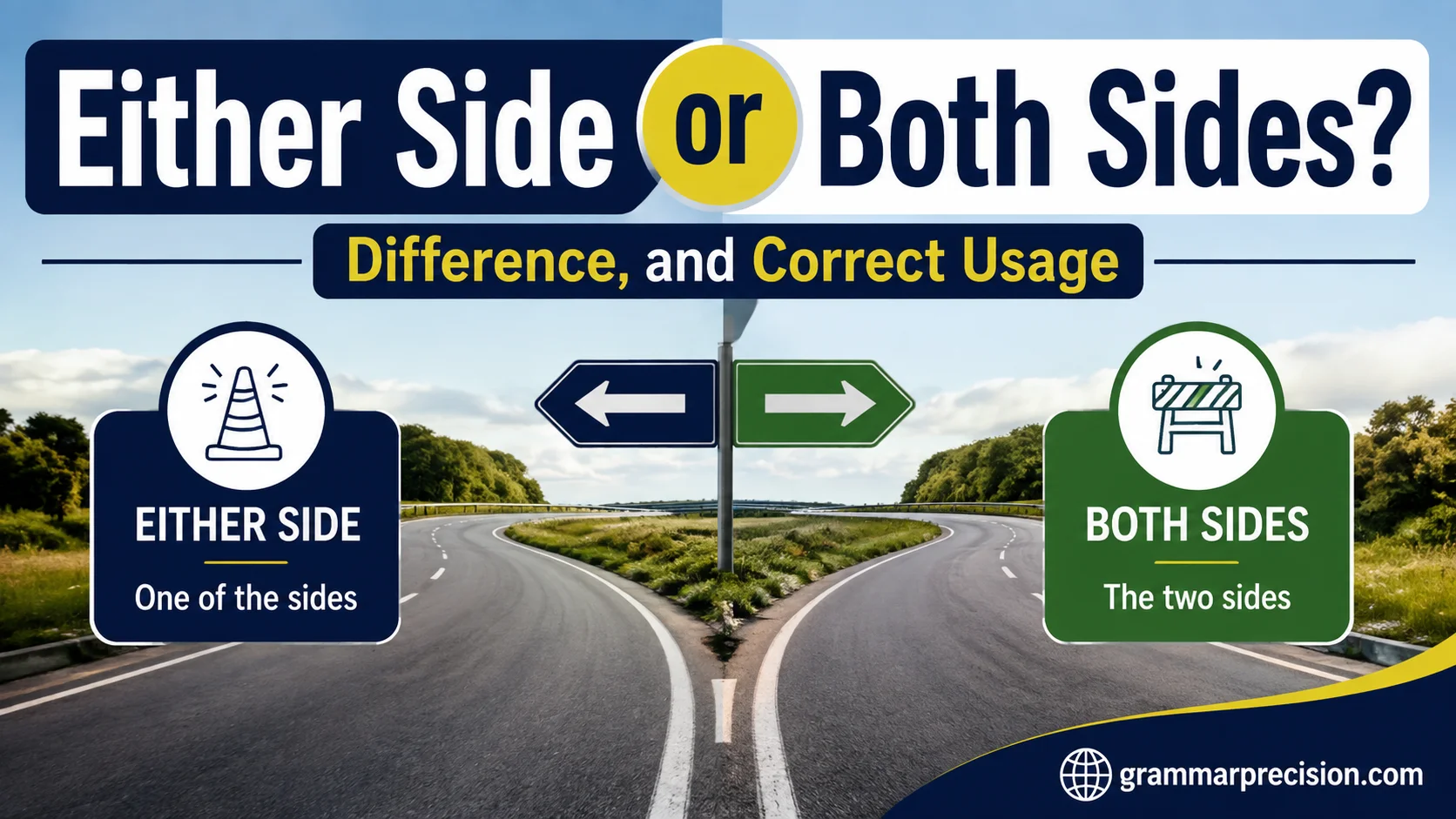
Either Side or Both Sides can seem confusing because both phrases describe two sides, but they have different meanings. Knowing when to use each phrase helps you write clear, natural, and grammatically correct English.
Use either side when you mean one of two sides, without choosing a specific side. In contrast, both sides means the two sides together. This simple difference is important in everyday English, formal writing, and clear communication.
Understanding either side vs both sides becomes easier when you focus on the intended meaning. Either refers to one option from two, while both includes the two options. Learning this distinction can improve your grammar, vocabulary, sentence accuracy, and writing skills.
Either Side or Both Sides: Quick Answer
Use either side when you mean one of two sides or when context allows either to mean each of two sides.
Use both sides when you clearly mean the two sides together.
Consider these examples:
- You can sit on either side of the table.
You can choose one side or the other. - People were standing on both sides of the table.
People occupied the two sides. - There are trees on either side of the road.
Trees appear on each of the two sides. - There are shops on both sides of the road.
Shops appear on the two sides collectively.
The first pair highlights choice versus inclusion. The second pair shows something more subtle: either side can sometimes describe both sides when the sentence talks about corresponding positions.
That second use is perfectly established English. Cambridge gives examples where either means “both” in expressions such as “on either side,” and Merriam-Webster likewise defines either as referring to “the one and the other of two” in certain constructions.
What Is the Meaning of “Either Side”?
At its most basic level, either side means one side or the other of two sides.
The word either commonly introduces a choice between two possibilities. For example:
You can park on either side of the street.
Here, the speaker gives you two possibilities. You don’t need to use both sides. You can choose the left side or the right side.
The same pattern appears in many ordinary situations:
- You can sit on either side of me.
- Put the chair on either side of the desk.
- The entrance has doors on either side.
- You can approach the building from either side.
- Take either side of the argument if you can defend it.
The exact interpretation depends on context. When either expresses a choice, it points toward one of two alternatives. Cambridge describes this as one of the central functions of either, especially when it appears before a singular countable noun.
Either Side Can Also Mean Each of Two Sides
Here’s where the plot thickens.
In some expressions, either side doesn’t suggest that only one side exists. Instead, it refers to each of the two sides.
For example:
There are trees on either side of the road.
This sentence normally means trees stand on the left and right sides of the road.
You aren’t being asked to choose one side. The sentence describes the arrangement of the trees.
This meaning explains why either side and both sides can sometimes appear interchangeable:
Shops stood on either side of the street.
Shops stood on both sides of the street.
Both can describe shops on the two sides. However, both sides makes the two-sided coverage more explicit, while either side can sound more natural when describing matching positions around something.
That distinction is important when precision matters.
What Is the Meaning of “Both Sides”?
Both sides means the two sides together.
Unlike either, both doesn’t normally present a choice. It includes the two items being discussed.
For example:
Both sides of the road were crowded.
The sentence tells you that the crowd appeared on the two sides. Neither side gets left out.
The same principle works with abstract ideas:
We need to hear both sides of the story.
Here, sides doesn’t refer to physical locations. It refers to two perspectives. The speaker wants information from each position before reaching a conclusion.
You can use both sides for:
- Physical locations
- Opposing arguments
- Two people or groups
- Two opinions
- Two perspectives
- Two surfaces
- Two positions in a disagreement
The word both specifically refers to two people or things together, which is why it works naturally in phrases such as “both sides of the argument.”
Either vs. Both: The Grammar Behind the Difference
The easiest way to understand this topic is to stop thinking about side for a moment.
Look at the core words:
Either = one or the other of two, or each of two in certain contexts.
Both = the two together.
That distinction carries through the sentence.
| Word | Main idea | Typical meaning |
| Either | Alternative or corresponding pair | One or the other; sometimes each of two |
| Both | Inclusion | The two together |
| Each | Individual treatment | One at a time within a group |
When either functions as a determiner before a singular countable noun, standard grammar normally uses the singular form:
- either side
- either option
- either road
- either answer
- either choice
You wouldn’t normally write either sides when either directly determines the noun. Cambridge specifically notes that the noun following this use of either is singular and countable.
However, either of works differently:
- Either of the sides is acceptable.
- Either of the options will work.
- Either of the answers could be correct.
The structure is therefore worth remembering:
either + singular noun
either of + plural noun/pronoun
That small grammatical pattern prevents many common errors.
Either Side vs. Both Sides Examples
Examples make the difference much easier to see.
| Sentence | Meaning |
| You can sit on either side. | Choose one of two sides. |
| People sat on both sides. | People occupied the two sides. |
| Take either side of the debate. | Choose one position. |
| We should consider both sides of the debate. | Consider the two positions. |
| There are trees on either side of the road. | Trees appear on each side. |
| There are trees on both sides of the road. | Trees appear on the two sides. |
| You may enter from either side. | Either entrance is possible. |
| The building has doors on both sides. | Doors exist on the two sides. |
Notice how the first and third examples involve choice. The second and fourth involve inclusion.
That’s the quickest semantic test.
Ask yourself:
Am I choosing one, or am I including two?
If you’re choosing one, either is often the better fit.
If you’re including the two, both usually wins.
“Either Side of” vs. “Both Sides of”
The phrase either side of deserves special attention because it causes much of the confusion.
Consider:
A narrow path runs between trees on either side of the river.
Here, either side describes the two corresponding sides of the river. It doesn’t mean that the trees exist on only one side.
Now compare:
A narrow path runs between trees on both sides of the river.
This version makes the same general spatial idea very explicit. Both emphasizes that the two sides are included.
The difference becomes sharper when the sentence expresses a choice:
You can walk along either side of the river.
This means you can choose one side or the other.
You can’t automatically replace either with both:
You can walk along both sides of the river.
Now the sentence says you can walk along the two sides, which changes the intended action.
That’s why context matters more than simply memorizing “either means one” and “both means two.”
Also Read This: Copy On vs Copy In: Meaning, Grammar, and Correct Usage
Either Side vs. Both Sides in Physical Locations
Physical descriptions provide some of the clearest examples.
Imagine you’re standing between two rows of trees.
Trees grow on either side of the path.
This sounds natural because the two sides correspond to one another. The phrase paints a balanced picture: trees here, trees there.
You could also say:
Trees grow on both sides of the path.
This version emphasizes complete coverage of the two sides.
Now imagine a person giving directions:
You can enter from either side.
That’s a choice. The person can use the left entrance or the right entrance.
But:
There are entrances on both sides.
That’s a description. It tells you that entrances exist on the two sides.
A Simple Physical-Space Test
When describing a location, ask:
Does the sentence offer two possible locations?
Use either.
Does the sentence report something existing in the two locations?
Use both.
For example:
- Sit on either side of the table. → choice
- Guests sat on both sides of the table. → inclusion
- You can approach from either side. → alternative
- Guards stood on both sides. → two groups or positions
The distinction may look tiny on paper. In practice, it controls the entire meaning of the sentence.
Either Side vs. Both Sides in Arguments and Debates
The physical meaning isn’t the only one that matters. English also uses side to describe opinions, arguments, disputes, and competing groups.
That’s where choosing the right phrase becomes especially important.
Consider:
People on either side of the debate criticized the proposal.
Here, either side can identify people associated with one or the other of two opposing positions. Depending on context, it may refer collectively to people on the two opposing sides.
Now compare:
We listened to both sides of the debate.
This clearly means the speaker considered the two opposing positions.
The second sentence is especially useful when neutrality or completeness matters.
For example:
Before making a decision, the manager listened to both sides of the dispute.
Replacing both with either could make the sentence less direct because the point is that the manager listened to the two positions, not merely one.
This is one reason both sides is common in discussions about arguments, conflicts, negotiations, and disagreements. It explicitly signals that the speaker has considered the competing perspectives.
Either Side vs. Each Side: Are They the Same?
Either side and each side overlap in some contexts, but they aren’t identical.
Either often focuses on alternatives or two corresponding possibilities.
Each focuses on the members of a pair individually.
Compare:
You can stand on either side of the door.
This gives you a choice.
Now:
Each side of the door has a handle.
This describes the two sides individually.
Here’s another contrast:
Either side can win.
This means one side or the other can win.
Each side submitted a proposal.
This means the two sides submitted proposals individually.
Meanwhile:
Both sides submitted proposals.
This treats the two sides collectively.
The Three-Way Comparison
| Expression | Main focus | Example |
| Either side | One of two alternatives | Choose either side. |
| Each side | Each member separately | Each side received a copy. |
| Both sides | The two together | Both sides agreed. |
Think of them as three different camera angles.
Either points toward a choice.
Each zooms in separately.
Both pulls the two together.
That mental picture makes the difference surprisingly easy to remember.
Common Mistakes to Avoid
Several mistakes appear repeatedly when writers confuse either side with both sides.
Mistake: Using “either” when you clearly mean both
Incorrect for the intended meaning:
The teacher explained both sides of the issue.
If the intended meaning is that the teacher explained one side or the other, then either could work:
The teacher explained either side of the issue.
However, if the teacher explained the two positions, both sides is the clearer choice.
Mistake: Writing “either sides”
Avoid:
The road has trees on either sides.
Use:
The road has trees on either side.
Or:
The road has trees on both sides.
When either directly modifies side, the noun stays singular.
Mistake: Assuming “either” always means only one
That’s too simple.
In “Choose either side,” either means one of two.
In “There are houses on either side of the road,” it can refer to each of the two sides.
Both uses are legitimate English. Cambridge and Merriam-Webster both recognize this broader use.
Mistake: Treating “both” as a synonym for “either”
They overlap only in particular constructions.
You can say:
There were people on either side of me.
You can also say:
There were people on both sides of me.
But:
You can choose both sides.
doesn’t mean the same thing as:
You can choose either side.
The first involves two selections. The second gives an alternative.
How Native Speakers Choose Between Them
Native usage often comes down to context and intention, not a rigid substitution rule.
A useful three-question method can help.
The Choice Test
Ask:
Can the person choose one of two sides?
If yes, either side is usually appropriate.
Example:
You can sit on either side of me.
The Inclusion Test
Ask:
Am I talking about the two sides together?
If yes, choose both sides.
Example:
Both sides of the street were decorated.
The Corresponding-Sides Test
Ask:
Am I describing something located on each of two matching sides?
If yes, either side can naturally work.
Example:
Tall trees stood on either side of the entrance.
You could also use:
Tall trees stood on both sides of the entrance.
The second version is more explicit. The first often sounds smoother when describing a symmetrical arrangement.
Case Study: One Sentence, Two Different Meanings
Imagine a theater with seats on two sides of an aisle.
A staff member says:
You can sit on either side of the aisle.
The listener understands choice. One side is enough.
Now imagine someone describing the theater:
There are seats on both sides of the aisle.
The listener understands location. Seats occupy the two sides.
Change one word and the grammatical structure remains simple. Yet the communicative purpose changes.
This illustrates an important writing principle: grammar doesn’t operate separately from meaning. Words gain their precise force from the situation around them.
Quick Facts About Either and Both
- Either can function as a determiner, pronoun, conjunction, or adverb.
- When either directly precedes a countable noun in its choice-related determiner use, that noun is normally singular.
- Both refers to two people or things together.
- Either of can precede plural nouns or pronouns, as in “either of the options.”
- Either can also appear in the construction either … or, which presents alternatives.
- In certain spatial expressions, either can mean each of two, as in “on either side.”
These facts explain why the simple rule “either equals one and both equals two” doesn’t cover every real English sentence.
Quick Quiz: Can You Choose the Right Phrase?
Choose either side, both sides, or each side.
You can park on ______ of the street.
Answer: either side. You’re choosing one of two locations.
The police blocked ______ sides of the road.
Answer: both sides. The statement includes the two sides.
There are flowers on ______ side of the entrance.
Answer: either side or both sides, depending on the intended emphasis. Both can describe flowers on the two corresponding sides.
We need to understand ______ sides of the disagreement.
Answer: both sides. The goal is to consider the two perspectives.
______ side submitted its own report.
Answer: each side. The sentence emphasizes the sides individually.
A Simple Memory Trick
Here’s the shortcut worth keeping:
Either gives you a choice. Both gives you the pair. Each examines them one by one.
If you can replace the phrase with “one or the other,” either probably fits.
If you can replace it with “the two together,” both probably fits.
If you mean “one at a time,” each may be the better choice.
Try the trick with these sentences:
You can use either door.
One door or the other.
Both doors are open.
The two doors together.
Each door has a security camera.
The doors considered separately.
Once you see the pattern, the choice becomes much less mysterious.
FAQs:
What does “either side” mean?
Either side means one of two sides, but it doesn’t specify which one. It’s often used when either option is possible or acceptable. For example, “You can sit on either side of the table” means you can choose one side or the other.
What does “both sides” mean?
Both sides means the two sides together. It clearly refers to both options, groups, or positions rather than just one. For example, “The discussion considered both sides of the argument” means the discussion included each opposing viewpoint.
Is “either side” singular or plural?
Either side is grammatically singular because “either” refers to one of two choices at a time. For example, “There is a chair on either side of the door” refers to a chair on each individual side, but the phrase treats each side separately.
Can I use “either side” and “both sides” interchangeably?
No, they aren’t always interchangeable. Either side usually means one of two sides, while both sides means the two sides together. Choosing the correct phrase depends on whether you want to discuss one option or include both options.
Which is correct: “on either side” or “on both sides”?
Both phrases are grammatically correct, but they express different meanings. “On either side” can mean on one side or the other, while “on both sides” means on the two sides. Always choose the phrase that matches your intended meaning.
Conclusion:
Understanding either side vs both sides is simple once you focus on the meaning of either and both. Use either side when referring to one of two sides, and use both sides when referring to the two sides together.
Choosing the right phrase makes your English clearer and more precise. With regular practice, you can easily use both expressions in everyday and formal writing.