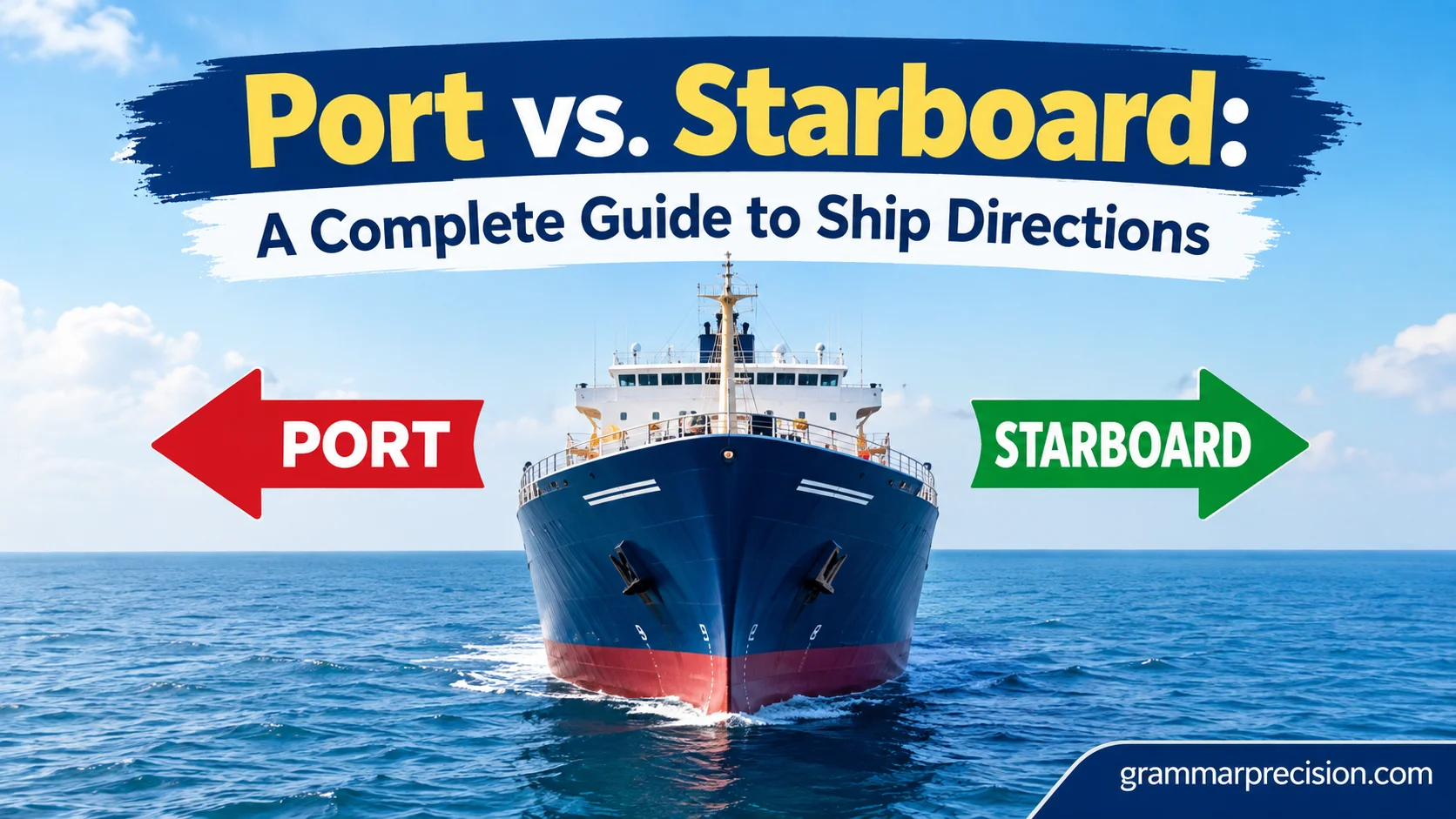
Understanding Port vs. Starboard can feel confusing at first, especially if you rarely travel by boat. These two nautical terms simply describe the left and right sides of a vessel. Once you learn their meanings, colors, and practical uses, you’ll quickly understand ship directions and avoid common navigation mistakes.
The biggest difference is surprisingly simple: port means left, while starboard means right when you face the bow of a vessel. These fixed maritime directions don’t change when a ship turns. Learning this basic rule helps passengers, sailors, and beginners understand nautical language, navigation terms, and common instructions used aboard boats and ships.
However, knowing the definitions isn’t always enough. You also need to understand port and starboard lights, vessel orientation, and the difference between bow and stern. Red represents the port side, while green identifies the starboard side in standard navigation lighting. These visual signals help mariners recognize another vessel’s position, especially during nighttime navigation and reduced visibility.
Fortunately, remembering these terms doesn’t require complicated sailing knowledge. Simple memory tricks, practical examples, and clear comparisons can make the difference stick. This guide explains port vs. starboard in plain English, explores their history and maritime meaning, and shows how sailors and passengers use these terms in real-world marine navigation and ship communication.
Port vs. Starboard in 30 Seconds
Here’s the essential answer:
- Port = left side of a vessel
- Starboard = right side of a vessel
- Port navigation light = red
- Starboard navigation light = green
The important detail is perspective. These directions describe the vessel itself, not the position of an observer standing on a dock or looking at a ship from the shore.
Imagine standing aboard a ship and facing the bow, which is the front. Your left side is port. Your right side is starboard.
That relationship remains fixed. If the vessel turns, port doesn’t suddenly become starboard. The ship simply changes its heading.
The Quick Memory Trick
A popular trick is “Port has four letters, just like left.” It isn’t a perfect linguistic connection, but it gives you a fast mental cue.
Another helpful pairing is:
Red means port; green means starboard.
Think of these as two permanent labels attached to the vessel. Once you connect the words with their sides and colors, the distinction becomes much harder to forget.
What Is the Port Side?
The port side is the left side of a vessel when you face forward toward the bow. This definition applies to ships, boats, and other watercraft that use standard nautical terminology.
For example, suppose you’re standing on a ferry and looking toward the front. The railing on your left is the port side railing. A cabin located on that side can be described as a port-side cabin.
Port can also appear in practical instructions:
- “Move to the port side.”
- “The vessel turned to port.”
- “The lifeboat is on the port side.”
- “The port navigation light is red.”
The word describes a fixed side of the vessel. It doesn’t depend on whether the vessel faces north, south, east, or west.
Why Port Means Left
The modern word port replaced an older nautical term, larboard, which referred to the left side of a vessel. “Larboard” could sound too similar to “starboard” when shouted across a noisy deck, particularly in difficult conditions.
Using “port” reduced that confusion. The two words now sound distinctly different, which helps crews communicate more reliably.
What Is the Starboard Side?
The starboard side is the right side of a vessel when you face forward toward the bow.
So, if you’re looking toward the front of a boat, the side on your right is starboard. A captain might say, “Turn to starboard,” meaning steer the vessel toward its right-hand side.
You’ll see the term used in many maritime situations:
- Starboard side
- Starboard bow
- Starboard quarter
- Starboard light
- Turn to starboard
- Starboard watch
Like port, starboard stays tied to the vessel. It doesn’t switch when the vessel changes course.
Where Did “Starboard” Come From?
The word has an interesting connection to early steering practices. In older vessels, a steering oar was commonly positioned on the right side. The term developed from Old English elements associated with the steering side of a vessel.
Because the steering oar occupied that side, the opposite side was associated with the loading area. Over time, maritime language evolved, and starboard became the standard term for the right side.
Port vs. Starboard: What’s the Difference?
The easiest way to compare them is to focus on left versus right from the vessel’s perspective.
| Feature | Port | Starboard |
| Side of vessel | Left | Right |
| Perspective | Facing the bow | Facing the bow |
| Navigation light | Red | Green |
| Opposite side | Starboard | Port |
| Common phrase | Turn to port | Turn to starboard |
| Memory cue | Four letters, like “left” | Green light |
One important point often causes confusion: port and starboard are not directions such as east and west. They are relative to the vessel.
If a boat points west, its port side faces south and its starboard side faces north. If it turns east, those relationships reverse geographically, but the vessel’s port side remains its left side when facing forward.
Why Ships Use Port and Starboard Instead of Left and Right
At first glance, using “left” and “right” seems easier. On a moving vessel, however, those words can create unnecessary ambiguity.
Imagine two crew members facing each other during an emergency. If one person says “move to the left,” the listener might interpret left from their own perspective. That confusion can waste precious seconds.
Port and starboard remove that perspective problem. They refer to fixed sides of the vessel.
This consistency helps with:
- Navigation instructions
- Emergency procedures
- Crew coordination
- Docking operations
- Passenger directions
- Collision avoidance
- Safety announcements
- Identifying equipment locations
The same principle explains why aviation and other specialized transportation contexts can use fixed directional terminology. Standardized language helps people communicate even when their physical orientation differs.
Port vs. Starboard Colors: Red and Green
The navigation lights provide one of the most helpful visual clues for distinguishing the two sides.
Port is red. Starboard is green.
These colors form part of the standardized navigation-light system used to help vessels determine another vessel’s orientation and movement at night or in reduced visibility.
The basic side-light arrangement is:
| Vessel side | Light color |
| Port | Red |
| Starboard | Green |
When you see a vessel from another boat, these lights can reveal which side of that vessel is facing you.
Why the Colors Matter at Night
Picture yourself on a dark ocean. You can’t clearly see the hull, bow, or stern of another vessel. Instead, you spot a small red or green light.
That color gives you information about the vessel’s orientation. Mariners can combine the visible lights with the vessel’s movement and other navigation information to assess the situation.
For example, seeing a red light on another vessel indicates its port side is visible to you. Seeing a green light indicates its starboard side is visible.
Seeing both side lights can indicate that you’re viewing the vessel from ahead, depending on the circumstances and other required lights.
Navigation lights aren’t decorative. They’re part of a carefully standardized safety system.
How Port and Starboard Work With Ship Directions
To understand nautical directions fully, learn four basic terms together:
| Term | Meaning |
| Bow | Front of the vessel |
| Stern | Back of the vessel |
| Port | Left side when facing the bow |
| Starboard | Right side when facing the bow |
You’ll also encounter forward and aft. Forward means toward the bow, while aft means toward the stern.
Another useful word is abeam, which generally describes a position roughly perpendicular to the vessel’s centerline.
A Simple Ship Map
Imagine the vessel like this:
BOW
↑
|
PORT ← 🚢 → STARBOARD
LEFT RIGHT
|
↓
STERN
The diagram gives you the core relationship. Face the bow, and port is on your left. Starboard is on your right.
This mental picture is more useful than memorizing isolated definitions.
Also Read This: Yep vs. Yup: Meaning, Differences, Usage, Tone & Examples
Does Port Always Mean Left?
Yes, port means the vessel’s left side when you face forward.
However, people sometimes get confused when they turn around physically. If you stand facing the stern, the port side will appear on your right. That doesn’t mean port has changed.
Your position changed. The vessel’s orientation didn’t.
This distinction is crucial.
Imagine walking through a hallway. If you turn around, the wall that was on your left appears on your right. The wall didn’t move. Your perspective did.
The same idea applies aboard a ship. Port and starboard describe the vessel’s orientation rather than your temporary viewpoint.
Port vs. Starboard When a Vessel Turns
A common misconception is that turning changes the port and starboard sides. It doesn’t.
Suppose a boat initially heads north. Its port side faces west, while its starboard side faces east.
Now the boat turns east.
Its port side faces north, while its starboard side faces south. The geographic directions changed, but the labels did not.
This is the key concept:
Port and starboard rotate with the vessel.
They are not compass directions.
Why This Matters
If a captain says, “There’s another vessel off the starboard bow,” the crew doesn’t need to ask which side the captain means. They know the reference immediately.
That precision becomes especially valuable when visibility is poor or when several crew members are moving at once.
Port vs. Starboard in Maritime Navigation
The distinction has practical safety value.
Mariners use standardized terminology when discussing course changes, relative positions, navigation lights, and encounters with other vessels. Clear communication supports safe decision-making.
In collision-avoidance situations, vessels follow established navigation rules rather than relying on casual guesses about who should move first. The exact action depends on the type of encounter, vessel status, and applicable rules.
For that reason, knowing port and starboard is more than a vocabulary exercise. It helps you understand the language used in real maritime safety procedures.
Reading Another Vessel’s Lights
At night, the colors can provide an immediate clue:
- Red visible: you’re seeing the vessel’s port side.
- Green visible: you’re seeing the vessel’s starboard side.
- Both side colors visible: you may be looking toward the vessel’s forward aspect.
- White lights: additional information is required to identify their meaning correctly.
Never interpret a single light in isolation when making navigation decisions. Mariners consider the complete lighting arrangement, vessel movement, distance, and circumstances.
Port vs. Starboard on Cruise Ships
Cruise passengers hear these terms frequently. A crew member might announce that a particular attraction is visible from the port side, or an emergency announcement might direct passengers toward a specific area.
For passengers, the distinction is mainly useful for orientation.
If you’re facing the ship’s bow:
- Your left = port
- Your right = starboard
Cabin descriptions may also identify one side or the other. On a cruise itinerary, the better side can depend on the route, coastline, scenery, sunrise, and sunset.
There’s no universal rule that says port is always the better side. A cabin facing the shore may offer wonderful views on one itinerary and mostly open water on another.
Port vs. Starboard on Sailboats and Powerboats
The same basic terminology applies to both sailboats and powerboats.
On a small recreational boat, you may hear “turn to port” or “keep that object off the starboard side.” On a sailboat, crew members may also discuss port and starboard while managing sails and coordinating maneuvers.
The vocabulary remains consistent because the underlying principle remains the same.
Whether you’re aboard a 15-foot recreational boat or a massive commercial ship, port is left and starboard is right when facing forward.
Common Port and Starboard Mistakes
Even experienced travelers can mix these terms up at first. The most common errors are predictable.
Mistake 1: Thinking Port Means Right
The fix is simple: remember port = left.
Mistake 2: Thinking the Sides Change When the Ship Turns
They don’t. The sides rotate with the vessel.
Mistake 3: Using Your Own Facing Direction
If you turn around, port doesn’t switch sides. Your viewpoint changed.
Mistake 4: Confusing Port With a Harbor
The word port has another common meaning: a place where ships load, unload, dock, or receive services.
Context tells you which meaning applies.
Compare:
- “The ship entered the port.”
- “The lifeboat is on the port side.”
The first refers to a harbor or maritime facility. The second identifies the vessel’s left side.
Mistake 5: Assuming Red Means Port in Every Context
Red is the standard port-side color in maritime navigation lights, but colors can have different meanings in other signaling systems. Always consider the context.
Port vs. Starboard Memory Tricks That Actually Work
Memorizing two unfamiliar words can feel like trying to remember two nearly identical passwords. A few associations make it easier.
Use the Four-Letter Trick
Port has four letters, just like left.
It isn’t an exact linguistic relationship, but it’s an effective mnemonic.
Remember Red and Green
Associate:
Port → Red
Starboard → Green
This is especially helpful when you’re looking at a boat rather than standing aboard one.
Face the Bow
Picture yourself standing at the front-facing position:
FRONT / BOW
↑
LEFT ← YOU → RIGHT
PORT STARBOARD
🔴 🟢
Repeat the relationship a few times. Your brain will begin treating it as one connected concept rather than four separate facts.
Think “Fixed Labels”
Imagine large signs attached permanently to each side of a ship.
The ship turns. The signs turn with it.
That mental image makes the most confusing part of port and starboard surprisingly easy.
Port vs. Starboard Quick Comparison
| Question | Port | Starboard |
| Which side? | Left | Right |
| Based on what perspective? | Facing the bow | Facing the bow |
| Navigation-light color | Red | Green |
| Opposite side | Starboard | Port |
| Does it change when the vessel turns? | No | No |
| Common instruction | Turn to port | Turn to starboard |
FAQs:
Is port left or right on a ship?
Port is the left side of a ship when you face the bow. This position stays fixed even when the vessel changes direction. A simple way to remember it is that port has four letters, just like the word “left.”
Is starboard left or right?
Starboard is the right side of a vessel when you face toward the bow. Unlike ordinary left and right, starboard remains fixed to the ship. This makes communication easier for sailors and crew members during navigation.
What color is the port side of a ship?
The port side uses a red navigation light, while the starboard side uses green. These colors help mariners identify a vessel’s orientation, particularly during night navigation or periods of limited visibility.
How do you remember port and starboard?
A useful memory trick is “Port is left, starboard is right.” You can also remember the colors: red means port and green means starboard. Another popular trick connects “port” with “left” because both words contain four letters.
Do port and starboard change when a ship turns?
No. Port and starboard never switch sides when a vessel turns. They remain fixed relative to the ship. However, their position compared with compass directions changes as the vessel changes course.
Conclusion:
Understanding Port vs. Starboard becomes much easier when you remember one simple rule: port is left and starboard is right when facing the bow.
Red identifies port, while green identifies starboard. These fixed nautical terms help sailors communicate clearly and safely. With a few simple memory tricks and practical examples, you can recognize these ship directions confidently without second-guessing yourself.