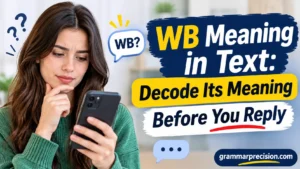
WB meaning in text can be confusing when you encounter it in different conversations, social media comments, or online chats. Understanding its common meanings helps you interpret messages and respond naturally.
Whether someone uses WB to welcome you back or encourage a reply, context makes all the difference. This guide explores its definitions, texting examples, social media usage, and conversational meanings to help you avoid misunderstandings.
You’ll also discover how WB fits into digital communication, including casual messaging, online communities, and gaming conversations. Learn how to recognize its tone, distinguish it from similar abbreviations, and choose appropriate responses for friendly, flirty, and professional interactions.
Quick Answer: What Does WB Mean in Text?
WB most commonly means “Welcome Back” in texting. People use it when someone returns to a conversation, online game, social media group, or digital community after being away.
For example:
- Person A: “Hey, I’m back!”
- Person B: “WB! We missed you.”
Here, WB expresses a friendly welcome without requiring a complete sentence.
However, WB can also mean “Write Back” in certain conversations. Someone might use it when asking another person to reply to a message.
The correct interpretation depends on context, timing, and the relationship between the people communicating.
What Does WB Mean in Texting?
WB is a shortened expression that makes digital communication quicker and more convenient. Its most recognized meaning is Welcome Back.
People commonly use it when someone returns after disappearing from a conversation or taking a short break. Instead of typing the entire phrase, they simply write two letters.
Imagine leaving a group chat to handle something important. When you return, someone might send “WB” to acknowledge your arrival.
The abbreviation carries a friendly tone and often makes conversations feel more relaxed.
The Most Common Meaning of WB
Welcome Back is the primary interpretation of WB in everyday texting.
It usually appears when someone:
- Returns to a group conversation.
- Rejoins an online gaming session.
- Comes back after taking a break.
- Becomes active on a social media platform.
- Returns to a conversation after being offline.
For example:
“Finally finished my assignment. I’m back!”
“WB! How did it go?”
This exchange shows how naturally WB fits into casual conversations.
It also communicates friendliness without requiring an elaborate greeting.
Why Do People Use WB Instead of Writing the Full Phrase?
Modern messaging encourages speed and convenience. People often prefer short expressions because they communicate ideas quickly.
WB offers several advantages:
- Saves time: Typing two letters takes less effort.
- Feels casual: It matches the relaxed atmosphere of texting.
- Fits group chats: Short messages keep conversations moving.
- Creates familiarity: Friends often use abbreviations they understand.
- Works across platforms: The expression appears in messaging apps, games, and online communities.
Think of WB as a digital wave. It acknowledges someone’s return without interrupting the conversation.
Different Meanings of WB in Text Messages
Although Welcome Back dominates everyday texting, WB doesn’t always carry the same meaning.
Its interpretation depends on the situation. Understanding these alternatives can help you avoid confusing one message with another.
| WB meaning | Typical situation | Example |
| Welcome Back | Someone returns | “WB! Missed you.” |
| Write Back | Someone requests a response | “Message me when you can. WB!” |
| Well-Being | Certain specialized discussions | “How’s your WB these days?” |
| World Bank | Financial or international discussions | “The WB released its report.” |
These interpretations aren’t equally common. Welcome Back remains the safest starting point when you’re reading an ordinary text message.
WB as Welcome Back
This meaning appears frequently in friendly conversations.
Someone might use WB when another person returns after being absent for several minutes, hours, or even days.
For example:
- Friend: “Sorry, my internet stopped working.”
- You: “WB! We were waiting for you.”
The expression can also appear in online communities when familiar members return.
Its tone is generally warm, welcoming, and informal.
WB as Write Back
Sometimes WB can mean Write Back, especially when someone wants another person to respond.
For example:
“Let me know what you think. WB when you’re free.”
Here, the sender encourages the recipient to reply.
However, this interpretation is less straightforward than Welcome Back. Other expressions, such as “text me back” or “reply when you can,” are more immediately recognizable.
If someone uses WB in this way, the surrounding sentence usually makes their intention clearer.
WB as Other Context-Specific Abbreviations
WB can represent other terms in specialized settings.
For instance, the World Bank is sometimes abbreviated as WB in financial journalism and international development discussions.
Similarly, specialized communities may use WB as shorthand for particular technical or organizational terms.
Don’t automatically apply these interpretations to casual messages. The conversation’s subject usually reveals which meaning makes sense.
How to Use WB in Everyday Conversations
WB works best when you want to acknowledge someone’s return naturally.
You don’t need a complicated sentence. A short greeting can communicate everything.
However, knowing when to use it makes your messages feel more appropriate.
Using WB When Someone Returns
This is the most natural situation for using WB.
You can send it when a friend returns to a conversation after being away.
Example:
- Friend: “Sorry, I had to answer the door.”
- You: “WB! Anyway, where were we?”
It also works when someone returns after a longer absence.
For example, if your friend returns to a group chat after several weeks, “WB!” makes a friendly opening.
Using WB to Encourage Someone to Reply
If you’re using WB to mean Write Back, make sure the surrounding message explains your intention.
Example:
“Send me your final decision whenever you can. WB!”
This usage might feel unclear to some readers. A more direct alternative would be “Reply when you’re free.”
Use familiar expressions whenever clarity matters.
Using WB in Group Chats
Group chats provide plenty of opportunities to use WB.
People frequently leave conversations temporarily because of work, school, family responsibilities, or internet problems.
When they return, other members can welcome them.
Example:
- Alex: “Guys, my phone died. I’m back now.”
- Sarah: “WB!”
- Daniel: “We were just talking about the weekend.”
- Alex: “Perfect. What’s the plan?”
This exchange demonstrates how WB helps maintain a friendly group atmosphere.
20 Examples of WB in Real-Life Text Conversations
Examples make abbreviations easier to understand because they show how people actually use them.
Here are 20 realistic conversations featuring WB.
| Situation | Example conversation |
| Returning to chat | “I’m back!” / “WB!” |
| Returning from lunch | “Finished eating.” / “WB, how was lunch?” |
| Internet problem | “My Wi-Fi stopped working.” / “WB!” |
| Gaming session | “I’m joining again.” / “WB, let’s play.” |
| School group | “Sorry, I missed the discussion.” / “WB!” |
| Work chat | “Back from my break.” / “WB! Let’s continue.” |
| Family group | “Hey everyone, I’m home.” / “WB!” |
| Late-night chat | “Couldn’t sleep, so I’m back.” / “WB 😂” |
| Social media | “I’m active again!” / “WB!” |
| Long absence | “It’s been months!” / “WB, stranger!” |
| Weekend plans | “Back online. What’s happening?” / “WB!” |
| Returning to a game | “Ready for another round.” / “WB, teammate!” |
| Friend’s return | “Finally got some free time.” / “WB!” |
| Group discussion | “Did I miss anything?” / “WB! Not much.” |
| Online class | “My connection is back.” / “WB, we saved your seat.” |
| Casual conversation | “I’m here again.” / “WB, what’s up?” |
| Reply request | “Check the details and WB.” / “I’ll reply tonight.” |
| Personal message | “Tell me what happened. WB.” / “Sure, I’ll message you.” |
| Gaming community | “Reinstalled the game today.” / “WB, legend!” |
| Friendly greeting | “Guess who’s back?” / “WB! Finally!” |
Notice the pattern: Most examples use WB as Welcome Back. The intended meaning becomes clear through the conversation.
What Does WB Mean on Snapchat, Instagram, TikTok, and WhatsApp?
WB doesn’t have a completely different definition on every social media platform.
Its meaning generally remains Welcome Back. However, the situations in which people use it can vary.
WB Meaning on Snapchat
On Snapchat, WB usually means Welcome Back.
Someone might send it when you return to a conversation or become active again after disappearing for a while.
Example:
“WB! You finally opened Snapchat again 😂”
It can also appear in messages between friends who regularly exchange snaps.
WB Meaning on Instagram
On Instagram, WB commonly appears in direct messages and group conversations.
For example:
“Hey, you’re posting again! WB!”
People may also use it when someone returns to an Instagram group chat or reconnects after a long break.
WB Meaning on TikTok
On TikTok, WB can appear in comments, livestream chats, and private messages.
For instance:
“You’re back on live! WB!”
The abbreviation helps viewers acknowledge a creator’s return without typing a longer greeting.
WB Meaning on WhatsApp and Messenger
On WhatsApp and Facebook Messenger, WB often appears in personal messages and group chats.
Someone returning after a busy day might receive:
“WB! We were wondering where you went.”
The meaning stays the same even though the platform changes.
What Does WB Mean From a Guy?
When a guy sends WB, he usually means Welcome Back.
However, his tone and intentions depend on your relationship and the conversation.
For example, imagine you haven’t spoken to him for several days. You suddenly return to his messages, and he replies:
“WB! Where have you been?”
This could simply show friendliness. He might be happy to continue your conversation.
Consider these possible situations:
- Friendly: He welcomes you back without any romantic intention.
- Playful: He jokes about your absence.
- Interested: He uses your return as an opportunity to restart a conversation.
- Casual: He acknowledges your message without suggesting anything deeper.
One abbreviation cannot reveal someone’s feelings.
Look at the broader communication pattern. Does he regularly initiate conversations? Does he ask personal questions? Does he make an effort to keep talking?
Those behaviors provide more meaningful clues than WB alone.
What Does WB Mean From a Girl?
When a girl texts WB, she generally uses it as a friendly way to say Welcome Back.
She might send it after you return to a group conversation or respond following a long break.
Example:
- You: “Sorry, I was busy with exams.”
- Her: “WB! Hope everything went well.”
This message sounds welcoming and supportive.
Depending on your relationship, it could also carry a playful or affectionate tone.
For instance, a close friend might write:
“WB, disappeared human! 😂”
That doesn’t automatically suggest romantic interest. It may simply reflect your existing friendship.
Is WB Flirty, Friendly, or Just Casual?
WB is generally a friendly and casual abbreviation, not an inherently romantic expression.
Still, context can influence how it feels.
Imagine someone you’ve been flirting with sends:
“WB, I’ve been waiting for you 😉”
The wink and surrounding message create a playful tone.
Now compare that with:
“WB! We need to finish our project.”
The second message is clearly practical and friendly.
Here are a few clues that can help you interpret the tone:
| Message style | Possible interpretation |
| “WB!” | Friendly greeting |
| “WB, stranger 😂” | Playful familiarity |
| “WB, missed you ❤️” | Affectionate or romantic |
| “WB, let’s finish this.” | Task-focused |
| “WB 😉” | Potentially flirty, depending on context |
Signs Someone Uses WB to Start Flirting
Sometimes, a person uses your return as an opportunity to reconnect.
Look for additional signals, such as:
- They continue the conversation after welcoming you.
- They ask personal questions.
- They use affectionate nicknames.
- They show genuine interest in your day.
- They frequently initiate conversations.
- They combine WB with playful compliments.
These clues can suggest interest, but none guarantees romantic feelings.
How to Recognize Friendly vs. Flirty Intentions
Pay attention to the entire exchange instead of focusing on two letters.
A friendly message usually stays focused on the conversation or shared activity.
A flirty message may include teasing, personal compliments, affectionate emojis, or playful questions.
For example:
Friendly: “WB! Ready for another game?”
Potentially flirty: “WB! I was getting bored without you 😉”
The difference comes from the surrounding language, not the abbreviation itself.
How to Respond When Someone Texts You WB
Your response should match the sender’s tone and your relationship.
You don’t need to overthink a simple greeting. A natural reply usually works best.
Here are some responses you can use.
Friendly Responses
Choose these when a friend or acquaintance welcomes you back.
- “Thanks! Good to be back.”
- “Haha, thank you!”
- “Hey! What’s happening?”
- “Thanks! What did I miss?”
- “Glad to be back!”
- “Appreciate it!”
Funny Responses
If you enjoy joking around, try something playful.
- “The legend has returned!”
- “Did you miss me that much? 😂”
- “I was never really gone.”
- “Back from another adventure!”
- “The comeback nobody expected!”
- “My disappearance was temporary.”
Flirty Responses
If you’re comfortable with the person and want to flirt, try these.
- “Missed me already? 😉”
- “Aww, you noticed!”
- “Glad you were waiting.”
- “Guess I made your day better.”
- “You sound happy I’m back!”
- “Were you thinking about me?”
Professional Responses
In workplace conversations, keep your reply clear and polite.
- “Thank you. I’m back now.”
- “Thanks! Let’s continue.”
- “Appreciate the welcome.”
- “I’m available again.”
- “Thank you. I’ll review the updates.”
A useful rule: Match the sender’s communication style without forcing a tone that doesn’t feel natural.
WB vs. Other Common Text Abbreviations
WB belongs to a larger collection of internet abbreviations.
Some expressions look similar but communicate completely different ideas.
Understanding these differences helps you interpret messages correctly.
| Abbreviation | Full meaning | Typical use |
| WB | Welcome Back | Greeting someone returning |
| WBU | What About You? | Asking about another person |
| WBY | What About You? | Requesting someone’s opinion or update |
| BRB | Be Right Back | Temporarily leaving |
| BTW | By The Way | Introducing additional information |
| WYD | What You Doing? | Asking what someone is doing |
| TTYL | Talk To You Later | Ending a conversation |
| HBU | How About You? | Returning a question |
WB vs. WBU
WB generally means Welcome Back.
WBU means What About You?
Example:
- Person A: “I’m doing great. WBU?”
- Person B: “Pretty good, thanks!”
The first person wants to know how the other person feels.
WB vs. BRB
BRB means Be Right Back.
People use it when they temporarily leave a conversation.
For example:
“BRB, someone is calling me.”
When that person returns, someone might respond with WB.
These abbreviations often appear together because they describe opposite stages of the same situation.
WB vs. WBY
WBY usually means What About You?
It works similarly to WBU.
For example:
“I’m watching a movie. WBY?”
The sender wants to know what you’re doing.
Don’t confuse it with WB. One welcomes someone back while the other asks about them.
Is WB Appropriate in Professional Messages?
WB can work in informal workplace conversations, especially between colleagues who communicate casually.
For example:
“WB! Hope you enjoyed your vacation.”
This sounds friendly and appropriate in many relaxed office chats.
However, formal emails and professional documents usually require complete expressions.
Instead of writing “WB,” consider:
- “Welcome back to the team.”
- “It’s good to have you back.”
- “I hope you had a relaxing break.”
- “Welcome back. We look forward to working with you.”
Choose your wording based on the communication setting.
A quick team message doesn’t need the same formality as an official business email.
Common Mistakes People Make When Interpreting WB
Even a short abbreviation can cause confusion when readers ignore its context.
Avoid these common mistakes:
- Assuming WB always means Welcome Back: Other interpretations exist.
- Treating every WB message as romantic: Most uses are simply friendly.
- Confusing WB with WBU: These abbreviations have different meanings.
- Ignoring the previous message: Earlier messages often reveal the intended meaning.
- Using WB in formal emails: Complete phrases usually sound more professional.
- Overanalyzing punctuation: An exclamation mark doesn’t automatically indicate excitement or romantic interest.
A little context goes a long way. If you’re uncertain, simply ask what the sender means.
FAQs About WB Meaning in Text
What Does WB Mean in Texting?
WB most commonly means Welcome Back. People use it when someone returns to a conversation, group chat, online game, or social media platform.
What Does WB Mean From a Guy?
A guy usually uses WB to welcome you back. Depending on your relationship, his message might sound friendly, playful, or affectionate.
What Does WB Mean From a Girl?
A girl generally uses WB to say Welcome Back. It can express friendliness, familiarity, or excitement about continuing a conversation.
Does WB Mean Write Back?
Yes, WB can mean Write Back in certain contexts. However, Welcome Back is the more common interpretation in everyday casual texting.
Is WB a Flirty Abbreviation?
Not necessarily. WB is generally friendly and casual. Additional wording, emojis, and conversational behavior can make it sound flirty.
What Does WB Mean on Snapchat?
On Snapchat, WB usually means Welcome Back. Friends may use it when someone returns to the app or resumes a conversation.
What Does WB Mean on Instagram?
On Instagram, WB commonly means Welcome Back in direct messages, comments, and group conversations.
Can I Use WB in Professional Communication?
You can use WB in relaxed workplace chats when colleagues understand the abbreviation. For formal emails, write “Welcome Back” instead.
What Is the Difference Between WB and WBU?
WB means Welcome Back, while WBU means What About You? They serve different purposes in everyday conversations.
How Should I Reply to WB?
You can respond with “Thanks!”, “Good to be back!” or “What did I miss?” Choose a friendly, funny, or professional response depending on the situation.
Conclusion:
Understanding WB meaning in text helps you read digital conversations with greater confidence. Most often, WB means “Welcome Back,” while “Write Back” may fit certain contexts. Always consider the message, relationship, and conversation before deciding what someone intends to say.
Whether you see WB in a private message, group chat, or social media comment, the surrounding words reveal its tone. Use context clues to understand the sender’s meaning, then choose a natural response that suits your relationship. With that simple approach, you can avoid confusion and keep every conversation flowing smoothly in everyday online chats.