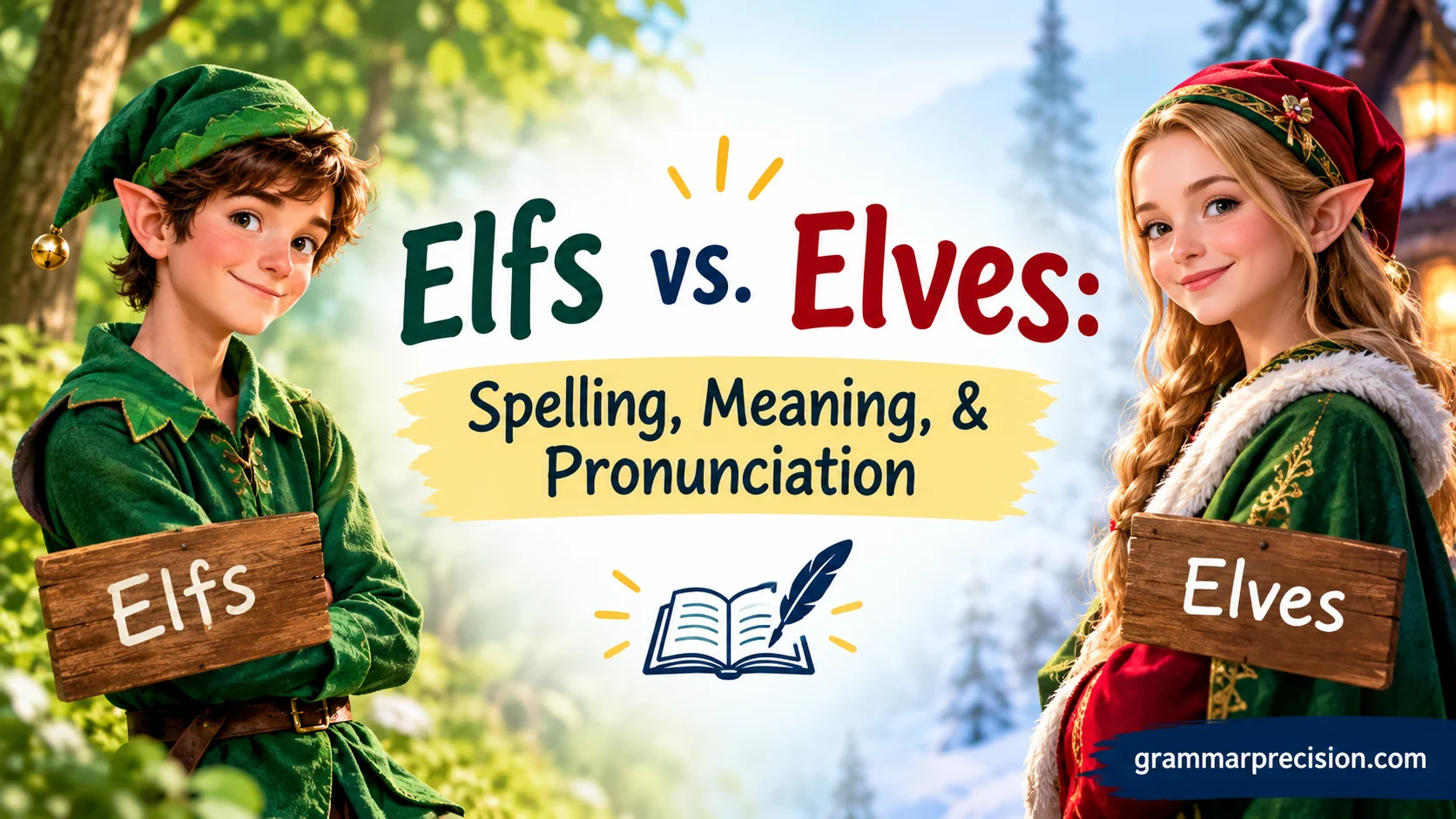
Elfs vs. Elves can be confusing because both words may look correct at first glance. However, only one form is generally accepted as the standard plural of elf in modern English, making the difference important for clear and accurate writing.
The word elves is the standard and widely accepted plural form of elf. Like leaf becomes leaves and wolf becomes wolves, the word changes its ending from -f to -ves. You will often see elves in mythology, fantasy stories, folklore, and popular culture. Understanding this grammar rule helps you choose the correct spelling with confidence in everyday and professional writing.
Although elfs may occasionally appear in informal writing or as a stylistic choice, elves is the preferred standard plural in modern English. This distinction matters when you want your grammar, spelling, and sentence structure to remain clear and accurate. Knowing the difference also helps writers avoid common English language mistakes, especially when discussing fictional characters, magical creatures, or traditional folklore.
Learning Elfs vs. Elves is simple once you understand how certain nouns change from -f to -ves in their plural forms. By recognizing the standard spelling and seeing it in practical examples, you can improve your English grammar, build stronger writing skills, and communicate more naturally. The following guide explains the meaning, grammar rules, differences, and examples in an easy-to-understand way.
Elfs vs. Elves: Which One Should You Use?
The quick answer is simple: use “elves” as the standard plural of “elf.”
| Word | Number | Standard Use | Example |
| Elf | Singular | Correct | An elf lives in the forest. |
| Elves | Plural | Correct | The elves live in the forest. |
| Elf’s | Singular possessive | Correct | The elf’s hat is red. |
| Elves’ | Plural possessive | Correct | The elves’ village is hidden. |
| Elfs | Plural | Generally nonstandard | Avoid it in ordinary writing. |
So, if you’re writing about two or more mythical creatures, choose elves.
Quick rule: One elf, two elves, many elves.
The spelling elfs may occasionally appear in names, creative works, historical discussions, or unusual specialized contexts. However, that doesn’t make it the normal plural for modern standard English.
Why “Elves” Is the Standard Plural
The plural elves developed through older English plural patterns rather than the simple addition of -s. Similar changes occur in several familiar words.
For example:
- leaf → leaves
- wolf → wolves
- knife → knives
- wife → wives
- life → lives
- half → halves
Because readers already recognize this pattern, elves sounds natural to modern English speakers. Elfs, by contrast, usually sounds unusual or incorrect when used as the ordinary plural.
Elf Meaning: What Does “Elf” Actually Mean?
An elf is a mythical or legendary being traditionally associated with supernatural powers, nature, magic, or otherworldly worlds. The exact appearance and personality of an elf depend heavily on the culture and story involved.
In older folklore, elves weren’t always the cheerful, elegant creatures familiar from modern fantasy. Different traditions described supernatural beings with very different traits. Some could help humans, while others could cause trouble or behave unpredictably.
Modern fantasy changed the picture considerably. Today, elves often appear as graceful, long-lived, magical beings who possess exceptional skills with weapons, nature, music, or spellcraft.
Elf in Folklore
The idea of elves has deep roots in Germanic and Scandinavian traditions. Old stories used related terms for supernatural beings that could interact with humans and influence the natural or mysterious world.
Their characteristics weren’t fixed. One story might portray an elf as beautiful and helpful, while another could describe supernatural beings as dangerous or mischievous.
That flexibility explains why the word has survived so well. An elf isn’t limited to one universal character type.
Elf in Modern Fantasy
Fantasy literature gave the word a much more recognizable identity.
Many modern fantasy settings portray elves as:
- Long-lived or immortal beings
- Highly skilled with bows
- Connected with forests and nature
- Naturally talented in magic
- Elegant or physically graceful
- Organized into distinct cultures or kingdoms
- Older and wiser than ordinary humans
However, these traits aren’t grammatical definitions. They’re fictional conventions that writers use to build fantasy worlds.
Elf in Christmas Traditions
Christmas stories use another familiar version of the elf. Santa’s elves are commonly portrayed as small, energetic workers who help prepare toys and gifts.
These characters became especially popular in modern Christmas culture. Their image now appears in books, television programs, decorations, advertisements, toys, and family traditions.
That gives elf an unusual range of meanings. The same word can describe a folkloric being, fantasy character, or Christmas helper depending on context.
Elves Meaning: What Changes in the Plural?
Elves simply means more than one elf.
The meaning doesn’t fundamentally change because the noun becomes plural. What changes is the number.
Consider these examples:
- One elf entered the village.
- Two elves entered the village.
- Several elves entered the village.
- The elves gathered around the ancient tree.
The first sentence discusses one creature. The others discuss multiple creatures.
This distinction seems obvious, yet plural errors can sneak into longer sentences. Writers sometimes remember that elf ends in f and automatically write elfs. English doesn’t always reward that kind of mechanical spelling.
Why Is “Elves” the Plural of “Elf”?
The answer comes from the history of English.
Modern English inherited many spelling and sound patterns from earlier Germanic languages. Some nouns that ended in sounds represented by f developed plural forms containing a v sound.
Over time, these forms became established in English vocabulary. The singular and plural forms therefore don’t always look like simple variations of one another.
The change isn’t merely an arbitrary modern rule. Historical sound changes helped shape the spellings that English speakers use today.
The “-f” to “-ves” Pattern
Several common English words demonstrate a similar pattern:
| Singular | Plural |
| Elf | Elves |
| Leaf | Leaves |
| Wolf | Wolves |
| Knife | Knives |
| Wife | Wives |
| Life | Lives |
| Half | Halves |
| Calf | Calves |
| Loaf | Loaves |
| Shelf | Shelves |
Notice the pattern. The final f changes to v and the plural ending becomes -es.
This isn’t a rule you can safely apply to every word ending in f. English has exceptions.
Why English Has So Many Plural Exceptions
English developed from several linguistic sources and changed significantly over centuries. As a result, its plural system contains regular patterns alongside older forms.
For example:
- roof → roofs
- chief → chiefs
- belief → beliefs
- proof → proofs
- safe → safes
You can’t simply see an ending in f and automatically change it to ves.
That’s why memorizing common forms works better than treating the pattern as an absolute rule.
Is “Elfs” Wrong?
In standard modern English, elfs is generally not the plural you should choose.
When writing an article, essay, story, school assignment, business document, or ordinary message, elves is the established plural.
Still, language isn’t always black and white. You may encounter elfs in particular names, creative contexts, historical material, or intentionally unconventional writing.
Standard English vs. Nonstandard Usage
Standard English favors elves because dictionaries and established usage recognize it as the normal plural.
For example:
The elves prepared gifts throughout the night.
Writing:
The elfs prepared gifts throughout the night.
would generally look like a spelling mistake to modern readers.
That distinction matters because seeing a form somewhere doesn’t automatically make it the preferred standard form.
Why “Elfs” Sometimes Appears
There are several reasons you might encounter elfs.
First, someone may simply apply the regular plural rule and add -s. That’s an understandable mistake.
Second, a writer might deliberately use an unconventional spelling for stylistic reasons.
Third, a proper name, title, fictional term, or specialized usage may preserve a particular spelling. Proper names don’t always follow ordinary grammatical conventions.
So, context matters. But for normal writing, the safest choice is still elves.
Elf vs. Elves vs. Elf’s vs. Elves’
The words become even easier once you understand their grammatical jobs.
Elf
Use elf when you’re talking about one creature.
Example:
An elf stood beside the ancient tree.
Elves
Use elves when you’re talking about two or more creatures.
Example:
The elves returned before sunset.
Elf’s
Use elf’s to show possession by one elf.
Example:
The elf’s cloak was covered with silver stars.
Here, one elf owns or is associated with the cloak.
Elves’
Use elves’ to show possession by multiple elves.
Example:
The elves’ village stood beyond the mountains.
The village belongs to or is associated with several elves.
This distinction is worth remembering because possessive apostrophes can create another layer of confusion.
How to Pronounce Elf and Elves
Pronunciation provides another useful clue.
In American English, elf is commonly pronounced roughly like “elf,” with one syllable. The plural elves is pronounced with a clear v sound at the end.
The difference is easy to hear:
- Elf → /ɛlf/
- Elves → /ɛlvz/
The vowel stays similar, while the ending changes.
The Sound Difference
Say these pairs aloud:
- leaf → leaves
- wolf → wolves
- elf → elves
You’ll notice that the plural forms use a v sound where the singular has an f sound.
This isn’t just a spelling trick. The historical development of these forms affected pronunciation as well.
Common Pronunciation Mistakes
A common mistake involves treating elves as though it ends with the same sound as elfs.
However, elves ends with a voiced z sound after the v. The word has one syllable.
Try saying:
elves
Then compare it with:
elf
The distinction becomes clear once you focus on the final consonants.
Elfs vs. Elves: Examples in Context
Examples make the difference much easier to remember.
Everyday Examples
- The elf sat quietly near the fireplace.
- The elves decorated the workshop.
- A friendly elf appeared in the story.
- Several elves traveled across the valley.
- The children dressed as elves for the holiday show.
Fantasy Examples
- The elf carried a silver bow.
- The elves protected the ancient forest.
- An elf taught the young warrior how to use magic.
- The elves built their city among enormous trees.
- Three elves watched the mountain pass.
Christmas Examples
- The elf placed a toy inside the box.
- Santa’s elves worked throughout the workshop.
- The elves helped prepare the Christmas gifts.
- A cheerful elf waved from the holiday float.
Possessive Examples
- The elf’s hat was unusually tall.
- The elf’s sword glowed in the darkness.
- The elves’ workshop was filled with toys.
- The elves’ leader addressed the crowd.
Also Read This: Happy Belated Birthday or Belated Happy Birthday
Elves Across Different Contexts
The word elves doesn’t have one fixed cultural image. Its meaning shifts with the setting.
| Context | Typical Image of Elves |
| Folklore | Supernatural or mysterious beings |
| Christmas | Small helpers associated with Santa |
| Fantasy | Magical, long-lived, skilled beings |
| Literature | Characters shaped by the author’s world |
| Video games | Playable races, enemies, allies, or magical characters |
| Film and television | Characters ranging from comic to powerful |
This variety explains why elf remains such a productive word in modern storytelling.
Fantasy Literature
Fantasy authors often build their own versions of elves. One fictional world may portray them as ancient guardians of nature, while another may depict them as politically complex societies.
As a result, elves don’t have one universal appearance, lifespan, ability, or personality in fantasy fiction.
That flexibility gives writers plenty of creative space.
Gaming and Popular Culture
Video games have expanded the concept even further. Elves may appear as archers, spellcasters, warriors, healers, villains, or entire playable civilizations.
Games often divide elves into different groups. Common fictional labels include wood elves, high elves, dark elves, and moon elves, although their exact characteristics depend on the particular fictional universe.
These labels are storytelling devices rather than universal definitions.
Related Plural Words That Cause Confusion
Understanding elves becomes easier when you compare it with other nouns that behave similarly.
Leaf vs. Leaves
A single leaf becomes leaves when you discuss more than one.
Example:
One leaf fell from the tree.
Example:
Hundreds of leaves covered the ground.
Wolf vs. Wolves
The same pattern appears with wolf and wolves.
Example:
A wolf crossed the snowy path.
Example:
Several wolves moved through the forest.
Knife vs. Knives
Here again, the singular ends in f, while the plural uses ves.
Example:
The chef picked up a knife.
Example:
The drawer contained several knives.
Life vs. Lives
This pair demonstrates that the spelling pattern can also affect the meaning and pronunciation of a very common noun.
Example:
Every life matters.
Example:
The rescue team saved several lives.
Roof vs. Roofs
Here’s where English throws a curveball.
The plural of roof is normally roofs, not rooves in standard contemporary usage.
That example proves an important point: don’t assume every noun ending in f must change to ves.
A Simple Trick to Remember “Elves”
If elves keeps slipping your mind, connect it with another familiar word.
Think:
Leaf → leaves → elf → elves
Both leaf and elf follow the same familiar f-to-v plural pattern.
Another useful memory sentence is:
One elf, two elves.
It’s short enough to repeat mentally whenever you’re writing.
You can also remember the phrase:
“Elves live in leaves.”
It sounds playful, but it links elves with leaves, making the spelling easier to recall.
Common Mistakes With Elfs and Elves
Even experienced writers can make small plural mistakes when words have irregular forms.
Using “Elfs” as the Standard Plural
The most common error is simply writing elfs instead of elves.
Incorrect in ordinary standard usage:
Five elfs entered the village.
Better:
Five elves entered the village.
Treating “Elves” as Singular
Elves is plural.
Incorrect:
An elves appeared near the river.
Correct:
An elf appeared near the river.
Adding an Apostrophe to Make a Plural
Don’t write elf’s when you simply mean more than one elf.
An apostrophe usually signals possession, not an ordinary plural.
- elf = one
- elves = more than one
- elf’s = belonging to one elf
- elves’ = belonging to multiple elves
Assuming Every “F” Word Uses “-ves”
This shortcut can lead to mistakes with words such as roof, chief, and belief.
English pluralization has patterns, but those patterns have exceptions. Check the established plural rather than relying on one mechanical rule.
A Quick Case Study: Why “Elves” Feels More Natural
Imagine reading these two sentences:
The village was protected by twelve elves.
Now compare:
The village was protected by twelve elfs.
The first sentence feels immediately familiar. The second makes many readers pause because elfs doesn’t match the established plural pattern.
That reaction demonstrates something important about language: frequent usage shapes what readers recognize as natural.
Even when a regular spelling seems logical, an established irregular form usually wins.
Quick Grammar Cheat Sheet for Elf and Elves
| Form | Meaning | Example |
| Elf | One elf | The elf smiled. |
| Elves | More than one elf | The elves smiled. |
| Elf’s | Belonging to one elf | The elf’s home was small. |
| Elves’ | Belonging to multiple elves | The elves’ homes were nearby. |
| Elfs | Generally nonstandard plural | Avoid in ordinary writing. |
This table gives you the entire rule at a glance.
If you’re ever unsure, identify how many elves you’re discussing first. Then determine whether you’re showing possession. That two-step approach eliminates most mistakes.
FAQs:
Is “elfs” a correct plural of elf?
Elves is the standard plural form of elf in modern English. “Elfs” is uncommon and generally not preferred in standard writing.
What is the plural form of elf?
The correct plural form is elves. For example, you can say, “The story is about three elves.”
Why does elf change to elves?
Elf changes to elves because some English nouns ending in -f or -fe form their plurals by changing the ending to -ves.
Is “elfs” ever used in English?
Yes, elfs can occasionally appear in older, informal, or specialized usage, but elves is the normal and widely accepted plural form.
Which spelling should I use in formal writing?
Use elves in formal, academic, professional, and everyday English. It is the safest and most natural choice when referring to more than one elf.
Conclusion:
Understanding Elfs vs. Elves is easy once you remember that elves is the standard plural form of elf. Although “elfs” may appear occasionally, elves is the preferred choice in modern English.
Using the correct spelling makes your writing clearer and more natural, especially in stories, articles, and everyday communication. Keep elves in mind, and you’ll avoid this common spelling mistake with confidence.