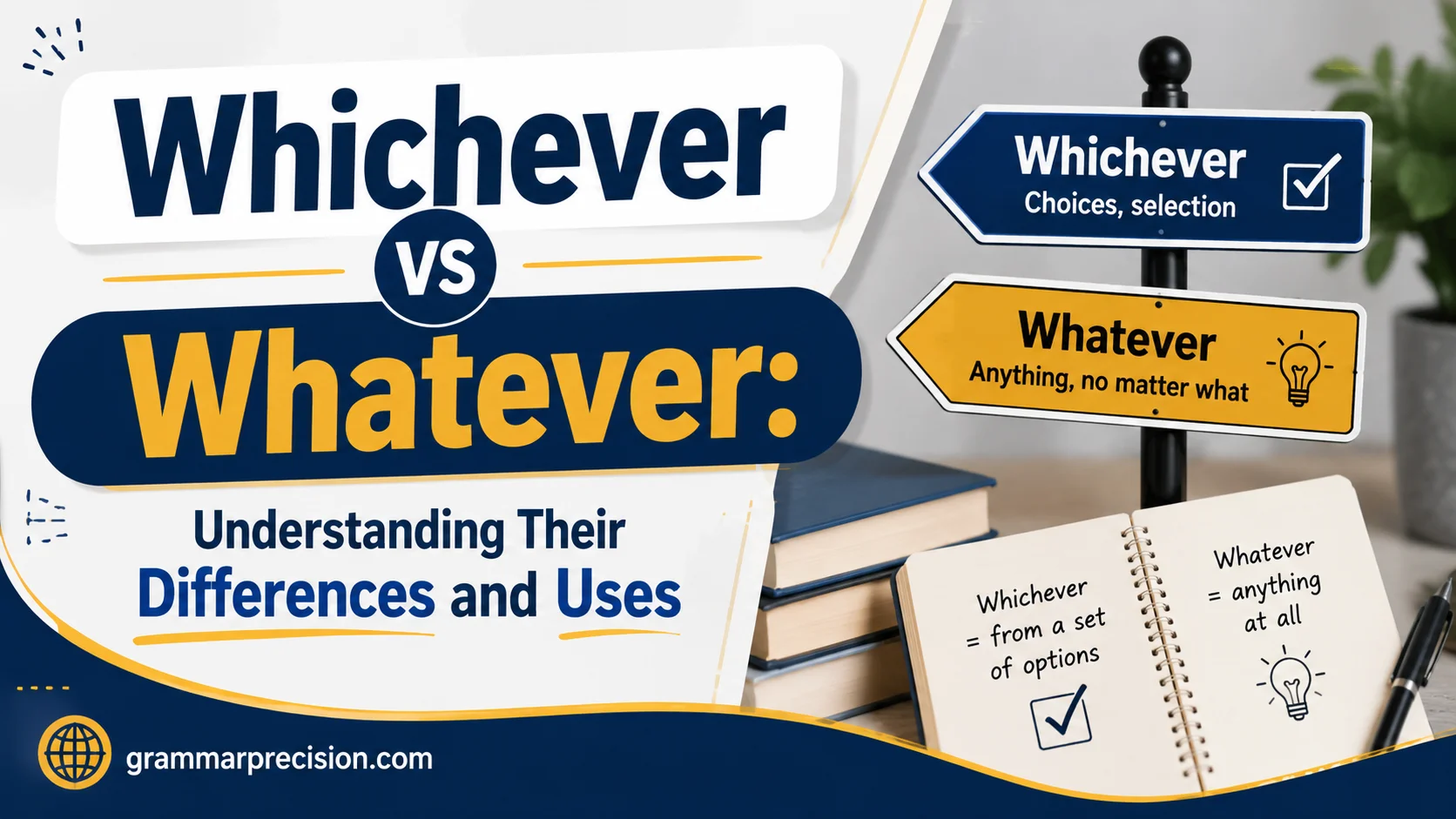
Whichever vs Whatever can confuse English learners because both words express choice, but their meanings differ when options are limited or completely open.
Whichever refers to a specific or limited choice from known options. For example, you can choose whichever color you prefer from two choices. It sounds precise and polite, making it useful when the available options are already clear.
Whatever refers to an unlimited choice without specific restrictions. It can mean anything at all, so it works well for open possibilities. Understanding this difference helps you choose the correct word and make your English sound more natural, clear, and confident.
Whichever vs Whatever: Quick Answer
The simplest rule is this:
Whichever usually means “any one from a particular group,” while whatever often means “anything at all” or “it doesn’t matter what.”
Consider these examples:
- Choose whichever shirt you like.
→ The speaker has a particular selection of shirts in mind. - Choose whatever you like.
→ The speaker gives you broad freedom to choose.
Cambridge Dictionary defines whichever as referring to any one from a limited set. It also uses the word for situations where the particular choice doesn’t matter.
Whatever, by contrast, can mean “anything or everything,” “it doesn’t matter what,” or something whose exact nature isn’t known.
| Word | Basic meaning | Typical idea |
| Whichever | Any one from a particular group | Choice among identifiable options |
| Whatever | Anything at all | Broad or unrestricted choice |
| Whichever option | Any option within a set | Limited possibilities |
| Whatever you want | Anything you want | No stated limits |
The difference isn’t always absolute. Context matters. Still, this distinction provides an excellent starting point.
What Does “Whichever” Mean?
Whichever combines which with -ever. In practical terms, it usually means any one from a known or limited selection.
For example:
- Choose whichever color you prefer.
- Take whichever bus arrives first.
- Pick whichever book you want from this shelf.
- We can meet Thursday or Friday, whichever works better for you.
Notice the hidden boundary in each sentence. There’s a group of colors, buses, books, or days. You aren’t choosing from the entire universe of possibilities.
Cambridge describes this core meaning as any one from a limited set. It also recognizes another use where the particular choice doesn’t matter.
Whichever as a Determiner
When whichever comes directly before a noun, it acts as a determiner:
- whichever route
- whichever candidate
- whichever answer
- whichever restaurant
- whichever date
For example:
Choose whichever route gets you there faster.
Here, “whichever” tells you that several routes exist and you may select one of them.
Whichever as a Pronoun
You can also use whichever without repeating the noun:
There are two trains. Take whichever arrives first.
The missing noun is understood from the context. In this case, whichever means something like “whichever train.”
This form is especially useful when repeating the noun would sound clumsy.
What Does “Whatever” Mean?
Whatever has a broader range of meanings than whichever. It can mean anything that, no matter what, or it doesn’t matter what.
For example:
- Eat whatever you want.
- Buy whatever book interests you.
- Call me whatever time you arrive.
- Whatever happens, stay calm.
- Do whatever you think is best.
The word doesn’t necessarily point to a clearly defined group.
Consider this sentence:
Take whatever you need.
The speaker hasn’t necessarily prepared a specific selection. The listener has broad freedom.
Whatever as a Determiner
Like whichever, whatever can appear before a noun:
- whatever food
- whatever reason
- whatever method
- whatever answer
- whatever amount
For example:
Use whatever method works best for you.
The sentence doesn’t restrict you to a named list of methods. The method remains open.
Whatever as a Pronoun
Whatever can stand alone:
“What should I bring?”
“Whatever you want.”
Here, the word refers broadly to anything the speaker chooses.
It can also appear in a more dismissive conversational response:
“Do you want pizza or pasta?”
“Whatever.”
That second use has a completely different social effect. More on that later.
Whichever vs Whatever: The Key Difference
The biggest distinction involves the size and clarity of the choice.
Think of whichever as standing in front of a menu. Think of whatever as opening the refrigerator and saying, “Take anything.”
Whichever = Choice Within a Set
Choose whichever of these three plans you prefer.
The speaker has identified three plans. The choice exists inside that group.
Whatever = Broad Freedom
Choose whatever you prefer.
The speaker doesn’t establish a particular set. The range is much wider.
A useful mental shortcut is:
Which → selection
What → general identity or thing
-ever → freedom or lack of importance
This pattern explains why whichever and whatever feel related while still behaving differently.
Whichever vs Whatever Examples
The clearest way to understand the difference is to compare similar sentences.
| Whichever | Whatever | Difference |
| Choose whichever dress you like. | Choose whatever dress you like. | The first suggests a particular selection. |
| Take whichever seat is available. | Take whatever you need. | The first points to available seats; the second gives broader freedom. |
| Pick whichever route is shorter. | Use whatever route you prefer. | The first emphasizes routes under consideration. |
| Buy whichever phone fits your budget. | Buy whatever you want. | The first implies a defined range of phones. |
| Choose whichever date works. | Come whatever day you like. | The first usually involves known dates; the second sounds unrestricted. |
However, don’t treat the distinction as a rigid mathematical rule. Native speakers sometimes use whichever and whatever in overlapping contexts.
For instance:
Choose whichever you want.
and
Choose whatever you want.
Both are grammatical. The first can suggest a choice from an understood group. The second sounds more open-ended.
Whichever vs Whatever With Nouns
The noun following the word often gives you a major clue.
Compare:
Pick whichever book you want.
with:
Read whatever book you want.
The first sentence more strongly suggests a recognizable group of books. Perhaps you’re standing in front of a shelf containing ten books.
The second sentence can mean that any book is acceptable. The speaker isn’t focused on a particular selection.
Another useful pair:
Take whichever cookie you like.
Eat whatever you like.
The first points toward cookies as the relevant set. The second doesn’t impose a category at all.
A Practical Test
When you’re unsure, ask yourself:
“Am I choosing from a particular group?”
If the answer is yes, whichever often fits.
If the answer is no and you mean anything at all, whatever usually works better.
Whichever vs Whatever in Relative Clauses
Both words can introduce clauses that express free choice or indifference.
Consider:
Whichever option you choose, we’ll support you.
This suggests that there are particular options under consideration. The exact choice doesn’t matter.
Now compare:
Whatever option you choose, we’ll support you.
This gives a broader sense of “any option you might choose.”
Both sentences can be perfectly natural. The difference lies in how the speaker frames the possibilities.
Whichever keeps the idea of selection visible. Whatever emphasizes the lack of restriction or importance.
Cambridge gives examples such as “Whichever option we choose” and “Whatever happens,” illustrating how the two words operate across different kinds of clauses.
When Both Whichever and Whatever Are Correct
This is where many grammar explanations become too simplistic.
Sometimes both words work because the context already tells you what the speaker means.
Imagine a manager discussing three project plans:
Choose whichever plan seems strongest.
That’s natural because the plans are already identified.
Now imagine the manager doesn’t want to restrict the employee:
Choose whatever plan you think will work.
That’s also natural, but the second sentence feels more open.
The difference becomes even smaller when the context has already established the choices:
We have several desserts. Take whichever you want.
Here, whichever clearly refers back to the known dessert selection.
If someone says:
Take whatever you want.
the meaning is broader and more relaxed.
So don’t memorize a rule that says these words can never replace each other. English depends heavily on context, intention, and conversational framing.
Also Read This: Therefor or Therefore? The Complete Guide to Usage
Whichever vs Whatever in Everyday Situations
Real-world examples make the distinction easier to remember.
Restaurants and Food
Imagine a waiter points toward five available desserts:
You can have whichever dessert you prefer.
The choice comes from a defined menu.
A friend at home might say:
Grab whatever food you want from the kitchen.
That sounds less restricted.
Travel and Transportation
Suppose two trains leave soon:
Take whichever train arrives first.
The relevant trains are known.
But if someone says:
Use whatever transportation works for you.
the choice could include a train, bus, taxi, bicycle, or something else.
Shopping
A store employee might say:
Try on whichever jacket you like.
The jackets in front of you form the relevant set.
A generous gift giver might say:
Buy whatever you want.
That statement removes the boundaries.
Work and Business
A supervisor could say:
Use whichever template matches this report.
The company likely has a particular collection of templates.
Another might say:
Use whatever method helps you finish the analysis accurately.
That gives the employee much more freedom.
The Different Meanings of “Whatever”
One reason whatever vs whichever confuses learners is that whatever has several common uses.
Whatever Meaning “Anything That”
Eat whatever you want.
Here, whatever means roughly “anything that.”
Whatever Meaning “No Matter What”
Whatever happens, keep moving forward.
The result doesn’t change the speaker’s main instruction.
Whatever Meaning “It Doesn’t Matter”
“Which movie should we watch?”
“Whatever.”
Here, the speaker says the particular choice isn’t important.
Whatever Showing Surprise
English speakers can also use whatever to make a question more emphatic:
Whatever are you doing?
This doesn’t mean “anything.” Instead, it adds surprise or disbelief to the question. Cambridge lists this as an emphatic use of whatever.
Why “Whatever” Can Sound Rude
The word whatever isn’t automatically rude. Tone creates much of the problem.
Compare:
“You can choose whatever you want.”
That’s friendly and permissive.
Now consider:
“Whatever.”
Depending on your tone, this can mean “I don’t care,” “leave me alone,” or “I’m not interested.”
Cambridge specifically notes that standalone whatever can be used sarcastically or disrespectfully to show a lack of interest.
That distinction matters in professional communication.
Neutral
“Whatever works best for the team is fine.”
Dismissive
“Whatever. Just do it.”
The spelling hasn’t changed. The social meaning has.
That’s why learners should study these words in context rather than treating dictionary definitions as complete instructions.
Whichever vs Whatever vs Which vs What
Understanding the base words makes the comparison much easier.
The British Council describes which as a specific determiner and what as a more general determiner.
| Word | Main idea | Example |
| Which | Selection from specific possibilities | Which shirt do you want? |
| What | General information or identity | What shirt do you want? |
| Whichever | Any one from a relevant set | Choose whichever shirt you like. |
| Whatever | Anything at all or no matter what | Choose whatever you like. |
Here’s a simple way to picture it:
Which → Which one?
Whichever → Any one of the relevant choices
What → What thing?
Whatever → Any thing at all
The -ever ending broadens the meaning of the original wh-word.
Whichever vs Whoever vs Whatever
The same pattern appears across several English words.
- Whichever → any one from a choice
- Whatever → anything
- Whoever → any person
- Wherever → any place
- Whenever → any time
- However → any way or no matter how
Cambridge explains that adding -ever to words such as what, which, when, where, and who changes their meaning toward ideas such as “any” or “it doesn’t matter.”
For example:
Whoever calls, take a message.
Wherever you go, stay safe.
Whenever you’re ready, we can begin.
Whatever happens, don’t panic.
Whichever option you select, the price remains the same.
Once you understand the pattern, these words become much easier to recognize.
Common Mistakes With Whichever and Whatever
Mistake: Treating Them as Perfect Synonyms
They overlap, but their emphasis differs.
Better: Think about whether the sentence points toward a known set or an unrestricted range.
Mistake: Using Whichever for Unlimited Choices
Choose whichever you want from the entire world.
This can sound odd because the choice isn’t clearly bounded.
A more natural option is:
Choose whatever you want.
Mistake: Assuming Whatever Always Means “I Don’t Care”
It doesn’t.
Whatever happens, I’ll support you.
Here, whatever creates a condition meaning “no matter what happens.”
Mistake: Thinking Whichever Is Always More Formal
Whichever isn’t simply a formal version of whatever. The two words express different shades of meaning.
Mistake: Ignoring Tone
A standalone whatever can sound dismissive, especially in casual speech. The surrounding sentence and delivery matter.
A Short Case Study: One Situation, Two Meanings
Imagine you’re planning a weekend trip with a friend.
There are three hotels already shortlisted:
- The Lakeside Hotel
- The City Center Hotel
- The Garden Hotel
You might say:
Stay at whichever hotel you prefer.
The listener understands that the choice comes from those three hotels.
Now imagine you haven’t shortlisted anything. You simply tell your friend:
Stay at whatever hotel fits your budget.
The second sentence creates a much wider choice.
This tiny change demonstrates the central idea:
Whichever highlights selection. Whatever highlights freedom.
Neither word is inherently better. The correct choice depends on the meaning you want to communicate.
Whichever vs Whatever: Quick Memory Trick
Use this simple formula:
WHICH + EVER = whichever → any one from the relevant choices
WHAT + EVER = whatever → anything at all
Then ask yourself one question:
“Is there a particular set of choices in the background?”
- Yes → whichever is often the better fit.
- No → whatever is often the better fit.
- Not sure → check the context and intended meaning.
Don’t force every sentence into a rigid rule. Natural English allows overlap.
Whichever vs Whatever Practice Quiz
Choose whichever or whatever in each sentence.
Questions
- Choose ______ dessert from this menu.
- Take ______ you need.
- Pick ______ of these two seats you prefer.
- Do ______ you think is right.
- Use ______ route gets you there fastest.
- Eat ______ you like.
- Choose ______ candidate from the shortlisted applicants.
- ______ happens, don’t give up.
- Take ______ book you want from this shelf.
- Buy ______ makes you happy.
Answers
- whichever — the menu creates a defined selection.
- whatever — the choice is unrestricted.
- whichever — the two seats form a specific set.
- whatever — no particular choice is identified.
- whichever — the relevant routes are being compared.
- whatever — the speaker allows broad freedom.
- whichever — the applicants have already been shortlisted.
- whatever — this means “no matter what happens.”
- whichever — the shelf creates a relevant group.
- whatever — the choice remains open.
FAQs:
What is the main difference between whichever and whatever?
Whichever refers to a choice from a limited or specific set of options, while whatever refers to an unlimited or unrestricted choice. The correct word depends on whether the available choices are known or open.
Can whichever and whatever be used interchangeably?
Not always. Although both words express choice or possibility, they have different meanings. Whichever suggests a known selection, while whatever allows anything without a specific limit or restriction.
Is whichever more formal than whatever?
Generally, whichever can sound more precise and polite, especially when discussing specific options. Whatever often sounds more casual and flexible, particularly in everyday conversation and informal communication.
When should I use whichever in a sentence?
Use whichever when you’re choosing from a specific or limited group. For example, “Choose whichever book you prefer” suggests that the books available for selection are already known or limited.
When should I use whatever in a sentence?
Use whatever when the choice is open or unlimited. For example, “Choose whatever you want” means there are no specific restrictions on what you can choose.
Conclusion:
Understanding whichever vs whatever becomes easier when you focus on choice and limitation. Use whichever for specific or limited options, and whatever for open or unlimited choices.
Although both words express possibility, their meanings change according to the context. With regular practice and real examples, you can use both words correctly and confidently.