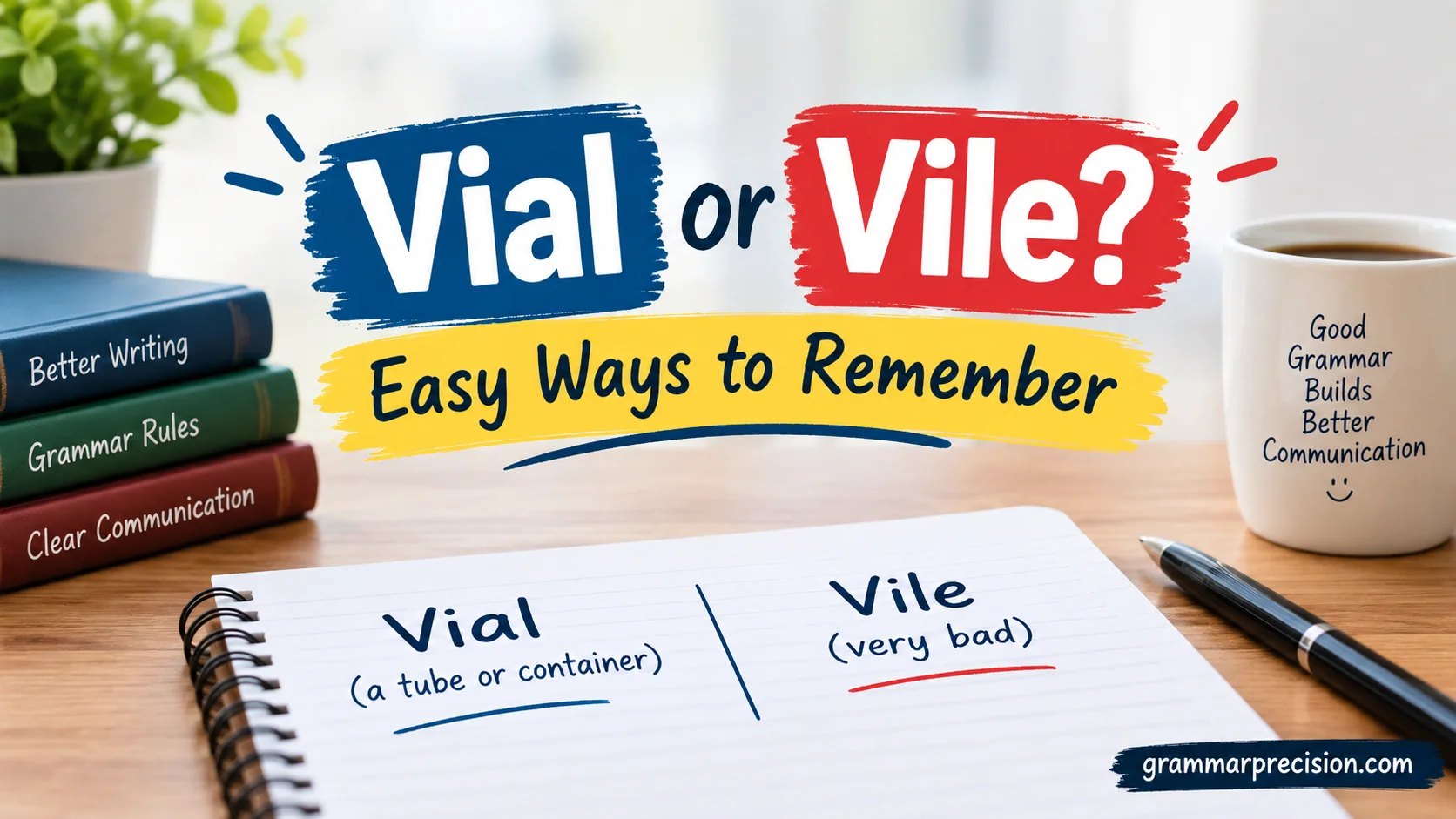
If you often confuse vial or vile, you’re not alone. These words look and sound similar, but their meanings are completely different. One refers to a small container, while the other describes something extremely unpleasant, wicked, or disgusting in writing.
Understanding vial vs vile becomes much easier when you connect each word with its meaning and grammar. A vial is a small container commonly used for medicine, samples, or chemicals. Vile, however, is an adjective for something horrible, offensive, disgusting, or morally bad. Once you see this clear difference, choosing the correct word feels simple. This distinction is useful for clear communication in writing confidently.
The confusion usually comes from their similar spelling and pronunciation. However, context gives you a clue. If you’re talking about a medical container, laboratory sample, or small bottle, you need vial. If you’re describing cruel behavior, a disgusting smell, or an offensive action, vile is the right choice. These patterns can improve your vocabulary, spelling, and writing accuracy. Practice makes the difference easy to remember.
This guide explains vial or vile in simple language, with clear definitions, examples, pronunciation tips, and practical memory tricks. You’ll also discover common mistakes and see how each word works in real sentences. Whether you’re writing an email, assignment, report, or everyday message, this comparison will help you use vial and vile correctly and avoid confusing them again. You’ll build confidence in writing with ease.
One Letter, Two Completely Different Meanings
Vial and vile share three letters and sound similar in many varieties of English. That resemblance makes them easy to mix up when you’re writing quickly. Their meanings, however, live in entirely different worlds.
A vial is a physical object. It’s a small container, usually made of glass or plastic, that holds a liquid, powder, medicine, sample, or other substance.
Vile is a descriptive word. It’s an adjective that tells you something is extremely unpleasant, disgusting, wicked, or morally offensive.
Compare these sentences:
- The pharmacist opened a vial of medication.
- The villain committed a vile act.
The first sentence identifies a container. The second judges an action. That basic contrast solves most vial or vile questions.
Think “Bottle” When You See Vial
What Is a Vial?
A vial is a small container designed to hold a substance. In medical settings, vials commonly contain injectable medicines, vaccines, powders that must be mixed with liquid, or laboratory materials.
A typical vial has a narrow opening and may use a rubber stopper, screw cap, or other closure. In healthcare, the exact design depends on the substance and how it needs to be stored or administered.
The word is a noun because it names a thing. You can have one vial, two vials, or several vials.
For example:
- The doctor ordered a vial of the medication.
- Keep the vial refrigerated according to the label.
- The laboratory stored the sample in a sealed vial.
Where Are Vials Used?
Although people often associate vials with medicine, the word has a broader range of uses. You might encounter it in several settings:
- Healthcare: A vial may contain medication or a vaccine.
- Laboratories: Researchers may store chemicals or biological samples in vials.
- Cosmetics: Small vials can hold concentrated fragrances, oils, or samples.
- Science: Specialized vials can hold materials used in experiments.
- Manufacturing: Small containers may package liquids, powders, or compounds.
That context matters. If the sentence talks about storing, opening, filling, labeling, or carrying a small container, vial is probably the word you need.
Vial vs Bottle vs Ampule
These terms overlap, but they aren’t perfect synonyms.
A bottle is a broad term for a container with a neck and opening. It can be large or small and may hold water, medicine, shampoo, or many other products.
A vial usually suggests a smaller container, especially one used for medicine, laboratory work, or specialized products.
An ampule or ampoule is a sealed container, traditionally made of glass, that must generally be opened by breaking its neck. A vial typically has a removable or pierceable closure instead.
So, calling every small medical container a bottle may be understandable, but vial gives more precise information when the container fits that description.
Think “Horrible” When You See Vile
What Does Vile Mean?
Vile is an adjective used for something extremely unpleasant, disgusting, wicked, or morally offensive. It can describe behavior, language, treatment, smells, conditions, people, or actions.
The strength of the word depends on context. Sometimes vile describes something physically revolting. In other cases, it expresses strong moral judgment.
For example:
- The room had a vile smell.
- The article contained vile insults.
- The criminal planned a vile act.
In each sentence, vile describes something rather than naming an object.
What Can Be Vile?
Because vile is an adjective, it can modify many different nouns. Its meaning often falls into two broad areas.
Physical unpleasantness: A smell, taste, substance, or condition can be vile when it seems extremely disgusting or offensive.
Moral badness: A person’s behavior, crime, lie, or treatment of others can be vile when it seems deeply wicked or contemptible.
Consider the difference between these examples:
- The spoiled food had a vile odor.
- The corrupt official carried out a vile scheme.
The first focuses on disgust. The second focuses on moral wrongdoing. Both use vile correctly.
Vile vs Evil vs Disgusting
These words overlap, but they aren’t interchangeable in every sentence.
Evil usually carries a strong moral meaning. It can describe a person, action, or force considered profoundly wicked.
Disgusting often focuses on something that causes strong physical or emotional revulsion.
Vile can cover both areas. It can suggest disgust, wickedness, contemptibility, or a combination of these ideas.
That flexibility makes vile powerful, but it also means you should consider the exact tone you want.
Vial vs Vile: The Ultimate Comparison
| Feature | Vial | Vile |
| Part of speech | Noun | Adjective |
| Basic meaning | A small container | Extremely unpleasant, wicked, or disgusting |
| Refers to | A physical object | A quality or characteristic |
| Common setting | Medicine, science, cosmetics | Behavior, actions, smells, language |
| Plural form | Vials | No ordinary plural form |
| Example | She opened a vial. | That was a vile act. |
| Memory clue | Think “container” | Think “horrible” |
The easiest distinction is grammatical. Vial is something you can hold. Vile is something you can use to describe.
That rule works surprisingly well.
If you can put “a” before the word and treat it as an object, vial may fit: “a vial.” You wouldn’t normally say “a vile” when you mean the adjective.
Why Writers Mix Up Vial and Vile
The confusion isn’t mysterious. Their spellings are nearly twins.
Vial has the letters V-I-A-L.
Vile has the letters V-I-L-E.
Both begin with “vi,” and both contain the familiar long-i sound in many pronunciations. When you’re typing quickly, that small difference can disappear from your attention.
Another issue comes from context. Someone writing “a vile of medicine” may mentally connect the sound with the correct medical concept but choose the wrong spelling.
There’s also a useful grammatical clue. Medical and laboratory writing often uses vial after words such as of, the, a, one, sealed, small, empty, glass, and medication.
Vile commonly appears before words such as act, behavior, crime, smell, language, insult, treatment, and deed.
These patterns aren’t absolute rules, but they can help you catch mistakes during proofreading.
Vial vs Vile Pronunciation Guide
Pronunciation can vary slightly by accent, especially for vial. In many forms of American English, vial is commonly pronounced like “VY-uhl,” with two syllables. Vile is generally pronounced like “vyle,” with one syllable.
The difference becomes clearer when you say the words slowly:
- vial: VY-uhl
- vile: VYLE
The ending of vial creates an extra syllable. Vile ends with a single long-i sound.
Try saying this pair aloud:
“I opened a vial.”
“That was vile.”
The rhythm changes. The first sentence contains the name of a container. The second uses an adjective to express a strong negative reaction.
Pronunciation helps, but spelling and meaning remain the safest guides in writing.
15+ Example Sentences You Can Learn From
Seeing words in real sentences is often more useful than memorizing dictionary definitions. Notice how the grammar changes with each word.
Examples With “Vial”
- The nurse prepared a vial of medication.
- The scientist labeled each vial before beginning the experiment.
- A tiny vial sat inside the laboratory cabinet.
- The pharmacist checked the vial before dispensing the medicine.
- The sample was transferred into a sterile vial.
- She placed the perfume sample in a glass vial.
- The technician removed one vial from the refrigerated storage unit.
- Each vial contained a carefully measured amount of liquid.
Examples With “Vile”
- The garbage produced a vile smell.
- His vile comments offended everyone in the room.
- The detective uncovered a vile scheme.
- The abandoned building had a vile odor.
- She condemned the attacker’s vile behavior.
- The novel describes a vile act of betrayal.
- The drink had a vile taste.
- The report exposed the company’s vile treatment of workers.
Notice the pattern: vial names the container, while vile describes something negatively.
Common Mistakes That Change the Meaning
A spelling error can create more than an awkward sentence. It can change the entire meaning.
Mistake: “The nurse opened a vile of medicine.”
This sentence uses vile when the intended word is vial. Medicine can be stored in a vial, not a “vile.”
Correct:
The nurse opened a vial of medicine.
Mistake: “That was a vial thing to do.”
Here, the writer probably means that the action was terrible or disgusting. The correct word is vile.
Correct:
That was a vile thing to do.
Mistake: “He has a vial attitude.”
If you mean his attitude is morally offensive or extremely unpleasant, use vile.
Correct:
He has a vile attitude.
Mistake: “The laboratory kept the sample in a vile.”
Again, the physical container requires vial.
Correct:
The laboratory kept the sample in a vial.
A useful proofreading question is simple: Am I naming a container or describing something awful? If you’re naming the container, choose vial. If you’re describing something deeply unpleasant, choose vile.
Also Read This: Truly vs Truely: How to Never Misspell It Again
Case Study: One Letter in a Medical Sentence
Imagine reading a medication instruction that says:
“Store the medicine in the original vile.”
A reader may understand the intended meaning from context, but the sentence still contains an error. Vile describes something unpleasant. It doesn’t name a container.
Now change one letter:
“Store the medicine in the original vial.”
Suddenly, the sentence uses the correct noun. The meaning becomes precise.
This tiny example shows why spelling accuracy matters in practical writing. In medical, scientific, technical, and professional contexts, precise vocabulary reduces confusion.
Case Study: One Letter in a Description
Now consider this sentence:
“The character performed a vial act.”
That wording sounds wrong because vial doesn’t describe behavior. Replace it with vile:
“The character performed a vile act.”
Now the sentence clearly communicates that the act was morally terrible or deeply offensive.
The grammar gives you a second clue. Act needs an adjective here, and vile can perform that job. Vial cannot.
The Fastest Way to Remember Vial vs Vile
Memory tricks work best when they create a strong mental picture.
For vial, imagine a tiny glass bottle sitting on a pharmacy shelf.
For vile, imagine something so disgusting or wicked that you immediately want to reject it.
Then remember this sentence:
Vial contains. Vile condemns.
It’s short enough to recall when you’re writing.
Another useful trick is:
Vial = vessel
Both words begin with a “V” idea. A vial is a small vessel or container.
Vile = very bad
The phrase isn’t a dictionary definition, but it captures the general emotional force of vile.
You can also remember the endings:
- Vial → container
- Vile → horrible
If you practice these associations a few times, the spelling becomes much easier to retrieve automatically.
Related Words Worth Knowing
Understanding related vocabulary can make the distinction even stronger.
Words Related to Vial
Bottle: A broad term for a container with a neck and opening.
Ampule: A small sealed container, often made of glass and commonly associated with medicines or laboratory materials.
Container: A general word for something designed to hold another substance.
Vialed: A rare technical form that can mean placed into vials. In everyday writing, phrases such as “placed in vials” are usually clearer.
Words Related to Vile
Vilify: To speak about someone or something in a strongly abusive or insulting way.
Vilification: The act of attacking someone’s reputation with harsh criticism or abuse.
Vileness: The quality of being vile.
Wicked: Morally bad or deliberately harmful, although its tone can vary by context.
These word families reveal an important spelling pattern. Vile connects with vilify, vilification, and vileness. Vial belongs to a completely different word family centered on containers.
Vial or Vile: Quick Decision Guide
When you’re stuck, run through this checklist:
- Is it a small container? → Vial
- Does it hold medicine or a sample? → Vial
- Are you talking about a laboratory container? → Vial
- Are you describing something disgusting? → Vile
- Are you describing cruel or wicked behavior? → Vile
- Are you criticizing an offensive act or remark? → Vile
This method takes only a few seconds.
The most important thing isn’t memorizing two spellings in isolation. It’s connecting each spelling to its meaning.
A 30-Second Test: Vial or Vile?
Ready to test the difference? Fill in each blank with vial or vile.
- The pharmacist handed me a small ___ of medicine.
- The spoiled meat had a ___ odor.
- The scientist sealed the sample inside a ___.
- The judge condemned the criminal’s ___ actions.
- The technician inspected every ___ before the experiment.
Answers
- vial
- vile
- vial
- vile
- vial
Here’s the shortcut: if the blank refers to a container, choose vial. If it describes something horrible, disgusting, or wicked, choose vile.
Vial or Vile in Everyday Writing
The distinction becomes especially useful when you’re writing quickly. Emails, school assignments, workplace documents, medical notes, and creative writing can all contain these words.
Suppose you’re describing a laboratory procedure. You might write:
“Place the liquid in a sterile vial.”
Now imagine reviewing a crime report:
“The investigators described the act as vile.”
The context almost gives you the answer before you consciously think about spelling.
A useful habit is to pause whenever a word looks familiar but feels uncertain. Don’t rely only on sound. Ask what role the word plays in the sentence.
If it names an object, vial is likely correct. If it describes a negative quality, vile is likely correct.
FAQs:
Is “vial” or “vile” correct for a small container?
Vial is correct when you mean a small container, especially one used for medicine, chemicals, laboratory samples, or other liquids. For example, “The nurse opened a vial of medication.” Vile doesn’t refer to a container.
What does “vile” mean?
Vile is an adjective that describes something extremely unpleasant, disgusting, wicked, or morally offensive. For example, you might describe cruel behavior as vile. The word can also describe a terrible smell, taste, action, or comment.
Are vial and vile pronounced the same?
No, they’re generally not pronounced the same. In American English, vial commonly has two syllables, while vile has one syllable. Their similar spelling can cause confusion, but their pronunciation and meanings help distinguish them.
How can I easily remember vial vs vile?
Use this simple memory trick: “Vial contains, vile condemns.” A vial is a container that holds something. Vile describes something horrible, disgusting, or wicked. Connecting each word with a clear idea makes the spelling easier to remember.
Can I use “vile” to describe a person?
Yes. Vile can describe a person when you want to express strong disapproval of their behavior, character, or actions. For example, “The story described him as a vile person.” However, it’s a strong and negative word, so use it when the context supports that level of criticism.
Conclusion:
Vial or vile may look similar, but their meanings are completely different. Vial means a small container, while vile describes something extremely unpleasant, disgusting, or morally bad. Knowing this basic difference can help you avoid common spelling and vocabulary mistakes.
When you need the word for a small bottle or medical container, choose vial. When you want to describe something horrible, wicked, offensive, or disgusting, choose vile. A simple memory trick can make the distinction stick: a vial contains, while vile describes.
Once you understand the meaning, grammar, and context of each word, choosing between them becomes much easier. Keep vial = container and vile = horrible in mind whenever you write. This small distinction can improve your spelling, vocabulary, clarity, and overall writing accuracy.