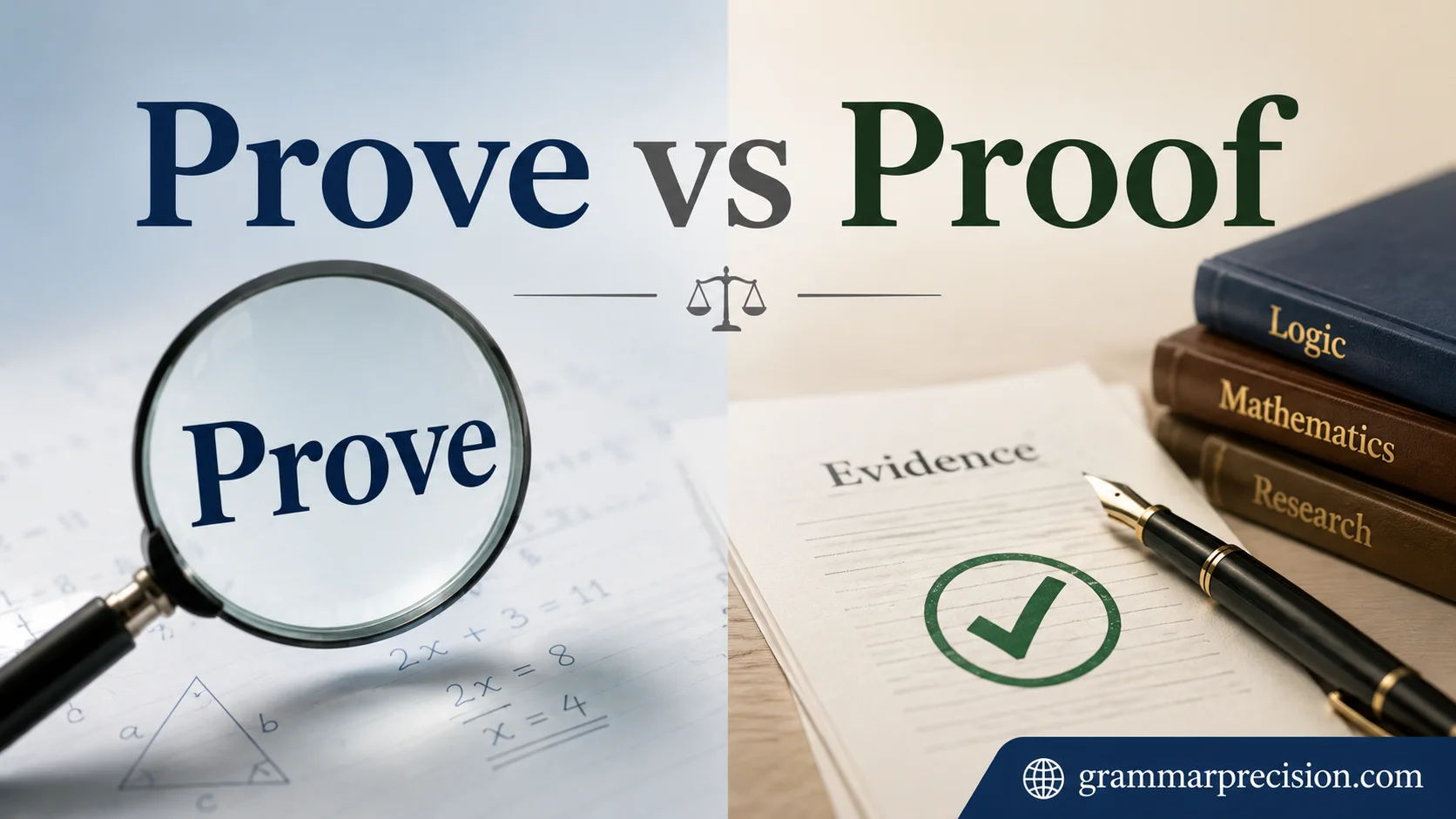
Prove vs Proof helps learners understand how prove shows action and proof shows evidence in simple English learning and reduces confusion in grammar usage for better clarity.
In my experience, learners often face confusion when dealing with this pair of words, because they sound identical and feel the same, creating a tricky context. I usually compare them using simple terms and examples based guidance, where prove is a verb showing action and truth demonstration, while proof is a noun showing evidence or verification. This comparison improves clarity, reduces confusion, and builds confidence in communication skills and writing.
When I teach, I focus on concept, function, and form so learners understand correct usage in different contexts. This helps avoid mistakes and improves grammar, making communication more clear, confident, and natural. Paying attention to structure, sentence, and semantics helps students develop skills in a fast and effective way, turning learning into a habit of better clarification and correctness.
The Fast Answer: Prove vs Proof
Here’s the simplest explanation possible:
WordPart of SpeechMeaningExampleProveVerbTo show something is true“Can you prove it?”ProofNounEvidence that shows something is true“Do you have proof?”
Think about it this way:
- You prove something
- You show proof of something
That single distinction solves most mistakes instantly.
What Does “Prove” Mean?
The word prove is a verb. A verb expresses an action.
When you prove something, you demonstrate that it is true through facts, logic, testing, or evidence.
Simple Definition of Prove
Prove = to establish truth
You actively do something.
Examples
- She proved her innocence.
- Scientists proved the theory.
- Can you prove your claim?
- He wants to prove everyone wrong.
In every example above, someone performs an action.
That’s why “prove” behaves like verbs such as:
- show
- confirm
- demonstrate
- verify
What Does “Proof” Mean?
The word proof is usually a noun.
A noun names a person, place, thing, or idea. In this case, “proof” refers to the evidence itself.
Simple Definition of Proof
Proof = evidence or confirmation
Examples
- Do you have proof?
- The video is proof of his innocence.
- We found proof that the system failed.
- There’s no proof she lied.
Notice the pattern:
You can hold, show, provide, or examine proof.
That’s because proof is a thing, not an action.
The Core Difference Between Prove and Proof
Many English learners confuse prove and proof because both words relate to showing that something is true. However, they have different grammatical roles and uses.
| Word | Part of Speech | Meaning | Example |
| Prove | Verb | To show that something is true | She will prove her point. |
| Proof | Noun | Evidence or facts showing something is true | Do you have any proof? |
What Does “Prove” Mean?
Prove is an action word (verb). It describes the act of demonstrating or confirming truth through facts, logic, or evidence.
Examples:
- The scientist tried to prove the theory.
- Can you prove your claim?
- His hard work will prove everyone wrong.
What Does “Proof” Mean?
Proof is a noun. It refers to the evidence, facts, or information used to confirm that something is true.
Examples:
- The lawyer presented strong proof in court.
- There is no proof of the rumor.
- Photos can serve as proof of identity.
Quick Memory Trick
- Prove = the action
- Proof = the evidence
Think of it this way:
You prove something by giving proof.
Common Mistake
❌ Incorrect:
- Can you proof that statement?
✅ Correct:
- Can you prove that statement?
❌ Incorrect:
- I need to prove of purchase.
✅ Correct:
- I need proof of purchase.
Prove vs. Proof in a Sentence
- The detective used solid proof to prove the suspect was guilty.
This sentence shows how both words work together naturally.
Why English Learners Confuse Prove and Proof
This mistake happens for several reasons.
The Words Look Related
Both words come from the Latin root probare, meaning “to test” or “to demonstrate.”
Because they share a root, learners naturally assume they function the same way.
They don’t.
English often creates related words with different grammatical roles:
VerbNounBelieveBeliefApproveApprovalProveProof
The relationship exists. The grammar changes.
Many Languages Use One Word
In several languages, one word covers both meanings.
A Reddit discussion highlighted how Dutch speakers translate both “proof” and “evidence” into one term.
That overlap causes direct translation mistakes.
For example:
- Incorrect: “I need prove.”
- Correct: “I need proof.”
The Internet Spreads Bad Grammar
Social media captions, memes, and casual texting often ignore grammar rules.
You’ll sometimes see phrases like:
- “Proof me wrong”
- “Where’s your prove?”
- “This is enough prove”
Native speakers notice these errors immediately.
How Native Speakers Instinctively Use These Words
Native speakers rarely stop to analyze grammar rules consciously. Instead, they recognize sentence rhythm.
Certain structures simply sound correct.
Common Native Patterns With “Prove”
- prove a point
- prove innocence
- prove a theory
- prove yourself
- prove them wrong
Common Native Patterns With “Proof”
- proof of identity
- proof of ownership
- proof of concept
- proof of address
- living proof
These combinations are called collocations. Native speakers memorize them naturally through repetition.
Also Read This: Dialog vs. Dialogue
Prove vs Proof in Real Life Situations
Grammar becomes easier when you see it in context.
In Business English
Correct
- Please provide proof of payment.
- We must prove the results are accurate.
Incorrect
- Please provide prove of payment.
- We must proof the results are accurate.
In Legal English
Lawyers constantly distinguish between proving something and presenting proof.
Example
- The attorney must prove the defendant acted intentionally.
- The fingerprint became proof of involvement.
In Academic Writing
Academic English heavily uses both words.
Examples
- Researchers proved the hypothesis through testing.
- The experiment offered proof of contamination.
In Everyday Conversation
Natural Sentences
- “Can you prove that?”
- “I need proof.”
- “That proves nothing.”
- “Do you have any proof?”
These expressions appear constantly in movies, TV shows, and casual conversation.
The Biggest Grammar Mistakes People Make
Some mistakes appear again and again.
Mistake: “Can You Proof It?”
Usually incorrect.
Why?
Because “proof” is normally a noun.
Correct Version
- “Can you prove it?”
However, there’s an important exception later in this article.
Mistake: “I Need Prove”
Incorrect because “need” requires a noun here.
Correct Version
- “I need proof.”
Mistake: “This Is a Prove”
Incorrect because “prove” is not functioning as a noun.
Correct Version
- “This is proof.”
Mistake: “Proof Me Wrong”
This one spreads online constantly.
Correct Version
- “Prove me wrong.”
The Surprising Exception: “Proof” Can Be a Verb
Here’s where English gets tricky.
Although “proof” is usually a noun, it can sometimes function as a verb.
That surprises many learners.
Example: Proofreading
Editors often say:
- “I need to proof this article.”
In publishing, “to proof” means checking text for errors before publication.
That usage comes from printing terminology.
Example: Baking
Bread makers also use “proof” as a verb.
Example
- “Let the dough proof for one hour.”
Here, “proof” means allowing dough to rise.
Why This Confuses Learners
A Reddit grammar discussion explained this perfectly:
“Proof is usually a noun. Prove is a verb.”
But English loves exceptions.
That’s why context matters.
Prove vs Proof vs Proven vs Proved
Now things get more interesting.
Many learners also confuse:
- prove
- proof
- proved
- proven
Let’s simplify them.
WordTypeMeaningExampleProveVerbShow truth“Prove it.”ProofNounEvidence“Where’s the proof?”ProvedPast tenseDemonstrated“She proved him wrong.”ProvenPast participle/adjectiveEstablished as true“A proven method.”
Proved vs Proven: Which Is Correct?
Both forms are correct in modern English.
However, usage depends on sentence structure.
Usually Use “Proved” For Simple Past
- He proved his point.
- Scientists proved the claim.
Usually Use “Proven” As an Adjective
- a proven strategy
- proven results
- proven methods
In formal mathematical writing, “proved” still appears frequently.
The Hidden Meanings of “Proof”
Most learners only know one meaning of proof: evidence.
English actually uses the word in several industries.
Proof in Mathematics
In mathematics, a proof demonstrates why something must logically be true.
Example
A geometry proof may show why:
genui{“math_block_widget_always_prefetch_v2”:{“content”:”a^2+b^2=c^2″}}
works for right triangles.
Mathematical proofs require structured logic.
Proof in Publishing
Publishers use “proof” to describe a trial version before final printing.
Examples
- proof copy
- page proof
- galley proof
Editors review these versions for mistakes.
Proof in Alcohol Measurement
In the United States, “proof” measures alcohol strength.
Example
- 80 proof whiskey
That means the alcohol content equals 40% ABV.
Many learners never realize this meaning exists.
Proof in Product Design
Modern business language includes phrases like:
- waterproof
- bulletproof
- future proof
- tamper proof
Here, “proof” suggests resistance or protection.
The Difference Between Proof and Evidence
People often treat these words as identical. They aren’t exactly the same.
A Reddit explanation summarized it beautifully:
“Proof requires evidence, but not all evidence constitutes proof.”
Simple Breakdown
WordMeaningEvidenceInformation supporting a claimProofConclusive confirmation
Example
- A fingerprint is evidence.
- Multiple confirmed facts may become proof.
This distinction appears constantly in law and science.
Common Collocations With “Prove”
Learning collocations dramatically improves fluency.
Natural Phrases
- prove a point
- prove your worth
- prove innocence
- prove guilt
- prove effective
- prove useful
- prove difficult
- prove impossible
Example Sentences
- The new software proved effective.
- She wants to prove her abilities.
- The test proved difficult.
Common Collocations With “Proof”
Natural Phrases
- proof of identity
- proof of concept
- proof of purchase
- proof of address
- burden of proof
- living proof
- photographic proof
Example Sentences
- We need proof of ownership.
- He’s living proof that hard work matters.
- The photo became proof of the accident.
Prove vs Proof Pronunciation
Pronunciation adds another layer of confusion.
WordPronunciationProveProovProofProof
The endings sound similar but not identical.
- Prove ends with a soft V sound
- Proof ends with an F sound
That tiny distinction matters in spoken English.
How to Remember the Difference Forever
Simple memory tricks work best.
Trick One: Action vs Object
- Prove = action
- Proof = object
Trick Two: Sentence Test
Ask yourself:
“Can I DO it?”
If yes, use prove.
“Can I HAVE it?”
If yes, use proof.
Trick Three: Verb vs Thing
- You prove a theory.
- You show proof of a theory.
Side by Side Sentence Comparisons
IncorrectCorrectI need prove.I need proof.Can you proof that?Can you prove that?This is a prove.This is proof.Please proof my essay.Correct in editing contextWe proved the theory.CorrectWe found proof.Correct
Why “Proofread” Causes So Much Confusion
The word “proofread” tricks many learners.
They assume “proof” must be a verb everywhere.
That’s not true.
What Proofread Actually Means
To proofread means:
- checking writing for mistakes
- correcting grammar
- reviewing formatting
Publishing history created this expression long ago.
It doesn’t mean every use of “proof” becomes a verb.
Mini Case Study: Real Workplace Mistake
A marketing intern once emailed:
“Please proof that the campaign works.”
The sentence sounded unnatural because the writer mixed up the noun and verb forms.
A native speaker would write:
“Please prove that the campaign works.”
OR
“Please proofread the campaign materials.”
One tiny word changed the entire meaning.
That’s why grammar precision matters in professional communication.
How Native Speakers Actually Think About These Words
Native speakers rarely memorize grammar charts.
Instead, they recognize patterns.
Here’s the mental shortcut many subconsciously use:
SituationWordShowing truthProveEvidence itselfProofEditing textProofBread risingProof
That’s why fluency comes from exposure and repetition.
Mini Quiz: Test Yourself
Choose the correct word.
Questions
- Can you ___ it?
- We finally found ___.
- The lawyer must ___ innocence.
- Do you have ___ of payment?
- Please ___ this article before publishing.
Answers
- prove
- proof
- prove
- proof
- proof
Advanced Grammar Insight Most Articles Miss
Here’s something many grammar guides ignore:
“Proof” and “prove” represent two different stages of truth.
Prove = Process
You actively demonstrate something.
Proof = Result
You now possess evidence.
That subtle distinction explains why the words feel related yet grammatically separate.
FAQs:
What is the main difference between Prove and Proof?
The main difference is that prove is a verb showing action of demonstrating truth, while proof is a noun showing evidence or verification in English usage.
Why do learners confuse Prove and Proof?
Learners often face confusion because both words sound similar, look identical, and come from the same common root, which creates a tricky context in English grammar.
How can I remember the difference easily?
You can remember by linking prove with action and verb, and proof with evidence and noun, which improves clarity and reduces mistakes in writing.
Can Prove and Proof be used interchangeably?
No, they are not interchangeable. Using them incorrectly can lead to wrong usage, poor sentence structure, and unclear communication in everyday English.
How does understanding Prove vs Proof improve communication?
Understanding Prove vs Proof improves communication skills, strengthens grammar, increases confidence, and makes your writing more clear, correct, and professional.
Conclusion:
Understanding Prove vs Proof is important for building strong English grammar foundations. It removes confusion, improves clarity, and helps learners use both words in the correct context.
With proper practice, you can confidently apply prove as an action verb and proof as evidence based noun, making your communication more effective, natural, and error free.