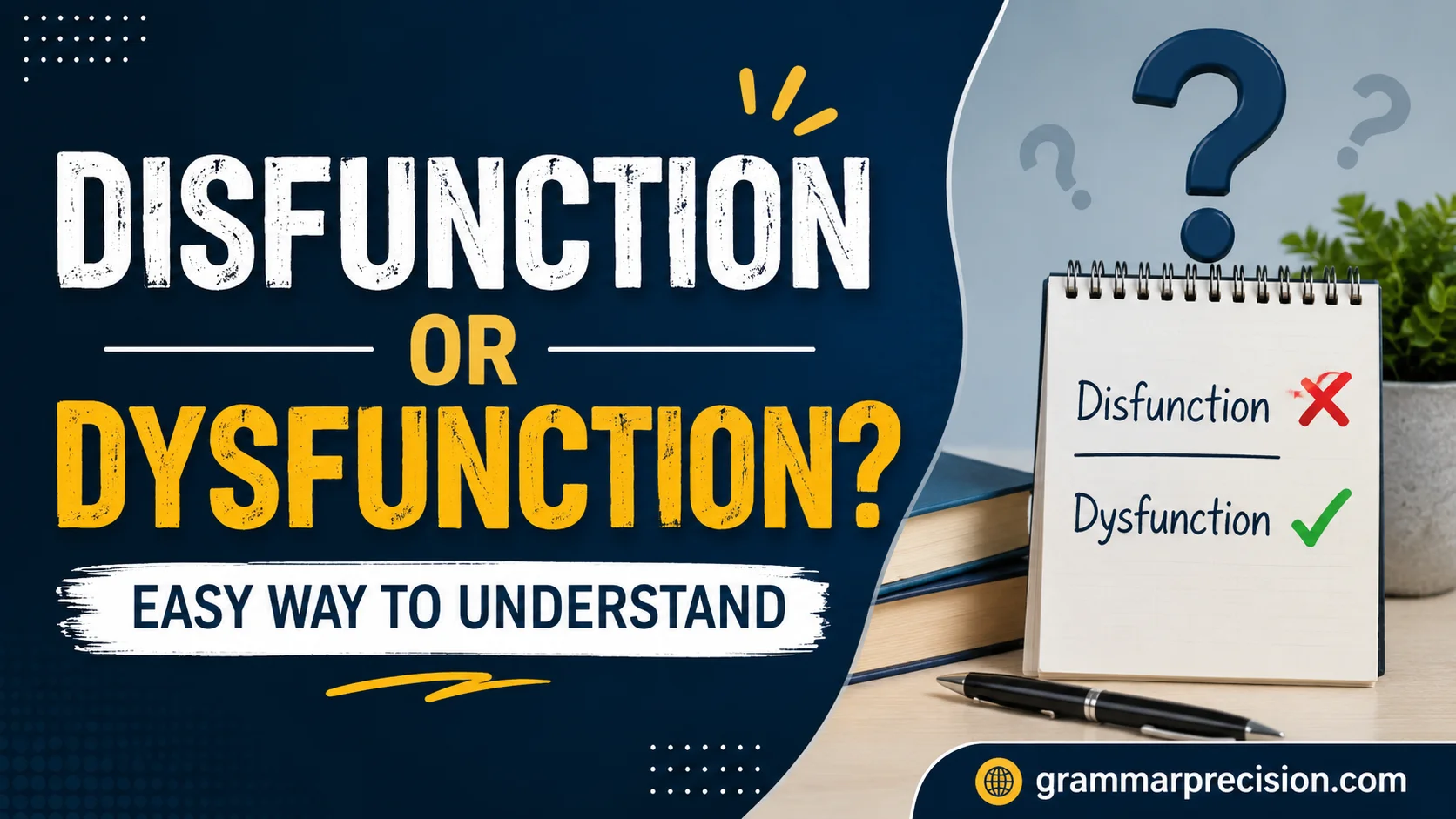
Confused about Disfunction or Dysfunction? You’re not alone. Many English learners mix up these spellings, but only one is standard in modern English. Let’s make the difference simple.
The correct spelling is dysfunction, which means abnormal or ineffective functioning. You’ll often see it in medical, psychological, workplace, and everyday contexts. Although “disfunction” looks familiar, it’s generally considered a misspelling in standard English. Understanding the prefix dys- makes the correct spelling much easier to remember.
Whether you’re writing an academic paper, professional report, blog post, or everyday sentence, choosing the right word matters. This guide explains dysfunction meaning, correct spelling, usage, examples, pronunciation, and related words. By the end, you’ll know exactly when to use dysfunction and why “disfunction” should usually be avoided.
Disfunction or Dysfunction: The Quick Answer
Dysfunction is the standard spelling in modern English.
Disfunction is generally considered a misspelling and should be avoided in formal, academic, professional, and edited writing.
| Spelling | Standard English? | Meaning |
| Dysfunction | Yes | Abnormal, impaired, or ineffective functioning |
| Disfunction | Generally no | Usually a misspelling of dysfunction |
| Dysfunctional | Yes | Not working or operating normally |
| Dysfunctionality | Yes | The state or quality of being dysfunctional |
For example:
The company developed serious dysfunction after its leadership changed.
Not:
The company developed serious disfunction after its leadership changed.
The distinction is simple: use dysfunction when you mean abnormal or ineffective functioning.
What Does Dysfunction Mean?
Dysfunction is a noun that describes a problem with the normal operation of a person, system, organization, relationship, body part, or process.
The word doesn’t always mean complete failure. Something can continue working while functioning poorly.
For example, a team might still complete projects despite constant arguments, unclear responsibilities, and poor communication. In that situation, you could describe the group as experiencing dysfunction.
The word appears in many fields, including:
- Medicine
- Psychology
- Family studies
- Business
- Education
- Technology
- Sociology
- Organizational management
Its broad meaning makes it useful whenever something isn’t functioning in the way it normally should.
Dysfunction in Simple English
In everyday language, dysfunction means a failure to work properly or normally.
Consider a bicycle with a loose chain. The bicycle hasn’t completely stopped being a bicycle. It simply can’t perform its intended job properly.
The same idea applies to less tangible things.
A workplace may have talented employees and excellent equipment, yet poor communication can create organizational dysfunction. A family may care deeply about one another while unhealthy communication patterns create relationship dysfunction.
In other words, dysfunction is about impaired functioning, not necessarily total destruction.
Dysfunction Pronunciation and Word Forms
Understanding the word’s pronunciation and related forms can make it easier to recognize and use correctly.
Dysfunction is commonly pronounced roughly as:
dis-FUNK-shun
The stress falls on funk.
The word also has several useful related forms:
| Word | Part of Speech | Meaning |
| Dysfunction | Noun | Abnormal or ineffective functioning |
| Dysfunctional | Adjective | Not functioning normally |
| Dysfunctionally | Adverb | In a dysfunctional manner |
| Dysfunctionality | Noun | The state or quality of being dysfunctional |
Examples:
- The organization suffers from dysfunction.
- The organization has a dysfunctional communication system.
- The departments work dysfunctionally together.
- The report examined the system’s dysfunctionality.
The most common forms you’ll encounter are dysfunction and dysfunctional.
Why Is Dysfunction Spelled With “Dys”?
Here’s where the spelling mystery gets interesting.
The word dysfunction contains the prefix dys-, which comes from Greek and carries meanings associated with bad, difficult, abnormal, impaired, or faulty functioning.
That prefix appears in many English words.
Examples include:
- Dyslexia
- Dysphasia
- Dysplasia
- Dysregulation
- Dysgraphia
- Dysfunction
So, although disfunction looks familiar, the standard spelling reflects the word’s formation with dys-.
What Does “Dys-” Mean?
The prefix dys- generally signals something abnormal, impaired, difficult, or poorly functioning.
For instance, dysfunction describes impaired functioning.
The same pattern appears in other specialized terms. This is especially noticeable in medical and scientific vocabulary, where dys- frequently identifies an abnormal process or condition.
What Does “Dis-” Mean?
The prefix dis- has several meanings. Depending on the word, it can indicate separation, reversal, removal, opposition, or negation.
Consider:
- Disconnect = separate
- Disagree = have a different opinion
- Disapprove = judge something negatively
- Disappear = cease to be visible
- Disable = make unable to function
Because dis- is so common, people sometimes apply it to function and produce the spelling disfunction.
That’s understandable as a spelling error. It isn’t the standard form, though.
Disfunction or Dysfunction: Detailed Comparison
The easiest way to settle the question is to compare the two forms directly.
| Feature | Dysfunction | Disfunction |
| Standard spelling | Yes | No |
| Common in edited English | Yes | Rare/nonstandard |
| Used as a noun | Yes | Usually a misspelling |
| Adjective form | Dysfunctional | Disfunctional is generally incorrect |
| Recommended in formal writing | Yes | No |
| Core meaning | Abnormal or ineffective functioning | Usually intended to mean dysfunction |
Is Disfunction Ever Used?
You may encounter disfunction in informal writing, online discussions, old documents, or text containing spelling mistakes.
Seeing a form in print doesn’t automatically make it a standard spelling. English contains many nonstandard spellings that appear repeatedly because writers confuse similar-looking words.
For modern standard English, dysfunction remains the safer and more appropriate choice.
If you’re writing an essay, report, article, business document, application, or academic paper, choose dysfunction.
Dysfunction vs Malfunction: What’s the Difference?
Dysfunction and malfunction overlap, but they’re not perfect synonyms.
A malfunction usually refers to something that fails to operate correctly, especially a machine, device, technical system, or mechanical component.
Dysfunction has a broader range. It can describe biological processes, relationships, organizations, social systems, and other situations involving impaired functioning.
Compare these examples:
The printer experienced a malfunction.
The department suffers from communication dysfunction.
The first sentence focuses on a technical failure. The second describes a broader problem in how people or a system operate.
| Word | Main idea | Common contexts |
| Dysfunction | Abnormal or ineffective functioning | Relationships, organizations, bodies, systems |
| Malfunction | Failure to operate correctly | Machines, devices, equipment |
| Disorder | Lack of normal order or functioning | Medicine, psychology, social conditions |
The words can overlap in some contexts. Still, choosing the more precise term makes your writing clearer.
Also Read This: Whichever vs Whatever: Understanding Their Differences and Uses
Dysfunction vs Disorder
Another common comparison is dysfunction vs disorder.
A disorder generally refers to a condition in which normal structure, order, or functioning has been disturbed. The word has especially important uses in medical and psychological contexts.
Dysfunction, by contrast, emphasizes impaired performance or operation.
For example:
The patient has a disorder affecting the nervous system.
The condition causes neurological dysfunction.
These sentences can describe related circumstances, but they aren’t identical. One emphasizes a recognized condition or disturbance. The other highlights impaired function.
In everyday writing, context determines which word fits best.
Dysfunction vs Dysfunctional
These words are closely related, but their grammatical roles differ.
Dysfunction is primarily a noun.
The organization has serious dysfunction.
Dysfunctional is an adjective.
The organization has a dysfunctional management structure.
A useful shortcut is to remember:
Dysfunction = the problem
Dysfunctional = describes something affected by the problem
More examples:
- Family dysfunction can affect communication.
- They grew up in a dysfunctional household.
- The company is dealing with organizational dysfunction.
- Its leadership structure is dysfunctional.
Is “Disfunctional” Correct?
Generally, no. Disfunctional is usually another misspelling created by changing dysfunctional to the more familiar dis- spelling pattern.
The standard form is:
dysfunctional
Not:
disfunctional
The same spelling principle applies to both words.
Dysfunction in Different Fields
One reason dysfunction appears so often online is its versatility. The word can describe many kinds of impaired functioning.
Medical Dysfunction
In medicine, dysfunction can describe a body part, organ, or physiological process that isn’t functioning normally.
Examples include:
- Kidney dysfunction
- Liver dysfunction
- Immune dysfunction
- Sexual dysfunction
- Neurological dysfunction
The exact meaning depends on the body system being discussed.
Relationship Dysfunction
In relationships, dysfunction often describes unhealthy patterns that interfere with communication, trust, cooperation, or emotional well-being.
For example, repeated manipulation, poor boundaries, constant conflict, or an inability to communicate openly may contribute to relationship dysfunction.
The term doesn’t necessarily mean that every part of the relationship is unhealthy. It focuses on patterns that prevent healthy functioning.
Workplace Dysfunction
A workplace can become dysfunctional when employees struggle with unclear authority, poor communication, repeated conflict, or ineffective leadership.
Consider this scenario:
A marketing team has skilled employees, but nobody knows who approves final campaigns. Two managers give conflicting instructions, deadlines constantly change, and employees stop raising concerns.
The team has capable people. The problem lies in how the system operates.
That’s a useful example of organizational dysfunction.
Technical Dysfunction
The word can also appear in technical contexts when a system operates abnormally.
For example:
Engineers investigated the network’s persistent dysfunction.
However, malfunction may sound more natural when discussing a specific device or mechanical failure.
Examples of Dysfunction in Everyday English
Seeing the word in context makes its meaning much easier to remember.
Example Sentences
- The committee’s internal dysfunction delayed the decision.
- The doctor evaluated the patient’s organ dysfunction.
- Poor communication created serious workplace dysfunction.
- The organization tried to address its leadership dysfunction.
- Family dysfunction can influence how people communicate.
- The software showed signs of system dysfunction.
- The new manager reduced conflict and improved team performance.
- The report examines the causes of organizational dysfunction.
- Chronic stress can contribute to problems with normal functioning.
- The company hired a consultant to identify sources of dysfunction.
Notice how the word changes slightly depending on context. Yet the central idea stays consistent: something isn’t functioning properly.
Common Mistakes With Dysfunction
Even when readers know the meaning, several spelling and usage mistakes can creep into their writing.
Mistake: Writing “Disfunction”
This is the most common error.
Incorrect:
The department suffers from serious disfunction.
Correct:
The department suffers from serious dysfunction.
Mistake: Writing “Disfunctional”
The adjective follows the same spelling pattern.
Incorrect:
The team has a disfunctional structure.
Correct:
The team has a dysfunctional structure.
Mistake: Confusing Dysfunction With Malfunction
Not every problem should automatically be called a malfunction.
A broken computer component may malfunction. A dysfunctional organization can still operate while performing poorly.
Mistake: Treating Dysfunction as Complete Failure
Dysfunction doesn’t necessarily mean that something has stopped working entirely.
A system can continue operating while functioning inefficiently, abnormally, or ineffectively.
That distinction matters in professional writing.
Synonyms for Dysfunction
The best synonym depends on the context.
Useful alternatives include:
- Impairment
- Malfunction
- Disruption
- Disorder
- Abnormality
- Inefficiency
- Failure
- Instability
- Breakdown
- Poor functioning
These words aren’t interchangeable in every sentence.
For example, breakdown may suggest a more severe failure, while inefficiency emphasizes poor performance. Impairment often suggests reduced ability or function.
Choosing the right synonym can make a sentence more precise.
How to Remember “Dysfunction” Forever
Here’s a simple memory trick.
Think of dys- as the prefix connected with abnormal or impaired functioning.
Then connect it with the base word:
Dys + function = dysfunction
You can also remember related words:
- Dyslexia
- Dysplasia
- Dysregulation
- Dysfunction
Seeing the same prefix across several words makes the spelling easier to recognize.
A Quick Spelling Test
Fill in the blank:
The organization suffers from serious _______.
Which spelling looks right?
- A. Disfunction
- B. Dysfunction
The correct answer is B. Dysfunction.
Once you’ve learned the pattern, the distinction becomes much less troublesome.
Correct vs Incorrect Examples
| Incorrect | Correct |
| disfunction | dysfunction |
| disfunctional | dysfunctional |
| disfuntion | dysfunction |
| organizational disfunction | organizational dysfunction |
| family disfunction | family dysfunction |
These mistakes usually happen because writers naturally associate the negative meaning with the familiar dis- prefix.
The fix is straightforward: whenever you mean abnormal or impaired functioning, check for dys-.
FAQs:
Is “disfunction” or “dysfunction” correct?
Dysfunction is the correct and standard spelling in modern English. Disfunction is generally considered a misspelling. Use dysfunction in academic, professional, and everyday writing when describing abnormal or ineffective functioning.
What does dysfunction mean?
Dysfunction means that a person, system, organization, or body part isn’t working or functioning normally. For example, workplace dysfunction can involve poor communication, conflict, or ineffective leadership.
Is “disfunction” a real English word?
You may find disfunction in informal writing or online content, but it isn’t the standard spelling recommended in modern English. For clear and professional writing, choose dysfunction instead.
What is the difference between dysfunction and malfunction?
Dysfunction has a broad meaning and can describe problems with people, relationships, organizations, or biological systems. Malfunction usually refers to a machine, device, or technical system that isn’t working correctly.
What is the adjective form of dysfunction?
The adjective form is dysfunctional. For example, “The company has serious dysfunction” uses the noun, while “The company has a dysfunctional management system” uses the adjective.
Conclusion:
When choosing between disfunction or dysfunction, always use dysfunction in standard English. It describes abnormal, impaired, or ineffective functioning in many different contexts.
Remember that the related adjective is dysfunctional, not “disfunctional.” Once you understand the dys- prefix, remembering the correct spelling becomes much easier.