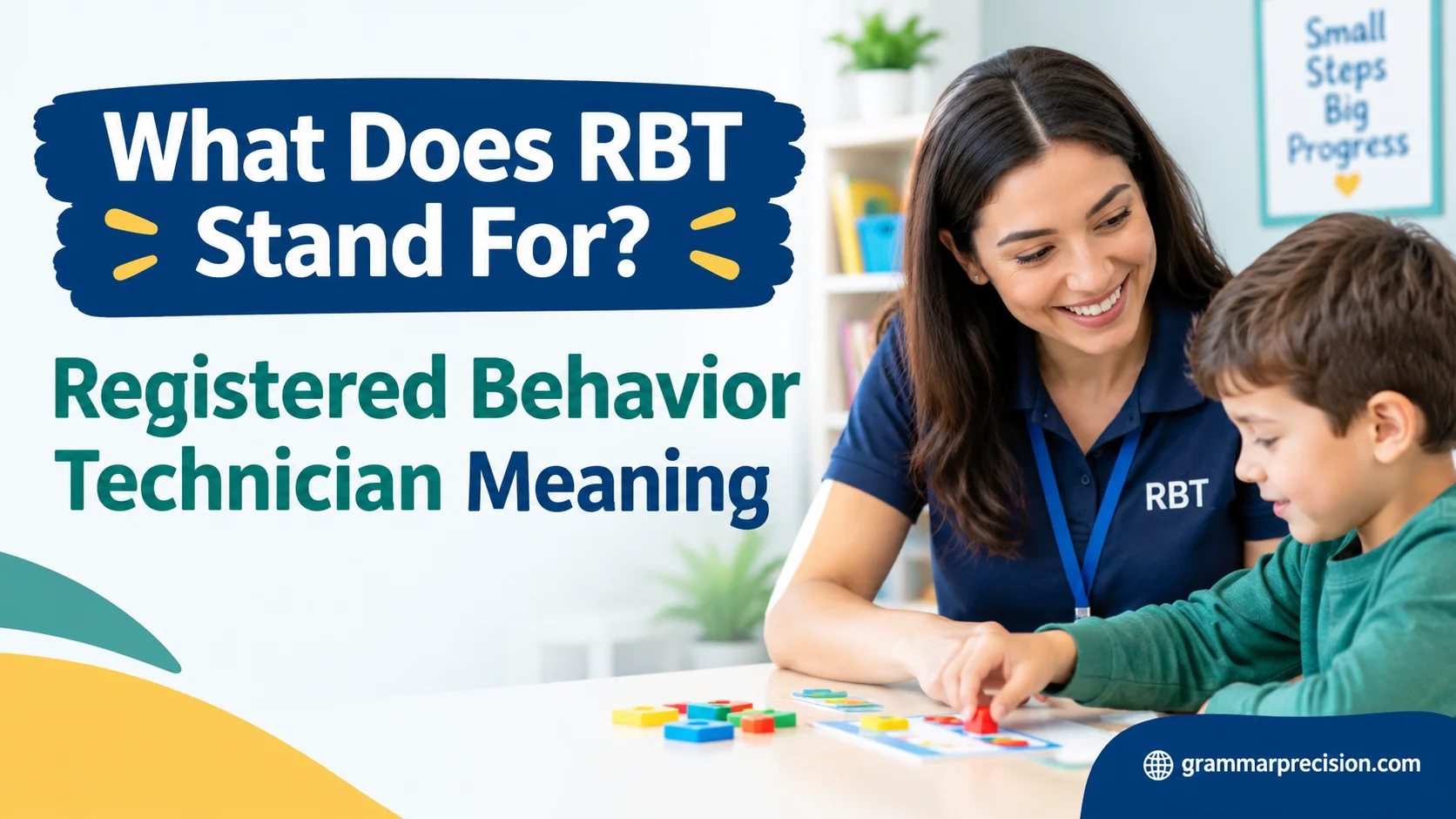
What does RBT stand for when you see this abbreviation in education, healthcare, or professional communication? The meaning can change with context, so understanding RBT helps you interpret messages, credentials, job titles, and workplace documents accurately and confidently without confusion.
RBT commonly refers to Registered Behavior Technician, a professional role in applied behavior analysis (ABA). RBTs work under supervision to support individuals with behavioral, developmental, or learning needs. Understanding this abbreviation can help you read job descriptions, educational resources, treatment plans, and professional communications with greater confidence and clarity in everyday situations and professional conversations at work, school, or home settings.
Knowing what RBT stands for is especially useful when you encounter the term in healthcare, education, therapy, or workplace settings. The abbreviation often appears alongside terms such as ABA therapy, behavior analysis, supervision, and intervention. Learning its meaning also makes it easier to understand professional credentials, service descriptions, scheduling details, and communication between families and care teams effectively and accurately in written communication too.
In this guide, you’ll discover the full meaning of RBT, what the role involves, where the abbreviation is commonly used, and how to use it naturally in sentences. We’ll also examine related terminology, common misunderstandings, and practical examples. Whether you’re a student, parent, professional, or curious reader, these explanations will make the term easier to recognize, understand, and use correctly every day in context too.
What Does RBT Stand For?
RBT stands for Registered Behavior Technician.
The credential is associated with the Behavior Analyst Certification Board (BACB). An RBT is a paraprofessional who practices within a defined scope of behavior-analytic services while working under the direction and close supervision of qualified supervisors.
In simple terms, an RBT often takes the strategies developed by a supervising behavior analyst and helps put those strategies into practice.
Think of the role like this:
Assessment and treatment planning → Supervision → RBT implementation → Data collection → Progress review
The RBT isn’t simply a person who works with clients. The position involves specific training, competency requirements, ethical responsibilities, and supervision.
What Does “Registered Behavior Technician” Mean?
Each part of the title provides useful information.
| Term | Meaning |
| Registered | The individual holds the applicable RBT credential through the certification system. |
| Behavior | The work focuses on observable behavior, learning, skill development, and behavior change. |
| Technician | The RBT applies assigned procedures and services rather than independently designing treatment programs. |
This distinction matters. An RBT has an important hands-on role, but the credential doesn’t make the individual equivalent to a BCBA or another independently practicing behavior analyst.
What Is a Registered Behavior Technician?
A Registered Behavior Technician is a trained paraprofessional who delivers behavior-analytic services under supervision.
RBTs may work with children, adolescents, or adults depending on the organization, client population, and services provided. Their responsibilities can include implementing teaching procedures, supporting communication skills, recording data, and following behavior-support procedures.
The exact daily routine varies considerably. One RBT might spend much of the day in a clinic. Another could provide services in a home, school, or community environment.
What remains consistent is the relationship between implementation, data, and supervision.
An RBT generally doesn’t decide independently which treatment approach a client needs. Instead, the RBT follows the procedures assigned within the client’s behavior-analytic program and communicates relevant observations to the supervising team.
What Does an RBT Do?
The simplest answer is that an RBT implements behavior-analytic services and records relevant information under supervision.
Depending on the treatment program, responsibilities may include:
- Teaching assigned communication or academic skills
- Supporting social and daily living skills
- Implementing behavior-reduction procedures
- Using reinforcement procedures
- Collecting behavioral data
- Recording session information accurately
- Following written treatment protocols
- Communicating observations to supervisors
- Participating in required supervision
- Maintaining professional and ethical boundaries
For example, suppose a child is learning to request a preferred item appropriately rather than grabbing it. The supervising behavior analyst may establish the teaching procedure. The RBT can then implement that procedure during sessions and record the child’s responses.
The resulting data can help the supervising team determine whether the intervention is producing meaningful progress.
What Does RBT Stand For in ABA?
In the context of applied behavior analysis (ABA), RBT refers to Registered Behavior Technician.
ABA is a field that applies principles of behavior science to improve socially significant behaviors and skills. Depending on the individual and treatment goals, services may address communication, learning, social interaction, adaptive skills, or behavior that interferes with daily life.
RBTs can serve as the professionals who consistently implement assigned procedures during direct service.
How RBTs Fit Into ABA
A typical ABA service team may include professionals with different levels of responsibility.
A BCBA may assess behavior, develop treatment programs, analyze data, and oversee services. An RBT may then implement specific components of those programs during direct sessions.
That arrangement doesn’t make the RBT’s work less important. In fact, consistent implementation and accurate data collection can provide essential information about how a program works in real-world settings.
Why Data Collection Matters
Behavior-analytic services depend heavily on measurable information.
Instead of relying only on statements such as “the session went well,” an RBT may record details such as:
- How frequently a behavior occurred
- How long a behavior lasted
- How quickly a client responded
- How many opportunities resulted in a correct response
- Which prompts were required
- Whether a skill occurred independently
Good data turns observations into information that a treatment team can analyze.
For example, if a client independently completes four out of five opportunities one week and eight out of ten the next week, the team has measurable information to review.
What Does an RBT Do During a Typical Session?
An RBT’s day can look different from one workplace to another. Still, many sessions follow a recognizable pattern.
Before the Session
The RBT may review relevant instructions, prepare materials, and understand the goals scheduled for the session.
Preparation matters because behavior-analytic teaching often depends on consistency. Missing materials or misunderstanding a procedure can affect implementation.
During the Session
The RBT may conduct teaching activities, use reinforcement, prompt desired responses, record data, and follow assigned behavior-support procedures.
A session might include several activities rather than one continuous exercise. For example, a client could practice communication, complete a structured learning activity, work on daily living skills, and participate in social activities.
After the Session
The RBT typically completes required documentation and communicates relevant information according to workplace procedures.
A useful rule is simple:
Record what happened accurately rather than what you hoped would happen.
Objective documentation gives supervisors better information for reviewing progress.
A Real-Life Example of an RBT
Consider a hypothetical client who is working on functional communication.
During a session, the supervising behavior analyst’s program may specify a teaching procedure designed to increase appropriate requests. The RBT presents opportunities for the client to communicate, follows the assigned prompting procedure, provides reinforcement according to the program, and records the client’s responses.
Over several sessions, the data might show increasing independent requests.
The RBT doesn’t need to independently redesign the entire intervention. Instead, the RBT provides consistent implementation and useful observations.
That distinction illustrates why RBT supervision is central to the credential.
RBT vs. BCBA vs. BCaBA
These credentials aren’t interchangeable.
| Credential | General Role | Typical Responsibility |
| RBT | Paraprofessional | Implements assigned behavior-analytic services under supervision |
| BCaBA | Assistant behavior analyst | Provides behavior-analytic services under BCBA supervision |
| BCBA | Behavior analyst | Performs higher-level assessment, treatment planning, analysis, and supervision within the scope of practice |
The exact responsibilities depend on the person’s credential, employer, applicable rules, and service setting.
RBT vs. BCBA
The biggest distinction involves scope and independence.
An RBT works under close supervision. A BCBA has a substantially broader professional role that can include assessment, program development, data analysis, clinical decision-making, and supervision.
Calling an RBT a “junior BCBA” therefore creates confusion. The credentials represent different professional roles.
RBT vs. BCaBA
A BCaBA is a bachelor’s-level behavior analyst credential. BCaBAs provide behavior-analytic services under the supervision of a BCBA.
An RBT, by contrast, is a paraprofessional credential with different eligibility, training, examination, and supervision requirements.
How to Become an RBT
Becoming an RBT involves more than completing a short online course.
The certification pathway includes eligibility requirements, training, competency assessment, application procedures, examination requirements, and ongoing supervision.
Because certification requirements can change, candidates should always check the current BACB requirements before beginning the process.
Meet the Eligibility Requirements
Applicants must meet the applicable BACB eligibility requirements. These can include age, education, background-check, and other certification-related requirements.
Candidates should verify the current standards rather than relying on an old blog post or social media checklist.
Complete the Required Training
RBT candidates must complete the required training through an appropriate provider.
The training covers foundational behavior-analytic concepts and skills relevant to the RBT role.
A commonly referenced requirement is 40 hours of RBT training, although the specific rules surrounding training and certification can change over time.
Complete the Competency Assessment
Candidates must demonstrate relevant skills through the required competency assessment process.
This stage is important because knowing terminology isn’t the same as demonstrating practical competency.
A person might understand the definition of reinforcement on a quiz but still need practice applying procedures correctly during real interactions.
Apply for Certification
After completing the required steps, candidates submit the appropriate application materials.
The application process involves documentation and other requirements established by the certification board.
Pass the RBT Examination
Eligible candidates must meet the applicable examination requirements and pass the RBT exam.
The examination evaluates knowledge and skills covered by the current RBT examination content outline.
Also Read This: What Does AR Stand For in Guns? Real Meaning Explained
What Is RBT Supervision?
Supervision is one of the defining features of RBT practice.
RBTs don’t simply complete training and then operate without oversight. The credential requires ongoing supervision under the applicable certification standards.
Supervision helps ensure that RBTs implement services correctly, maintain professional standards, and receive support when situations become more complex.
Who Supervises an RBT?
Qualified supervisors can oversee RBT services under the BACB’s applicable requirements.
Supervision may involve direct observation, feedback, review of performance, discussion of cases, and evaluation of competency.
The exact structure depends on the certification rules and the organization providing services.
Why Ongoing Supervision Matters
Imagine learning to operate specialized equipment from a training manual and then never receiving feedback again. Technical knowledge alone wouldn’t guarantee good performance.
RBT work is similar in one important respect: skills improve through observation, practice, feedback, and continued oversight.
Supervision also gives RBTs an appropriate route for raising concerns about procedures, client needs, or unusual situations.
RBT Certification Requirements in 2026
The RBT certification landscape continues to evolve. For anyone researching the credential in 2026, current requirements matter more than information published several years ago.
The BACB has updated RBT materials and examination content over time. The RBT Test Content Outline, 3rd edition, applies to examination content beginning in 2026.
This makes it especially important to check the current requirements before paying for training or scheduling an examination.
What Should Candidates Check?
Before starting an RBT program, review:
- Current eligibility requirements
- Current training requirements
- Competency assessment rules
- Application procedures
- Examination requirements
- Supervision requirements
- Renewal or maintenance obligations
- Current ethics and professional standards
A course advertised as “RBT certification” doesn’t automatically mean that completing the course itself grants certification.
What Is on the RBT Exam?
The RBT examination tests knowledge associated with the current RBT task content.
Rather than memorizing isolated definitions, candidates benefit from understanding how behavior-analytic concepts work together.
Important areas can include concepts related to:
- Measurement
- Assessment
- Skill acquisition
- Behavior reduction
- Documentation
- Professional conduct
- Responsibilities within the RBT role
A practical example can help.
Suppose a question describes how frequently a behavior occurs during a session. Understanding frequency measurement is more useful than simply memorizing the word’s definition.
RBT Ethics and Professional Responsibilities
Technical skill isn’t enough. RBTs also need strong professional judgment within their defined role.
Ethical responsibilities can involve protecting client dignity, maintaining confidentiality, following supervision requirements, documenting services honestly, and staying within professional boundaries.
Accurate Documentation
An RBT should document services truthfully.
If five opportunities occurred, documentation shouldn’t claim that ten opportunities occurred simply because ten were planned.
Small documentation errors can create larger problems when treatment teams use those records to evaluate progress.
Professional Boundaries
RBTs work closely with clients and families. That closeness makes appropriate boundaries especially important.
Professional communication should remain respectful and relevant to the service relationship.
Following the Chain of Supervision
When an RBT encounters a situation outside the assigned procedure, asking the appropriate supervisor is generally more appropriate than improvising a new intervention.
Knowing when to ask for guidance is part of professional competence.
Where Do RBTs Work?
RBTs may provide services in several environments.
Common settings include:
- Behavioral health clinics
- Schools
- Homes
- Community environments
- Specialized treatment centers
- Other service locations
The setting can dramatically change the rhythm of the job.
In a clinic, an RBT may work within a structured schedule alongside other professionals. In a home-based program, the environment may be less predictable. School-based services may involve classroom routines and coordination with educational staff.
The underlying principles remain consistent, but implementation must fit the setting and assigned treatment plan.
What Does a Day in the Life of an RBT Look Like?
There isn’t one universal RBT schedule.
A typical day could involve preparing materials, meeting with clients, implementing skill-building activities, recording data, attending supervision, completing documentation, and communicating relevant observations.
Some sessions may feel highly structured. Others require flexibility within clearly defined procedures.
For example, a child may arrive tired or distracted. The RBT still needs to follow the applicable program while responding appropriately to the circumstances and communicating relevant changes to the supervising team.
That combination of structure and adaptability is one reason the job requires more than memorizing ABA terminology.
Can an RBT Become a BCBA?
An RBT can pursue additional education and professional credentials. However, RBT certification itself doesn’t automatically lead to BCBA certification.
Becoming a BCBA requires meeting the separate education, coursework, supervised fieldwork, examination, and certification requirements applicable at the time.
A person interested in long-term growth might therefore view RBT work as one possible way to gain exposure to behavior-analytic practice while pursuing further education.
The paths aren’t identical for everyone.
RBT and BCBA are separate credentials with separate requirements.
Common RBT Misconceptions
“RBT Means Behavioral Therapist”
The terms aren’t necessarily interchangeable.
An RBT is specifically a Registered Behavior Technician credential. “Behavioral therapist” can be used more broadly and may describe different roles depending on the employer and setting.
“RBTs Work Completely Independently”
This is incorrect.
RBT certification includes supervision requirements. RBTs provide services within the scope of their credential and assigned responsibilities.
“RBT and BCBA Mean the Same Thing”
They don’t.
An RBT and a BCBA have different credentials, training pathways, responsibilities, and scopes of practice.
“Completing RBT Training Makes You Certified”
Training is one part of the process.
Candidates must satisfy the applicable certification requirements rather than assuming that completing a training course alone creates the credential.
RBT Terms You Should Know
If you’re new to ABA, these terms can make RBT information much easier to understand.
| Term | Simple Meaning |
| ABA | Applied behavior analysis |
| RBT | Registered Behavior Technician |
| BCBA | Board Certified Behavior Analyst |
| BCaBA | Board Certified Assistant Behavior Analyst |
| Reinforcement | A consequence intended to increase a behavior |
| Prompt | Assistance provided to encourage a desired response |
| Data collection | Systematic recording of behavior or performance |
| Skill acquisition | Teaching new skills |
| Behavior reduction | Procedures designed to decrease targeted behavior |
| Supervision | Professional oversight and support |
Learning these terms gives you a useful foundation before tackling more advanced behavior-analytic concepts.
RBT Meaning at a Glance
Here’s the entire concept in one quick reference:
| Question | Answer |
| What does RBT stand for? | Registered Behavior Technician |
| What field is it associated with? | Behavior analysis and ABA services |
| Is an RBT a BCBA? | No |
| Does an RBT work independently? | No, RBT services involve required supervision |
| What does an RBT commonly do? | Implements assigned services, teaches skills, collects data, and documents sessions |
| Is training alone enough for certification? | No |
| Can an RBT pursue additional credentials? | Yes, subject to the separate requirements for those credentials |
FAQs:
What does RBT stand for in ABA?
RBT stands for Registered Behavior Technician. In ABA services, an RBT is a credentialed paraprofessional who implements assigned behavior-analytic services under supervision.
What does a Registered Behavior Technician do?
An RBT may implement skill-acquisition procedures, support behavior-change programs, collect data, document sessions, and communicate relevant observations to supervisors.
Is an RBT the same as a BCBA?
No. An RBT and a BCBA hold different credentials and have different professional responsibilities. A BCBA has a broader role that can include assessment, treatment planning, data analysis, and supervision.
How long does it take to become an RBT?
The timeline varies depending on how quickly a candidate completes training, competency assessment, application steps, and examination requirements. The required training component has commonly involved 40 hours, while the overall timeline depends on the candidate and certification process.
Can an RBT work without supervision?
RBT services require supervision under the applicable certification standards. The credential isn’t designed as an independent behavior-analyst credential.
What is the difference between RBT and BCaBA?
An RBT is a paraprofessional credential. A BCaBA is an assistant behavior analyst credential that requires a separate educational and certification pathway and works under BCBA supervision.
Is RBT a certification or a job title?
RBT refers to a professional certification credential. Employers may use additional job titles to describe the position or work performed.
What does an RBT do with data?
An RBT may record measurable information about client behavior and skill performance. Supervisors can use that information to monitor progress and make treatment decisions within their professional scope.
Does RBT certification expire?
RBT certification has ongoing maintenance requirements. Candidates and certified professionals should follow the current BACB rules for renewal, supervision, and continued certification.
Conclusion:
So, what does RBT stand for? It stands for Registered Behavior Technician, a credential associated with behavior-analytic services and applied behavior analysis.
RBTs play a hands-on role by implementing assigned procedures, supporting skill development, collecting data, and documenting services under supervision. The credential is more than an acronym.
It represents a defined professional role with specific training, competency, examination, supervision, and ethical requirements. If you’re researching an RBT career or simply trying to understand an ABA treatment team, knowing these distinctions gives you a much clearer picture of where the RBT fits.