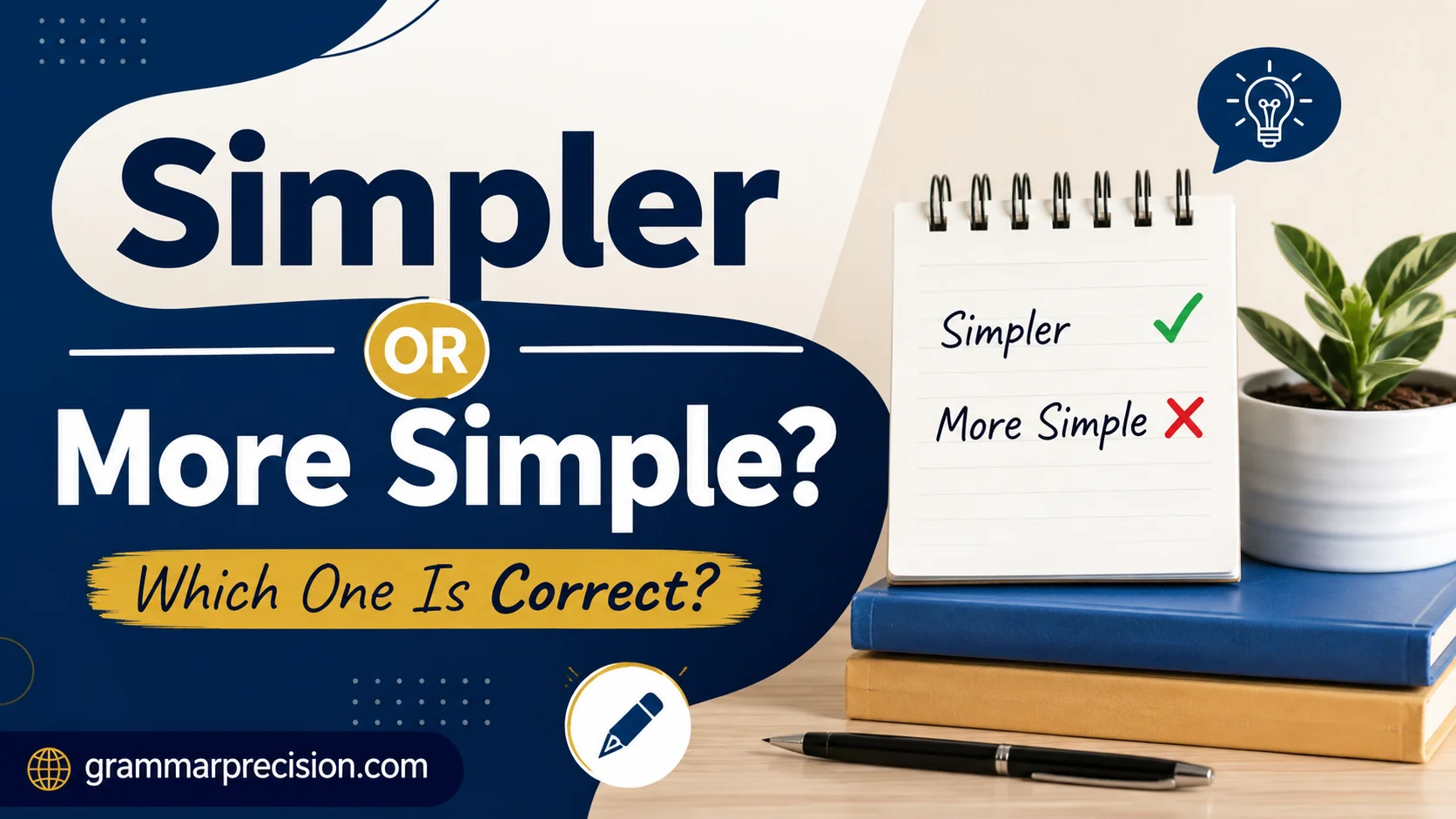
The Simpler or More Simple? debate explains how grammar choices affect comparisons in English and helps learners understand the correct use of simpler and more simple in daily language use.
The word simpler is the common comparative form of the adjective simple and appears often in everyday English conversations. More simple can also be used for special emphasis or contrast when speakers want to highlight a specific idea. Understanding this distinction improves clarity and supports better communication for both native and non-native English language users.
Learning the difference between simpler and more simple helps writers avoid confusion and make accurate choices in different contexts. Strong knowledge of grammar rules improves writing skills in academic and professional settings. These forms show how English usage changes depending on meaning, audience, and purpose, creating more effective and precise communication.
Simpler or More Simple: The Quick Answer
When comparing two things, simpler is the form most English speakers naturally choose.
The adjective simple changes into:
| Form | Word | Example |
| Positive form | Simple | This explanation is simple. |
| Comparative form | Simpler | This explanation is simpler than the first one. |
| Superlative form | Simplest | This is the simplest explanation available. |
In most situations, simpler sounds smoother and follows standard English grammar patterns.
For example:
✅ This method is simpler than the old method.
❌ This method is more simple than the old method.
The second sentence isn’t completely impossible to understand, but it sounds less natural to most native speakers.
Think of simpler as the default choice. It is shorter, cleaner, and usually the version you should use in everyday writing and speech.
What Is the Comparative Form of Simple?
To understand why we say simpler, you first need to understand how comparative adjectives work.
Comparative adjectives help you compare two people, objects, ideas, or situations. They show that one thing has a greater or lesser quality than another.
English usually forms comparatives in two main ways:
- Add -er to shorter adjectives.
- Add more before longer adjectives.
Examples:
| Basic adjective | Comparative form |
| Fast | Faster |
| Small | Smaller |
| Bright | Brighter |
| Beautiful | More beautiful |
| Expensive | More expensive |
| Interesting | More interesting |
The word simple creates confusion because it has two syllables. Many learners assume that all two-syllable adjectives must use more, but English has exceptions.
The word simple follows the shorter adjective pattern:
Simple → Simpler
This pattern is common with many two-syllable adjectives ending in -le, -ow, or -er.
Examples:
- Gentle → Gentler
- Narrow → Narrower
- Clever → Cleverer
- Simple → Simpler
However, some of these words can also accept more, depending on style and preference.
Is “Simpler” Correct?
Yes, simpler is completely correct.
It is the standard comparative form of the adjective simple. Dictionaries recognize it as the preferred form, and native speakers use it frequently in conversations, books, articles, and professional writing.
The word simpler means “more simple” or “less complicated compared with something else.”
For example:
“The new app design is simpler than the previous version.”
This means the new design has fewer complications, requires less effort to understand, or contains fewer unnecessary features.
Here are more examples:
- The teacher gave us a simpler explanation of the topic.
- A simpler solution can save time and money.
- This recipe is simpler because it requires fewer ingredients.
- The updated instructions are simpler for beginners to follow.
Notice how simpler works naturally in different situations:
Everyday Life
“I need a simpler way to organize my schedule.”
The speaker wants something less complicated.
Technology
“The company created a simpler user interface.”
The design became easier to understand.
Education
“The professor provided a simpler example.”
The example became easier to follow.
Is “More Simple” Correct?
The phrase “more simple” can be grammatically acceptable in some situations, but it is less common than simpler.
English does not always follow strict mathematical rules. Sometimes speakers choose more simple because they want to emphasize the idea of simplicity rather than simply compare two things.
For example:
“We need a more simple explanation before moving forward.”
This sentence sounds acceptable because the writer focuses on the quality of the explanation rather than making a direct comparison.
However, in many cases, simpler sounds more natural:
✅ The instructions are simpler now.
✅ The instructions are more simple now.
Both sentences communicate the idea, but the first one feels more fluent.
When “More Simple” May Be Used
There are a few situations where people intentionally choose more simple.
To Emphasize a Greater Level of Simplicity
Sometimes writers use more simple to stress that something has become significantly less complicated.
Example:
“The company needs a more simple approach to customer support.”
Here, the speaker may be contrasting a complex system with a completely simplified one.
In Technical or Professional Writing
Some industries use “more simple” when discussing processes, designs, or systems.
Example:
“The updated model offers a more simple structure for users.”
Although many editors would prefer simpler, the meaning remains clear.
Simpler vs More Simple: Key Differences
The easiest way to understand the difference is by comparing their common uses.
| Feature | Simpler | More Simple |
| Grammar | Correct comparative form | Sometimes acceptable |
| Natural speech | Very common | Less common |
| Formal writing | Usually preferred | Used occasionally |
| Meaning | Less complicated | A stronger emphasis on simplicity |
| Native preference | Higher | Lower |
A useful rule:
Choose “simpler” almost every time.
Use **“more simple” only when you have a specific reason to emphasize simplicity.
Why Do We Say “Simpler” Instead of “More Simple”?
The reason comes from how English developed over time.
English speakers often prefer shorter comparative forms when they feel natural. Words like simple have existed for centuries, and the -er ending became the accepted comparative pattern.
Language tends to favor efficiency. Saying:
“This process is simpler.”
requires fewer sounds than:
“This process is more simple.”
Both communicate the same idea, but the first option feels quicker and smoother.
This happens with many other adjectives:
- Quiet → Quieter
- Clever → Cleverer
- Narrow → Narrower
- Gentle → Gentler
The shorter comparative form often feels more direct.
Simpler Does Not Always Mean Easier
One common mistake is assuming that simpler and easier mean exactly the same thing.
They are related, but they describe different ideas.
Simple means:
- Not complicated
- Easy to understand
- Having fewer parts
Easy means:
- Not difficult to do
- Requiring little effort
For example:
“The instructions are simpler, but the task is still difficult.”
The instructions may have fewer steps, but the actual task might require advanced skills.
Another example:
“The software has a simpler design, but learning it still takes practice.”
The design became clearer, but users still need time to master it.
Understanding this difference helps you choose better words.
Common Mistakes With Simple Comparative Forms
Many learners make similar mistakes when comparing adjectives. Here are the most common errors.
Using “Simpleer”
❌ This explanation is simpleer.
✅ This explanation is simpler.
The word simple already has an accepted comparative form. Adding -er without changing the spelling creates an incorrect word.
Using Double Comparatives
A double comparative happens when someone uses both more and -er together.
❌ This method is more simpler.
✅ This method is simpler.
Never combine the two comparative markers.
Other examples:
❌ more faster
✅ faster
❌ more easier
✅ easier
Using “Most Simple” Instead of “Simplest”
When comparing more than two things, use the superlative form.
❌ This is the most simple solution.
✅ This is the simplest solution.
Although “most simple” appears occasionally, simplest is the standard choice.
Simpler vs More Simple in Different Situations
The best word choice can depend on where and how you use it.
In Conversations
Native speakers almost always prefer:
“Can you explain it in a simpler way?”
It sounds natural and friendly.
In Business Writing
Professional writing usually favors:
“We need a simpler process.”
It creates a clear and confident tone.
In Academic Writing
Researchers and students often use:
“A simpler explanation helps readers understand the concept.”
The shorter form improves readability.
In Marketing
Companies may use either:
“A simpler solution for your business.”
or
“A more simple approach.”
However, marketing copy usually sounds stronger with simpler because it feels more direct.
Real-World Examples of Simpler vs More Simple
Understanding examples makes grammar rules easier to remember.
| Incorrect or Less Natural | Better Choice |
| This program is more simpler. | This program is simpler. |
| We need a more simple answer. | We need a simpler answer. |
| The instructions became more simple. | The instructions became simpler. |
| This design is more simple than before. | This design is simpler than before. |
Here are natural sentences you can use:
- A simpler plan can help everyone stay organized.
- The new version is simpler and faster to use.
- She explained the concept in a simpler way.
- The company created a simpler process for customers.
Similar Comparative Adjectives That Create the Same Confusion
The confusion between simpler and more simple is not unique. English has many adjectives that make learners wonder whether they should use -er or more.
These words often follow the same pattern as simple. They can accept both forms in some cases, but one option usually sounds more natural.
Understanding these examples can help you recognize English patterns instead of memorizing individual rules.
Clever vs More Clever
The adjective clever can become:
- Cleverer
- More clever
Both forms exist, but cleverer is more common in everyday English, especially in American and British conversations.
Examples:
✅ My brother is cleverer than I expected.
✅ She found a cleverer solution to the problem.
However:
“That was a more clever strategy than the first one.”
This can work because the speaker wants to emphasize the quality of the strategy.
Narrow vs More Narrow
The usual comparative form is:
Narrow → Narrower
Examples:
- The road becomes narrower near the mountain.
- We need a narrower focus for this research.
Although “more narrow” appears sometimes, it often sounds less natural.
Gentle vs More Gentle
Both forms appear:
- Gentler
- More gentle
The choice depends on style.
Examples:
✅ Use a gentler approach with children.
✅ The doctor recommended a gentler treatment.
“More gentle” may appear when the writer wants to highlight a comparison.
Example:
“This fabric creates a more gentle feeling against the skin.”
Also Read This: Desert vs. Dessert: The Complete Guide to Understanding the Difference
Common Two-Syllable Comparative Patterns
Here are more examples:
| Adjective | Preferred Comparative | Less Common Alternative |
| Simple | Simpler | More simple |
| Quiet | Quieter | More quiet |
| Clever | Cleverer | More clever |
| Gentle | Gentler | More gentle |
| Narrow | Narrower | More narrow |
The important lesson is that English does not work like a strict formula. Some words follow patterns, while others depend on common usage.
How Native Speakers Usually Use “Simpler”
Native speakers usually choose words based on what sounds natural, not only what follows a grammar rule.
When people communicate quickly, they tend to prefer shorter and smoother expressions. That is why simpler appears much more often than more simple.
Consider these everyday examples:
“Can you make this simpler?”
This sounds natural because the speaker wants something clearer.
Now compare:
“Can you make this more simple?”
The meaning is understandable, but many speakers would feel that something sounds slightly unusual.
The difference is small, but natural language often depends on these small details.
Why “Simpler” Works Better in Everyday Communication
The word simpler has several advantages:
It Sounds More Natural
People commonly hear and use it, so it flows easily in conversations.
Example:
“The simpler option is usually the better choice.”
This sentence feels direct and comfortable.
It Saves Words
Good communication often removes unnecessary complexity.
Compare:
“We need a more simple method.”
and
“We need a simpler method.”
The second sentence delivers the same message with fewer words.
It Matches Common English Patterns
English speakers already use many similar forms:
- Faster
- Smaller
- Cleaner
- Stronger
- Easier
Using simpler follows the same rhythm.
The Psychology Behind Simple Language
The popularity of words like simpler connects with a bigger communication principle: people understand information faster when it feels clear and organized.
A simpler explanation does not mean a less intelligent explanation. In many cases, experts simplify complex ideas because they understand them deeply.
For example, a great science teacher does not impress students by using the most complicated words. Instead, they explain difficult concepts in a way anyone can understand.
A famous communication principle says:
“If you can’t explain it simply, you don’t understand it well enough.”
This idea applies to writing, teaching, business, and everyday conversations.
Choosing simpler instead of unnecessary complicated wording helps your message become stronger.
Simpler or More Simple in Professional Writing
When writing emails, reports, articles, or presentations, word choice affects how professional your message sounds.
Most professional writers choose simpler because it feels cleaner and more confident.
Examples:
Business Communication
Less natural:
We created a more simple process for employees.
Better:
We created a simpler process for employees.
Technical Documentation
Less natural:
The software provides a more simple way to manage files.
Better:
The software provides a simpler way to manage files.
Educational Content
Less natural:
This guide offers a more simple explanation.
Better:
This guide offers a simpler explanation.
Clear writing helps readers focus on your message instead of your wording.
A Simple Trick to Remember Simpler vs More Simple
If you are unsure which form to use, follow this easy rule:
Use “simpler” first.
In most situations, it will be correct and natural.
You can remember it like this:
Simple becomes simpler, not simple-er and usually not more simple.
The comparison pattern looks like this:
Simple → Simpler → Simplest
Examples:
- This lesson is simple.
- This lesson is simpler than yesterday’s lesson.
- This lesson is the simplest one in the course.
This three-step pattern works in almost every situation.
Case Study: How Small Word Choices Improve Clarity
Imagine two companies explaining a new software update.
Company A:
“We designed a more simple platform experience with more simple navigation options.”
The sentence feels repetitive and slightly unnatural.
Company B:
“We designed a simpler platform experience with simpler navigation options.”
The second version sounds cleaner and more professional.
The meaning is almost identical, but the second sentence creates a better impression.
This example shows how small grammar choices influence how readers perceive your writing.
Good grammar is not only about being technically correct. It is also about making communication smoother.
Quick Comparison: Simpler vs More Simple
| Question | Answer |
| Is simpler correct? | Yes, it is the standard comparative form. |
| Is more simple always wrong? | No, but it is less common. |
| Which form do native speakers prefer? | Simpler. |
| Which form should learners use? | Simpler in most situations. |
| What is the superlative form? | Simplest. |
FAQs:
Is “simpler” or “more simple” correct?
Both simpler and more simple can be correct, but simpler is the standard comparative form used in most situations. More simple is sometimes used for emphasis or when a speaker wants to create a stronger contrast between two ideas.
Why is “simpler” more common than “more simple”?
Simpler is more common because short adjectives like simple usually form their comparative by adding -er. Native speakers naturally use simpler in everyday English because it sounds smoother and more natural.
Can I use “more simple” in formal writing?
Yes, you can use more simple in formal writing when it adds a specific meaning or emphasis. However, simpler is usually preferred because it follows common grammar rules and creates clearer communication.
What is the difference between simpler and more simple?
The main difference is in usage and emphasis. Simpler directly compares two things, while more simple can highlight that something is easier compared with another option in a particular context.
How can I remember when to use simpler?
You can remember that simpler is the usual comparative form of simple. In most everyday conversations, academic writing, and professional communication, choosing simpler will sound correct and natural.
Conclusion:
Understanding simpler or more simple helps you make better grammar choices and improve your English usage. While both forms can appear in different contexts, simpler remains the most common and natural option. Learning this distinction improves clarity, strengthens writing skills, and helps you communicate more effectively in everyday and professional situations.