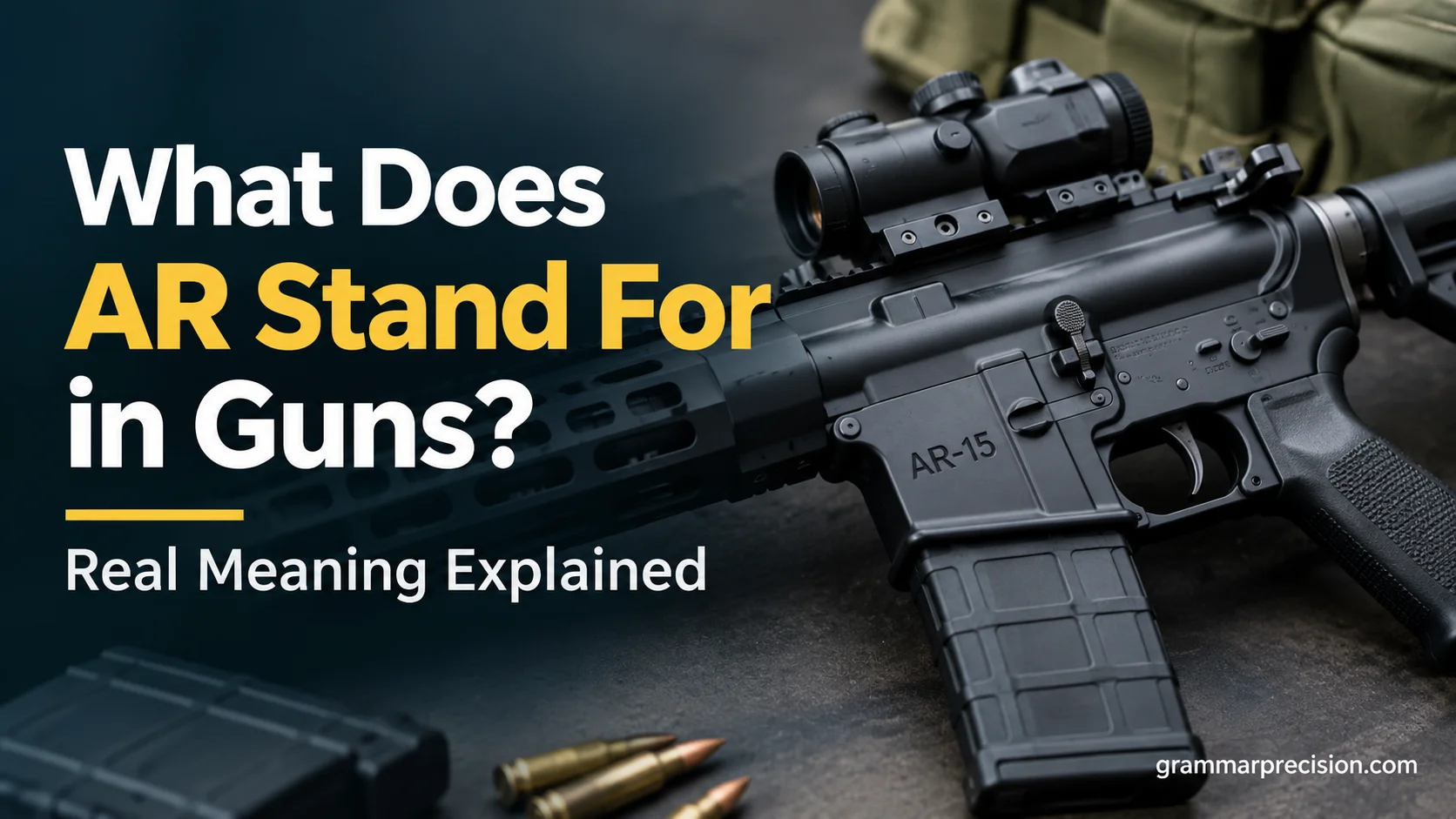
If you’ve ever wondered what does AR stand for in guns, you’re not alone. The letters appear everywhere in discussions about the AR-15, yet people often give completely different answers. Some say “assault rifle,” while others say “automatic rifle.” Neither explanation captures the original meaning.
In firearms history, AR traditionally refers to ArmaLite, the American company that developed a series of innovative rifles during the 1950s. The designation became associated with names such as AR-10 and AR-15. Understanding that history makes the terminology much easier to follow.
The confusion grows because people now use “AR” in several different ways. A historical model name, a modern design family, a military designation, and a general media term can all enter the same conversation. That overlap creates plenty of room for misunderstandings.
This guide breaks down what AR stands for in guns, where the abbreviation came from, what AR-15 means, and how terms such as M16, M4, assault rifle, and assault weapon differ. By the end, the terminology should feel much less mysterious.
What Does AR Stand For in Guns?
The most widely accepted historical explanation is that AR stands for “ArmaLite Rifle.” The name comes from ArmaLite, a company established in the 1950s that developed several lightweight firearm designs.
The “AR” designation appeared in names assigned to ArmaLite’s designs. Two of the most famous examples are the AR-10 and AR-15.
However, the letters don’t describe a firing mechanism. They don’t automatically mean “automatic rifle,” either. Instead, they originated as part of a manufacturer’s model-designation system.
Does AR Stand for Assault Rifle?
No. AR does not originally stand for “assault rifle.”
That misunderstanding probably exists because the AR-15 has a military-style appearance and because the phrase “assault rifle” frequently appears in public discussions about it. The visual similarity can make the explanation seem intuitive.
Historically, however, the AR designation traces back to ArmaLite.
The distinction matters because “assault rifle” has a specific technical meaning in firearms terminology, while “AR-15” identifies a particular design lineage. The two expressions aren’t interchangeable.
Does AR Mean Automatic Rifle?
No. AR isn’t an abbreviation for “automatic rifle.”
The confusion is understandable because “AR” could look like a natural abbreviation for those words. Yet abbreviations don’t necessarily work that way. In this case, the historical connection is to ArmaLite, not the word “automatic.”
A firearm’s operating system and firing capability are separate questions from its historical model name.
Where Did the AR Name Come From?
The story begins with ArmaLite, a small American firearms company founded in California during the 1950s. The company operated under the Fairchild Engine and Airplane Corporation and explored lightweight firearm designs.
That period produced an important shift in rifle development. Designers experimented with lighter materials, including aluminum components and advanced manufacturing techniques.
ArmaLite became particularly associated with designer Eugene Stoner, whose work helped shape the company’s best-known rifle designs.
The company’s designation system eventually produced a family of firearms carrying the AR prefix.
Eugene Stoner and the AR Rifle Family
Eugene Stoner played a central role in developing the designs that made the AR name famous.
His engineering approach emphasized lightweight construction, modular components, and modern manufacturing methods. Those ideas were significant because traditional rifles of the period often relied heavily on steel and wood.
Stoner’s work first gained major attention through the AR-10.
The AR-10 was a lightweight rifle chambered for the 7.62×51mm NATO cartridge. Its design demonstrated that a rifle could combine a relatively powerful cartridge with innovative materials and a substantially different engineering approach.
The later AR-15 developed from this design lineage.
What Is the AR-10?
The AR-10 is one of the most important pieces of the AR story because it came before the AR-15.
It was designed around the larger 7.62×51mm cartridge and incorporated many features that later influenced smaller-caliber rifles.
Although the AR-10 didn’t achieve the same cultural recognition as the AR-15, it established the basic design lineage that made the later rifle possible.
AR-10 vs. AR-15
The relationship becomes clearer when you place the two side by side.
| Feature | AR-10 | AR-15 |
| Historical position | Earlier design | Later design |
| Development period | 1950s | Late 1950s |
| Original ArmaLite connection | Yes | Yes |
| Cartridge family | 7.62×51mm | .223 Remington/5.56mm lineage |
| General role | Full-power rifle design | Smaller-caliber rifle design |
| Historical importance | Major predecessor | More widely recognized descendant |
The AR-15 wasn’t simply an AR-10 with a different name. Engineers adapted the design for a smaller cartridge and different requirements.
That development created the rifle platform that would eventually become one of the most recognizable firearm designs in the United States.
What Does AR-15 Stand For?
AR-15 refers to the ArmaLite model designation AR-15. The “AR” connects the name to ArmaLite’s designation system.
The “15” is a model number. It isn’t a reference to magazine capacity, bullet diameter, or the number of rounds the firearm fires.
That’s another surprisingly common misconception.
The original AR-15 emerged from ArmaLite’s work on the AR-10. ArmaLite later licensed the design to Colt, which played a major role in bringing the platform into military service and the broader American firearms market.
This history explains why the phrase AR-15 survived even after ArmaLite was no longer the company manufacturing the rifles most people recognize today.
What Does the “15” Mean in AR-15?
The 15 is part of the model designation.
It doesn’t mean:
- 15 rounds
- 15 bullets
- 15 inches
- 15 millimeters
- 15 firing modes
Model numbers often look meaningful when they aren’t. Manufacturers frequently assign numbers according to internal naming systems, product sequences, or historical designations.
In this case, “15” belongs to the rifle’s historical designation rather than describing a physical specification.
How Did the AR-15 Become the M16?
One of the most important chapters in the story involves Colt and the U.S. military.
ArmaLite eventually licensed the AR-15 design to Colt. Colt then developed and marketed versions of the design, including military configurations.
The U.S. military adopted a version under the designation M16.
This created a historical relationship between the AR-15 and M16 that still causes confusion today.
The names are closely related, but they’re not simply two words for exactly the same firearm.
AR-15 vs. M16
The easiest way to understand the relationship is to think about lineage and designation.
The AR-15 name belongs to the ArmaLite design and its subsequent commercial development. M16 became a U.S. military designation for a related rifle adopted by the armed forces.
Different versions and configurations developed over time. Therefore, saying that every AR-15 is an M16 or that every M16 is simply an AR-15 misses important historical distinctions.
AR-15 vs. M4
The M4 is another military firearm closely related to the same broader design family.
The M4 is a shorter military carbine developed from the M16 family. It became widely associated with U.S. military service during the late 20th century and afterward.
A useful terminology map looks like this:
ArmaLite → AR-10 → AR-15 → Colt development → M16 family → M4 family
This doesn’t mean every modern firearm carrying an AR-style design is an M16 or M4. It simply illustrates the historical relationship between several famous designations.
Why Do People Think AR Means “Assault Rifle”?
The misunderstanding has several sources.
First, AR-15 rifles can resemble military firearms, particularly because many design elements came from military-oriented development. Second, the AR-15 became highly visible in news coverage and political debates. Third, people often shorten complicated terminology during everyday conversations.
That combination created a powerful association between “AR” and “assault rifle.”
However, appearance isn’t enough to establish a technical classification.
The term assault rifle has traditionally referred to a military rifle with particular characteristics, including select-fire capability and an intermediate-power cartridge. A civilian firearm called an AR-15 may have a different configuration and legal status.
Assault Rifle vs. Assault Weapon
These terms deserve special attention because they’re often treated as synonyms.
Assault rifle is generally used as a technical firearms term.
Assault weapon, by contrast, is commonly used in legislation and legal discussions. Its precise definition can vary substantially depending on the jurisdiction and statute.
That’s why a statement about whether a particular firearm legally qualifies as an “assault weapon” requires attention to the applicable law.
The terminology isn’t merely academic. A technical definition and a legal definition can describe different things.
Also Read This: What Does CD Stand for in Banking?
What Does “AR-Style” Mean?
You’ve probably seen phrases such as “AR-style rifle” or “AR-pattern firearm.”
These expressions usually describe firearms that follow the broad design architecture associated with the AR family.
Modern manufacturers produce many firearms influenced by the AR-15 or related platforms. Some use different manufacturers, materials, chamberings, dimensions, and configurations.
Consequently, “AR” in modern conversation can be broader than its original historical meaning.
The distinction is similar to how people sometimes use a famous brand name to describe an entire category. Historical terminology starts narrowly, then everyday language stretches it.
Is AR a Brand or a Type of Gun?
The answer depends on how the term is being used.
Historically, AR was part of ArmaLite’s model-designation system. Today, however, people frequently use “AR” as shorthand for firearms based on the AR-15 design.
That doesn’t make “AR” the name of one universal firearm.
Think of it as having several layers:
| Term | Meaning |
| ArmaLite | Historical firearms company |
| AR | Historical designation associated with ArmaLite |
| AR-10 | Specific ArmaLite rifle design |
| AR-15 | Specific historical rifle designation and modern design family |
| AR-pattern | Broader modern description |
| M16 | Military designation for a related rifle family |
| M4 | Military carbine designation within the same broader lineage |
This layered approach prevents most terminology mistakes.
What the Letters “AR” Tell You—and What They Don’t
A short abbreviation can’t tell you everything about a firearm.
What “AR” Can Tell You
In historical context, the designation points toward ArmaLite and its rifle designs.
In modern conversation, it can indicate an AR-15-pattern design family.
What “AR” Doesn’t Automatically Tell You
The letters alone don’t establish:
- A firearm’s exact manufacturer
- Its precise model
- Its legal classification
- Its firing capability
- Its cartridge
- Its configuration
- Its intended use
That distinction is crucial.
For example, calling something an “AR” doesn’t provide enough information to determine its exact specifications. The term describes lineage or design language more than a complete technical specification sheet.
Common AR Myths You Should Stop Believing
The internet has produced plenty of explanations that sound plausible but don’t survive a closer look.
Myth: AR Means Assault Rifle
Fact: The historical designation is associated with ArmaLite, not “assault rifle.”
Myth: AR Means Automatic Rifle
Fact: “Automatic rifle” isn’t the origin of the abbreviation.
Myth: The 15 Means 15 Rounds
Fact: The 15 is part of the model designation.
Myth: Every AR Is an AR-15
Fact: AR is broader than one specific model name. The historical ArmaLite family included multiple AR-designated firearms.
Myth: AR-15 and M16 Are Exactly the Same
Fact: They share important design lineage, but their historical designations and configurations differ.
Myth: AR-15 Is the Name of Every Modern AR-Style Firearm
Fact: Modern AR-pattern firearms can come from many manufacturers and may differ considerably from the original model.
A Simple Case Study: How One Name Became Several Meanings
Imagine someone hears a news report describing an “AR-style rifle.”
A beginner might interpret that phrase as a single standardized firearm. Another person might hear “AR” and immediately think “assault rifle.” A firearms historian, meanwhile, may think about ArmaLite’s original AR designations.
All three people are reacting to the same two letters.
The difference comes from context.
Historical context: AR points toward ArmaLite.
Modern firearms context: AR can describe an AR-15-derived design family.
Public or media context: AR may be used casually when discussing semiautomatic rifles.
Legal context: Terms such as “assault weapon” can have jurisdiction-specific definitions.
The lesson is simple: always ask what context the speaker means.
Why the AR Name Still Matters Today
The significance of the AR designation goes beyond a simple abbreviation.
It represents a major chapter in American firearms engineering. ArmaLite’s experiments with lightweight construction and innovative rifle architecture influenced later firearm development.
The AR-10 established an important foundation. The AR-15 then carried that design philosophy into a smaller-caliber platform. Colt’s subsequent involvement helped transform the design into a military and commercial success.
Today, the term has become culturally recognizable far beyond its original engineering context.
That’s why a two-letter question can lead into decades of history.
AR Terminology Cheat Sheet
If you want a quick reference, keep this table handy.
| Term | Simple explanation |
| AR | Historical designation associated with ArmaLite |
| AR-10 | Earlier ArmaLite rifle design |
| AR-15 | ArmaLite rifle designation that became a major modern design family |
| AR-pattern | Modern term for firearms based on the AR design architecture |
| M16 | U.S. military designation for a related rifle family |
| M4 | U.S. military carbine designation derived from the M16 family |
| Assault rifle | Technical military firearms term |
| Assault weapon | Legal/policy term whose definition varies by jurisdiction |
| Semi-automatic | A firing mechanism description, not the meaning of “AR” |
FAQs About What AR Stands For in Guns
What does AR stand for in guns?
AR traditionally stands for “ArmaLite Rifle.” The designation originated with ArmaLite, the company that developed the AR-10 and AR-15 during the 1950s. In modern conversation, “AR” often refers more broadly to AR-15-pattern firearms.
Does AR stand for assault rifle?
No. AR doesn’t historically stand for assault rifle. The abbreviation comes from ArmaLite’s rifle-designation system. “Assault rifle” is a separate technical term.
Does AR stand for automatic rifle?
No. Automatic rifle isn’t the origin of AR. The letters are historically connected to ArmaLite rather than the word “automatic.”
What does AR-15 mean?
AR-15 is a historical model designation associated with ArmaLite. The “AR” connects to the ArmaLite designation, while “15” forms part of the model number.
What does the 15 mean in AR-15?
The 15 is a model designation. It doesn’t indicate ammunition capacity, bullet diameter, or the number of rounds the firearm can fire.
Is an AR-15 the same as an M16?
They share significant design lineage, but the names aren’t interchangeable. AR-15 refers to the original design designation and its modern descendants, while M16 is a military designation for a related rifle family.
Is an AR-15 an assault rifle?
The answer depends on which definition you’re using. In strict firearms terminology, “assault rifle” has a specific technical meaning. Legal terms such as “assault weapon” can have different definitions under particular laws.
Who designed the AR-15?
Eugene Stoner was the principal designer associated with the AR-15’s development at ArmaLite. The design evolved from the earlier AR-10 and was later licensed to Colt.
What is the difference between AR-10 and AR-15?
The AR-10 came first and was designed around the 7.62×51mm cartridge. The AR-15 followed as a smaller-caliber development related to the AR-10 design.
Conclusion:
So, what does AR stand for in guns? The standard historical answer is ArmaLite Rifle, connecting the abbreviation to ArmaLite and its series of rifle designs. The famous AR-15 grew from that lineage after the earlier AR-10.
The biggest mistake is treating “AR” as shorthand for “assault rifle” or “automatic rifle.” Those interpretations may sound logical, but they don’t explain the abbreviation’s historical origin.
Once you separate historical names, model numbers, military designations, technical terminology, and legal language, the confusion largely disappears. Two letters may look simple, yet the history behind them stretches across decades of firearm development.