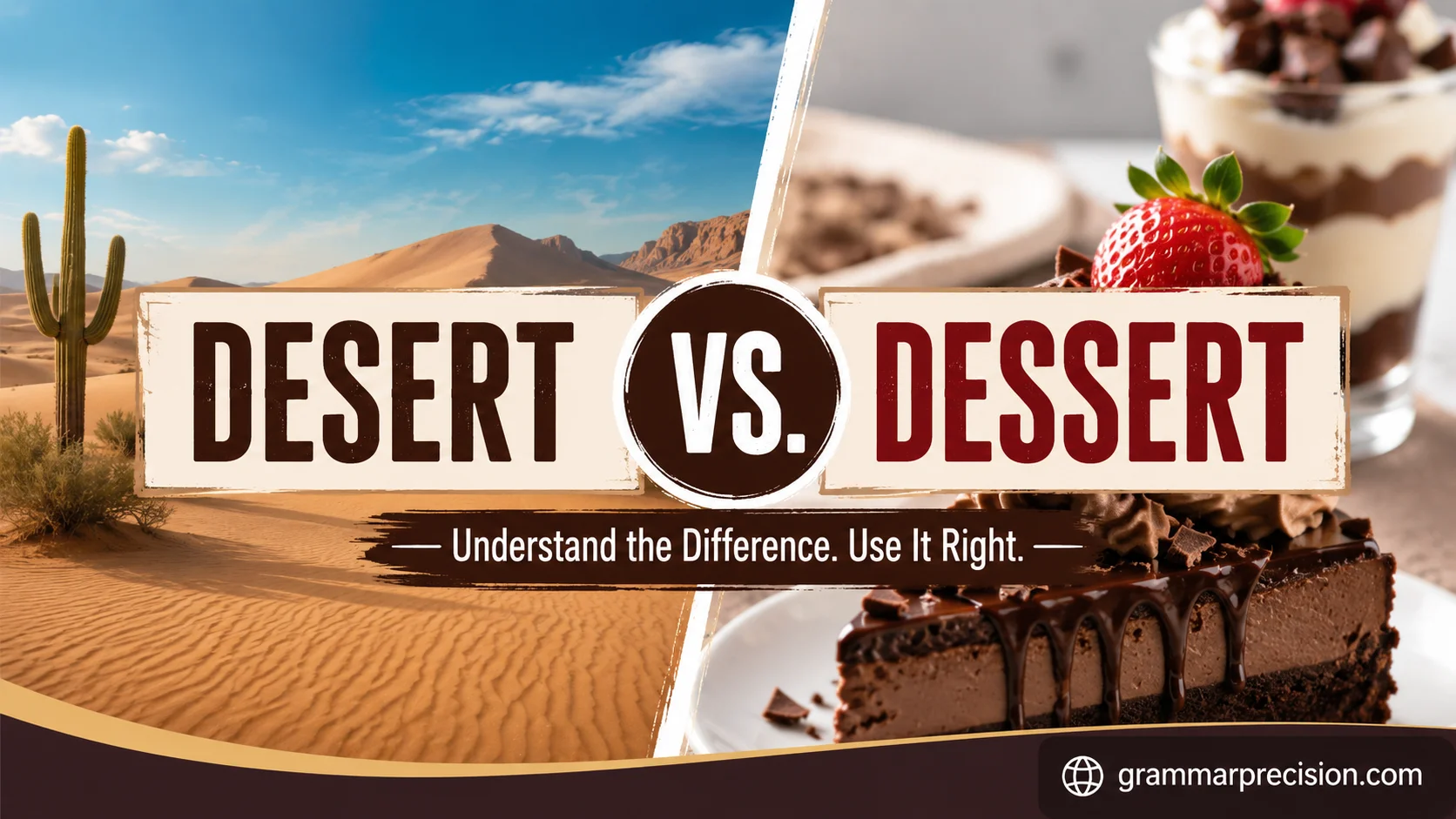
Understanding Desert vs. Dessert helps you solve common spelling mistakes by learning the correct meanings and usage of these similar words in English with simple examples and clear language tips.
A desert describes an arid landscape with little rainfall while a dessert refers to sweet treats like cake or ice cream after a meal. Understanding the context helps you choose the right word because their spelling looks similar but their meanings are different. Remember the extra S in dessert as a simple memory trick for accuracy.
The Sahara is a famous example of a desert where dry land and sand dominate the area. In contrast, chocolate cake and ice cream represent dessert choices. These unrelated words may confuse writers, but practicing their correct pronunciation and definition makes communication clearer. Use these easy tips whenever you write to avoid spelling errors confidently.
Desert vs. Dessert: The Quick Difference at a Glance
Before exploring each word deeply, let’s look at the main difference between desert vs. dessert.
| Word | Meaning | Pronunciation | Part of Speech | Example |
| Desert | A dry area of land with little rainfall | DEZ-ert (noun) | Noun | The Sahara is the largest hot desert in the world. |
| Desert | To abandon or leave someone/something | dih-ZERT (verb) | Verb | He decided not to desert his team. |
| Dessert | A sweet food eaten after a meal | dih-ZERT | Noun | We ordered chocolate cake for dessert. |
The easiest way to remember the difference is simple:
- Desert has one “s” because it is usually associated with something dry or lacking.
- Dessert has two “s’s” because you usually want a second serving.
Think of it this way: a desert has less, while a dessert gives you more.
What Does Desert Mean?
The word desert has more than one meaning. Most people know it as a type of landscape, but it can also work as a verb that means leaving or abandoning something.
The meaning depends entirely on how the word appears in a sentence.
Desert as a Noun: A Dry Land Area
When desert appears as a noun, it refers to a large area of land that receives very little rainfall. Many people imagine deserts as endless seas of sand, but that picture is incomplete.
A desert is defined by low precipitation, not by the amount of sand it contains.
For example, some deserts have:
- Sand dunes
- Rocky terrain
- Ice and snow
- Dry valleys
- Sparse vegetation
A place can become a desert if it receives extremely little rain or snow throughout the year.
Famous Deserts Around the World
Some of the world’s most well-known deserts include:
| Desert | Location | Interesting Fact |
| Sahara Desert | North Africa | It is the largest hot desert on Earth. |
| Antarctic Desert | Antarctica | It is technically the world’s largest desert because of its extremely low precipitation. |
| Arabian Desert | Middle East | It covers much of the Arabian Peninsula. |
| Gobi Desert | Mongolia and China | It is a cold desert with harsh winters. |
| Mojave Desert | United States | It contains Death Valley, one of the hottest places recorded on Earth. |
A desert environment may look empty, but many species survive there. Camels, desert foxes, snakes, insects, and specialized plants have adapted to extreme conditions.
For example, cactus plants store water inside their thick stems, while many desert animals avoid daytime heat by becoming active at night.
Common Examples of Desert as a Noun
Here are some sentences showing the correct use of desert:
- The travelers crossed the desert during their journey.
- The Sahara Desert attracts millions of visitors every year.
- Few plants can survive in such a dry desert environment.
- The desert landscape looked beautiful at sunset.
In each example, desert refers to a physical place.
Desert as a Verb: To Leave or Abandon
The second meaning of desert is completely different. As a verb, it means to leave someone or something behind, especially when support or responsibility is expected.
This usage often appears in serious situations involving relationships, duties, or responsibilities.
For example:
- A soldier who leaves their position without permission may be accused of deserting their post.
- A person who leaves their family during difficult times may be described as having deserted them.
Examples of Desert as a Verb
- The captain refused to desert his crew.
- Some animals will desert their young if they cannot survive.
- He felt that his friends had deserted him during his hardest moments.
The verb form often carries a negative meaning because it suggests someone left when they should have stayed.
Desert vs. Deserted: Understanding Related Forms
The word desert can change form depending on the sentence.
| Word | Meaning | Example |
| Desert | To leave or abandon | They refused to desert their mission. |
| Deserted | Empty or abandoned | The old village looked deserted. |
| Deserting | The act of leaving | He was punished for deserting his duties. |
A deserted building does not mean a building located in a dry area. It means the building has been left empty.
For example:
- “The desert road was dangerous.” → A dry land area.
- “The deserted road was dangerous.” → A road with nobody around.
The spelling looks similar, but the meanings are completely different.
What Does Dessert Mean?
Now let’s move from dry landscapes to something much sweeter.
Dessert means a sweet food or dish usually served after the main meal. It is often considered the final course of breakfast, lunch, or dinner.
Desserts can be simple or elaborate. They may include baked goods, frozen treats, fruits, or traditional sweets from different cultures.
Common Types of Desserts
Desserts vary widely around the world. Some popular examples include:
| Dessert | Origin | Description |
| Cake | Worldwide | A baked sweet food often served at celebrations. |
| Ice cream | Ancient origins with modern development worldwide | A frozen dairy-based dessert. |
| Baklava | Middle East | Layers of pastry, nuts, and syrup. |
| Cheesecake | Ancient Greece/modern variations worldwide | A creamy dessert made with cheese filling. |
| Mochi | Japan | A sweet treat made from sticky rice. |
| Crème brûlée | France | A creamy dessert topped with caramelized sugar. |
Dessert traditions often reflect local ingredients and culture. For example, tropical regions may use fruits like mango and coconut, while colder regions may rely more on baked desserts.
Why Is Dessert Served After a Meal?
Dessert traditionally comes at the end of a meal for several reasons:
- It creates a pleasant finishing experience.
- Sweet flavors provide contrast after savory foods.
- Celebrations often use desserts as a symbol of enjoyment.
- Many cultures connect desserts with hospitality and special occasions.
A birthday cake, wedding dessert table, or holiday pie often represents more than food. It represents celebration, connection, and shared memories.
Why Does Dessert Have Two S’s?
One of the biggest questions people ask is:
Why does dessert have two S’s while desert only has one?
English spelling does not always follow perfect rules, but this difference has a helpful memory trick.
A popular saying is:
“Dessert has two S’s because you always want seconds.”
This works because dessert is something people usually enjoy and want more of.
Another way to remember:
- Desert = dry, less water, less “s.”
- Dessert = sweet, special, and extra “s.”
Although this is only a memory tool and not a grammar rule, it helps many English learners remember the correct spelling.
Desert vs. Dessert Pronunciation Explained
Pronunciation creates another layer of confusion because the words can sound similar.
The pronunciation changes depending on the meaning of desert.
| Word | Pronunciation | Meaning |
| Desert | DEZ-ert | A dry land area |
| Desert | dih-ZERT | To abandon |
| Dessert | dih-ZERT | Sweet food |
Notice something interesting:
Dessert and the verb form of desert sound almost identical.
The difference appears in spelling and meaning.
Examples:
- “The desert is extremely dry.”
Pronounced: DEZ-ert - “They chose to desert their responsibilities.”
Pronounced: dih-ZERT - “We ate dessert after dinner.”
Pronounced: dih-ZERT
Context helps listeners understand which word someone means.
Also Read This: Manor vs Manner vs Manir: The Complete Guide
Desert vs. Dessert: Common Mistakes and How to Avoid Them
Even experienced writers sometimes confuse desert vs. dessert because both words look and sound similar. The mistake often happens because your brain recognizes the general shape of the word but misses the extra letter.
This type of error is called a spelling confusion, and English has many examples. Words like there/their/they’re, your/you’re, and affect/effect create similar problems.
The good news? Once you understand the pattern behind desert and dessert, you can avoid the mistake almost every time.
Common Desert vs. Dessert Mistakes in Writing
Let’s look at some incorrect sentences and fix them.
| Incorrect Sentence | Correct Sentence | Explanation |
| We ate chocolate cake for desert. | We ate chocolate cake for dessert. | A sweet food after a meal is always dessert. |
| The Sahara dessert is huge. | The Sahara Desert is huge. | A dry land area is a desert. |
| He decided to dessert his family. | He decided to desert his family. | To leave someone means desert. |
| The empty town looked desert. | The empty town looked deserted. | Deserted means abandoned. |
These mistakes may look small, but they can change the meaning of your writing completely.
Imagine writing a travel article and describing the “Sahara dessert.” Readers might picture a giant chocolate cake instead of one of the world’s greatest natural landscapes.
Why Do People Confuse Desert and Dessert?
The confusion happens for several reasons.
Similar Spelling
The two words differ by only one letter:
- Desert → one “s”
- Dessert → two “s’s”
When people write quickly, they often forget whether the word needs one or two letters.
Similar Pronunciation
The verb desert and the word dessert have the same pronunciation:
- Desert (verb) → dih-ZERT
- Dessert → dih-ZERT
Because they sound identical, writers must depend on meaning and spelling.
English Has Many Exceptions
English developed from several languages, including Latin, French, Germanic languages, and Greek. Because of this history, spelling does not always follow simple patterns.
For example:
- “Receive” has a different spelling pattern than “believe.”
- “Two” and “too” sound the same but have different meanings.
- “Desert” and “dessert” look similar but represent completely different ideas.
Learning these differences helps you become a stronger English writer.
Easy Memory Tricks to Remember Desert and Dessert
A good memory trick can save you from making mistakes.
Here are some of the most effective ways to remember desert vs. dessert.
Trick: Dessert Has Seconds
This is the most popular method:
Dessert has two S’s because you always want seconds.
Picture yourself finishing a delicious piece of cake and asking:
“Can I have another serving?”
That extra serving reminds you of the extra S.
Trick: Desert Is Dry and Has Less
A desert usually has:
- Less water
- Less rainfall
- Less vegetation
So remember:
Desert = less = one S
This connection works because the spelling matches the meaning.
Trick: Create a Mental Picture
Visual memory can make spelling easier.
Think:
🌵 Desert → hot sand, dry land, cactus
🍰 Dessert → cake, ice cream, sweetness
Your brain remembers images faster than isolated letters.
Desert vs. Dessert Examples in Sentences
Seeing these words in real sentences makes the difference clearer.
Examples of Desert as a Place
- The explorers traveled across the desert for several days.
- The desert receives very little rainfall each year.
- Many animals have unique adaptations for surviving in the desert.
- The sunset over the desert created a breathtaking view.
Examples of Desert as a Verb
- Nobody should desert their friends during difficult times.
- The soldiers promised not to desert their mission.
- She felt hurt because her teammates seemed to desert her.
- Some plants can survive after being deserted by gardeners.
Examples of Dessert
- My favorite dessert is chocolate ice cream.
- We ordered dessert after a delicious meal.
- The restaurant offers several homemade desserts.
- Grandma’s apple pie is the perfect dessert for family gatherings.
Desert vs. Dessert in Professional Writing
Spelling mistakes become more noticeable in professional writing because readers expect accuracy.
Whether you write emails, articles, reports, or academic assignments, using the wrong word can affect your credibility.
Consider these examples:
Travel Article Mistake:
❌ “Visitors can explore the Sahara dessert.”
A reader may understand the intended meaning, but the sentence looks careless.
✅ “Visitors can explore the Sahara Desert.”
Restaurant Review Mistake:
❌ “The restaurant serves amazing desert options.”
This changes the meaning completely.
✅ “The restaurant serves amazing dessert options.”
Business Writing Mistake:
❌ “Employees should never dessert their responsibilities.”
The sentence sounds like employees should never eat sweets.
✅ “Employees should never desert their responsibilities.”
Small spelling differences can create funny misunderstandings.
Word Origins of Desert and Dessert
Understanding where words come from can make them easier to remember.
The Origin of Desert
The word desert comes from the Latin word desertum, meaning “an abandoned place” or “a thing left behind.”
Over time, the meaning developed into the idea of an empty, isolated area.
This connection makes sense because deserts often appear empty and untouched.
The verb form of desert, meaning “to abandon,” also comes from the same Latin root.
So both meanings share the idea of something being left behind:
- A desert = a place left empty.
- To desert = to leave something behind.
The Origin of Dessert
The word dessert comes from the French word desservir, meaning “to clear the table.”
In traditional French meals, dessert came after the main dishes when the table was cleared.
The word eventually became associated with the sweet course served at the end of a meal.
This history explains why dessert is connected with finishing a meal.
Desert vs. Dessert: A Simple Comparison Guide
Here is a complete summary:
| Feature | Desert | Dessert |
| Number of S’s | One | Two |
| Meaning | Dry land or abandon | Sweet food |
| Main category | Place/action | Food |
| Pronunciation | DEZ-ert (place), dih-ZERT (verb) | dih-ZERT |
| Example | The desert is dry. | The dessert was delicious. |
| Memory clue | Less water | Want seconds |
Fun Facts About Desert and Dessert
Learning facts makes vocabulary more memorable.
Interesting Desert Facts
- The Antarctic Desert is the largest desert on Earth because it receives very little precipitation.
- The Sahara Desert covers approximately 9.2 million square kilometers.
- Some desert plants can survive for decades with very little rainfall.
- Deserts exist on every continent except one? Actually, Antarctica itself is considered a desert because of its dry conditions.
Interesting Dessert Facts
- Ice cream is one of the world’s most popular desserts.
- Many cultures have traditional desserts connected to holidays and celebrations.
- Chocolate desserts became especially popular after cocoa became widely available.
- Some desserts require advanced techniques, while others are simple homemade recipes.
Desert vs. Dessert: Quick Quiz
Test your knowledge.
Choose the correct word:
The travelers crossed the hot ______.
A) Dessert
B) Desert
✅ Answer: Desert
We ordered cheesecake for ______.
A) Dessert
B) Desert
✅ Answer: Dessert
The soldier refused to ______ his position.
A) Desert
B) Dessert
✅ Answer: Desert
The restaurant has a large menu of ______ options.
A) Desert
B) Dessert
✅ Answer: Dessert
FAQs:
What is the main difference between Desert and Dessert?
The main difference between desert and dessert is their meaning and usage. A desert is a dry, sandy area with very little rainfall, while a dessert is a sweet food eaten after a meal. Although they have similar spelling, they represent completely different things.
How can I remember the spelling of Desert and Dessert?
A simple way to remember the difference is to notice that dessert has an extra S because you usually want “seconds” of a sweet treat. A desert has only one S and refers to land or the action of leaving something behind.
Is Desert pronounced differently from Dessert?
Yes, desert and dessert can have different pronunciations depending on their meanings. A dry land desert is usually pronounced with stress on the first syllable, while dessert has stress on the second syllable and refers to sweet food.
Can Desert be used as a verb?
Yes, desert can also work as a verb. It means to abandon or leave someone or something without permission. For example, a person may desert a place or responsibility. This meaning is different from the noun desert, which describes an arid landscape.
Why do people confuse Desert and Dessert?
People often confuse desert and dessert because both words are spelled similarly and have almost the same letters. However, their definitions, contexts, and uses are different. Learning their meanings, examples, and correct spelling helps avoid common writing mistakes.
Conclusion:
Understanding the difference between Desert vs. Dessert makes your writing more accurate and clear. A desert refers to dry land, while a dessert means sweet food. Remembering the extra S in dessert can help you choose the correct word. With regular practice and attention to context, you can avoid this common spelling confusion easily.