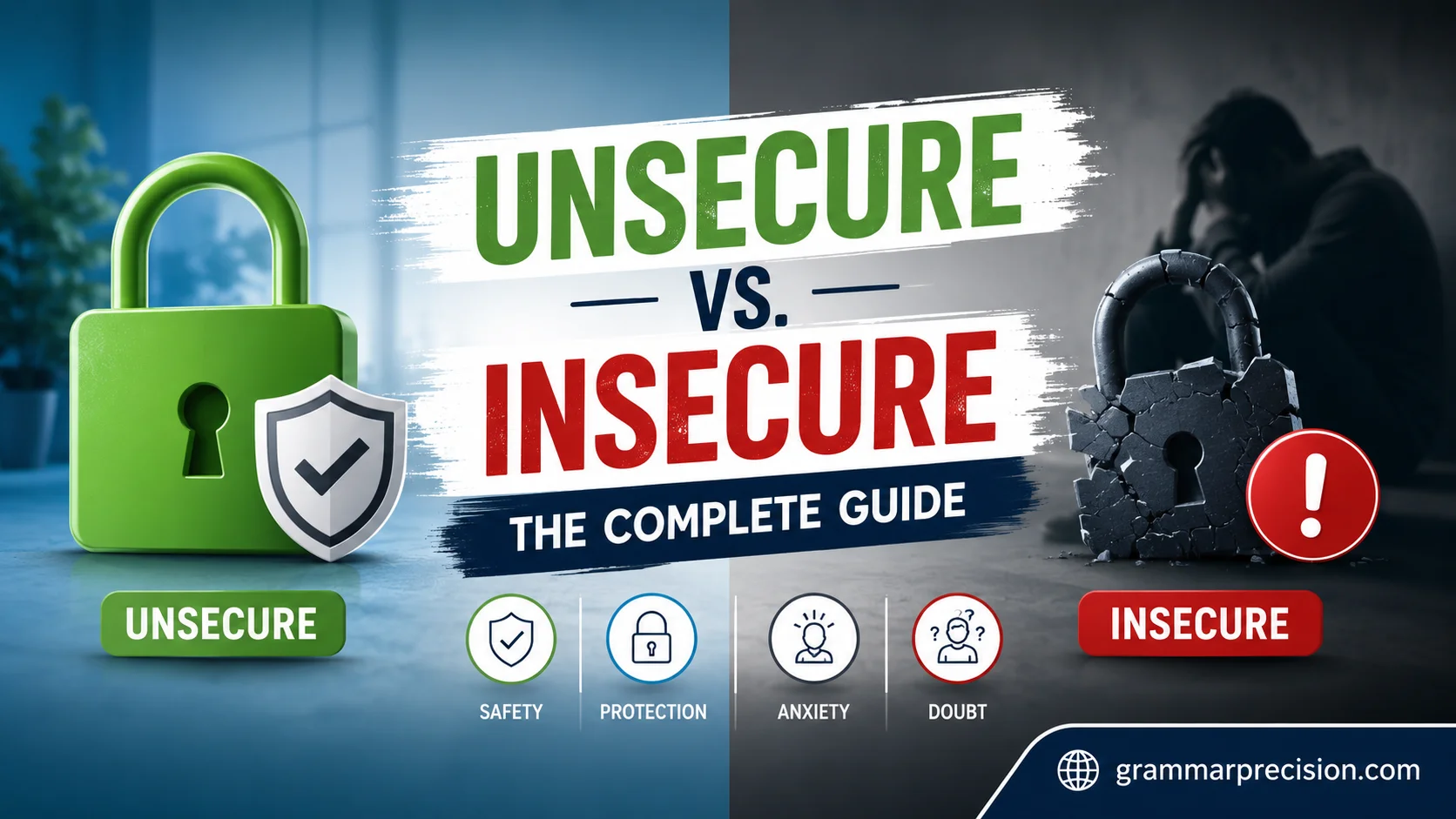
Unsecure vs. Insecure explains why these two similar words create confusion. Many people search for the correct usage because both terms seem alike, but their meanings and contexts are different in English writing.
Insecure is the standard English word used for a person who feels unsure or lacks confidence. It can also describe safety issues in some contexts. On the other hand, unsecure is rarely used and often considered incorrect in most situations.
Understanding the difference between unsecure vs insecure helps writers, students, and professionals avoid grammar mistakes. Using the correct word choice improves writing accuracy, confidence, and overall English language skills in emails, articles, and reports.
| Word | Main Meaning | Common Uses |
| Insecure | Lacking confidence, certainty, or emotional stability | People, feelings, situations, technology |
| Unsecure | Not protected, not safe, or lacking security | Systems, locations, objects, information |
This guide explains the difference between unsecure vs. insecure, explores their meanings, provides examples, and shows you exactly when to use each word.
Unsecure vs. Insecure: The Quick Difference
The easiest way to remember the difference is to focus on the type of “security” involved.
Insecure often describes something internal. It connects with thoughts, emotions, confidence, and uncertainty.
Unsecure usually describes something external. It relates to protection, safety systems, and physical or digital security.
Think of it this way:
- Insecure = a problem inside someone’s mind or within a feeling of uncertainty
- Unsecure = a problem with protection or safety
Consider these examples:
- “She feels insecure about her writing skills.”
- “The website has an unsecure connection.”
The first sentence describes confidence. The second describes protection.
However, English can sometimes make this distinction tricky because insecure can also describe security problems, especially in technology. That is why context matters.
What Does Unsecure Mean?
Unsecure means something is not secure, protected, or properly guarded. It suggests that a person, object, place, or system does not have enough protection against possible harm or unauthorized access.
The word appears most often in discussions about safety and security.
Examples include:
- An unsecure building entrance
- An unsecure storage area
- An unsecure connection
- An unsecure network
Imagine leaving your front door unlocked while you are away. The house becomes less protected. In that situation, you could describe the door or the house as unsecure.
Similarly, a computer network without proper protection creates risks. Hackers may access private information because the system does not have enough security measures.
Examples of Unsecure in Sentences
Here are some examples that show how unsecure works:
- “The company discovered an unsecure server that exposed customer information.”
- “The package was left in an unsecure location.”
- “Employees should avoid connecting to unsecure public networks.”
- “The old building had several unsecure entry points.”
In each example, the problem involves a lack of protection.
Is Unsecure a Correct English Word?
Yes, unsecure is a real English word. However, it is less common than insecure and sometimes sounds less natural to native speakers.
Many writers prefer alternatives such as:
- Unsecured
- Unsafe
- Unprotected
- Vulnerable
- Exposed
For example:
Less natural:
“The website has an unsecure connection.”
More common:
“The website has an unsecured connection.”
The word unsecured often sounds more professional, especially in cybersecurity and business writing.
What Does Insecure Mean?
Insecure has several meanings, but it most commonly describes a lack of confidence, certainty, or emotional safety.
When you describe a person as insecure, you usually mean they feel unsure about themselves. They may worry about how others see them or doubt their abilities.
For example:
- “He feels insecure about his appearance.”
- “She became insecure after comparing herself to others.”
- “The new employee felt insecure during the first week.”
An insecure person is not necessarily weak. Everyone experiences insecurity at different moments. A student may feel insecure before an exam. An employee may feel insecure when starting a new job.
The word simply describes a feeling of uncertainty or self-doubt.
Different Meanings of Insecure
The word insecure can appear in several contexts.
Emotional Insecurity
This is the most common use.
Examples:
- Feeling insecure about your skills
- Feeling insecure in a relationship
- Feeling insecure about your appearance
Emotional insecurity often comes from fear, comparison, or uncertainty.
For example, someone who constantly compares their achievements with others may develop feelings of insecurity.
Uncertainty or Instability
Insecure can also describe situations that are uncertain or unstable.
Examples:
- “Many workers felt insecure about their future employment.”
- “The country faced an insecure economic situation.”
Here, insecure does not describe emotions directly. Instead, it describes a lack of stability.
Technology and Digital Security
Interestingly, technology experts often use insecure to describe systems that are vulnerable.
Examples:
- An insecure password
- An insecure website
- An insecure network
In this context, insecure means the system does not provide enough protection.
Unsecure vs. Insecure: Key Differences Explained
Understanding the main differences becomes easier when you compare their uses.
| Difference | Unsecure | Insecure |
| Main idea | Lack of protection | Lack of confidence or certainty |
| Common subject | Objects, systems, locations | People, emotions, situations |
| Frequency | Less common | Much more common |
| Example | An unsecure building | An insecure person |
| Related words | Unsafe, unsecured, vulnerable | Uncertain, doubtful, unsure |
Difference Between Security and Confidence
The biggest difference is the type of security involved.
Security can mean protection from danger. It can also mean confidence within yourself.
For example:
- “The password is insecure.”
- Meaning: The password is weak and can be attacked.
- “The employee is insecure.”
- Meaning: The employee lacks confidence.
The same word can describe completely different problems depending on context.
Difference Between Objects and People
A useful rule:
Use insecure when describing people’s emotions.
Use unsecure or unsecured when describing protection problems.
Examples:
Correct:
- “She feels insecure about her performance.”
- “The file was stored on an unsecured server.”
Incorrect:
- “The server feels insecure.”
- “She feels unsecure about her abilities.”
The second examples sound unnatural because they mix the meanings.
Also Read This: Simpler or More Simple? The Complete Guide
Unsecure vs. Insecure in Technology and Cybersecurity
Technology creates one of the biggest areas of confusion.
Many people see security warnings online and wonder whether they should use unsecure or insecure.
Both words can appear in technology discussions, but insecure is usually more common.
A cybersecurity professional might describe a weak system as:
- An insecure network
- An insecure application
- An insecure password
- An insecure connection
Why?
Because the system does not provide reliable protection.
However, unsecured is also widely used:
- An unsecured Wi-Fi network
- An unsecured website
- An unsecured database
In professional writing, unsecured often sounds more precise than unsecure.
Examples From Digital Security
| Situation | Better Word |
| A weak password | Insecure password |
| Public Wi-Fi without protection | Unsecured Wi-Fi |
| A website with poor security | Insecure website |
| Data stored without encryption | Unsecured data |
A simple password like “123456” is insecure because attackers can guess it easily. A public Wi-Fi network without encryption is unsecured because it does not protect users’ information.
Why People Confuse Unsecure and Insecure
The confusion happens because English prefixes do not always follow simple rules.
The prefixes un- and in- can both create opposite meanings.
Examples:
- Happy → Unhappy
- Correct → Incorrect
- Possible → Impossible
- Secure → Insecure
The problem is that English developed over hundreds of years. Different words entered the language through different sources, so the rules are not always predictable.
You cannot simply replace every “in-” word with “un-” and expect the meaning to stay correct.
For example:
- Incorrect is correct.
- Uncorrect is not commonly used.
The same idea applies to secure.
Common Mistakes With Unsecure and Insecure
Many writers use these words incorrectly because they focus only on spelling.
Here are common mistakes to avoid.
Using Insecure for Physical Protection Problems
Incorrect:
“The warehouse has an insecure door.”
This could mean the door lacks protection, but it may also sound like the door itself has emotional doubt.
Better:
“The warehouse has an unsecured door.”
Using Unsecure for Emotions
Incorrect:
“He feels unsecure about his abilities.”
Better:
“He feels insecure about his abilities.”
Feelings, confidence, and self-doubt almost always require insecure.
Assuming Both Words Are Interchangeable
Although both words connect to the idea of lacking security, they are not perfect substitutes.
Changing one word can completely change the meaning.
Example:
“The employee is insecure.”
This describes confidence.
“The employee’s account is insecure.”
This describes cybersecurity.
Unsecure vs. Insecure: Real-Life Examples
Seeing these words in everyday situations makes the difference easier to remember.
Workplace Example
Imagine a new employee joins a company.
During the first month, the employee worries about making mistakes and feels nervous during meetings.
The employee is insecure.
Now imagine the company’s computer system uses outdated security software.
The system is insecure or unsecured.
The person has a confidence issue. The system has a protection issue.
Online Example
You create an online account.
If you use a simple password like “password123,” your account is insecure because it can be easily attacked.
If the website does not use proper protection methods, the website may be unsecured.
Personal Example
A person might say:
“I felt insecure when I started speaking in public.”
This means they lacked confidence.
They would not normally say:
“I felt unsecure when I started speaking in public.”
That sounds unnatural because speaking affects emotions, not physical safety.
Better Alternatives for Unsecure
In many cases, stronger word choices improve your writing.
Instead of unsecure, consider:
| Original Word | Better Alternative |
| Unsecure website | Unsecured website |
| Unsecure system | Vulnerable system |
| Unsecure area | Unsafe area |
| Unsecure information | Exposed information |
| Unsecure connection | Unsecured connection |
These alternatives often sound clearer and more professional.
How to Remember the Difference Between Unsecure and Insecure
A simple memory trick:
Insecure starts with “in,” which reminds you of inner feelings.
Think:
- Inner doubts → Insecure
Unsecure focuses on missing protection.
Think:
- Unprotected → Unsecure
You can also ask yourself one question:
“Is this about confidence or protection?”
If it is about confidence, use insecure.
If it is about protection, use unsecure, unsecured, or another clearer alternative.
FAQs:
What is the main difference between unsecure and insecure?
Insecure is the correct and commonly used English word that describes a person who feels unsure, lacks confidence, or something related to a lack of safety. Unsecure is rarely used and is often considered incorrect in most contexts.
Is unsecure a correct English word?
Unsecure exists in some dictionaries, but it is not a standard English choice in most writing. In professional, academic, and everyday communication, using insecure is usually the better option.
When should I use the word insecure?
Use insecure when talking about a person’s emotions, such as feeling uncertain or lacking confidence. It can also describe situations involving security risks, depending on the context, such as an insecure network or system.
Why do people confuse unsecure and insecure?
People often confuse these words because they look similar and have close meanings at first glance. However, their usage and context are different, which can create grammar mistakes in writing.
How can I remember the difference between unsecure and insecure?
Remember that insecure is the safer choice for most situations. Focus on the meaning and context of the sentence instead of only looking at the spelling. This will improve your English skills and writing accuracy.
Conclusion:
Understanding the difference between unsecure and insecure helps you make better word choices in English. While insecure is the commonly accepted term, unsecure is rarely appropriate. Learning their correct usage, meaning, and context allows you to write clearer sentences and avoid common grammar mistakes in professional and everyday communication.